Hello! Welcome to your fifth and final lesson in the module on Market Entry and Positioning.
In our last lesson, we concluded that for your new woodworking business, a 'Dove' strategy—differentiating by focusing on a premium, modern CNC-milled niche—is your most powerful path to success. This avoids a head-on, resource-draining battle with established, traditional players.
That decision answers the question of how and where to compete. But an equally critical question is when to make your move. This brings us to today's learning outcome: to analyze the role of entry timing based on competitor preparedness and market conditions. We'll explore the classic strategic dilemma: is it better to be the first to enter a new market, or is there an advantage in waiting?
The First-Mover vs. Fast-Follower Dilemma
As you prepare to launch your line of premium modern cabinets, you face a timing decision. You could be the first mover in your local market to seriously target this niche. Alternatively, you could be a fast follower, waiting to see if the market develops or if another small competitor tests the waters first, and then entering with a refined offering.
Each path has distinct advantages and risks. Let's start by exploring the potential upsides of being first.
FIrst-Mover Advantages (With real world examples) | From A Business Professor
The video 'First-Mover Advantages' from Business School 101 gives a great overview of the benefits companies can gain by being the first to market.
Please watch the section on benefits, from 01:02 to 03:51. As you watch, think about which of these advantages would be most valuable for your woodworking business.
As the video highlights, being first can allow you to:
- Increase Brand Recognition: You could become "the CNC modern cabinet guy" in your area, making your brand synonymous with the category.
- Improve Customer Loyalty: Early, happy customers for a unique product can become powerful advocates.
- Develop Key Relationships: You might secure exclusive relationships with suppliers of unique hardware or premium wood veneers, or become the preferred partner for architects specializing in modern design.
The First-Mover Paradox: Why a Head Start Can Lead to Failure
The promise of being first is tempting, but the reality is often harsh. Many pioneers fail, while the companies that follow them end up dominating the market. Think of MySpace preceding Facebook, or early search engines like Yahoo being overtaken by Google.
First-Mover Advantage: Winning the Time-to-Market Race
The article 'First-Mover Advantage: Winning the Time-to-Market Race' provides a data-driven look at this phenomenon, which it calls the 'first-mover paradox.' It explains why pioneers often bear the greatest risks.
Please read the sections 'The first-mover paradox: When second movers win' and 'The reality: 47% of first movers fail vs. 8% of followers'. Pay close attention to the reasons why first movers often stumble.
This article and the following video segment point out several critical risks of being a first mover that are directly relevant to your situation:
FIrst-Mover Advantages (With real world examples) | From A Business Professor
Now, let's watch the section on limitations from the same 'First-Mover Advantages' video. It neatly summarizes the major downsides.
Please watch from 05:24 to 06:55. This will crystallize the risks we just read about.
For your business, the key risks are:
- The Burden of Market Education: You would have to spend significant time, money, and effort convincing customers and designers why they need premium CNC-milled cabinets and what makes them special. A follower benefits from your marketing spend.
- Helping Competitors: An established, larger cabinet maker can watch you. If they see your niche is profitable, they can leverage their existing scale, supplier discounts, and reputation to launch a competing line, potentially at a lower cost. They learn from your successes and failures for free.
- High Risk and Investment: You are considering investing in expensive CNC machinery for a market segment that is not yet proven in your area. If the demand isn't there, that's a significant sunk cost.
- The "First-Mover Trap": You might lock yourself into certain designs, materials, or processes. A follower can observe customer reactions to your products and launch with an improved, second-generation version that better meets market desires.
"Learning Velocity" > "Launch Velocity"
The core insight from this trade-off is that success isn't just about being fast to launch; it's about being fast to learn.
First-Mover Advantage: Winning the Time-to-Market Race
The same article, 'First-Mover Advantage,' introduces a powerful concept to frame this: 'Learning velocity outpaces launch velocity.' This section explains why adapting quickly is more important than launching quickly.
Please read the section titled 'Learning velocity outpaces launch velocity.'
A fast follower wins by having superior learning velocity. They let the pioneer conduct the expensive experiments, and then they enter the market with a clear understanding of what works.
A Framework for Your Timing Decision
So, how do you decide whether to lead or follow? The choice depends on an honest assessment of two factors: market conditions and your organizational capabilities.

Let's use this framework to analyze your situation:
- Market Situation: The market for premium, modern cabinetry is likely not 'Rough Waters' (where technology changes constantly). It's probably somewhere between 'Calm Waters' (styles evolve slowly) and 'The Market Leads' (customer tastes are shifting towards modern design, but it's an evolution, not a revolution). In these situations, a durable first-mover advantage is possible but requires significant resources.
- Required Resources: The matrix shows that to succeed as a first mover in these markets, you need investment capital, the ability to scale up production, and strong marketing skills to build brand awareness. As a new startup, these are precisely the resources that are most constrained.
This analysis suggests that being a pure first mover is very risky. A fast-follower strategy, where you let others prove the market, is safer. However, since you are targeting an unoccupied niche, you are by definition a type of first mover. The key is to move in a way that minimizes risk and maximizes your ability to learn.
Modeling Entry as a Sequential Game
Your timing decision is also dependent on how you expect your competitors to react. We can think of this as a sequential game, just like the ones we've discussed before.
Let's represent this using a game tree. A game tree maps out the sequence of moves, the decisions available to each player at each stage, and the resulting payoffs.
This document on Sequential Games provides a concise introduction to the Entrant-Incumbent game model, which is a perfect analogy for your situation.
Please read the introduction and the sections 'A Game Tree' and 'Subgame Perfect Nash Equilibrium (SPNE)'. You don't need to master the formal definitions, but focus on understanding the structure of the game tree and the logic of 'backward induction'—starting at the end to figure out the best move at the beginning.
The key tool from that reading is backward induction. You predict your competitor's most rational move, and then you work backward to determine your best opening move.
Let's look at a concrete example.
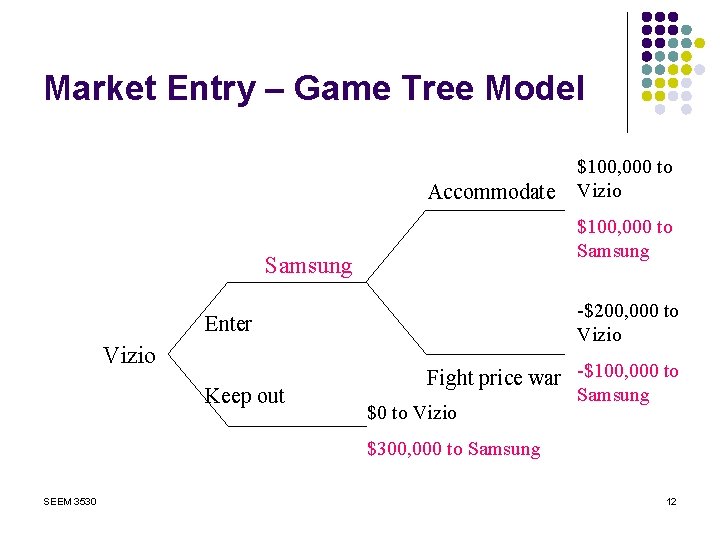
To analyze this using backward induction, you start at Samsung's decision:
- If Vizio enters, Samsung can either 'Fight' and lose $100k, or 'Accommodate' and make $100k.
- Assuming Samsung is rational and wants to maximize its profit, it will choose to Accommodate.
Now, work backward to Vizio's decision:
- Vizio knows that if it enters, Samsung will accommodate, and Vizio will make $100k.
- If Vizio stays out, it makes $0.
- Since $100k > $0, Vizio's best move is to Enter.
This logic eliminates Samsung's "threat" of a price war, because it would not be in Samsung's best interest to actually follow through. The threat is not credible.
Test your understanding!
Imagine your main competitor is "Traditional Tops Inc." from our last lesson. They are not prepared for modern CNC work; their machinery, staff, and brand are all focused on traditional styles.
If you enter your niche now, do you think their threat to "fight" (i.e., quickly launch a competing modern line) is credible? Why or why not, based on the logic of backward induction?
Show answer
The threat is likely not credible. To fight you, Traditional Tops Inc. would have to make significant investments: buy new CNC machinery, retrain their staff, develop new marketing, and potentially dilute their well-established "traditional" brand. The cost and effort of fighting would likely lead to a negative payoff for them, especially for a small niche market.
Since accommodating you (ignoring your niche) costs them nothing and allows them to continue focusing on their profitable core business, that is their most rational move. Knowing this, your entry becomes much less risky.
Conclusion
Deciding when to enter a market is as important as deciding what to offer. While being the absolute first has its allure, the evidence shows it's a high-risk path. Fast followers often outperform pioneers by learning from their mistakes and entering a market once it's been validated.
Key Takeaways:
- Timing is a Strategic Choice: You must weigh the benefits of being a first mover (brand recognition, customer loyalty) against the significant risks (market education costs, high investment, helping competitors).
- Learning Velocity is Key: Success often goes to the "fast learner," not the "fast launcher." A fast follower can observe, learn, and enter with a superior, less risky offering.
- Analyze Your Context: Use frameworks like the market/resource matrix to assess if you have the capabilities and if the market is ready for a first-mover strategy. For a startup, the answer is often "no."
- Anticipate Competitor Preparedness: Model the entry decision as a sequential game. Use backward induction to analyze whether a competitor's threat to fight your entry is credible. If they are unprepared to fight, the risk of entering is much lower.
For your business, this means that while you are a "first mover" into a specific niche, your move is made safer by the high probability that unprepared incumbents will choose to accommodate rather than fight you.
Preview of the Next Module:
We've now established a strategy: enter a differentiated niche at a time when competitors are unprepared to fight back. But what if you could do more than just hope they accommodate? What if you could take an action so decisive that it actively discourages them from ever competing with you?
In our next module, "Making Your Strategy Credible: Commitment," we will explore how you can use irreversible investments—like the purchase of a specific CNC machine—not just as a production tool, but as a powerful strategic signal to shape the game to your advantage.