
Hello, and welcome to the first lesson in your Staff/Principal Engineer preparation course.
This first module is about shifting from excellent delivery within a team to technical leadership across teams and over longer time horizons. That shift matters for the Staff or Principal roles you are targeting: strong Java, Spring Boot, API, and database experience is valuable foundation, but these roles are evaluated primarily by the scope of outcomes you create, the ambiguity you can reduce, and the people and teams you can align.
By the end of this lesson, you should be able to distinguish Senior, Staff, and Principal Engineer responsibilities through four lenses:
- Scope — how large a technical and organizational area you own.
- Ambiguity — whether you are solving a known problem or helping define the problem itself.
- Influence — whether your impact is mainly through your own team or through alignment across many teams.
- Time horizon — whether you optimize a delivery, a multi-year technical direction, or an organization’s long-term capability.
Plan for about 40 minutes, including the short resources.
First principle: titles vary; operating level matters
There is no universal definition of “Staff,” “Senior Staff,” or “Principal.” A Staff Engineer at a 40-person startup, a large product company, and a consulting-led engineering organization may have quite different formal responsibilities.
So, do not use the title alone as evidence of level. When examining a role description, ask:
- What outcome is this person accountable for?
- How many teams or systems must cooperate for that outcome?
- Who defines the problem and makes trade-offs?
- How far into the future do their decisions matter?
- Do they lead mainly by direct delivery, or by enabling others to deliver?
The ladder diagram below is useful as a broad orientation. It also makes an important point: beyond Senior, engineering careers commonly branch into an individual-contributor path and an engineering-management path. A Staff Engineer is not simply an Engineering Manager without direct reports. Both lead, but they own different things.
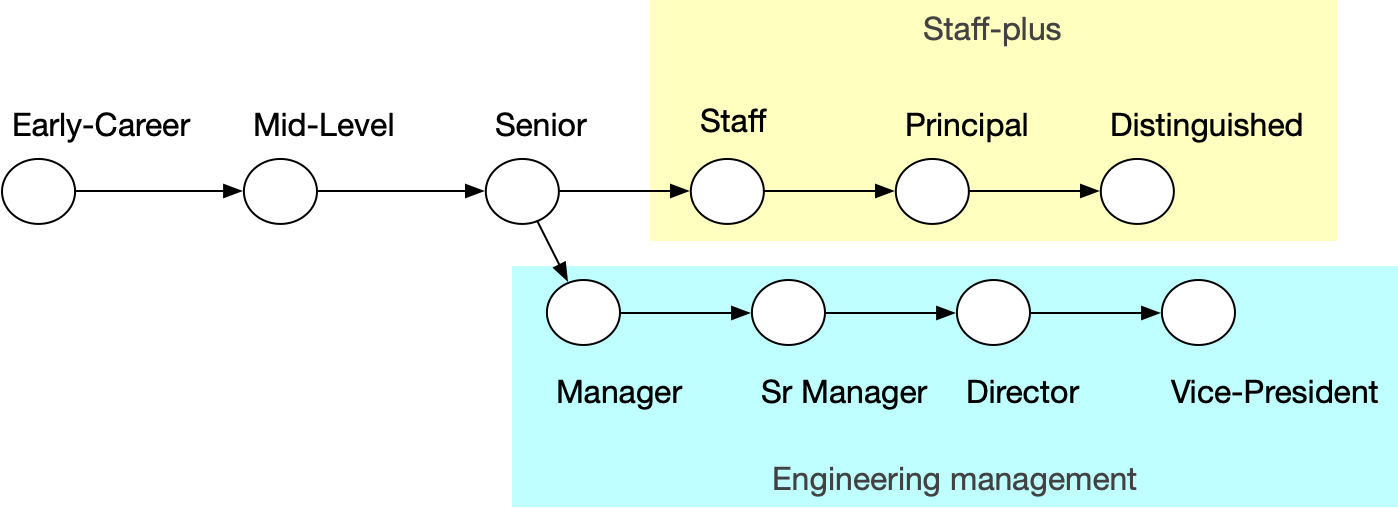
For your job search, “Senior Staff Engineer” needs extra verification. At one employer it may mean a Staff-plus role, roughly between Staff and Principal; elsewhere it may be a title used differently. Read the actual expectations before deciding whether a position matches your target.
The four dimensions of engineering seniority
A useful mental model is that levels are not defined by whether someone can write code, create a design, mentor, or speak to stakeholders. Engineers at all three levels may do all of those things.
The distinction is the unit of responsibility.
| Dimension | Senior Engineer | Staff Engineer | Principal Engineer |
|---|---|---|---|
| Scope | A team, major feature, product capability, or bounded system | Multiple teams, a platform, domain, or major technical initiative | A large organization, multiple domains, or a company-critical technical direction |
| Ambiguity | Resolves solution ambiguity within a broadly understood goal | Helps define both the problem and the solution; prioritizes competing needs | Frames strategic technical problems amid business, organizational, and market uncertainty |
| Influence | Leads a team and collaborates beyond it when needed | Aligns teams, roadmaps, and technical decisions without relying on hierarchy | Shapes senior technical and organizational decisions across broad areas |
| Time horizon | Release, quarter, or annual team goals | Multi-quarter to multi-year system or product evolution | Multi-year organizational capability, major investment choices, and systemic risk |
| Primary leverage | Direct design and delivery; team-level mentoring | Technical strategy, cross-team alignment, reusable systems, delegated leadership | Organizational strategy, technical portfolio decisions, staff-level leadership, long-term stewardship |
These are gradients, not hard walls. A Senior Engineer may contribute to a cross-team initiative; a Principal may still investigate a production defect or write a prototype. The question is: what are they expected to make happen consistently?
Scope: from a component to an outcome system
At the Senior level, scope is usually a team-owned capability. For example, a Senior Engineer might own a Spring Boot service that handles account onboarding. They can take an epic such as “support enterprise account provisioning,” decide how to implement it, coordinate with immediate dependencies, deliver it safely, and improve the team’s reusable patterns.
At Staff level, the scope expands beyond one service or team. Perhaps enterprise onboarding is slow because identity, billing, account management, and support workflows are all separate. The Staff Engineer sees the whole outcome:
“We cannot reliably onboard enterprise customers in under two days because ownership, API contracts, approval flows, and failure handling are fragmented across four teams.”
That is not merely a larger coding task. It is a multi-team problem that needs a shared technical direction, sequencing, decisions about ownership, and agreement on success measures.
At Principal level, the scope often becomes a company-wide technical capability or strategic risk. The concern might be:
“Our partner-integration model is becoming a bottleneck to market expansion. We need an organization-wide strategy for external APIs, security controls, onboarding tooling, and operational ownership for the next three years.”
A Principal Engineer does not necessarily implement each service. Their responsibility is to make the organization capable of solving the class of problem coherently.
Ambiguity: from “how?” to “what?” to “why this?”
Ambiguity is one of the clearest ways to understand the transition.
A Senior is frequently given a meaningful outcome, but must resolve substantial uncertainty in the implementation:
- Which API contract best fits?
- Should the service use synchronous calls or events?
- What data model protects the required invariants?
- How can we release this without breaking existing clients?
- What are the operational risks?
A Staff Engineer works with ambiguity at an earlier stage. They may need to establish:
- Is the requested feature really the right problem to solve?
- Which teams should own which parts?
- Is the local optimization hurting the broader organization?
- Should the organization build a shared platform, standardize existing services, or deliberately keep separate solutions?
- What should be done now, deferred, or explicitly not done?
A Principal Engineer often faces ambiguity that includes organizational strategy:
- Which technical investments preserve the company’s ability to compete or adapt?
- Where is inconsistency a useful local choice, and where is it an expensive organizational risk?
- Which architectural constraints must become organization-wide standards?
- Which technical risks justify executive attention and funding?
Put simply:
- Senior: “Given this outcome, what is the right implementation?”
- Staff: “What outcome should these teams pursue, and what coordinated technical path makes it feasible?”
- Principal: “Which long-term technical direction best protects or expands the organization’s ability to achieve its goals?”
The Senior baseline: autonomous, team-level technical leadership
Before aiming to demonstrate Staff behavior, establish a precise view of strong Senior performance. Dropbox’s IC4 framework describes a Senior Engineer as autonomously delivering business impact across “a team, product capability, or technical system.” It is a useful baseline because it includes more than feature coding: system design, safe rollout, customer impact, and team improvement.
Dropbox Engineering Career Framework
Read Dropbox’s IC4 framework as one concrete example of a strong Senior Engineer baseline. Its terminology is company-specific, but its distinction between ownership of a team-level area and broader Staff-level strategy is valuable.
In the opening “Scope” and “Collaborative Reach” sections, read the ownership description. Then read the “Impact Levers” and “Results” sections to see how strategy, project leadership, product awareness, and mentorship appear at this level. In “Software Design” and “Architecture Design,” read the design expectations. Finish the “Technical Strategy” paragraph. Focus on the phrase “in my team”: it is the key boundary in this framework.
A Senior Engineer typically:
- owns difficult delivery end to end;
- turns an epic into a coherent design and execution plan;
- identifies and manages technical trade-offs;
- delivers safely, including testing, monitoring, rollback thinking, and operational readiness;
- improves team velocity and quality through mentoring, design reviews, or reusable tooling;
- contributes to cross-team work, while remaining primarily accountable for a team or bounded system.
For example, suppose a product team needs to expose a new REST API for enterprise customers. A Senior Engineer might lead the API design, choose an idempotency strategy, define error behavior, coordinate with the authentication team, implement the Spring Boot service changes, and ensure observability and safe deployment.
That is demanding technical leadership. But it does not automatically make the work Staff-level. The main question is whether the engineer owns the team’s implementation of a known need, or whether they are accountable for aligning multiple teams around the organization’s broader technical response.
Staff: technical leadership across teams
A Staff Engineer scales impact mainly by creating clarity and alignment around a problem too broad for a single team to solve alone. They still need technical depth—especially to judge architecture, identify hidden operational risks, and challenge unsound assumptions—but they cannot personally implement the whole solution.
Dropbox’s Staff framework expresses this in unusually direct language: multi-year, multi-team strategy, delivered through direct implementation or broad technical leadership.
Read this Staff Engineer framework after the Senior framework. Notice that the change is not “Staff engineers stop coding”; it is a change in the scale of ownership, decision-making, and technical stewardship.
In the opening “Scope” and “Collaborative Reach” sections, read the Staff remit. Compare its “multi-year, multi-team” language with the Senior framework’s team-level ownership. Next, in “Results” and “Decision Making,” read the operating model. Focus on root-cause unblocking and choosing wider organizational outcomes over locally optimal ones. Finally, in “Architecture Design,” read the architecture stewardship section. Notice the expectation that a system remains healthy without depending on the Staff Engineer’s personal expertise.
What Staff responsibility looks like in practice
A Staff Engineer does not “own all decisions” or act as a bottleneck. Their job is to make the right decisions easier for the organization to make and execute.
Common Staff-level responsibilities include:
- framing a vague technical or product concern into a decision-ready problem;
- identifying affected teams, constraints, incentives, risks, and dependencies;
- leading design discussions that surface trade-offs rather than merely collecting agreement;
- creating a multi-phase roadmap that allows delivery while reducing long-term risk;
- establishing interfaces, standards, platform capabilities, or operating practices used by several teams;
- making sure ownership, reliability, and maintenance are clear after the initiative ends;
- mentoring senior engineers and technical leads by delegating meaningful decisions rather than retaining all strategic work.
A Staff Engineer’s influence is mostly earned rather than granted. The payments team, platform team, and customer-facing product team might report to different managers. The Staff Engineer cannot simply instruct them to adopt a design. They need to make the costs, evidence, trade-offs, and benefits visible enough that the relevant people can commit to a direction.
This short discussion from LeadDev captures two important Staff realities: the role becomes less pre-defined, and communication is a technical multiplier rather than a substitute for technical judgment.
Understanding the role of a Staff engineer
Watch “Understanding the role of a Staff engineer” from LeadDev for practitioners’ descriptions of Staff-level ambiguity and influence. The conversation is not a formal career framework, but it gives a realistic view of how Staff work feels day to day.
Watch ambiguity and alignment. Listen for the transition from well-defined delivery work to deciding what deserves attention at organizational scale. Then watch technical influence. Focus on the argument that communication and leadership do not replace technical depth; they scale the impact of technically sound judgment through design documents, reviews, and cross-team collaboration.
Staff is not “Senior, but with more meetings”
This is a common misunderstanding. More meetings are not evidence of Staff-level work. Staff work has a different pattern of accountability:
| A weak interpretation | A Staff-level interpretation |
|---|---|
| Attend cross-team meetings | Create a decision process that resolves a cross-team dependency |
| Review everyone’s designs | Establish principles and delegate design ownership appropriately |
| Become the expert on a platform | Ensure the platform can be operated and evolved without relying on one person |
| Solve every escalation personally | Remove root causes, clarify ownership, and develop other technical leaders |
| Write a large design document | Build alignment around a decision, roadmap, and measurable outcome |
For your transition, this distinction is especially important. Nineteen years of implementation experience can support Staff-level technical judgment, but interviewers will want evidence that you have used that judgment beyond the boundary of your own service or immediate team.
Principal: organization-wide technical direction
Principal Engineers generally work on the same kinds of problems as Staff Engineers, but at a broader and more strategic scale. Their impact reaches across a large engineering group, several product domains, or the company’s most consequential technical capabilities.
A simple career-ladder explanation can be useful here, provided you treat it as a heuristic rather than a universal job specification.
The Software Engineer Career Ladder Explained
Watch the Principal Engineer portion of “The Software Engineer Career Ladder Explained” by Cody Engel for a concise overview of how Principal scope is often framed as company-wide and long term.
Watch principal overview. Focus on the shift toward long-term organizational questions: systemic inefficiencies, future market relevance, and technical choices that affect the company well beyond a single project.
A Principal Engineer may be accountable for areas such as:
- an enterprise-wide data, identity, platform, developer-productivity, or reliability strategy;
- a technical response to a company-level risk, such as regulatory change, reliability failures, security exposure, or a major scale limit;
- standards and investment decisions that affect many domains;
- technical coherence across several Staff-led initiatives;
- developing other Staff Engineers and improving the organization’s ability to make technical decisions.
The word strategy matters here. A Principal’s work should change what the organization is capable of doing over the next several years.
However, avoid treating “Principal = mini-CTO” as a literal rule. In a smaller organization, a Principal may indeed have CTO-like breadth. In a larger company, they may own a critical technical domain rather than the entire technology organization. The role’s real test remains scope, ambiguity, influence, and horizon.
One business objective at three levels
Consider this business objective:
Reduce enterprise customer onboarding from ten business days to two days while supporting a new partner channel within twelve months.
The same objective can create Senior-, Staff-, and Principal-level work.
Senior Engineer response
A Senior Engineer could own the account-provisioning service:
- design the Spring Boot APIs and PostgreSQL schema;
- implement idempotent provisioning requests;
- handle integration failures;
- create dashboards and alerts;
- coordinate with the identity service team;
- safely deliver the feature for their team’s scope.
This is broad, high-quality ownership. The goal and organizational boundaries are largely given.
Staff Engineer response
A Staff Engineer could identify that onboarding delays arise from fragmented workflows across sales operations, identity, billing, account management, and partner integrations. Their responsibility is to:
- establish a shared problem statement and success metrics;
- clarify system and data ownership;
- decide which workflow steps should be centralized or remain domain-owned;
- align several teams on API and event contracts;
- sequence work so value can be delivered before every dependency is perfect;
- identify risks such as duplicate provisioning, inconsistent customer state, security approval delays, and operational handoffs;
- create a roadmap that enables teams to deliver independently but coherently.
The Staff Engineer may implement a critical prototype or service, but their central contribution is ensuring that the multi-team system of work succeeds.
Principal Engineer response
A Principal Engineer may see the onboarding issue as evidence of a wider strategic problem: the company cannot efficiently launch partner-led products because every new channel requires bespoke integrations and manual operations.
They might frame and lead a long-term direction for:
- reusable partner integration capabilities;
- company-wide identity and authorization standards;
- API governance and developer onboarding;
- shared observability and audit requirements;
- decisions about platform investment versus product-team autonomy;
- sequencing investments against revenue opportunities and operational risk.
The Principal is not simply responsible for making onboarding faster once. They are shaping the organization’s ability to repeatedly create and operate new partner channels.
A practical comparison for interviews and job descriptions
When you read a Staff or Principal job description, translate vague phrases into observable behaviors.
| Phrase in a job description | Evidence of Senior behavior | Evidence of Staff behavior | Evidence of Principal behavior |
|---|---|---|---|
| “Own architecture” | Designed and delivered a bounded system | Set direction across systems and teams, including ownership and evolution | Established direction across major domains or a strategic technical portfolio |
| “Drive technical strategy” | Aligned a team’s implementation with known goals | Defined a multi-team path, priorities, and trade-offs | Influenced long-term organizational investment and capability |
| “Influence stakeholders” | Coordinated with adjacent teams | Built durable alignment across teams with different incentives | Influenced senior leaders and Staff peers on consequential decisions |
| “Mentor engineers” | Helped engineers improve craft and delivery | Developed senior engineers into independent technical leaders | Built Staff-level capability and organizational decision-making capacity |
| “Operate in ambiguity” | Chose a solution despite incomplete requirements | Defined the problem, constraints, and decision process | Reframed strategic uncertainty into organizational choices and investments |
A strong Staff/Principal interview answer should therefore include more than “I implemented X.” It should show:
- The wider outcome: What business or organizational problem mattered?
- The ambiguity: What was unclear, contested, or missing?
- Your technical judgment: What options and trade-offs did you evaluate?
- Your influence: Which people or teams needed to align, and how did you create alignment?
- The durable result: What improved after delivery—reliability, speed, cost, ownership, reuse, or organizational capability?
Years of experience may help you develop judgment, but they are not themselves evidence of Staff scope. Conversely, you do not need a Staff title before you can begin operating in Staff-like ways. You need opportunities that cross boundaries and a disciplined way to make your impact visible.
A calibration for your six-month transition
Based on your current self-assessment, the important gap is not core backend implementation. Your Java/Spring Boot, REST API, and relational-database experience can support credible technical work. The higher-priority gap is demonstrating Staff-level behavior around:
- architecture and trade-off framing;
- distributed-systems and reliability judgment;
- cross-team direction and stakeholder communication;
- technical leadership that enables others rather than centralizing work;
- modernization or platform initiatives with clear measurable outcomes.
This course will build those capabilities in a deliberate sequence. The immediate goal is not to claim Principal-level scope prematurely. It is to develop evidence that you can move from strong implementation to Staff-level ownership of a multi-team technical problem.
Before the next lesson, choose one past project that had some uncertainty, dependency, production issue, or stakeholder tension. Keep any concrete facts you can recall: business goal, systems involved, teams involved, constraints, decisions, failures, and measurable outcome. We will use it to distinguish what evidence already supports a Staff narrative and what evidence you still need to create.
Key takeaways
- Senior Engineers autonomously deliver substantial outcomes within a team, product capability, or bounded technical system.
- Staff Engineers create and deliver multi-team technical direction, resolving ambiguity and aligning work toward broader organizational outcomes.
- Principal Engineers shape long-term, high-consequence technical strategy across major domains or the organization.
- The durable differences are scope, ambiguity, influence, and time horizon—not whether someone writes code or attends meetings.
- Titles vary across employers. For Staff/Principal job searches, examine the expected operating scope rather than relying on a title such as “Senior Staff.”
- For your transition, focus on building specific evidence of cross-team problem framing, architectural trade-offs, influence, and durable technical outcomes.
Next, you will assess one of your past projects against Staff Engineer expectations and identify the specific evidence gaps to close over the coming months.
Can't find a good explanation? Sign up and we'll make it for you
Sign up