
Hello. In the previous lesson, you built the limit skills needed for this unit: limits as a variable becomes very large, and one-sided limits near a finite point. Those limits are exactly what make improper integrals meaningful.
A usual definite integral has a finite interval and a well-behaved integrand. This lesson explains what changes when either the interval continues without end or the function becomes infinitely large. The main aim is to spot why an integral is improper before trying to evaluate it.
1. Proper versus improper integrals
For an ordinary, or proper, definite integral,
we normally assume:
- and are finite real numbers.
- is continuous, hence bounded, on the closed interval .
For example,
is proper. The interval begins at , ends at , and the function stays finite and continuous throughout.
An integral is called improper when this standard situation fails in either of two important ways:
- the interval of integration is unbounded;
- the integrand is unbounded at an endpoint or at some point inside the interval.
“Improper” does not mean “impossible” or “divergent.” It means that we cannot use ordinary endpoint substitution alone. We must first define the integral through a limit.
The essential idea is:
An improper integral represents the limiting value of a sequence of ordinary proper integrals.
2. First source of improperness: an unbounded interval
Consider
The symbol is not an ordinary number and is not a genuine endpoint at which we can directly substitute an antiderivative. The interval has no final point; it continues indefinitely to the right.
That is why this is an improper integral.
To give it a precise meaning, stop temporarily at a finite number :
This is a proper integral for every finite . Then allow to grow without bound:
The integral is therefore not obtained by “putting infinity into” an antiderivative. It is obtained by asking whether the accumulated area approaches a finite limiting value.
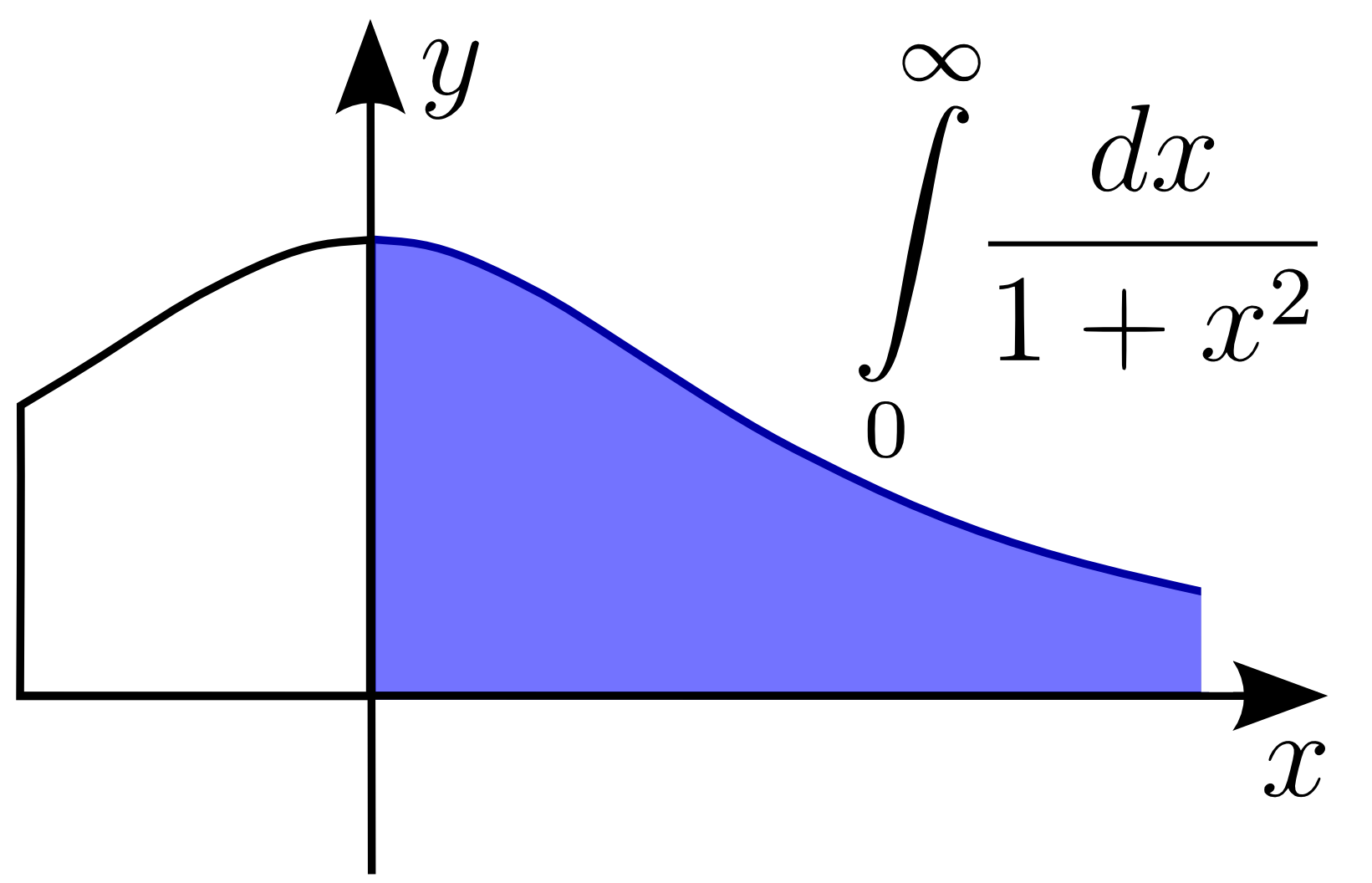
The graph gives an important warning against intuition: an infinite horizontal distance does not automatically mean infinite area. A function can decrease quickly enough that the additional area becomes smaller and smaller.
For example,
So this improper integral converges: it has the finite value .
Compare it with
Again, the integrand tends to zero as , but that fact alone is not enough. Its accumulated value is
which increases without bound. Therefore,
is improper and diverges.
Common forms of an unbounded interval
Any of the following is improper because the interval is unbounded:
They are often called Type 1 improper integrals.
The full interval from negative infinity to positive infinity needs special care: it must be separated into two parts at a finite number, often . You will study that procedure in detail in the next part of the unit.
Watch “Evaluating Improper Integrals” by Professor Dave Explains for a concise visual introduction to the two sources of improperness: an infinite interval and a vertical asymptote.
First watch the definition, where the two general situations are introduced. Then watch the asymptote example. Focus on why a finite interval can still require a limit when the graph rises without bound at an endpoint; do not worry yet about memorising every evaluation step.
3. Second source of improperness: an unbounded integrand
Now consider a different-looking integral:
The interval is finite, so the problem is not its width. The issue is the integrand:
As approaches from the right,
The graph has a vertical asymptote at . Its height becomes arbitrarily large near the lower endpoint. This is called an infinite discontinuity.
Since the function is unbounded at , the ordinary definite-integral rule cannot be applied directly. Instead, move the lower boundary slightly to the right, using :
Notice the one-sided limit . The interval lies to the right of , so the approach must remain within the interval.
Although the function is infinitely high near , the integral converges:
This gives another important principle:
An unbounded integrand does not automatically make an integral divergent. The deciding factor is whether the defining limit is finite.
Integrals with an infinite discontinuity are often called Type 2 improper integrals.
Endpoint singularities
An integrand may become unbounded at either endpoint.
| Problem point | Example | Required approach |
|---|---|---|
| Lower endpoint | with as | Approach from the right |
| Upper endpoint | with as | Approach from the left |
For example,
is improper because
The interval is finite, but the function falls without bound near .
4. An unbounded point inside the interval
The infinite discontinuity does not have to be at an endpoint. It may occur inside the interval.
For example,
is improper because the denominator is zero at :
becomes unbounded as approaches from either side.
The correct concept is to treat the two sides separately:
Each part has its own one-sided limit. Both parts must converge for the original integral to converge.
This rule prevents a serious error: one cannot allow an infinite behavior on one side of a discontinuity to “cancel” an infinite behavior on the other side.
For instance,
is improper at . Even though the graph has negative values on the left and positive values on the right, the integral must be tested separately on both sides. Ordinary cancellation is not permitted.
5. What does not make an integral improper?
Not every discontinuity produces an improper integral in this sense. The critical issue is an unbounded discontinuity.
Consider
For , this simplifies to
At , the original expression is undefined, but the nearby values remain close to . The discontinuity is a removable hole, not an infinite discontinuity. It does not involve the function becoming arbitrarily large.
In this unit, use the following check:
- Is an endpoint or ? The integral is improper.
- Does become unbounded on the integration interval? The integral is improper.
- Is there only a finite hole or a removable discontinuity? It is not the usual Type 2 infinite-discontinuity case.
6. A fast exam method: locate every problem point
Before integrating, spend a few seconds checking the interval and the formula.
Step 1: Inspect the limits of integration
Ask whether either endpoint is
or
If yes, the integral is improper because the interval is unbounded.
Step 2: Inspect the integrand
Look for values that make the function undefined or infinitely large. Common warning signs are:
- a denominator equal to zero;
- a square root in the denominator becoming zero;
- a logarithm with input approaching ;
- trigonometric functions with vertical asymptotes.
For a rational function, solve
Then check whether those values lie in the interval of integration.
Step 3: State the reason clearly
Good exam wording is direct:
- “The integral is improper because the upper limit is infinite.”
- “The integral is improper because is unbounded as .”
- “The integral is improper because there is an infinite discontinuity at .”
Step 4: Replace the problematic part by a limit
Do not write an antiderivative and substitute as though it were a number. Do not substitute an endpoint where the function becomes infinite. Introduce a variable boundary and take the appropriate limit.
Key takeaways
An integral is improper for either of these reasons:
- Unbounded interval: one or both limits of integration are infinite.
- Unbounded integrand: has an infinite discontinuity at an endpoint or inside the interval.
In both cases, the integral must be defined using a limit. It converges only when that limit exists and is finite; otherwise, it diverges.
Next, you will classify improper integrals systematically as Type 1, Type 2, or mixed Type 3, and identify every problematic point before beginning a calculation.
Can't find a good explanation? Sign up and we'll make it for you
Sign up