
Hello. In the previous lesson, you converted a multi-year total return into an annualized compound return. That figure tells you how quickly your investment grew in dollar terms per year, on average, after compounding.
But dollars alone are not the full story. If prices of goods and services rise while your investment grows, some of the apparent gain merely offsets a loss in purchasing power. This lesson introduces real return: the investment return left after accounting for inflation. By the end, you will be able to turn a nominal return into a useful approximate real return and recognize when a more precise calculation matters.
Nominal dollars versus purchasing power
A nominal return is the return expressed in ordinary dollars, without adjusting for inflation. It is usually the number displayed in a brokerage account or fund-performance report.
A real return measures the change in what your investment can actually buy. It adjusts the nominal return for the general rise or fall in prices.
For example, suppose USD 100 grows to USD 105 over one year:
A 5% nominal return sounds like progress. But if prices also rose 3% during that year, USD 105 at year-end does not buy 5% more goods and services than USD 100 bought at the start. Some of the extra USD 5 is needed simply to keep up with higher prices.
The basic idea is:
- Your investment value rises at its nominal return.
- The cost of a general basket of goods and services rises with inflation.
- The remaining change is your real return, or change in purchasing power.
In the United States, a commonly used broad inflation measure is the Consumer Price Index, or CPI, published by the Bureau of Labor Statistics. CPI is useful for a general real-return estimate, although an individual household’s costs may rise faster or slower than CPI depending on its spending on housing, health care, education, energy, and other categories.
The quick calculation: subtract inflation
For most practical comparisons, use this approximation:
The subtraction is in percentage points, not “percent of the return.”
Suppose an investment earns a nominal return of while inflation is :
The interpretation is:
The investment increased purchasing power by approximately 4.0% over the period.
FINRA gives this same practical approach: an investment return of 5% in a year with 3% inflation is commonly described as a 2% real return.
Understanding Bond Yield and Return
Read FINRA’s brief “Figuring Bond Return” discussion to see why an annual investment return should be evaluated in purchasing-power terms, not only in stated dollars.
In the “Figuring Bond Return” section, begin with the paragraph that starts “When you calculate your return” and read the inflation adjustment example. Focus on the distinction between the stated return and the buying power of the earnings; the surrounding bond discussion is context rather than a requirement for this calculation.
Worked example: applying inflation to the prior lesson
Recall the prior lesson’s annualized nominal return of over four years. Suppose inflation averaged per year over the same period.
Rounded appropriately:
A complete statement would be:
The investment earned a 7.19% nominal annualized return, or approximately a 4.0% annualized real return after 3.2% annual inflation, before taxes.
This is an important change in interpretation. The account balance still rose by 7.19% per year in nominal dollars, but purchasing power rose by only about 4.0% per year.
Why the exact method is slightly different
Subtraction is quick and usually close, but it is not mathematically exact because investment returns and inflation both compound.
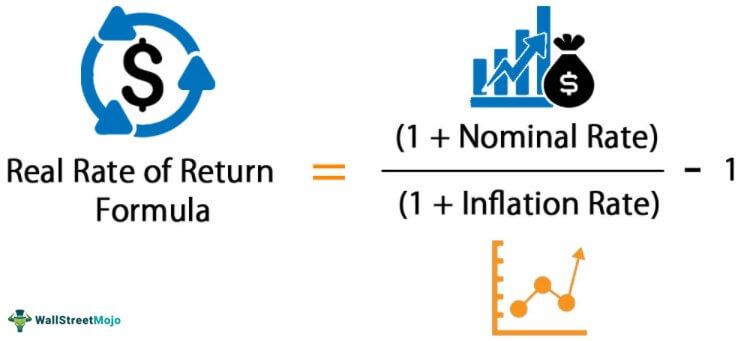
The exact relationship is:
where:
- is the real return,
- is the nominal return,
- is the inflation rate.
Solving for real return:
The numerator tells you how much the investment grew in dollars. The denominator tells you how much prices grew. Dividing the two converts the ending dollars into comparable start-of-period purchasing-power terms.
Here is the same nominal-return example, with inflation:
The subtraction approximation gave ; the exact calculation gives . The difference is small because both rates are moderate.
This table shows the relationship:
| Method | Calculation | Result |
|---|---|---|
| Approximate | ||
| Exact |
For this course’s outcome, subtraction is the essential skill. Use the exact formula when precision matters, when returns or inflation are high, or when you are modeling many years of compounding.
Nominal interest, real interest, and inflation calculations | AP Macroeconomics | Khan Academy
Watch Khan Academy’s “Nominal interest, real interest, and inflation calculations” for a compact visual explanation of why receiving more dollars does not necessarily mean being able to buy more.
Watch the purchasing-power problem to establish why real return is needed. Then watch both calculations, which contrasts the quick subtraction approximation with the precise division-based method. Notice that the exact approach uses growth factors such as 1.05 and 1.02, rather than subtracting rates directly.
Seeing the exact calculation in dollars
The exact formula becomes more intuitive when expressed through an investment balance.
Suppose you start with USD 5,000. It earns a nominal return of over one year.
At the same time, inflation of means an item or basket that cost USD 5,000 at the beginning of the year would cost:
So, USD 5,359.50 at year-end has purchasing power equivalent to:
in start-of-year dollars.
The gain in purchasing power is therefore:
That matches the exact formula. The investment did not merely end at USD 5,359.50; it ended with the buying power of about USD 5,193 in beginning-of-year dollars.
Negative real returns
A nominal gain can still produce a real loss.
Suppose a savings account earns , but inflation is .
The account balance rose. Yet its owner can buy approximately 1.3% less than before.
This is why cash and low-yielding investments can be risky over long horizons even when their dollar value does not decline. Their principal may be stable in nominal terms, but inflation can steadily erode their purchasing power.
A real return of zero is the break-even point:
At that point, the investment is roughly preserving purchasing power, before considering taxes.
Matching the periods correctly
A reliable real-return calculation requires returns and inflation to cover the same period.
| If the nominal return is... | Use inflation measured over... |
|---|---|
| One month | The same month |
| One calendar year | That calendar year |
| A four-year annualized return | Annualized inflation over the same four years |
| A five-year cumulative return | Cumulative inflation over the same five years |
Do not subtract an annual inflation rate from a five-year total return. That mixes incompatible periods.
For instance, if an investment gained in total over five years, you should first annualize its nominal return, as you learned in the previous lesson:
If annual inflation over that same period averaged , the approximate annual real return is:
This comparison is consistent because both figures are annual rates.
Keep the basis consistent, too
When reporting a real return, specify what the nominal return includes:
- Fees: A net-of-fee nominal return produces a net-of-fee real return.
- Taxes: If you subtract taxes from the return first, you have an after-tax real return. Taxes can materially reduce an investor’s actual purchasing-power gain.
- Income: For stocks and bond funds, use total return when possible, including dividends or interest.
- Inflation measure: State the broad measure used, such as U.S. CPI, when the context calls for it.
A useful professional-style report is:
The fund produced an 8.0% nominal total return, net of fund expenses. With 3.0% U.S. inflation over the same year, its approximate real return was 5.0%, before investor taxes.
A practical workflow
When you want to translate an investment result into purchasing-power terms:
- Identify the nominal return. Use a total return that includes income and reflects fees consistently.
- Find inflation for the same period. For a broad U.S. estimate, CPI-based inflation is commonly used.
- Use the quick approximation for a fast interpretation:
- Use the exact formula when you need more precision:
- State the result clearly. Identify the time period and whether it is before or after fees and taxes.
In Excel or Google Sheets, if:
B2contains the nominal return as a decimal, such as0.0719C2contains inflation as a decimal, such as0.032
the approximate calculation is:
=B2-C2
The exact calculation is:
=(1+B2)/(1+C2)-1
Format the result as a percentage.
Key takeaways
Nominal return measures growth in dollars. Real return measures growth in purchasing power after inflation.
For a quick estimate:
For a precise result:
Positive nominal returns are not necessarily real gains: if inflation exceeds the nominal return, purchasing power falls. Match the return period and inflation period, and label whether your result is before or after fees and taxes.
This completes the course’s core return-math module. Next, you will move into U.S. markets and securities, beginning with the different ownership claims, cash flows, and risks of stocks, bonds, cash equivalents, mutual funds, and ETFs.
Can't find a good explanation? Sign up and we'll make it for you
Sign up