Hello! Welcome to the final lesson of our course, "Chess to 1500 ELO."
In our last session, you designed a personalized weekly training schedule based on the "three pillars" of tactics, playing/analyzing, and focused study. You now have a solid routine for consistent practice.
Today, we will address our final learning outcome: to track rating progress and adjust study focus based on performance trends and identified weaknesses. This lesson closes the loop on our improvement cycle. A good plan is a great start, but a great plan is one that adapts. We'll explore how to use data from your games—much like you'd use analytics to optimize a marketing campaign—to ensure your 30-minute daily study time is always focused on the areas that will give you the biggest return on your rating.
1. The 'Measure and Optimize' Mindset
Before we dive into the tools, let's establish why we're doing this. Playing and studying without tracking your progress is like launching a digital campaign without analytics. You're active, but you don't know what's working. A data-driven approach to chess provides clear, objective feedback.
Tracking Progress: Building a Personal Dashboard from Your Games
The article 'Tracking Progress: Building a Personal Dashboard from Your Games' from ChessWorld.net provides an excellent overview of the benefits of a data-driven approach to chess improvement.
Please read the introduction and the section titled 'Why Track Your Chess?'. Focus on the three key benefits it highlights: Motivation Through Visible Progress, Identifying Weaknesses Quickly, and Structured Training.
As the article points out, tracking your stats turns ambiguous feelings ("I think I'm bad at endgames") into concrete data points ("My accuracy score drops by 30% in the endgame"), which you can then take direct action to fix.
2. Your Toolkit for Tracking Progress
There are two main ways to track your performance: using automated tools built into your chess platform, and a more manual, deliberate method using a spreadsheet. Let's look at both.
The Automated Dashboard: Chess.com Insights
Chess.com has a powerful feature called "Insights" that automatically analyzes your game history and presents it in a dashboard. It's the quickest way to find patterns in your play.
How does chess.com's new "Insights" feature work? 💡
The 'Chess Vibes' YouTube channel has a helpful video that gives a tour of the Insights feature. It will show you what kind of data is available and where to find it.
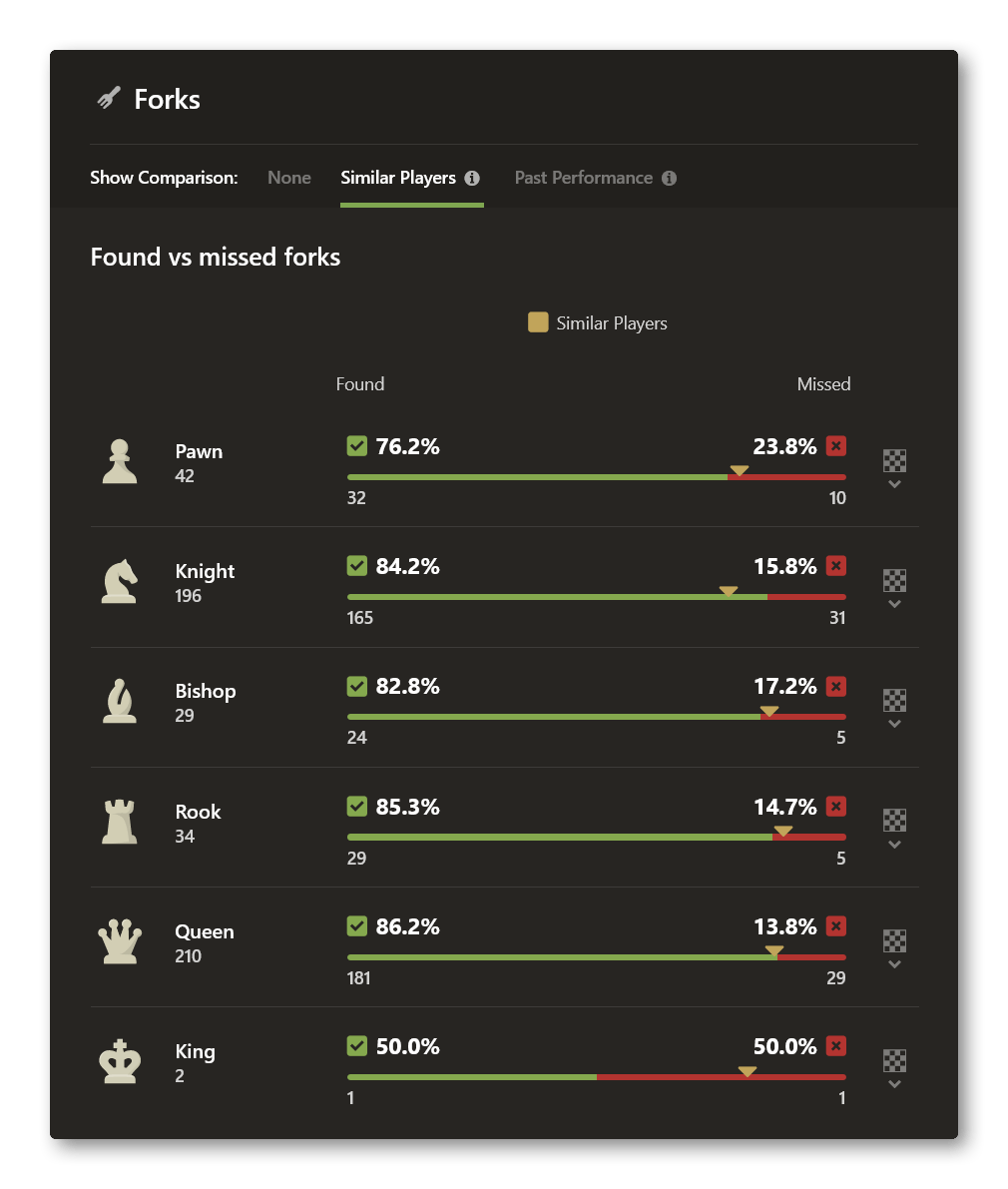
Watch the following segments to understand what data is available to you: Introduction (00:00 - 00:48): A quick overview of what Insights does. Key Metrics (00:48 - 02:28): Notice the variety of stats, such as performance by game phase and opponent rating. Tactical Analysis (02:28 - 06:07): This is the most important part for you. Pay close attention to how Insights tracks your performance on tactical motifs like forks and pins, showing what you've 'Found' vs. 'Missed'. Filtering (06:07 - 06:36): Note how you can filter by time control (e.g., Rapid) and date range to focus on the games relevant to your training.
The tactical breakdown in Insights is particularly valuable. If you see a report like this, it gives you an immediate, data-backed area for focused study.
The Manual Approach: A Personal Spreadsheet
For a more granular and customizable view, many strong players track their games in a spreadsheet. This requires more discipline, but the act of manually entering data forces you to be more mindful of each game. Given your background in data analysis, this method may feel quite natural.
The Spreadsheet I Used To Get To 2500 - Chess.com
This blog post by Chess.com's Sam Copeland, 'The Spreadsheet I Used To Get To 2500,' explains the method and provides a template you can use.
Please read the following sections: Start with the introduction to understand the concept. Crucially, click the 'COPY SPREADSHEET TEMPLATE' link to make your own copy of the Google Sheet. Read section '2. Being mindful about my games' and '3. Detecting patterns'. Focus on how this manual process helps you identify recurring issues like time management or struggles with specific openings.
A filled-out spreadsheet can give you a powerful overview of your performance across many different metrics that you define yourself.

3. From Data to Action: Adjusting Your Study Plan
Having the data is one thing; using it is what drives improvement. This is where you connect your findings back to the weekly study plan you created in the last lesson.
The process is a simple, iterative loop: Gather Data → Identify a Weakness → Adjust Your Plan.
Step 1: Gather Data (Weekly or Bi-Weekly)
Set aside 15 minutes at the end of each week (perhaps during your "Weekly Review" day) to look at your stats. You can use Chess.com Insights for a quick overview or update and review your spreadsheet.
Step 2: Identify the Biggest "Leak"
What is the single biggest thing costing you games right now? The "Tracking Progress" article lists several high-impact stats to look for.
Tracking Progress: Building a Personal Dashboard from Your Games
Let's revisit the 'Tracking Progress' article to focus on what metrics are most important for you to track.
Please read the sections 'Key Stats Worth Tracking', 'Common Pitfalls', and 'Frequently Asked Questions'. Focus on the most vital stats for your level, like blunders and accuracy, and note the advice on avoiding over-tracking.
At your level, the most impactful metrics are often:
- Blunders per game: The single best indicator of progress.
- Accuracy by phase: Are you struggling in the opening, middlegame, or endgame?
- Missed tactical motifs: What specific patterns (forks, pins, etc.) are you failing to spot?
- Opening performance: Are you consistently getting bad positions out of a specific opening?
Step 3: Adjust Your 'Focused Study' Time
Once you've identified a primary weakness, you will dedicate your "Focused Study" blocks in the upcoming week to fixing it.
Here are some examples:
-
Data Finding: Your Insights report shows you miss 60% of discovered attacks.
-
Plan Adjustment: In your next "Focused Study" session, go to
Chess.com -> Puzzles -> Puzzle Themesand drill "Discovered Attack" puzzles for 15 minutes. -
Data Finding: Your spreadsheet shows your win rate as Black against
1.d4is only 25%, and you often lose control of the center. -
Plan Adjustment: Use your "Focused Study" time to review the main ideas of your chosen defense (e.g., the Slav Defense) and play through an annotated master game in that opening.
-
Data Finding: Your game analysis consistently shows your accuracy plummets in king-and-pawn endgames.
-
Plan Adjustment: Dedicate one "Focused Study" block to practicing basic king opposition and passed pawn scenarios under
Chess.com -> Puzzles -> Drills -> Endgames.
Finally, it's also helpful to do a broader review every 20-30 games to spot larger-scale patterns.
How to analyze your games and learn from your mistakes
In addition to weekly tweaks, a periodic 'deep dive' can reveal overarching trends. In this clip from the 'Hanging Pawns' channel, the creator explains how to perform a statistical analysis over a batch of games.
Watch from 28:34 to 31:01. The key idea is to categorize your mistakes over a larger sample of games (e.g., by game phase or by type like 'tactical blindness') to confirm the big-picture weaknesses you need to address.
Conclusion and Course Wrap-Up
Congratulations on completing the "Chess to 1500 ELO" course! Today, you've learned to close the feedback loop, turning your game results into an actionable plan for improvement. You are now equipped to be your own coach.
Key Takeaways from this Lesson:
- Track your progress to stay motivated and identify weaknesses objectively.
- Use a combination of automated tools (Chess.com Insights) for quick analysis and manual methods (spreadsheets) for deliberate, mindful tracking.
- The goal is to connect data to action: identify your biggest "leak" and dedicate your 'Focused Study' time to fixing it.
- Improvement comes from the consistent cycle of Play → Analyze → Track → Adjust.
Over the past ten modules, you've built a comprehensive chess toolkit. From fundamental tactics to mating patterns, calculation, and strategy, you have all the knowledge you need. The final pieces you've added—a structured routine, an error journal, and a tracking system—are what will sustain your growth long after this course is over.
The path to 1500 ELO and beyond is now in your hands. Trust the system you've built, stay consistent with your daily practice, and most importantly, enjoy the process of becoming a stronger chess player. Good luck