
Hello. This course takes a deliberately selective approach to home education: first, the intellectual architecture of a modern trivium and quadrivium; then, practical ways to deliver it in the UK through parents, tutors, enrichment, and potentially a high-standard cooperative.
We begin with Dorothy L. Sayers because her 1947 essay The Lost Tools of Learning asks a question more fundamental than “Which subjects should a child take?” Her concern is whether education equips a person to continue learning, reason about claims, and communicate sound conclusions once formal instruction ends. This lesson isolates her diagnosis; the next lessons unpack her proposed remedy.
The problem Sayers wants us to notice
Sayers begins provocatively. Modern pupils may encounter more material and more separately timetabled subjects than earlier generations, but does this necessarily mean that they are more educated in the important sense? Her answer is: not if they lack the intellectual means to assess, connect, and independently acquire knowledge.
Read the opening diagnosis in Sayers’s own voice. Her rhetoric is intentionally vivid, but the examples are useful because they make the abstract failure concrete: people who cannot identify a relevant argument, define a term, distinguish a scholarly source from an unreliable one, or approach an unfamiliar field without being led step by step.
Read the opening argument of Dorothy L. Sayers’s essay. It establishes the central diagnosis for this module: education may supply subject knowledge while failing to cultivate the reusable practices by which a person learns and judges.
In the opening pages of the essay, approximately printed pp. 4–6, begin with “Before you dismiss me…” and read through the piano-and-craft analogy, ending just before Sayers turns to the medieval scheme of education. Read the opening diagnosis. As you read, distinguish her list of social symptoms—propaganda, confused debate, sloppy language, intellectual compartmentalisation—from the underlying defect she thinks explains them.
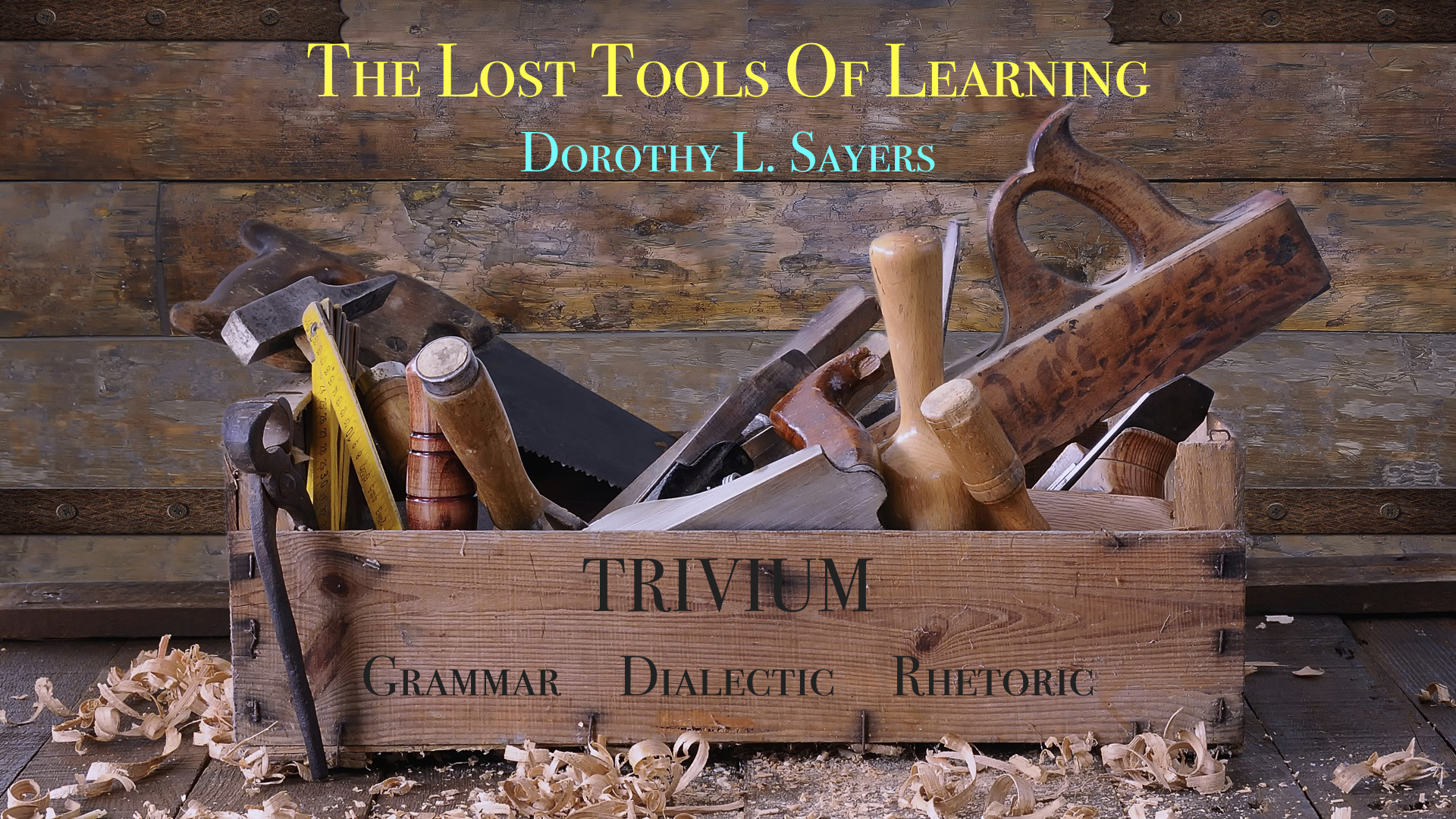
Sayers’s sharpest formulation is that pupils may “learn everything, except the art of learning.” This does not mean that she thinks facts, disciplines, technical competence, or difficult content are dispensable. On the contrary, her argument presupposes that real learning requires material to work on. Her objection is that schools can present subjects as self-contained destinations rather than using them also to teach methods that carry beyond the particular lesson.
A student may, for example, memorise a collection of historical facts, complete a set of algebraic procedures, or write essays in a familiar school format. Yet when presented with a new policy claim, scientific controversy, or unfamiliar book, that same student may not know how to begin:
- What precisely is being claimed?
- Which terms need defining?
- What kind of evidence could support the claim?
- Which sources deserve confidence, and why?
- Does the conclusion actually follow from the evidence?
- What would count as an alternative explanation or a serious objection?
For Sayers, an education that has not increasingly enabled a pupil to undertake such work independently is incomplete.
From subject acquisition to intellectual independence
Her diagnosis has three connected parts.
1. Knowledge can remain inert
Sayers observes that people often become competent within a single field while showing little better judgment than anyone else outside it. They may retain what they learned but not remember—or perhaps never have been taught—the process by which they learned it.
This is a claim about transfer. Suppose someone has been guided through six subjects by teachers, textbooks, syllabuses, and examinations. If they meet a seventh subject without those supports, do they have a working method for orienting themselves? Can they identify central questions, find dependable introductory material, discriminate among sources, make notes that preserve the argument, and test their own understanding?
Sayers thinks too much schooling leaves the answer uncertain. Subjects become, in her phrase, “water-tight bulkheads”: distinct compartments with little intellectual traffic between them. A learner may know some economics without seeing how causal reasoning matters in history; know some science without asking what makes evidence persuasive; or write English essays without recognising that definitions and logical structure matter in public argument.
The target is not shallow interdisciplinarity—making arbitrary connections between everything. It is the ability to recognise recurring intellectual operations across domains: defining, classifying, observing, inferring, comparing, checking sources, quantifying, explaining, and arguing.
2. Literacy without judgment leaves people vulnerable
Sayers’s second concern is civic and epistemic. A population can be highly literate yet still be susceptible to advertising, propaganda, and emotionally powerful but weakly supported claims. The mere ability to read is not the ability to evaluate what one reads.
Her examples concern failures that are familiar in contemporary public discourse:
| Symptom Sayers notices | Intellectual capacity she thinks is missing |
|---|---|
| Fact is confused with opinion, or what is proven with what merely sounds plausible | Evidential judgment and calibrated confidence |
| Debaters do not address the actual question | Attention to the proposition at issue |
| Writers use key terms vaguely or shift their meaning | Definition and conceptual precision |
| An argument assumes what it set out to show | Ability to expose an argument’s structure and circularity |
| Adults cannot distinguish serious scholarship from unreliable work | Source evaluation and disciplined inquiry |
| Communication creates avoidable misunderstanding | Control of language, syntax, and implication |
In the essay, Sayers criticises particular published arguments, including one which she believes confuses different types of explanation. The point is not that every error requires a child to master philosophy or formal logic before speaking. It is that educated people should acquire habits of intellectual self-defence: slowing down, identifying the actual claim, noticing an equivocation, and asking what has and has not been established.
For an ambitious home education, this matters beyond examination performance. A child eventually needs to be able to navigate a world of persuasive claims about politics, finance, health, history, science, religion, and personal conduct. The appropriate aim is neither reflexive scepticism nor credulous deference. It is disciplined judgment: knowing how to investigate, where one’s competence ends, and how strongly one is entitled to conclude.
3. Communication is part of thinking, not decorative polish
Sayers is also concerned by rambling committees, irrelevant interventions, and arguments whose terms are never defined. This may initially sound like a complaint about style. Her deeper point is that unclear expression often reveals unclear thought—and, more importantly, causes practical misunderstanding.
An argument cannot be properly assessed if the proposition is vague. A disagreement cannot be resolved if the parties mean different things by a central word. A policy cannot be scrutinised if its advocate slips between several meanings of “fair,” “efficient,” “freedom,” or “risk” without acknowledging the change.
Thus, communication is not merely the final presentation layer after reasoning is complete. In much serious work, trying to write or explain an idea exposes gaps in the idea itself. The standard should be that a child can say:
- what they mean;
- what evidence they have;
- what inference they are making;
- what uncertainty remains; and
- what objection might reasonably be raised.
Sayers’s later account of the trivium gives these capacities a more specific form. For now, the essential diagnosis is simpler: schools may treat language, argument, and expression as side activities attached to English, foreign languages, or extracurricular debating, rather than as a coherent intellectual training embedded throughout education.
The piano analogy: performance versus capability
Sayers’s most memorable analogy contrasts two kinds of musical achievement. Imagine teaching a child, mechanically and by rote, to play one particular piano piece. The child may perform it impressively. But if they have not learned scales, notation, rhythm, and how to practise a new passage, they cannot reliably learn the next piece alone.
The distinction is worth retaining:
| Narrow achievement | Generative capability |
|---|---|
| Performing a learned piece | Learning a new piece independently |
| Completing familiar mathematics exercises | Identifying a method for an unfamiliar problem |
| Repeating a historical explanation | Assessing a new historical source or interpretation |
| Writing to an established school template | Forming and defending a clear argument |
| Recalling a science result | Designing a way to investigate a related question |
Sayers is not against performing the piece, solving routine problems, memorising facts, or absorbing established knowledge. Those activities are often necessary foundations. Her claim is that they are inadequate as final aims. A good education should make future learning progressively less dependent on the teacher’s permanent presence.
This distinction should be especially useful when assessing a home-education arrangement. A tutor can produce rapid visible gains by tightly scaffolding work, supplying methods, and correcting each step. Those are often excellent forms of teaching. But over time, one should also ask whether the child can take increasing responsibility for selecting resources, planning an investigation, testing an answer, and explaining why it is warranted.
What “judging an unfamiliar subject” can reasonably mean
Sayers’s language can sound grand: the “tools of learning” appear to promise mastery of any subject. Taken literally, that would be too strong. No general method turns someone without biology into a biologist, or someone without economics into a competent macroeconomist. Subject-matter knowledge is indispensable, and deep expertise takes time.
A defensible modern interpretation is more modest and more useful. The intellectual tools help a person make a good first approach to an unfamiliar domain. They allow the learner to proceed efficiently, avoid common errors, and form provisional judgments proportional to their evidence.
When encountering a new issue, the learner should increasingly be able to:
- Frame the question. State the problem clearly and distinguish empirical, conceptual, and normative parts of it.
- Build an initial map. Identify important terms, likely mechanisms, authoritative introductory sources, and points of genuine disagreement.
- Evaluate reasoning and evidence. Ask whether cited evidence is relevant and reliable; separate a source’s evidence from its interpretation; look for assumptions, counterexamples, and alternatives.
- Communicate a provisional conclusion. Give reasons, distinguish confidence from certainty, and revise the conclusion if stronger evidence emerges.
Consider an unfamiliar public question such as whether a city should introduce road pricing. A mature learner need not pretend to resolve it immediately. But they can distinguish factual claims about congestion or emissions from value judgments about fairness; ask how costs fall across different groups; compare sources; recognise trade-offs; and state what evidence would change their view. That is a far better outcome than having strong opinions supported only by slogans or inherited allegiance.
For a future home-education programme, Sayers’s diagnosis therefore suggests an exit criterion more valuable than a completed worksheet: over time, can the child increasingly learn without you?
Treating Sayers as a powerful question, not a settled verdict
It would be a mistake to accept every part of Sayers’s argument uncritically. Her essay is a polemic: it makes sweeping contrasts between “modern” and medieval education, and it offers no controlled evidence that a particular curriculum causes resistance to propaganda or produces broad transfer of reasoning skills.
Several cautions are important.
- The medieval contrast is idealised. Historical medieval schooling was diverse, often narrow in access, and could become excessively formal or sterile. Sayers herself recognises that scholastic disputation sometimes became rigid and trivial.
- Propaganda has many causes. Media technology, incentives, social identity, fear, institutional trust, and political power all matter. Better education helps, but it cannot immunise anyone completely.
- Transfer is difficult. Children do not reliably generalise a skill merely because they have learned it once. If they learn to evaluate evidence in biology, they need guided opportunities to recognise when and how that practice applies in history, economics, and everyday claims.
- Tools require material. Logic without knowledge can become empty cleverness; rhetoric without intellectual honesty can become manipulation; critical thinking without substantive study risks shallow scepticism.
These cautions do not weaken the central educational question. They sharpen it. Rather than promising that a trivium will manufacture universally rational adults, a modern parent can aim to create repeated, explicit practice in the habits that make independent learning and responsible judgment more likely.
Key takeaways
Sayers’s diagnosis can be summarised in one sentence:
Education too often teaches pupils the results of learning in separate subjects without adequately teaching the reusable methods by which they can learn, test, connect, and communicate knowledge for themselves.
Her evidence is a cluster of familiar adult failures: vulnerability to persuasive language, muddled public argument, undefined terms, poor source judgment, intellectual compartmentalisation, and dependence on external instruction when encountering a new topic.
For home education, the implication is not to abandon rich subject teaching in favour of generic “skills.” It is to ensure that subject teaching gradually develops intellectual independence: the child should acquire both valuable knowledge and an increasingly explicit method for investigating and judging what they do not yet know.
Next, we turn from the diagnosis to Sayers’s proposed structure: grammar, dialectic, and rhetoric as successive but connected modes of intellectual formation.
Can't find a good explanation? Sign up and we'll make it for you
Sign up