
Hello! Welcome to the next lesson in our course on building production-ready microservices.
In our last lesson, we established the importance of "defense in depth" for inter-service communication, using mTLS to secure the channel and JWTs to carry authorization context. That discussion ended with a critical question: if we're not supposed to hardcode credentials like client secrets or store private keys in our source code, where do we put them?
This lesson provides the answer. Our goal is to describe strategies for secrets management in a microservices environment, focusing on HashiCorp Vault and cloud provider Key Management Services (KMS). Mastering this topic is non-negotiable for a mid-to-senior level role, as it demonstrates your understanding of security, operational maturity, and core system design principles.
1. What Are Secrets and Why Are They So Hard to Manage?
Before diving into solutions, we must be precise about the problem. A "secret" isn't just any configuration value.
Secrets Management | System Design
To understand the fundamental difference between regular configuration and secrets, and the common pitfalls that lead to security breaches, let's turn to the article "Secrets Management | System Design" from AlgoMaster.
Please read the following sections: "What Are Secrets?": Focus on the table of secret types and the core idea that exposure leads to direct, negative consequences. "Why Secrets Management Is Hard": Understand the proliferation, access, and lifecycle problems. This is the 'why' behind dedicated tools. "Common Secrets Management Mistakes": Pay close attention to these anti-patterns. In an interview, being able to identify these shows practical experience and a strong security mindset.
As the article highlights, the core challenges are:
- Proliferation: Secrets multiply across services and environments.
- Access: Both humans and machines need access, creating multiple potential leak points.
- Lifecycle: Secrets must be created, distributed, rotated, and revoked securely, a process that is impossible to manage manually at scale.
The common mistakes mentioned, like hardcoding secrets in Git, are not just theoretical; they are the root cause of countless real-world data breaches.
Test your understanding!
You are reviewing a colleague's application.properties file for a new microservice. You see the following lines:
# Database Configuration
spring.datasource.url=jdbc:postgresql://prod-db.example.com:5432/users
spring.datasource.username=user_service_prod
spring.datasource.password=Str0ngP@ssw0rd!

# External API
stripe.api.key=sk_live_123abc...
server.port=8080
Which of these are secrets, and which are just configuration? What is the primary anti-pattern being demonstrated here?
Show answer
- Secrets:
spring.datasource.passwordandstripe.api.key. If exposed, they grant direct access to the database and the Stripe payment processing API, respectively. Thespring.datasource.usernameis also sensitive and often treated as a secret. - Configuration:
server.portandspring.datasource.url. If exposed, they reveal information about the system's architecture but do not grant direct access to compromise data or functionality. - Anti-Pattern: This is a classic example of hardcoding secrets in configuration files. If this file is committed to a version control system like Git, these production credentials will be permanently exposed in the repository's history.
2. The Modern Solution: Dedicated Secrets Managers
To solve these challenges, modern architectures use dedicated secrets management systems. Instead of scattering secrets in config files, environment variables, or code, applications fetch them on-demand from a centralized, secure, and audited service.
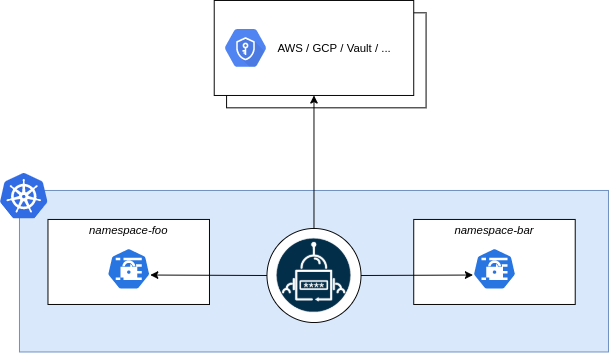
A modern secrets manager is built on four pillars.
Secrets Management | System Design
The AlgoMaster article provides an excellent breakdown of how these systems work under the hood.
Please read the section "How Secrets Management Systems Work", which covers the four pillars: Authentication, Authorization, Encrypted Storage, and Audit Logging. This provides the conceptual framework for the tools we'll discuss next.
A particularly powerful feature of many modern secrets managers is the concept of dynamic secrets. Instead of storing a static, long-lived password, the manager generates a unique, short-lived credential for each client on-demand. This dramatically reduces the risk of a compromised credential, as it expires automatically.
3. Strategy 1: The Platform-Agnostic Powerhouse - HashiCorp Vault
HashiCorp Vault is arguably the most well-known and feature-rich secrets management tool. It's an open-source, standalone product that can be run anywhere, making it ideal for multi-cloud or hybrid-cloud environments.
Vault is much more than a simple key-value store. It's a comprehensive platform for managing secrets, encryption, and identity.
Hashicorp Vault - What is Vault, Overview, Use Cases & Architecture Explained
To get a comprehensive overview of Vault's capabilities, please watch this video from Learn with GVR.
Watch the video from 0:41 to 13:53. Focus on understanding: What Vault manages (1:42): It's not just passwords, but API keys, certificates, SSH keys, and more. Key Features (2:34): Pay special attention to Dynamic Secrets, Leasing/Renewal, and Revocation. Use Cases (4:23): See how Vault solves real-world problems like database credential rotation and API key generation. High-Level Architecture (10:10): Understand the core components like Secret Engines, Auth Methods, and the Audit Trail.
Key takeaway for Vault: It is an extremely powerful and flexible tool, but that power comes with operational complexity. You are responsible for deploying, managing, and securing the Vault cluster itself.
4. Strategy 2: The Integrated Solution - Cloud Provider KMS
The major cloud providers (AWS, GCP, Azure) offer their own managed secrets management services. These are excellent choices if your infrastructure is primarily on a single cloud platform. We'll use AWS Secrets Manager as our primary example.
The main value proposition of a managed service like AWS Secrets Manager is simplicity and deep integration. You don't have to run any servers; you just consume an API.
Day-23 | Secret Management on AWS | Most asked Interview question | #aws #abhishekveeramalla
This video from Abhishek Veeramalla is framed specifically for interview preparation and provides a great comparison between different AWS options and when to consider an external tool like Vault.
Please watch the following segments: AWS Systems Manager vs. Secrets Manager (2:48 - 10:45): This explains the trade-offs between two AWS services. Focus on why you'd choose Secrets Manager for highly sensitive data, especially its automatic rotation feature. Why and When to Use HashiCorp Vault (14:04 - 16:59): This section directly addresses the multi-cloud/hybrid-cloud scenario and explains why an organization might choose Vault over a native AWS service.
Key takeaway for AWS Secrets Manager: It offers lower operational overhead and seamless integration with the AWS ecosystem (e.g., IAM for permissions, RDS for automatic rotation), but it locks you into the AWS platform.
5. Head-to-Head Comparison: Choosing Your Strategy
In a system design interview, you'll be expected to justify your choice of technology. The best choice depends on the specific context and constraints of the problem.
Secrets Management | System Design
Let's crystallize the comparison with the summary table from the AlgoMaster article. It provides a concise, at-a-glance view of the trade-offs.
Review the "Comparison Table" in the section titled "Popular Secrets Management Tools". This is a perfect summary to have in mind for an interview.
Here is a summary of the key decision factors:
| Feature | HashiCorp Vault | Cloud-Native (e.g., AWS Secrets Manager) |
|---|---|---|
| Environment | Multi-cloud, hybrid-cloud, on-premise. Platform-agnostic. | Single-cloud. Deeply integrated with the provider's ecosystem. |
| Operational Overhead | High. You must manage the Vault cluster itself (deployment, HA, upgrades, unsealing). | Low. Fully managed service. No infrastructure to maintain. |
| Feature Set | Very Rich. Comprehensive dynamic secrets, encryption-as-a-service, PKI engine, etc. | Good but Focused. Excellent for core secret storage and rotation. Dynamic secrets are often limited to the provider's own services (e.g., AWS RDS). |
| Flexibility | High. Extensive plugin ecosystem, many authentication methods, and secret engines. | Medium. Less flexible; designed to work best within the provider's ecosystem. |
| Cost | Open-source version is free (but you pay for infrastructure/ops). Enterprise/Cloud versions are priced separately. | Pay-as-you-go based on the number of secrets and API calls. |
| Best For | Organizations needing a unified solution across different environments or requiring advanced features like a certificate authority. | Organizations heavily invested in a single cloud provider who want to minimize operational burden. |
Conclusion: Production-Ready Secrets Management
You are now equipped with the knowledge to discuss and defend different secrets management strategies—a crucial skill for a senior engineer.
Key Takeaways:
- Secrets are not just configuration; their exposure has direct, severe consequences. Avoid anti-patterns like hardcoding them in Git at all costs.
- Modern systems use dedicated secrets managers that provide centralized storage, strong access control, encryption, and auditing.
- HashiCorp Vault is the powerful, feature-rich, platform-agnostic choice, ideal for complex or multi-cloud environments but comes with higher operational overhead.
- Cloud-native solutions like AWS Secrets Manager are the path of least resistance for single-cloud environments, offering seamless integration and low operational burden at the cost of vendor lock-in and less flexibility.
- The choice between them is a classic system design trade-off based on your organization's environment, team expertise, and specific security requirements.
Next Up
We've focused on externalizing secrets to a dedicated manager. However, another common pattern involves keeping configuration in a Git repository but encrypting sensitive values within it. In our next lesson, we will explore this strategy by learning how to implement symmetric encryption for sensitive properties in a configuration repository and configure clients for decryption, a feature commonly used with tools like Spring Cloud Config.
Can't find a good explanation? Sign up and we'll make it for you
Sign up