
Welcome to the first module of the course. Platform engineering is not only about building reliable Azure platforms; it also requires turning a business or engineering need into visible, prioritized, releasable work. This module establishes that delivery vocabulary before moving into Scrum, Kanban, Azure Boards, and Jira.
In this lesson, you will map the path from a product roadmap to release management. The focus is practical: at each stage, identify the decision being made, the artifact that records it, and the people who own or contribute to it. This will help you distinguish a strategic roadmap from a delivery commitment, and a release plan from the work needed to execute it.
Delivery is a chain of decisions, not a linear document
A product delivery lifecycle is often drawn as a series of phases. In practice, it is a set of connected decisions that teams revisit as they learn more. Requirements change, technical constraints emerge, incidents interrupt plans, and feedback may show that a planned capability has less value than expected.
For a platform team, consider this example:
Application teams take too long to obtain secure Kubernetes namespaces, Azure Key Vault access, and standard monitoring. The platform team is asked to offer a self-service “application landing zone” capability.
That request is not yet a project plan. It first needs to become a shared understanding of the problem, desired outcome, scope, and priorities. Only then can it be broken into deliverable work.
A useful delivery lifecycle has these broad stages:
- Discovery and alignment: establish why a problem matters and what success means.
- Roadmapping: decide which capabilities are likely to be delivered over a medium-term horizon.
- Backlog and release planning: decide what to deliver next, in what order, and at what level of confidence.
- Execution: build, test, integrate, document, and operate the work in short feedback cycles.
- Review and release management: decide whether a usable increment is ready for users and coordinate its deployment and adoption.
- Retrospective and learning: improve both the product and the delivery system.
The important distinction is between intent, forecast, and commitment:
| Level | Primary question | Typical confidence | Example |
|---|---|---|---|
| Product vision | Why should this exist? | Directional | “Enable teams to deploy compliant services without filing manual infrastructure tickets.” |
| Roadmap | Which outcomes and capabilities matter over time? | Medium to low farther out | “Self-service namespace provisioning this quarter; managed deployment templates later.” |
| Release plan | What valuable scope do we intend to make available in a near-term release? | Higher | “Release an initial landing zone with RBAC, Key Vault integration, and observability defaults.” |
| Sprint or flow plan | What will the team work on now? | Highest | “Implement the namespace provisioning API and its policy checks.” |
A roadmap should not be treated as a fixed project schedule. It is a strategic communication tool, updated when evidence changes. A release plan is more concrete, but it too is a forecast rather than a promise that every listed item will be delivered unchanged.
What is the Product Development Lifecycle? Ideation to launch 💡 ➡️ 🚀 | DOWNLOADABLE guide
Watch “What is the Product Development Lifecycle?” by Anika Rani for a practical view of the early product stages: discovery, planning, ideation, research, and product definition. It provides useful context for where a roadmap and release plan originate.
Watch the lifecycle overview to establish the three broad areas: discovery, planning, and execution. Then watch ideation and research, focusing on the difference between generating possible solutions and validating that a problem is real and worth solving. For platform work, substitute “internal developer or operations team” for “customer” when considering users and their needs.
From vision to roadmap: choosing a direction
Before a roadmap exists, a team aligns around a problem and an outcome. This is where stakeholders decide whether an idea is sufficiently valuable to pursue.
For the self-service landing-zone example, the team might discover:
- Application teams wait five business days for a namespace and initial access.
- Teams implement RBAC and monitoring inconsistently.
- Security approval is repeated manually for routine, low-risk requests.
- Success means reducing provisioning time to less than one hour while enforcing mandatory controls.
The principal decision is:
Which customer or organizational outcome are we trying to improve, and how will we know it improved?
Useful artifacts at this point include:
- a short problem statement;
- stakeholder and user map;
- desired outcomes and measurable success criteria;
- assumptions, constraints, and major risks;
- a high-level product or platform vision.
The product manager or product owner normally owns prioritization of user and business value. For an internal platform, this role may be a platform product manager, platform engineering manager, or senior technical lead acting with product responsibility. The role title matters less than clarity about who decides priority.
A platform engineering lead contributes differently. You should make technical constraints, dependencies, service boundaries, operating costs, reliability targets, and security obligations visible early. You should not silently turn an architectural preference into a roadmap commitment. Instead, state the trade-off:
- A fully automated landing zone may deliver the desired outcome, but requires identity integration and policy controls first.
- A manual pilot may validate demand quickly, but does not prove the target operating model.
- A small proof of concept may reduce technical risk, but is not itself a production capability.
The roadmap: a strategic, outcome-oriented forecast
The roadmap expresses the likely path toward the product vision over roughly the next six to twelve months. It should show major capabilities, milestones, dependencies, and intended outcomes without pretending that detailed scope is known far in advance.
For the platform example, a roadmap could contain:
| Time horizon | Intended capability | Outcome or evidence | Important dependency |
|---|---|---|---|
| Near term | Standard AKS namespace request workflow | Teams can request a namespace through a supported process | Entra ID group structure |
| Next | Secure defaults for workload onboarding | New namespaces receive baseline RBAC, quotas, and logging | AKS policy decisions |
| Later | Self-service service templates | Teams deploy a compliant starter API with less manual effort | Container registry and CI/CD integration |
| Future | Platform scorecards | Teams can see compliance and operational readiness | Consistent telemetry and governance data |
The principal roadmap decisions are:
- Which outcomes matter most?
- Which capabilities best contribute to those outcomes?
- What must precede other work?
- What uncertainty needs validation before substantial investment?
- Which items are deliberately not being pursued now?
The Agile Playbook calls the roadmap a project’s “North Star”: a broad representation of vision, goals, capabilities, and milestones rather than a detailed schedule.
Read the relevant sections of the Agile Alliance’s Agile Playbook to connect strategic alignment with preparation, delivery, roadmaps, release plans, and backlogs. Its central idea is especially useful for platform teams: plan enough to start confidently, then refine decisions as evidence arrives.
Start with the “An Agile Delivery Model” section and read the Align Prepare Deliver model. Focus on how alignment, preparation, and delivery overlap rather than occur only once. Next, read the “Product Roadmap” practice, beginning the roadmap guidance. Notice its emphasis on outcomes, broad horizons, rough sizing, and team participation. Then, in the “Release Plan” practice, read the release planning discussion. Pay particular attention to prioritizing high-value work, user communication, rollout, and the distinction between a roadmap and a release-specific plan. Finally, in “Backlog Creation” and “Product and Sprint Backlogs,” read how roadmaps become actionable backlog items. Focus on the Product Owner’s accountability for priority and the idea that the product backlog evolves continuously.
Turning direction into executable work
A roadmap gives direction, but engineers cannot execute a direction. They need a refined and prioritized product backlog.
The product backlog is the ordered set of work that may help achieve the product or platform outcome. It can contain new capabilities, technical enablers, defects, operational work, risk-reduction experiments, documentation, and compliance activities.
For the landing-zone capability, backlog items could include:
- Define the approved namespace and naming model.
- Create an Entra ID group-to-Kubernetes RBAC design.
- Build a namespace provisioning workflow.
- Apply default resource quotas and network policies.
- Publish onboarding documentation.
- Add audit logging and an operational dashboard.
- Run a pilot with two application teams.
- Resolve defects found during the pilot.
A common hierarchy in Azure Boards is:
| Work-item level | Purpose | Landing-zone example |
|---|---|---|
| Epic | Large strategic objective spanning substantial work | Developer self-service on AKS |
| Feature | Coherent capability that delivers recognizable value | Self-service application landing zone |
| User story or product backlog item | A small, testable need from a user or stakeholder perspective | “As an application team, I want a namespace provisioned with approved defaults so that I can begin deployment safely.” |
| Task | Implementation activity needed to complete a story | Create Terraform module; configure RBAC mapping; write validation tests |
| Bug | A defect requiring correction | Namespace workflow creates an incorrect role binding |
The hierarchy creates traceability. A delivery lead should be able to start with a strategic epic and see which features, stories, tasks, and defects contribute to it. Conversely, an engineer should be able to explain why a task exists and what outcome it supports.
The product owner owns ordering and value decisions, but does not estimate the engineering effort alone. The delivery team estimates complexity and identifies dependencies. The platform lead helps make technical work visible: a story such as “automate namespace provisioning” may require prerequisite architecture, identity, security, and operational design that needs deliberate backlog treatment.
Refinement: reducing uncertainty just in time
Backlog refinement is the regular activity of making the next likely items understandable enough to plan. It is not a one-time requirements phase.
During refinement, the team commonly:
- clarifies the user or stakeholder need;
- adds acceptance criteria;
- identifies external dependencies and risks;
- breaks oversized items into smaller slices;
- estimates relative effort;
- confirms that work is technically feasible;
- reprioritizes based on current evidence.
A refined backlog does not mean every future item has complete detail. Near-term work should be clear; distant work can remain broad. Excessive detail too early creates false certainty and wastes effort when priorities change.
Release planning: choosing a valuable, operable increment
A release is a coordinated availability event: a set of work becomes usable by its intended users. For a platform team, a release might be a new self-service capability, a new supported cluster baseline, a versioned Terraform module, or a policy change that application teams must adopt.
A release plan translates the roadmap into a near-term decision:
What scope will we make available, to whom, under what conditions, and how will we measure its result?
A credible release plan contains more than a target date. It normally identifies:
- Release goal: the outcome intended for this release.
- Scope: features or backlog items included, plus explicitly deferred work.
- Target window: a date or time range based on team capacity and dependencies.
- Release criteria: functional, security, operational, documentation, and approval conditions.
- Rollout approach: pilot, phased deployment, broad availability, or feature flag.
- Communication and support plan: release notes, onboarding guidance, ownership during rollout.
- Rollback or mitigation plan: what happens if a release causes harm.
- Success measures: adoption, error rates, lead time, satisfaction, policy compliance, or operational load.
For the landing-zone release, a release goal might be:
Two pilot application teams can provision a compliant AKS namespace through a documented workflow, with baseline RBAC, quotas, Key Vault access patterns, and logs visible to the platform support team.
That is stronger than “deliver namespace automation.” It defines intended users, outcome, operational scope, and evidence of success.
Readiness is a decision, not merely a test result
Release management is the discipline of coordinating and governing the move from “built” to “available and supported.” Automated tests are critical, but release readiness is broader.
A platform release-readiness decision may consider:
| Readiness dimension | Example release question | Typical contributor |
|---|---|---|
| Functional | Does the provisioning workflow create the expected namespace and standard resources? | Engineering team |
| Security | Are least-privilege access, secrets handling, and policy controls validated? | Security engineer, platform lead |
| Reliability | Are failure modes, retries, alerts, and rollback understood? | SRE or platform operations |
| Operability | Are dashboards, runbooks, support ownership, and escalation paths ready? | Platform operations |
| Compatibility | Will existing application teams be disrupted? | Application representatives, platform team |
| Compliance | Are required controls and audit evidence present? | Governance or compliance stakeholders |
| User readiness | Do pilot users have documentation and a clear support route? | Product owner, enablement team |
The team should not replace judgment with a meeting or a manual checklist. Automate repeatable controls where possible, such as tests, policy checks, vulnerability scans, and deployment validation. Then use a focused release decision for risks that need accountable human judgment.
Who owns what?
Agile delivery does not require a fixed organizational chart. A smaller team may combine several responsibilities in one person; a large enterprise may distribute them across many people. The critical requirement is that decision rights are clear.
| Stage | Principal decision | Core artifacts | Accountable owner | Key contributors |
|---|---|---|---|---|
| Discovery and alignment | Is the problem worth solving, and what outcome matters? | Vision, problem statement, success measures, stakeholder map | Product manager or sponsor | Users, platform lead, architects, security, operations |
| Product roadmap | Which capabilities and outcomes are the strategic priorities? | Outcome-based roadmap, milestones, dependency view | Product manager or product owner | Engineering lead, stakeholders, delivery lead |
| Backlog management | What work is valuable next? | Product backlog, epics, features, user stories, acceptance criteria | Product owner | Delivery team, platform lead, users |
| Technical preparation | How will the solution meet technical and operational needs? | Architecture decisions, technical design, risk register, environment plan | Platform or technical lead | Engineers, SRE, security, architects |
| Sprint or flow planning | What can the team realistically complete now? | Sprint backlog or Kanban pull policies, estimates, capacity view | Delivery team | Scrum Master or delivery lead, product owner |
| Execution and review | Does the increment meet agreed acceptance criteria, and what should change next? | Code, tests, deployment artifacts, demos, feedback, updated backlog | Delivery team for delivery; product owner for acceptance | Stakeholders, operations, security |
| Release management | Is the increment ready to make available, and how will it be rolled out safely? | Release plan, readiness evidence, change record where needed, release notes, rollback plan | Release owner or designated service owner | Product owner, platform lead, operations, security |
| Improvement | What should the team change in its way of working? | Retrospective notes, improvement actions | Delivery team | Scrum Master or delivery lead, product owner |
Two cautions are worth retaining:
- “Accountable” does not mean “does all the work.” A product owner can be accountable for priority while engineering owns estimates and implementation.
- Architecture governance should enable flow, not become a late-stage gate. Platform and security expertise is most effective when involved while work is being shaped, not after all design choices are effectively locked in.
Making the lifecycle visible in Azure Boards
Azure Boards provides a way to represent this relationship between strategy, planned capabilities, and detailed work. A Delivery Plan can show multiple teams and their work across iterations, helping leaders see dependencies and timing without reducing planning to a spreadsheet.
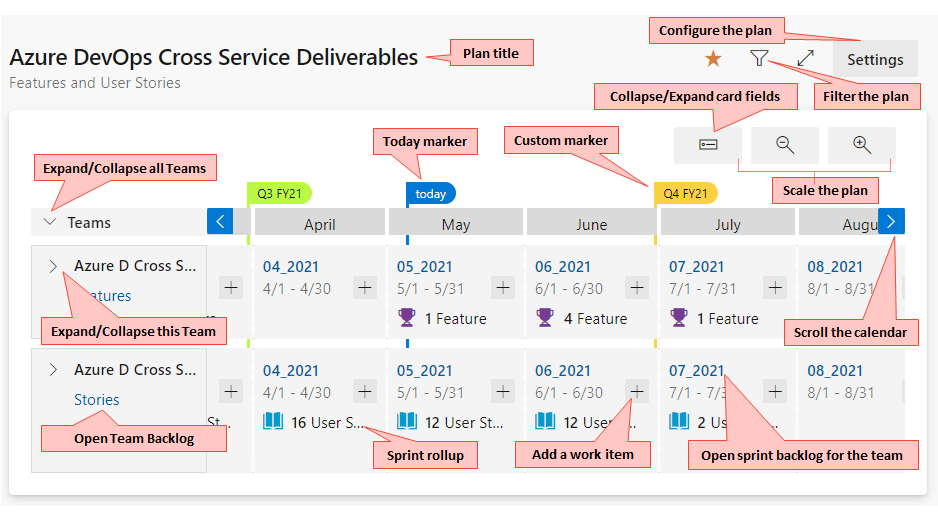
In a healthy Azure Boards setup:
- Epics and features communicate strategic outcomes and major capabilities.
- User stories or product backlog items represent small, testable slices of value.
- Tasks and bugs support execution and quality management.
- Iteration paths show when work is expected to be undertaken.
- Delivery Plans communicate feature-level timing across teams.
- Dashboards and queries later help reveal flow, blockers, throughput, and delivery risk.
Dates in a plan are not instructions imposed independently of the team. They should be informed by evidence: team capacity, completed work, dependency status, technical risk, and historical delivery patterns.
How to Create a Project Roadmap, Delivery Plan & Link Work Items | Azure DevOps | Scrum Master Q & A
Watch “How to Create a Project Roadmap, Delivery Plan & Link Work Items” by BeingAgile Consulting for a short Azure DevOps demonstration of creating a Delivery Plan at the feature level.
Watch creating a plan. Observe the choice of project, team, and backlog level. A feature-level Delivery Plan is useful when communicating a release-oriented view across teams; it is not a replacement for the detailed product backlog or the team’s day-to-day board.
As you progress through the module, you will build the detailed working practices behind this view: selecting a delivery framework, writing user stories, structuring Azure Boards work items, running sprint workflows, and managing flow with Kanban.
A working mental model for a platform engineering lead
When asked for a date, a roadmap, or a release commitment, do not start by creating work items. First identify the decision that is actually needed.
For example:
- If leadership asks, “When will teams get self-service namespaces?” they may need a roadmap-level forecast and clarity on dependencies.
- If a product owner asks, “What can our pilot users receive next month?” they need a release plan with a release goal and readiness criteria.
- If engineers ask, “What do we work on in the next two weeks?” they need refined backlog items and a realistic plan based on capacity.
- If operations asks, “Can this go live safely?” they need release-readiness evidence, operating ownership, and a rollback approach.
Treat every planning artifact as a tool for making one of these decisions visible. Avoid creating documentation simply because a process says it exists.
Key takeaways
A product delivery lifecycle connects strategic intent to usable, supported outcomes:
- Discovery and alignment establish the problem, value, success measures, and stakeholders.
- The roadmap gives medium-term direction through outcomes, capabilities, dependencies, and broad timing. It is not a detailed promise.
- The product backlog turns direction into prioritized work and changes as the team learns.
- A release plan selects a near-term, valuable increment and defines release scope, readiness, rollout, communication, and measures of success.
- Release management coordinates the decision to make work available safely and support it in operation.
- Clear ownership matters more than job titles: product ownership governs value and priority; the delivery team owns implementation and estimates; the platform lead makes technical, security, reliability, and operational considerations explicit.
Next, you will compare Scrum, Kanban, and Scrumban for platform-team scenarios, where planned engineering work must often coexist with operational requests, incidents, and changing priorities.
Can't find a good explanation? Sign up and we'll make it for you
Sign up