
Welcome back. In the previous lesson, you practised taking a deliberate two-second pause after a question ends. That pause creates space—but under pressure, space can quickly fill with too many competing thoughts: Which example should I use? What is the best English sentence? What if I miss something important?
Today you will use those two seconds to make a three-keyword map of the question before you begin answering. The aim is not to prepare a perfect speech in your head. It is to reduce a large, demanding question into three small cues that give your answer a direction.
This is especially useful when you know the subject but cannot retrieve it smoothly under interview or group pressure. Because the cues represent ideas, not grammar, you can use the same method in English, Hindi, or any language you speak.
Why a question can make your mind go blank
A question such as, “How would you prioritise technical SEO issues in your first 90 days?” contains many decisions at once:
- What does “prioritise” mean here?
- Should you discuss crawlability, indexation, revenue, content, effort, or stakeholders?
- Should you give a real example or a general approach?
- How much detail is enough?
- What is the best first sentence?
Trying to solve all of those at the same time can overload your thinking. Then the mouth starts moving before the mind has selected a route:
“There are many factors, and it depends on the website, and first I would analyse everything…”
That is not a knowledge problem. It is a selection problem.
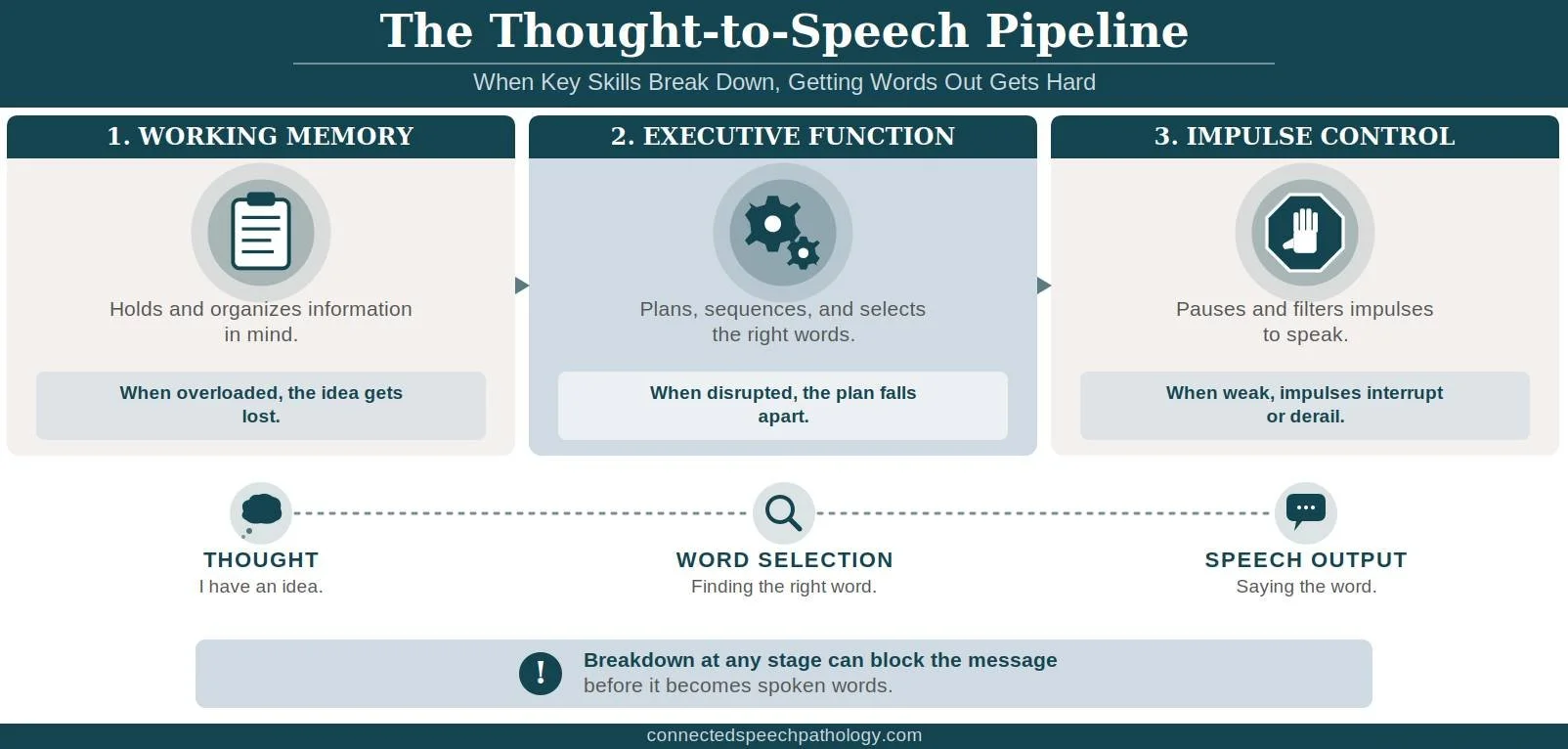
Treat this diagram as a practical model, not as a diagnosis. When a question arrives, working memory can become crowded, and the urge to speak immediately can interrupt the selection process. Your pause from the last lesson protects a small moment for executive function: choosing a manageable path.
Three keywords are that path.
The 3-2-1 Speaking Trick That Forces You To Stop Rambling!
Watch “The 3-2-1 Speaking Trick That Forces You To Stop Rambling!” by Vinh Giang. It illustrates a useful principle for impromptu speaking: a simple constraint gives your mind something specific to do instead of searching every possible idea at once.
Watch the problem and tool to notice how an unexpected question can trigger scattered thinking, and why a simple structure reduces rambling. Then skip the promotional interruption and watch the live examples, where people choose one simple route for an unprepared topic. Do not try to copy the video’s exact 3-2-1 technique today; focus on its central lesson: limiting choices makes it easier to speak.
The three-keyword map
A keyword prompt is a short word or phrase that triggers an idea. It is not a full sentence, a script, or a point you must say aloud.
For example, faced with this question:
“How would you prioritise technical SEO issues in your first 90 days?”
You might silently create:
baseline — impact — plan
These prompts are enough to start:
“I would begin by establishing a baseline of the site’s technical health and organic performance. Then I would prioritise issues based on business impact and urgency. Finally, I would turn the highest-priority work into a practical 90-day plan with owners and measurement.”
Notice what you did not do:
- You did not remember a memorised paragraph.
- You did not attempt to cover every SEO topic you know.
- You did not speak the prompts mechanically: “Baseline, impact, plan.”
- You did not wait until the entire answer was perfect.
You selected three ideas, then allowed the sentences to form around them.
The three jobs your prompts should do
In most answers, your three prompts should give you:
| Prompt job | What it helps you decide | Example |
|---|---|---|
| Starting point | Where will I begin? | Baseline |
| Main reasoning | What principle or action matters most? | Impact |
| Useful endpoint | How will I show value, proof, or a next step? | 90-day plan |
The words themselves will change from question to question. What matters is that they create a small, logical route through the answer.
A good prompt is usually one to three words:
- Good: “stakeholder concern,” “evidence,” “outcome”
- Too detailed: “explain how I used Search Console segmentation to identify declining nonbrand clicks”
- Too vague: “strategy,” “work,” “success”
If your prompts are too detailed, you are trying to script. If they are too vague, they will not trigger useful content.
First identify the task hidden inside the topic
A question has a topic and a task.
Consider:
“What is your approach to AEO?”
The topic is AEO. The task is explain your approach.
Or:
“Tell me about a time you influenced a stakeholder.”
The topic is stakeholder influence. The task is describe a real experience and its result.
Under pressure, many people focus only on the topic. They start mentally searching everything they know about AEO, SEO, analytics, or stakeholder management. Instead, first listen for the task word:
| If the interviewer says… | Your answer needs to do… |
|---|---|
| “How would you…?” | Explain an approach or decision |
| “Tell me about a time…” | Describe one real experience |
| “Why…?” | Give a reasoned explanation |
| “What do you think…?” | State and support a view |
| “Compare…” | Use criteria to distinguish options |
You do not need to say this category aloud. Just identify it internally, then select three prompts that suit it.
Four practical prompt sets
These are not full interview frameworks to memorise. They are quick cue families you can adapt in the two-second pause.
| Question type | A useful three-prompt route | Example question and prompts |
|---|---|---|
| Approach | Goal, criteria, action | “How would you prioritise content?”: goal — impact — action |
| Experience | Challenge, action, result | “Tell me about a difficult project”: conflict — alignment — result |
| Opinion | View, reason, example | “Is AI search a threat to SEO?”: opportunity — user intent — example |
| Unfamiliar problem | Assumption, analysis, first step | “How would you assess a new channel?”: audience — evidence — test |
The point is to give your mind an initial route, not to force every answer into the same shape. Later in the course, you will learn more formal structures for experiences, opinions, and recommendations. For now, use these as retrieval cues.
Keep the question smaller than your knowledge
Your experience gives you a lot of available material: technical SEO, landing-page strategy, keyword opportunity analysis, content briefs, AEO, GEO, reporting, and cross-functional execution. In an interview, the danger is not having too little to say. It is trying to include too much.
Imagine this prompt:
“How do you identify SEO growth opportunities?”
A broad, overloaded set of thoughts might be:
competitors, keywords, technical health, content gaps, conversion rate, backlinks, seasonality, Search Console, GA4, pages, stakeholders…
That list may be accurate, but it is not yet speakable. Reduce it:
demand — gap — priority
Now you can begin clearly:
“I start by identifying where there is meaningful search demand and business relevance. Then I look for gaps, such as competitors winning visibility where our content or landing pages are weak. Finally, I prioritise opportunities based on likely impact, effort, and the ability to measure results.”
The three prompts do not limit your expertise; they make it accessible to the listener.
Toastmasters communication coach Matt Abrahams makes a related point: spontaneous answers are easier to follow when they have a logical order rather than becoming a long list.
Improve Your Impromptu Speaking - Toastmasters.org
Read the “Message” section of “Improve Your Impromptu Speaking” from Toastmasters. It explains why listeners respond better to structured responses than to rambling lists, and introduces a simple three-part way of organising a message.
In the “Message” section, under “Step 4: Structure your message,” read the three-part explanation and then read the short coaching example that follows it. You are not required to use the article’s exact structure today. Focus on the principle that a small sequence helps both the speaker and listener stay oriented.
Use the pause and prompts together
Your routine is now slightly more precise than in the last lesson:
- Listen until the question is completely finished.
- Pause silently for two seconds.
- Identify the task. Is this asking for an approach, experience, opinion, comparison, or response to a new problem?
- Choose three keyword prompts.
- Start with the first prompt.
For an easy question, this can happen very quickly. For a more difficult one, it may take a little longer. Silence is still better than beginning with a filler while your thoughts are unorganised.
Here are three examples.
Example 1: Professional experience
Question: “Tell me about a time you used data to change a marketing decision.”
Silent prompts:
traffic drop — segmentation — content shift
Possible start:
“In one role, we saw a decline in organic traffic to an important group of landing pages. I segmented the performance data to identify where the drop was concentrated, which showed a mismatch between search intent and our existing content. That led us to adjust the content plan and prioritise pages with stronger commercial potential.”
The prompts support the answer, but they are not the answer itself.
Example 2: Strategic judgment
Question: “How would you decide whether an AEO initiative is worth investing in?”
Silent prompts:
audience — visibility — business value
Possible start:
“I would first assess whether the target audience is using question-based or AI-assisted search journeys relevant to the brand. Then I would examine where the brand currently appears and where competitors are gaining visibility. The investment should be judged by business value, not by visibility alone, so I would define the expected impact and measurement before scaling the work.”
Example 3: A question you do not fully know
Question: “How would you evaluate a channel you have not managed before?”
Silent prompts:
objective — evidence — small test
Possible start:
“I would begin with the business objective and the audience we are trying to reach. Then I would review available evidence on channel behaviour, costs, and comparable campaigns. Rather than make a large commitment immediately, I would recommend a small test with clear success criteria.”
This is tactically strong because you do not pretend to be an expert in the unfamiliar channel. You show how you would think.
Practice: build speed without memorising
Set aside about 18 minutes for this practice. Record the second round on your phone or laptop, because recording is the most reliable way to see whether you are actually pausing and simplifying.
Round 1: Prompt-only sprints — 6 minutes
Read each question aloud. Pause for two seconds. Then say only your three prompts aloud, with a brief pause between them. Do not give a full answer yet.
Use these prompts:
- “How would you prioritise a technical SEO issue?”
- “Tell me about a time you found a growth opportunity.”
- “What is the practical value of AEO for a brand?”
- “How would you respond if organic traffic fell sharply?”
- “How would you handle disagreement with a content stakeholder?”
Your task is not to find the best three prompts. Your task is to choose a workable set within five seconds.
For example:
- Technical SEO issue: impact — urgency — effort
- Growth opportunity: data — insight — result
- Traffic fall: diagnose — segment — test
- Stakeholder disagreement: goal — evidence — alignment
Round 2: Short answers — 8 minutes
Choose four of the same questions. For each one:
- Listen to or read the full question.
- Take your two-second silent pause.
- Form three prompts mentally.
- Give a 20- to 30-second answer.
- Stop. Do not restart to improve your English.
Your answer may be incomplete. That is acceptable. This drill trains a more important habit: select first, speak second.
Round 3: One pressure simulation — 4 minutes
Turn on your camera and sit as you would in a video interview. Use the 60-second breathing and grounding reset from two lessons ago before starting.
Ask yourself:
“How would you create a 90-day SEO growth plan for a new website?”
Pause, choose three prompts, and answer for 45 seconds. A possible map could be:
baseline — opportunities — roadmap
Do not copy that map if a different one comes naturally. The goal is to trust your own ability to reduce complexity.
Review: assess the map, not your grammar
After recording, review each answer using this narrow checklist:
| Check | Yes / Not yet |
|---|---|
| I waited until the question ended before thinking aloud | |
| I created only three prompts, rather than a long internal list | |
| My first sentence matched the question’s actual task | |
| Each prompt led to a distinct idea | |
| I avoided trying to sound perfect before beginning |
If an answer becomes scattered, do not conclude, “I cannot speak well.” Instead, diagnose the map:
- No prompts: You started too quickly.
- Six or seven prompts: You tried to include everything you know.
- Very abstract prompts: Choose one concrete cue, such as “crawl errors,” “competitor gap,” or “conversion pages.”
- An answer that does not address the question: Identify the task word more carefully before choosing prompts.
A useful standard is this: after hearing the question, can you hold the entire route in your mind without strain? If not, make the prompts shorter.
Key takeaways
A pressured question feels overwhelming when you try to retrieve your entire knowledge base at once. The solution is not perfect vocabulary or a memorised answer. It is a smaller route.
- Use your deliberate two-second pause.
- Identify what the question is asking you to do.
- Reduce it to three short prompts: a starting point, main reasoning, and useful endpoint.
- Keep prompts as ideas, not sentences.
- Begin speaking from the first prompt before trying to perfect the whole answer.
For the next few days, use the three-keyword map before every recorded answer. Write the prompts down only after you answer, so you can check what your mind actually selected.
Next, you will learn concise recovery phrases for the moment when you lose a thought mid-answer, so a brief blank does not become panic or force you to restart.
Can't find a good explanation? Sign up and we'll make it for you
Sign up