
Welcome back. In the previous lesson, you built a pressure-practice ladder: a gradual path from private recordings to realistic interviews and presentations. That ladder gives you where to practise. This lesson gives you a short routine for the moment your body starts signalling danger: racing thoughts, tight chest, shallow breathing, shaky voice, or the urge to answer immediately.
The purpose of a reset is not to erase anxiety or make you sound perfect. It is to reduce the sense of urgency enough that you can access what you already know. For an interview, meeting, or presentation, one minute of deliberate breathing and grounding can shift your attention from “What if I freeze?” back to the immediate task: listening, thinking, and giving one useful answer.
By the end of this lesson, you will be able to perform a repeatable 60-second reset before a high-pressure speaking task.
What a reset is—and is not
Under pressure, people often breathe high in the chest, speak before they have formed a thought, and monitor themselves harshly: My voice is shaking. My grammar will be wrong. They will think I do not know this. That attention is pulled inward and toward a feared future.
A reset gives your attention two concrete places to go:
- Your breath, especially a comfortable, slower exhale.
- Your immediate surroundings, using the senses to notice that you are here, in this room, at this moment.
This does not guarantee that nervousness disappears. The success criterion is more practical:
I notice pressure, complete the reset, and still begin the task.
Think of it as a pre-call routine, not an emergency trick you use only after everything has gone wrong. Use it before recording an answer, before joining an interview, while waiting for a presentation to begin, or after you notice your earliest warning sign from Lesson 2.
The University of California, Berkeley’s Breathing Exercises explains the two physical principles behind our routine: breathe from the lower belly rather than only the upper chest, and make the exhale longer than the inhale.
Read the University of California, Berkeley guide to understand abdominal and paced breathing. Its practical guidance will help you make the reset comfortable rather than turning it into another task to perform perfectly.
On the first page, read the “Abdominal Breathing Technique,” beginning with the seated breathing instructions. Notice the cue that the belly, rather than only the chest, expands. Then find “Paced Breathing” and read the counting guidance. The exact count can vary; the useful pattern is a gentle, unforced inhale followed by a longer exhale.
A useful detail: do not take huge, strained breaths. Your aim is steady, comfortable breathing. If counting or holding your breath makes you light-headed, tense, or uncomfortable, stop the count and return to normal, easy breathing.
The 60-second “Land, Breathe, Orient” reset
Use this exact version for the next week. Keeping one stable routine means you can use it more automatically when pressure rises.
Seconds 0–10: Land in your body
Sit or stand with both feet in contact with the floor. Let your shoulders drop slightly and loosen your jaw. Notice the support under you: the chair, floor, or both.
Choose one ordinary object in front of you—a pen, wall, notebook, screen, or door. Silently name it.
This is not about looking calm. It is about giving your brain immediate sensory information instead of feeding the internal alarm.
Seconds 10–50: Breathe at a steady pace
Complete four comfortable cycles:
- Inhale through your nose for a count of 4.
- Exhale slowly through your mouth for a count of 6.
Let the lower belly expand gently on the inhale. On the exhale, imagine that you are releasing air steadily through a narrow straw. Do not force the air out.
Four cycles take about 40 seconds. Counting occupies the part of your attention that may otherwise race ahead to an imagined bad outcome. A longer exhale also gives you a deliberately slower rhythm before you speak.
Seconds 50–60: Orient through three senses
Without searching hard, notice:
- One thing you can see: “The blue notebook.”
- One thing you can feel: “Both feet on the floor.”
- One thing you can hear: “The fan,” or “background voices.”
Then let your attention return to the task in front of you.
Here is the full routine in a compact form:
| Time | Action | Quiet attention cue |
|---|---|---|
| 0–10 seconds | Feel feet and chair; release shoulders and jaw | “I am here.” |
| 10–50 seconds | Four cycles: inhale 4, exhale 6 | Count only the current breath |
| 50–60 seconds | Notice one sight, one physical sensation, one sound | “See. Feel. Hear.” |
Do not add a long motivational speech in your head. A complicated internal script gives pressure more material. The reset should be simple enough to perform in a hallway, on a video call before joining, or while sitting outside an interview room.
A short grounding method for real professional situations
The well-known 5-4-3-2-1 technique is a longer sensory grounding practice. It invites you to name five things you see, four you feel, three you hear, two you smell, and one you taste.
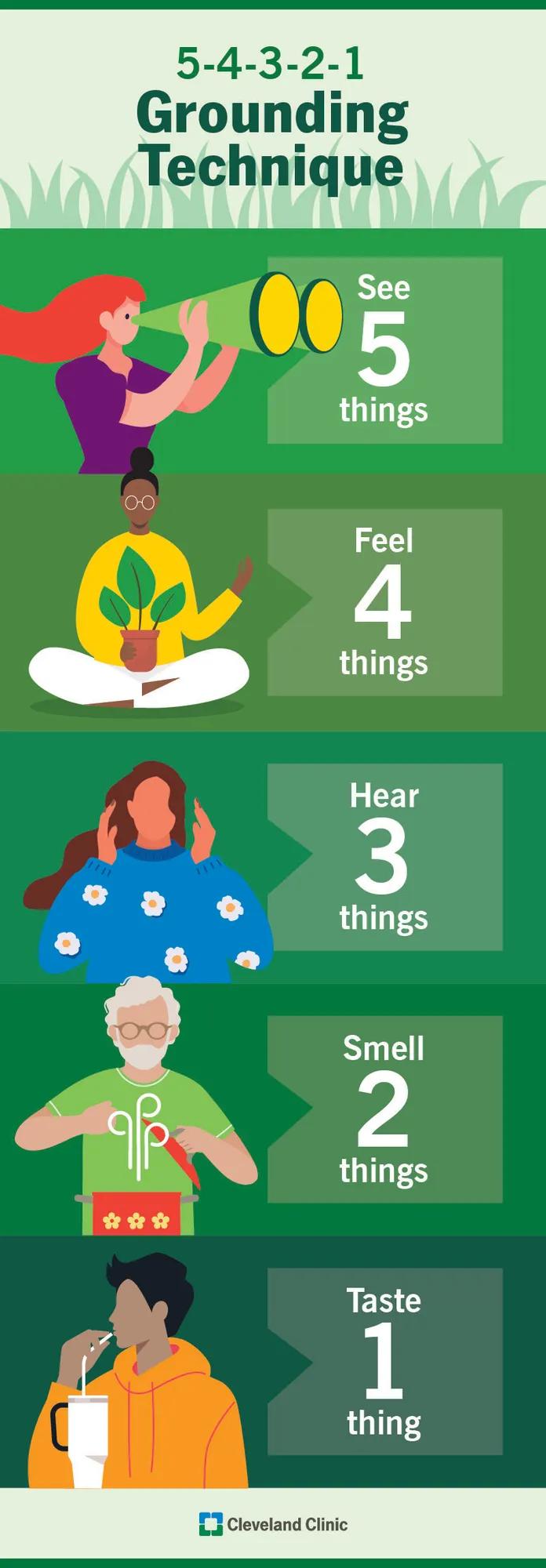
For a full anxiety spike when you have privacy and a few minutes, the complete sequence can be helpful. But before speaking, it may be too long. Your one-sight, one-feel, one-sound version is a compressed professional adaptation. It gives you the same basic benefit: an external, present-moment anchor—without delaying the conversation.
For example, before a Growth Marketing interview begins, you might do this silently:
- “I can see the interviewer’s name on the screen.”
- “I can feel my back against the chair.”
- “I can hear the air conditioner.”
Then you listen to the first question. You are not trying to prove you are fearless; you are making yourself available to think.
Greater Good in Action describes this use of breathing well: thoughts will wander, particularly under stress. The skill is noticing that you have wandered and gently returning attention to a present anchor, rather than arguing with the thought.
Mindful Breathing | Practice | Greater Good in Action
Read Greater Good in Action’s “Mindful Breathing” for a clear explanation of attention as a trainable skill. This matters when your mind starts predicting failure before an interview or group discussion.
In “How to Do It,” read the basic practice, including the suggested short breath for stressful moments. Then read the “Why It Works” section, beginning with the explanation of the breath as an anchor. Focus on the distinction between noticing a thought and needing to obey it.
Practise the timing before you need it
First, practise the reset when you are only mildly nervous. A skill learned only during panic is much harder to retrieve.
Use the following practice sequence today. It takes about 10 minutes.
Round 1: Learn the mechanics
Set a 60-second timer. Do the routine exactly as written:
- Land for 10 seconds.
- Complete four cycles of -second inhale and -second exhale.
- Orient through one sight, one feeling, and one sound.
After the timer ends, simply notice your state. You do not need to feel dramatically calmer.
Round 2: Add a realistic prompt
Choose a familiar prompt that uses knowledge you already have, such as:
- “Tell me about an SEO initiative you improved.”
- “How do you prioritise technical SEO issues?”
- “What is one AEO opportunity you have identified?”
Read the prompt, perform the full 60-second reset, and then record a brief answer. For this round, do not judge the content, grammar, or structure. Notice only whether you could start speaking without rushing.
Round 3: Recreate the first seconds of pressure
Stand or sit as you would for a video interview. Turn on your camera, look at the screen, read a new familiar prompt, and do the reset without stopping the recording.
This teaches an important association: camera on does not have to mean immediate panic or immediate speech. It can mean: first, I land; then I answer.
Record only three quick observations in your practice log:
| Observation | Example |
|---|---|
| Early warning sign | “My shoulders rose and I wanted to answer instantly.” |
| Reset completed? | “Yes; four full cycles.” |
| Effect on start of answer | “Still nervous, but I began more slowly and could finish my first sentence.” |
Avoid judging the reset by whether your anxiety rating reaches zero. A better question is: Did I regain enough space to begin?
Why box breathing is an optional alternative
You may encounter box breathing, which uses equal counts for inhale, hold, exhale, and hold again. It can be useful for some people because its repeated counting gives attention a clear structure.
This short Headspace video demonstrates the pattern and explicitly connects it to focus before high-stakes discussions. Watch it once to experience a guided version. For this course, however, keep the -in, -out routine as your default unless the holds feel comfortable and useful to you.
Learn Breathing Technique Box Breathing: Practice Breathwork for Focus and Anxiety with Dora Kamau
Watch “Learn Breathing Technique Box Breathing” from Headspace with Dora Kamau. It provides a guided comparison method and shows how counted breathing can recenter attention before presentations and difficult conversations.
Watch the setup to hear the relationship between counting, focus, and anxiety. Then follow two guided rounds of box breathing. Finish with the work context, where the presenter describes using it before presentations and high-stakes discussions. If the breath holds feel uncomfortable, do not force them; return to the longer-exhale routine from this lesson.
The key is not finding the one perfect breathing technique. It is choosing one brief routine, practising it repeatedly, and using it before pressure becomes overwhelming.
Put the reset on your pressure-practice ladder
Add the reset as a standard pre-step before the ladder tasks you designed previously.
For your next two planned practice sessions:
- Choose a familiar professional prompt.
- Rate your anticipated pressure from to .
- Perform the 60-second reset.
- Record or deliver the planned answer.
- Log whether you completed the reset and one observation about your start.
Keep the reset separate from the answer itself. In a real interview, you will usually use the full minute before the meeting begins, while you are waiting to enter, or between practice questions. You do not need to make an interviewer wait for 60 seconds after asking a question. In the next lesson, you will learn a much shorter tool for that exact moment: a deliberate two-second pause before you begin.
If anxiety becomes intense, you feel faint, or breathing exercises make symptoms worse, return to normal breathing and ground yourself through your surroundings instead. If speaking anxiety regularly disrupts work or daily life, professional mental-health support can complement communication training.
Key takeaways
A 60-second reset is a bridge between feeling pressure and responding usefully. Your routine is:
- Land for 10 seconds: feet, chair, shoulders, jaw, and one visible object.
- Breathe for 40 seconds: four gentle cycles of inhale for , exhale for .
- Orient for 10 seconds: identify one thing you see, feel, and hear.
- Begin the task, even if some nervousness remains.
Use the same routine before recordings, mock interviews, meetings, and presentations this week. Next, you will train the small but powerful behaviour that follows the reset: beginning an answer with a deliberate two-second pause rather than reacting immediately.
Can't find a good explanation? Sign up and we'll make it for you
Sign up