
Hello again. In the previous lesson, you recorded a baseline answer and evaluated it for anxiety signals, clarity, structure, and delivery. You also selected an evidence-based observation rather than using a vague label such as “I lack confidence.”
This lesson looks one step earlier in the process: what starts the pressure, and what are the first signs that pressure is taking control? The aim is not to eliminate every nervous feeling. It is to recognize your personal speaking-pressure cycle soon enough that later lessons can give you a reliable response to it.
Pressure is a sequence, not a personality trait
A difficult interview question, a senior person in a meeting, or being asked to speak without preparation can produce a familiar experience: your heart rate rises, you start monitoring your English, your mind goes blank, and the knowledge you normally have feels unavailable.
That does not mean the knowledge has disappeared. Under perceived social threat, attention narrows. Instead of focusing on the task—answering the question, explaining the data, or asking a useful follow-up—you may focus on danger signals:
- “What if I cannot frame this correctly?”
- “What if they think I am not good enough for a manager role?”
- “They will notice that my voice is shaking.”
- “I need to give the perfect answer or I will lose this opportunity.”
The body treats this as a threat, even though an interview or meeting is not physically dangerous. That can produce real effects: tense muscles, dry mouth, faster breathing, a weak or rushed voice, difficulty concentrating, and the experience of “going blank.”
A useful principle for this course is:
Nerves are a signal, not a verdict.
Your task is to identify the signal and the sequence around it. You are not trying to prove that your fear is irrational, force yourself to feel calm, or diagnose yourself with a condition.
The Vicious Circle of Social Anxiety diagram shows how a belief about social performance can lead to anxious predictions, physical symptoms, self-focused attention, and protective behaviors such as avoiding eye contact or saying less. Afterwards, harsh self-evaluation can strengthen the original belief and make the next situation feel more threatening.
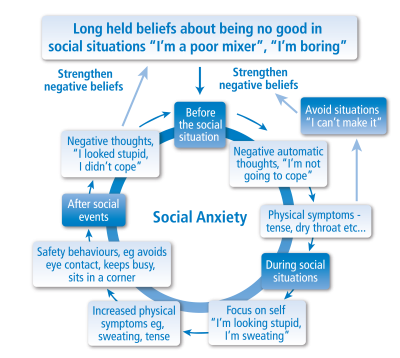
For professional communication, a cycle might look like this:
- A hiring manager asks, “How would you build an AEO strategy for a new client?”
- You interpret the question as a test you must answer perfectly.
- Your body becomes tense; you notice your heartbeat or dry throat.
- Your attention turns inward: “I am taking too long. My English is weak.”
- You rush into details, use fillers, or stop before explaining your actual reasoning.
- Afterward, you replay the weakest moment and conclude, “I cannot handle unfamiliar questions.”
The important point is that the question itself is not the whole cause. The interpretation, physical response, attention, and behavior interact. Once you can name those parts, you can work with them.
Module 1 - Understanding Social Anxiety
Read Module 1: Understanding Social Anxiety from the Centre for Clinical Interventions. It explains why pressure can produce physical symptoms and maps the thoughts, attention patterns, and protective behaviours that can keep a social-anxiety cycle active.
On p. 4, locate the paragraph beginning “If you believe that it is very likely that you will appear nervous.” Read the threat estimate and notice the two judgments involved: how likely you think a feared outcome is, and how serious you think it would be. Then read pp. 5–6, from the discussion of negative thoughts through the section on safety behaviours. Focus on thoughts and safety behaviours. On p. 6, also read attention patterns. Finally, on pp. 8–10, examine the example model and blank worksheet. Read the model overview. You will create a shorter, work-focused version of this map below.
Identify the trigger type before judging your response
A trigger is the cue that activates pressure. It is not always the topic. You may speak comfortably about technical SEO with a colleague but freeze when the same information must be shared in an interview. That difference gives useful evidence: the trigger may be the setting, the audience, or the stakes you attach to the outcome.
Three trigger categories are especially useful.
| Trigger type | What activates pressure | Professional examples |
|---|---|---|
| Situation-based | The format, setting, or degree of spontaneity | Camera on; panel interview; being called on without warning; speaking to a large group; a timed case question |
| Audience-based | Who is listening and their perceived authority or expertise | Founder, hiring manager, senior marketing leader, client, technical specialist, unfamiliar group |
| Goal-based | The future outcome you feel you must secure | “I must get this job”; “I cannot make a grammar mistake”; “I need to sound like a manager”; “I must prove I know everything” |
These categories can overlap. For example, a final-round interview may be difficult because it is a formal performance setting, because the interviewer is a senior growth leader, and because you see the job as highly important. Still, one category is often the strongest trigger.
The distinction matters because “I am nervous in interviews” is too broad to guide practice. Compare it with these more precise observations:
- “I become anxious when I am asked an unexpected question in front of senior people.”
- “I become anxious when I believe I need perfect English to sound credible.”
- “I become anxious when I see a panel interview as an examination rather than a conversation about work.”
- “I can explain SEO results one-to-one, but I tense up when a client asks for a number I do not remember exactly.”
Each statement points to a different part of the pressure cycle.
No Freaking Speaking: Managing Public Speaking Anxiety
Watch No Freaking Speaking: Managing Public Speaking Anxiety from Think Fast Talk Smart. The speaker separates anxiety created by the speaking situation from anxiety created by the audience, which will help you label your triggers accurately rather than treating all pressure as the same.
Watch situation triggers to see why formal speaking can feel like a pass-or-fail performance even when the topic is familiar. Pay attention to the suggested reframe from performance to conversation. Then watch audience triggers. As you watch, consider whether authority, expertise, unfamiliarity, or perceived judgment changes your comfort level more than the subject itself.
Early warning signs: catch the cycle while it is still small
A trigger is the starting cue. An early warning sign is the first observable clue that your nervous system and attention have shifted into pressure mode.
Early signs are valuable because they appear before the most disruptive outcome: a long blank, rambling answer, very fast pace, or complete silence. If you only notice anxiety after you have lost your thought, you have missed the best point for intervention.
Look for signs in three places.
1. Body signs
These are not failures. They are physical data.
Common examples include:
- tight chest, shoulders, jaw, or throat;
- dry mouth;
- shallow or rapid breathing;
- heat in the face;
- sweating or shaky hands;
- a racing heart;
- a sudden feeling of mental fog.
For one person, dry mouth may be the first sign. For another, it may be tightening the jaw or speaking on very little breath. Identify your first sign, not every possible symptom.
2. Thought and attention signs
Pressure often changes where attention goes. Instead of listening to the full question, you may begin monitoring yourself or scanning for signs of judgment.
Common examples:
- rehearsing several possible answers before the interviewer has finished speaking;
- translating every sentence internally;
- trying to find the most advanced English word;
- thinking, “Do not make a mistake,” rather than listening for the question’s actual purpose;
- looking at an interviewer’s neutral face and interpreting it as disapproval;
- mentally jumping ahead to the result: “If I fail this answer, I will not get the role.”
This is especially relevant when you say, “I know the answer, but I cannot think.” Often, thinking has not stopped; it has been redirected from the task to self-monitoring and threat prediction.
3. Speech and behavior signs
These are the visible or audible effects that appeared in your baseline recording.
Examples include:
- starting to answer before the question ends;
- saying “actually,” “basically,” or “like” while searching for an answer;
- speaking too quickly;
- lowering your voice at the end of sentences;
- giving excessive background detail before stating the main point;
- avoiding eye contact, looking down, or repeatedly checking notes;
- saying, “Sorry, I do not know,” before attempting to reason through the question;
- becoming overly prepared, memorized, or rigid because you fear any deviation.
Some of these are safety behaviours. A safety behaviour is something that reduces discomfort in the moment but may keep the fear going over time. For example, staying silent in a meeting creates immediate relief, but it also prevents you from learning that you can make a useful contribution without sounding perfect.
Do not judge yourself for using these behaviors. They were attempts to cope. The first step is simply to recognize them accurately.
Build your personal speaking-pressure map
Set aside 12–15 minutes for this activity. Use a recent real situation from the last two weeks if possible. It can be an interview, client call, meeting, presentation, networking conversation, or even the baseline recording from the previous lesson.
Choose one situation—not your entire history of speaking anxiety. Specific events produce better evidence.
For example:
“In a weekly marketing meeting, a senior colleague asked why organic traffic was not converting as expected. I knew several possible reasons, but I froze before explaining them.”
Write a short factual description first. Avoid interpretations such as “I was useless” or “everyone judged me.” At this stage, record what occurred as if a camera had captured it.
Then complete this map.
| Part of the cycle | What to record | Example |
|---|---|---|
| 1. Situation | Where were you? Who was present? What happened immediately before pressure rose? | Video interview; two interviewers; asked an unfamiliar question after a technical question |
| 2. Trigger category | Situation-based, audience-based, goal-based, or a combination | Audience-based and goal-based: senior interviewer; fear of losing the opportunity |
| 3. Automatic prediction | What did you fear would happen? Write the actual words or image in your mind. | “If I cannot answer immediately, they will think I do not have strategic knowledge.” |
| 4. First warning sign | What was the earliest body, thought, attention, or speech signal? | I stopped listening fully and began searching for a perfect answer. |
| 5. Pressure response | What happened next in your body and delivery? | Dry throat; rushed explanation; repeated “actually”; no clear recommendation |
| 6. Protective behavior | What did you do to escape discomfort or hide it? | Gave a vague answer, then moved quickly to a familiar SEO example. |
| 7. Immediate result | What relief did you get, and what did the event seem to teach you afterward? | Relief because the question ended; afterward I concluded that unfamiliar questions are dangerous. |
A useful map uses concrete language:
| Too vague | Specific and usable |
|---|---|
| “I panic around people.” | “I tense up when a senior person asks me to explain a metric without preparation.” |
| “I have no confidence.” | “My first sign is that I start planning my whole answer before I have identified the question.” |
| “My English is bad.” | “When I cannot retrieve one word, I abandon the sentence instead of explaining the idea with simpler words.” |
| “I was bad in the interview.” | “After I forgot one metric, I rushed the rest of the answer and did not state my recommendation.” |
When your map is complete, write one neutral summary sentence:
“When [specific trigger] happens, I tend to predict [feared outcome]. My earliest warning sign is [observable signal], and I then [pressure behavior].”
Here are two examples tailored to likely professional situations:
“When an interviewer asks a question I did not prepare for, I predict that I must know the exact answer to appear credible. My earliest warning sign is that I stop listening and start searching for perfect English, and I then give an overlong answer without a clear point.”
“When I need to speak in front of senior stakeholders, I predict they will judge my expertise from one mistake. My earliest warning sign is a tight throat and low voice, and I then avoid stating my recommendation directly.”
This is a diagnosis sentence, not an identity statement. It describes a learned pattern that can be changed.
Separate fact, prediction, and consequence
Pressure becomes stronger when a prediction is treated as a fact. This does not mean you should replace every anxious thought with forced positivity. Instead, separate three things clearly.
| Category | Example in an interview |
|---|---|
| Fact | “The interviewer asked a question about a channel I have not managed directly.” |
| Prediction | “They will conclude I am not qualified.” |
| Consequence I imagine | “I will lose the role, and it will prove I cannot move into growth marketing.” |
Only the first statement is confirmed by the situation. The other two may feel convincing, but they are forecasts. Identifying them creates a little space between the question and the spiral.
This distinction is particularly important for manager-level roles. No credible Growth Marketing or SEO/AEO Manager is expected to know every channel, metric, or business context instantly. A strong communicator can clarify assumptions, connect the question to relevant experience, and reason aloud. Later in the course, you will practice those responses. For now, notice whether the demand to know everything immediately is itself a major trigger.
If your map shows that fear or avoidance is intense, frequent, or significantly affects work and daily life, consider discussing it with a qualified mental-health professional. Communication training can build important skills, while professional support can offer additional help for persistent anxiety.
Keep one signal in view this week
Do not try to monitor every thought, symptom, and behavior during every conversation. That can create more self-focus.
Instead, select one early warning sign from your map. Write it as a brief observation:
- “My first sign is rushing before I know my main point.”
- “My first sign is monitoring my grammar instead of listening.”
- “My first sign is looking down when I do not know an answer.”
- “My first sign is a dry throat followed by a weak voice.”
- “My first sign is imagining the interview result rather than answering the current question.”
For the next few days, simply notice when this sign appears in low-stakes conversations, calls, or recordings. You do not need to fix it yet. The purpose is to make the pattern visible earlier and more accurately.
Key takeaways
Speaking pressure is a cycle involving a trigger, a prediction of social danger, physical and attention changes, protective behaviors, and an after-event interpretation. The cycle can make you blank or lose sentence structure even when you know the subject well.
For your own pattern, identify:
- the situations, audiences, or goals that most strongly trigger pressure;
- the feared outcome you predict;
- your earliest body, attention, thought, or delivery warning sign;
- the behavior you use to reduce discomfort in the moment;
- the conclusion you draw afterward.
Your completed pressure map will be the starting point for the next lesson. You will use it to build a graded pressure-practice ladder: a sequence from manageable solo recordings to realistic interview and presentation simulations, without jumping directly into the most difficult situation.
Can't find a good explanation? Sign up and we'll make it for you
Sign up