Hello! Welcome to the first lesson in our module on Signal Generation and Oscillators.
In our previous modules, we've explored how circuits respond to external signals. We've analyzed their behavior in both the time domain (transient response) and the frequency domain (AC analysis). Now, we're shifting our focus to a fascinating question: how can a circuit generate a signal all by itself?
This lesson will introduce the fundamental principles behind electronic oscillators. Our goal is to understand the Barkhausen Criterion, a set of conditions that must be met for a circuit to produce a sustained, stable oscillation. We will cover the conceptual model of an oscillator, derive the criterion mathematically, and discuss the practical nuances of how oscillations start and stabilize in real-world circuits.
Given your background in radiophysics, you'll likely find the feedback loop analysis familiar, as it's a core concept in control systems theory.
1. The Basic Oscillator Model
An electronic oscillator is a circuit that produces a repetitive, periodic electronic signal, such as a sine wave or a square wave, without any external AC input. At its heart, an oscillator is a feedback system. It consists of two main components:
- An amplifying element (A): This provides gain to the signal. It could be a transistor or an operational amplifier.
- A feedback network (β): This is typically a passive, frequency-selective circuit (often using resistors, capacitors, or inductors) that takes a portion of the output signal and feeds it back to the input.
The key to oscillation is positive feedback, where the feedback signal reinforces the input signal.

The diagram illustrates a common configuration. The amplifier inverts the signal (180° phase shift). For the feedback to be positive (i.e., in phase with the original input), the feedback network must introduce an additional 180° phase shift. This results in a total phase shift of 360° around the loop, meaning the signal that returns to the input is perfectly in phase with how it started.
2. The Barkhausen Criterion for Oscillation
Heinrich Barkhausen formulated the conditions required for this self-sustaining process to occur in 1921. Let's start by reading a concise summary of his criterion.
Barkhausen Criterion - Oscillators
This article from Analog Circuit Design provides a clear and direct statement of the two conditions that form the Barkhausen Criterion. Please read the first section.
Please read the section titled 'Barkhausen Criterion for Sustained oscillations'. Focus on the two numbered conditions.
As you've just read, for a circuit to sustain a steady oscillation, two conditions must be met simultaneously at a specific frequency, :
- Magnitude Condition: The magnitude of the loop gain must be exactly one.
- Phase Condition: The total phase shift around the feedback loop must be zero or an integer multiple of 360 degrees (2π radians).
Let's build an intuition for these conditions:
- The phase condition ensures that the signal fed back to the input is "in sync" with the signal already there, reinforcing it constructively.
- The magnitude condition ensures the oscillation is stable. If , the signal would diminish with each pass around the loop and die out. If , the signal would grow exponentially until limited by the circuit's physical constraints (like the power supply voltage).
The following image illustrates these three scenarios.
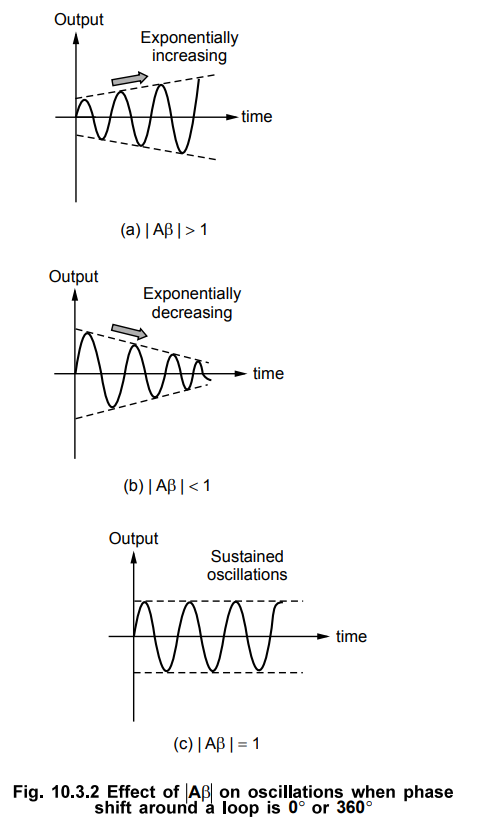
3. Mathematical Derivation of the Criterion
These conditions aren't arbitrary; they arise directly from the mathematics of feedback systems. Your background in electronics and physics means you're well-equipped to appreciate the formal derivation from the system's transfer function.
Let's analyze the standard block diagram for a system with positive feedback.
The output voltage is .
The input to the amplifier is the sum of the external input and the feedback signal: .
The feedback signal is a fraction of the output: .
Substituting these gives:
The overall closed-loop gain, , is the ratio of the output to the input voltage:
An oscillator is defined by its ability to produce an output () with no external input (). For this to be possible, the closed-loop gain must be infinite. This occurs if and only if the denominator of the transfer function is zero:
The term is the loop gain, which is a complex number representing both a magnitude and a phase shift. The equation is a compact way of stating the two Barkhausen conditions:
- The magnitude must be 1: .
- The phase angle must be 0: or .
To see the derivation laid out formally, please review the following resource.
Barkhausen Criterion - Oscillators
This section of the same article provides the step-by-step mathematical derivation we just discussed. It's a good reinforcement of the concept.
Read the subsection 'For positive feedback systems' under 'Derivation of Barkhausen's criteria'. You can skim the negative feedback part, but notice how it leads to the condition Aβ = -1, which is relevant for instability in amplifiers.
4. Practical Considerations and Nuances
The theoretical condition presents a paradox: if the gain is exactly one, how does the oscillation ever start? And how can a real circuit be built to satisfy this condition perfectly?
Starting the Oscillation
In any practical circuit, there is always electronic noise. To ensure oscillation begins, designers intentionally make the loop gain slightly greater than one () at the desired frequency of oscillation. When the circuit is powered on, a component of noise at the oscillation frequency is amplified, and its amplitude grows exponentially with each trip around the loop.
Sustaining the Oscillation
As the signal amplitude grows, it eventually becomes large enough to drive the amplifying element (e.g., a transistor) into its non-linear region of operation (saturation or cutoff). This non-linearity effectively reduces the amplifier's gain. The amplitude of the oscillation stabilizes at the point where the average loop gain over one full cycle is reduced to exactly 1. Thus, a practical oscillator is a non-linear system that uses to start and non-linearity to achieve an average of for sustained oscillation.
Necessary, but Not Sufficient
It's important to understand a key subtlety of the Barkhausen criterion.
Barkhausen stability criterion
The Wikipedia article on the Barkhausen criterion highlights some important limitations and common misunderstandings. This will add rigor to your understanding.
Please read the sections titled 'Criterion' and 'Erroneous version'. Pay close attention to the statement that the criterion is 'necessary but not sufficient'.
As the reading points out, the Barkhausen criterion is a necessary condition for oscillation, but it is not always sufficient. There are some circuits that satisfy the criterion at a certain frequency but fail to oscillate. A more complete analysis requires more advanced tools like the Nyquist stability criterion, which examines the behavior of the loop gain across all frequencies. However, for designing and understanding most common oscillators, the Barkhausen criterion is the essential starting point.
Conclusion
In this lesson, we established the foundational principles of electronic oscillators. Let's summarize the key takeaways:
- Oscillators are autonomous circuits that generate periodic signals using an amplifier and a frequency-selective feedback network.
- Positive feedback is the core mechanism, where a portion of the output is fed back in phase to reinforce the input.
- The Barkhausen Criterion defines the two necessary conditions for sustained, steady-state oscillation at a frequency :
- The loop gain magnitude must be unity: .
- The total loop phase shift must be a multiple of 360°: .
- In practice, oscillations are initiated with a loop gain slightly greater than 1, and the amplitude is stabilized by non-linearities in the amplifier that force the average loop gain back to 1.
We have now built the theoretical framework. In our next lesson, "RC Oscillators: Phase-Shift and Wien Bridge Topologies," we will apply these principles to analyze specific circuits. We'll see exactly how different configurations of resistors and capacitors are used to create the precise phase shift needed to satisfy the Barkhausen criterion and generate a signal at a predictable frequency.