Hello! Welcome back.
In our previous lesson, we established how to achieve exactly-once semantics per partition using an idempotent Kafka producer. This solved the problem of message duplication from producer retries. However, as we noted, its guarantee is limited to a single partition. Many real-world scenarios, especially in the financial and e-commerce domains you're familiar with, require atomicity across multiple operations.
Today's lesson addresses that limitation directly. We will explore Kafka Transactions, which build upon idempotence to provide atomic writes across multiple partitions and topics. This is the final piece of the puzzle for achieving exactly-once semantics (EOS) within Kafka's producer-broker-consumer ecosystem. Our goal is to implement a transactional Kafka producer that can guarantee a set of messages are all successfully written, or none are.
1. From Idempotence to Atomicity
Let's recap the limitation of the idempotent producer with a scenario from your world: an internal FX trade settlement. Imagine a process that needs to record two events atomically:
- Debit EUR from a nostro account (written to
settlements-topic, partition 10). - Credit USD to another nostro account (written to
settlements-topic, partition 25).
With a simple idempotent producer, if the application sends the first message successfully and then crashes before sending the second, the system is left in an inconsistent state—a debit without a corresponding credit.
Kafka Transactions solve this by grouping multiple producer.send() calls into a single, atomic unit. This ensures that for a set of messages, either all of them become visible to consumers, or none of them do, even across different topics and partitions.
2. The Mechanics of a Kafka Transaction
To achieve this atomicity, Kafka introduces a few key components that work in concert. The process is analogous to a two-phase commit (2PC) protocol, which you may be familiar with from distributed databases.
- Transactional ID (
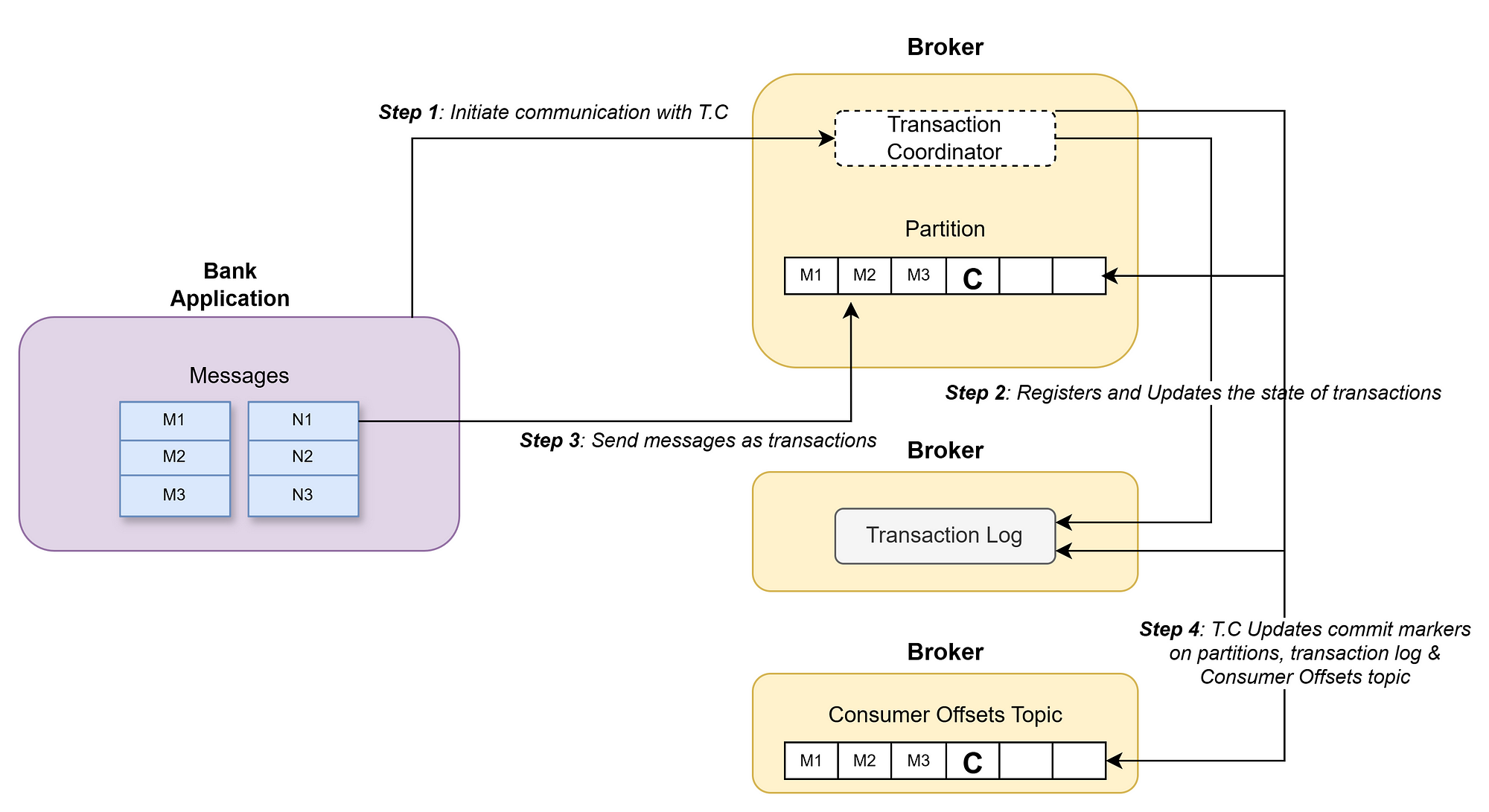
transactional.id): This is the cornerstone. Unlike the ephemeral Producer ID (PID) from the last lesson, thetransactional.idis a stable, unique identifier that you configure for your producer application. It allows the Kafka cluster to identify a specific producer instance across application restarts and fence off "zombie" instances. - Transaction Coordinator: This is a specific broker in the cluster responsible for managing the state of a transaction. The producer finds its coordinator based on the
transactional.id. The coordinator writes the state of the transaction (e.g.,Ongoing,PrepareCommit,CompleteCommit) to an internal topic. - Transaction Log (
__transaction_state): A highly available internal Kafka topic where the coordinator persists the state of all transactions. This log is the source of truth. - Control Messages: When a transaction is committed or aborted, the coordinator writes special
COMMITorABORTmarker messages into the log of every partition involved in that transaction. These markers are invisible to your application but signal to consumers which messages are part of a completed transaction.
The diagram below illustrates how these components interact. The application (producer) communicates with the Transaction Coordinator, which in turn writes to the transaction log and places commit markers on the relevant topic partitions.
3. Implementing a Transactional Producer
Now, let's translate the theory into practice. The producer API for transactions is straightforward, but the underlying error handling and configuration require careful attention.
The core workflow is:
- Initialize: Call
producer.initTransactions(). This registers thetransactional.idwith the coordinator, gets a PID, and fences any older producers with the sametransactional.id. - Begin: Call
producer.beginTransaction(). - Produce: Call
producer.send()for all messages that are part of the transaction. These messages are staged on the broker but are not yet visible to consumers configured withisolation.level="read_committed". - Commit or Abort:
- If all operations succeed, call
producer.commitTransaction(). This begins the two-phase commit process. - If an error occurs, call
producer.abortTransaction(). This instructs the coordinator to discard the staged messages by writingABORTmarkers.
- If all operations succeed, call
The following reading provides a detailed walkthrough of this process, including a robust Java code example that demonstrates proper configuration and, crucially, how to handle different types of exceptions.
Kafka Exactly-Once Semantics Guide
Please read the following sections from the 'Kafka Exactly-Once Semantics Guide'. They cover the transactional flow and provide a comprehensive Java implementation.
First, read the section '2. Kafka Transactions (Atomic Read-Process-Write)' and the 'How it works' list to understand the lifecycle. Then, carefully study the 'Java Transactional Producer Example' code block. Pay close attention to the try-catch structure, which distinguishes between fatal errors (ProducerFencedException) and abortable errors (KafkaException).
Key Implementation Points
Let's break down the most critical aspects from the code you just reviewed.
Producer Configuration:
Two properties are essential:
// Required for transactions
props.put(ProducerConfig.ENABLE_IDEMPOTENCE_CONFIG, "true");
// Must be unique across all running instances of your application
props.put(ProducerConfig.TRANSACTIONAL_ID_CONFIG, "my-fx-settlement-producer-v1");
Setting enable.idempotence is a prerequisite for transactions. The transactional.id must be unique and stable.
Error Handling:
This is the most complex part of a transactional implementation. As the example showed, exceptions are not all equal:
- Fatal Errors (
ProducerFencedException,OutOfOrderSequenceException): These indicate the producer is in an unrecoverable state. The only safe action is to close this producer instance immediately. A new instance can then be created to take over. This "fencing" mechanism is vital for correctness, preventing a "zombie" producer from committing a transaction after a new instance has already started. - Abortable Errors (other
KafkaExceptions): For transient issues like a temporary network blip during a send, you can safely callproducer.abortTransaction()and then retry the entire transaction in a new loop.
The Consumer Side:
For transactions to be meaningful, consumers must be configured to ignore messages from aborted transactions. This is achieved with a single setting:
// Ensures the consumer only reads messages from committed transactions.
consumerProps.put(ConsumerConfig.ISOLATION_LEVEL_CONFIG, "read_committed");
Consumers with the default read_uncommitted setting will see messages before the transaction is complete, defeating the purpose of atomicity.
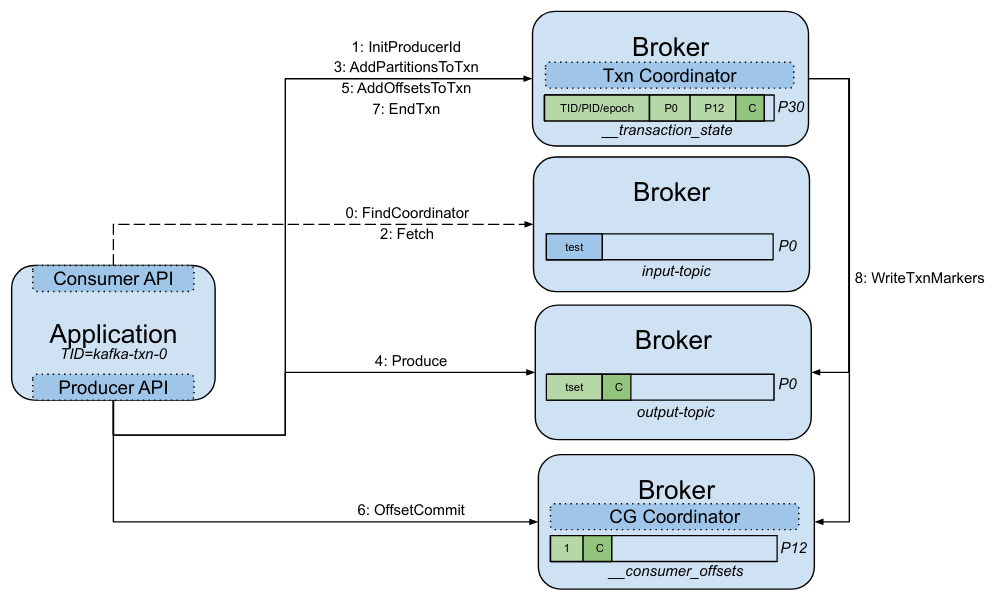
The diagram below visualizes the sequence of API calls and broker interactions.
4. Operational Considerations and Best Practices
Deploying transactional producers in a high-load production environment, like the ones you manage, requires attention to a few operational details.
Kafka Exactly-Once Semantics Guide
To round out your understanding, please read these sections on expert insights and common pitfalls. They address the practical challenges you'd face in production.
Read the 'Expert Insight: Transactional ID Uniqueness' box, followed by the sections 'Best Practices for Using Kafka EOS' and 'Common Pitfalls and How to Avoid Them'. Focus on the advice regarding transactional.id management, transaction timeouts, and handling fencing.
Here is a summary of the most critical operational points:
transactional.idManagement: In a dynamically scaled environment (e.g., Kubernetes), you cannot hardcode thetransactional.id. You need a strategy to assign stable, unique IDs to producer instances. A common pattern is to derive the ID from a stable identifier of the processing task itself, for example,my-app-<partition-number>if each instance processes specific partitions.- Keep Transactions Short: Long-running transactions increase the risk of hitting the
transaction.timeout.mslimit, which defaults to 1 minute. A timed-out transaction is automatically aborted by the coordinator. This can also increase memory pressure on brokers and delay message visibility forread_committedconsumers. - Monitoring is Key: In production, you must monitor metrics related to transactions, such as the rate of aborted transactions, transaction commit latency, and the number of producer fencing events. These are leading indicators of potential problems in your application or cluster.
Conclusion
Today, we completed our journey to exactly-once semantics within Kafka. By building on the foundation of the idempotent producer, we've unlocked atomic writes across multiple partitions.
Key Takeaways:
- Purpose: Kafka Transactions provide atomicity, ensuring a group of messages sent to multiple partitions are either all committed or all aborted.
- Mechanism: This is achieved via a stable
transactional.id, a broker-side Transaction Coordinator, and a two-phase commit protocol that writesCOMMITorABORTmarkers to the log. - Implementation: The producer API involves
initTransactions(),beginTransaction(), andcommit/abortTransaction(). Robust error handling to distinguish fatal (fencing) from abortable errors is non-negotiable. - Consumption: Consumers must be configured with
isolation.level="read_committed"to only see data from successfully completed transactions. - Operations: Careful management of
transactional.iduniqueness and monitoring for timeouts and fencing are critical for production stability.
Preview of the Next Module
We have now covered the most advanced data integrity features within Kafka. Our next module, "Resilience and Failure Handling Patterns," will broaden our scope to patterns that apply across different components of a distributed system. We will start by implementing the Retry pattern with exponential backoff and jitter, a universal technique for handling transient failures when communicating with any remote service.