
Hello! Welcome back to your technical diving course.
In our last lesson, we explored the Meyer-Overton hypothesis, establishing that the narcotic effect of an inert gas is directly proportional to its solubility in lipids. We answered the fundamental question of why gases like nitrogen cause narcosis.
Today, we will build directly on that knowledge. This lesson focuses on the learning outcome: Analyze the narcotic potency of different inert gases relative to nitrogen. We will move from the theoretical "why" to the practical "how much," learning to quantify and compare the narcotic strength of the different gases you might encounter in technical diving. This is a foundational skill for selecting safe breathing mixtures for deep dives.
1. From Theory to a Practical Scale: Relative Narcotic Potency
In the last lesson, we saw that different gases have different narcotic effects. Helium is less narcotic than nitrogen, while argon is more so. To make this comparison useful for dive planning, we need a standardized scale. This is achieved by defining a relative narcotic potency, where all gases are compared to a common baseline: nitrogen.
By convention:
- Nitrogen (N₂) is assigned a narcotic potency of 1.
- Gases that are less narcotic than nitrogen have a potency value less than 1.
- Gases that are more narcotic than nitrogen have a potency value greater than 1.
Let's examine the accepted values for the gases relevant to diving.
Moving in extreme environments: inert gas narcosis and ...
This research paper from the National Center for Biotechnology Information (NCBI) provides a clear, standard table comparing the narcotic strength of various gases. We will use this as our primary reference.
Please find 'Table 2. Relative narcotic strength of a number of gases' within the 'Mechanisms of action of IGN' section. Focus on the 'Relative narcotic potency' column. Note the values for Helium, Hydrogen, Nitrogen, and Argon.
2. Interpreting the Data
Let's pull the key values from that table and discuss their implications for diving:
| Gas | Relative Narcotic Potency | Implication for Divers |
|---|---|---|
| Helium (He) | 0.2 | Significantly less narcotic than nitrogen. This is precisely why it is the preferred gas to dilute oxygen and nitrogen in Trimix for deep dives. |
| Hydrogen (H₂) | 0.6 | Less narcotic than nitrogen, but about three times more narcotic than helium. Used in highly experimental diving (Hydreliox) for extreme depths. |
| Nitrogen (N₂) | 1.0 | Our baseline. The primary cause of narcosis when breathing air or nitrox. |
| Oxygen (O₂) | 1.7 | Surprisingly, oxygen is also narcotic—more so than nitrogen. However, its partial pressure is strictly limited by toxicity, so its narcotic effect is often a secondary concern. |
| Argon (Ar) | 2.3 | More than twice as narcotic as nitrogen. This makes it completely unsuitable as a breathing gas for diving. |
| Xenon (Xe) | 25.6 | Extremely narcotic. It is so potent that it can be used as a general anesthetic at sea-level pressure. |
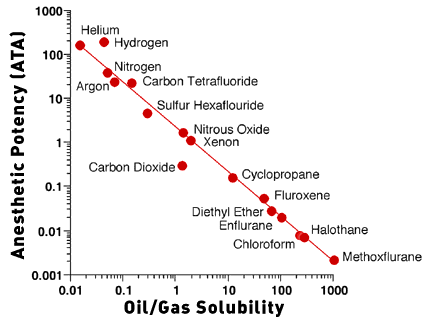
This table is the practical application of the Meyer-Overton hypothesis. The low lipid solubility of helium results in a low narcotic potency, while the higher solubility of argon results in a much higher potency.
This relationship is clearly illustrated in the following graph, which plots anesthetic potency against the oil/gas partition coefficient (a measure of lipid solubility).
A Note on Different Conventions
It's worth noting that you may encounter this information presented differently. Some older or non-standard sources use an inverted scale.
A Practical Discussion of Nitrogen Narcosis for Deep Diving
For example, this practical article from TDI, a major technical diving agency, presents the same concept but with an inverted scale. Being aware of this can prevent confusion.
Read the paragraph starting with 'At any rate...' and examine the 'Table: Relative Narcotic Potencies'. The author explicitly states 'the highest number reflecting the least narcotic effect.' In this table, Helium is listed as 4.26. This is roughly the inverse of the standard value we use (1 / 0.23 ≈ 4.3). This is not a contradiction, just a different convention.
For this course, we will consistently use the standard where Nitrogen = 1 and a higher number means more narcotic.
3. Practical Application: Comparing Gas Mixes
Knowing the relative potencies allows us to compare the narcotic effect of different gas mixes at depth. The total narcotic load is the sum of the partial pressures of each narcotic gas, weighted by its relative potency.
Let's compare breathing air to a typical trimix at 60 meters (7 ATA).
Scenario 1: Air (79% N₂, 21% O₂) at 60 meters
(Note: This is a purely theoretical example for narcosis; breathing air at this depth would result in fatal oxygen toxicity).
- Partial Pressure of Nitrogen (P_N₂):
0.79 * 7 ATA = 5.53 atm - The narcotic load is equivalent to breathing 5.53 atmospheres of pure nitrogen. This would cause severe, debilitating narcosis.
Scenario 2: Trimix 18/45 (18% O₂, 45% He, 37% N₂) at 60 meters
Here, we have two inert gases contributing to narcosis: nitrogen and helium. We account for their different potencies.
- P_N₂:
0.37 * 7 ATA = 2.59 atm - P_He:
0.45 * 7 ATA = 3.15 atm
To find the total narcotic load, we convert helium's effect into an equivalent amount of nitrogen:
- Nitrogen's contribution:
2.59 atm * 1.0 (potency) = 2.59 - Helium's contribution:
3.15 atm * 0.2 (potency) = 0.63
Total Narcotic Load = 2.59 + 0.63 = 3.22
This means the combined narcotic effect of this trimix at 60 meters is equivalent to breathing nitrogen at a partial pressure of 3.22 atm.
This is a massive improvement over the 5.53 atm from air! To put this in perspective, what depth on air would give you a P_N₂ of 3.22 atm?3.22 atm / 0.79 (N₂ in air) = 4.08 ATA, which is a depth of about 31 meters.
This calculation is known as finding the Equivalent Narcotic Depth (END). By diving with Trimix 18/45 at 60 meters, the diver experiences a level of narcosis similar to what they would feel on air at just 31 meters. We will formalize and practice END calculations in a future lesson.
To see how these different gas choices play out in the real world of technical diving, the following video provides a helpful overview.
What Gases Do SCUBA Divers Breathe? From Air To Trimix, Hydreliox & Beyond
This video from the Dive SAGA channel provides context on why divers choose these different gas mixtures, directly linking the choice to managing narcosis.
Watch the sections on Trimix (5:45-6:56) and Heliox (9:27-9:53). Notice how the justification for using helium is its non-narcotic property, allowing for clear thinking at depth.
Conclusion
In this lesson, we have quantified the intoxicating power of different inert gases, a critical step in planning safe deep dives. By understanding and applying these values, a technical diver can intelligently design a breathing gas that keeps their mind clear when it matters most.
Key Takeaways:
- The narcotic potency of gases is measured on a relative scale with nitrogen as the baseline (N₂ = 1).
- Helium (potency ≈ 0.2) is significantly less narcotic than nitrogen, making it the ideal choice for mitigating narcosis in deep diving.
- Gases like Argon (potency ≈ 2.3) are highly narcotic and unsuitable for breathing.
- We can calculate the total narcotic load of a mixed gas by summing the partial pressures of the constituent gases, weighted by their relative narcotic potencies.
- This principle allows us to design gas mixes (like Trimix) that have a manageable level of narcosis even at extreme depths.
Preview of the Next Lesson:
We've established that substituting helium for nitrogen is the primary strategy for managing narcosis. However, in diving, there are no free lunches. While helium solves the narcosis problem, its physical properties introduce a new challenge: heat loss. The next learning outcome is: Evaluate the thermal properties of helium and their physiological consequences for the diver. We will explore why diving with helium-based mixes makes you colder and what strategies are used to manage this risk.
Can't find a good explanation? Sign up and we'll make it for you
Sign up