
Introduction
Welcome to the first lesson of our module on Medieval Western Philosophy. In our last lesson, we concluded our exploration of Mesoamerican thought by comparing Nahua process metaphysics with the inquiries of the Greek Pre-Socratics. You saw how different cultures, worlds apart, grappled with the same fundamental questions about the nature of reality.
We now move forward in history to a period where the legacy of ancient Greek philosophy, particularly that of Plato, was radically transformed. This lesson serves as a crucial bridge between the classical world and the philosophical developments of the Middle Ages. Your learning outcome is to explain the core tenets of Neoplatonism, including Plotinus' concepts of the One, the Intellect, and the Soul.
We will focus on the philosopher Plotinus, the founder of this immensely influential school of thought. You will learn about his metaphysical system, which describes reality as a hierarchical structure flowing from a single, ultimate source. Understanding Neoplatonism is essential, as it provided the philosophical vocabulary and framework for many of the great Christian, Jewish, and Islamic thinkers that followed, including Augustine of Hippo, whom we will study in our next lesson.
1. The Emergence of Neoplatonism
The term "Neoplatonism" is a modern label. The thinkers we call Neoplatonists, starting with Plotinus (c. 204–270 CE), saw themselves simply as faithful interpreters and defenders of Plato's philosophy. However, working nearly 600 years after Plato, Plotinus synthesized Plato's ideas with concepts from Aristotle and the Stoics, creating a unique and comprehensive system. He lived in a period of intense religious and philosophical syncretism in the Roman Empire and established a school in Rome that attracted many followers. His student, Porphyry, compiled his teacher's writings into a collection known as the Enneads.
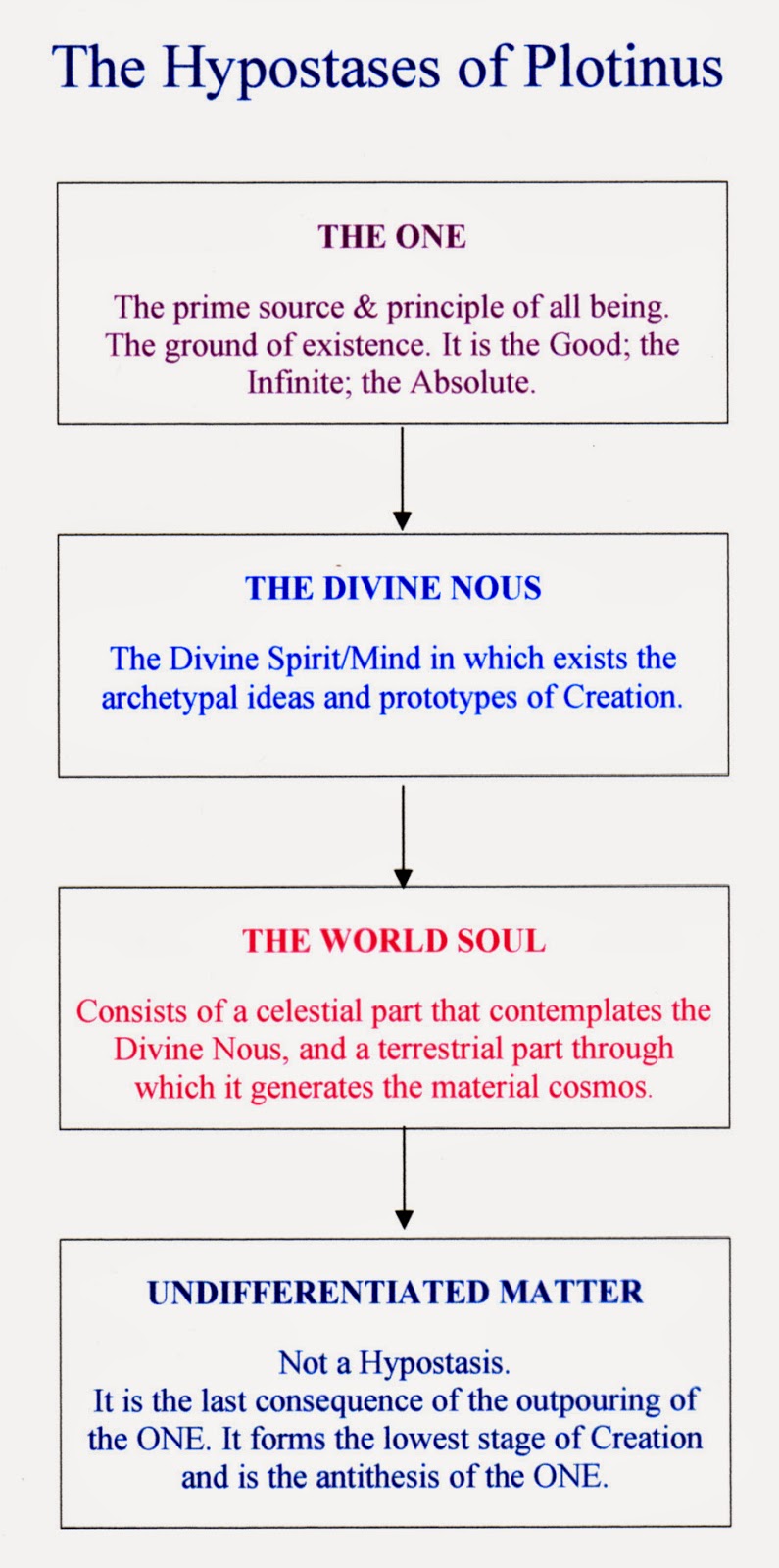
To understand Neoplatonism is to understand its core metaphysical structure, which posits three fundamental principles, or hypostases (singular: hypostasis, meaning underlying reality or substance). These are not three separate gods, but three distinct levels of a single, unified reality. They are, in descending order:
- The One (or The Good)
- The Intellect (Nous)
- The Soul (Psyche)
All of reality is said to "emanate" or flow from the One, like light from the sun or water from a spring. This is not a temporal process that happened at a point in time, but an eternal, logical relationship of dependence. The lower levels are less unified and less "real" than the higher ones, but they are never completely separate from their source.
This hierarchy is beautifully illustrated in the following diagram.
2. The Three Hypostases
To get a clear initial overview of these three principles, we will watch a short video that explains the structure of this system.
The YouTube channel Let's Talk Religion offers a concise summary of Plotinus's three hypostases. This segment will introduce you to the nature of the One, the Intellect, and the Soul, and how they relate to one another through the process of emanation.
Please watch the video from 18:17 to 23:32. As you watch, focus on the distinct characteristics of each of the three levels of reality.
Now that you have a general picture, let's examine each hypostasis in more detail.
Plotinus (Stanford Encyclopedia of Philosophy/Fall 2019 Edition)
For a rigorous, text-based explanation, we will turn to the Stanford Encyclopedia of Philosophy's entry on Plotinus. This reading will provide a deeper analysis of the philosophical arguments behind each of the three principles.
Please read Sections 2, 2.1 ('The One'), 2.2 ('Intellect'), and 2.3 ('Soul'). Focus on understanding the primary function of each principle and why, according to Plotinus, each one is necessary to explain reality.
Drawing on the video and the reading, let's solidify our understanding of these core tenets.
The One (The Good)
The One is the ultimate source of everything, the first principle of reality. However, it is fundamentally different from anything else that exists.
- Absolute Simplicity and Unity: The One is perfectly simple, without parts or division. It is pure unity.
- Transcendence: It is beyond all categories and concepts we use to understand the world. It is beyond Being, beyond thought, and beyond description. You cannot say what it is, only that it is.
- Apophatic Theology: Because the One is beyond all description, we can only talk about it using the via negativa (the negative way). We can only say what it is not: it is not a thing, it is not complex, it is not in time or space.
- Source of All: The One is the cause of all existence, but not through an act of will or creation. Reality emanates from it effortlessly, as a necessary consequence of its own perfection, much like a fire radiates heat without intending to. Plotinus calls this an "overflowing."
The Intellect (Nous)
The Intellect is the first emanation from the One. It is the highest reality that can be truly known.
- The Realm of Being and Forms: The Intellect is where the Platonic Forms reside. It contains the perfect, eternal archetype of every kind of thing that exists in the physical world. It is synonymous with Being itself.
- Cognitive Identity: The Intellect is a divine mind that is eternally thinking. But what does it think about? It thinks about the Forms. Crucially, in the Intellect, the thinker, the act of thinking, and the object of thought (the Forms) are all identical. The Intellect is the Forms.
- Unity-in-Multiplicity: The Intellect is the first stage where multiplicity appears (the many Forms), but it holds this multiplicity in a perfect unity. It "looks back" towards the One to ground its unity and generates the Forms in this act of contemplation.
The Soul (Psyche)
Emanating from the Intellect, the Soul is the third hypostasis. It acts as an intermediary between the intelligible world of the Intellect and the sensible, material world.
- Dual Nature: The Soul has a higher and a lower aspect. The higher part of the Soul remains connected to the Intellect, which it contemplates. The lower part of the Soul "descends" to give life to and govern the material world.
- The Principle of Life and Desire: The Soul animates the physical universe. It is the source of all life, motion, and desire in the cosmos. It creates time and space as it generates the world of nature as a moving image of the eternal archetypes in the Intellect.
- World Soul and Individual Souls: Plotinus speaks of a universal World Soul that animates the entire cosmos, as well as individual souls (like ours) which are parts of it.
3. The Return to the One
Neoplatonism is not just a descriptive cosmology; it is a spiritual path. Just as reality flows out from the One in a process of emanation (or procession), there is a corresponding impulse for all things to return to their source, a movement known as return (epistrophe).
For human beings, this means our life's purpose is to ascend from our focus on the body and the material world back up the ladder of being. The goal is to purify the soul, turning inward through philosophy and contemplation to realize our true home in the Intellect. The ultimate, mystical goal is henosis—a transcendent union with the One itself.
Let's return to the Let's Talk Religion video to explore this practical, participatory dimension of Neoplatonism.
Please watch from 26:39 to 32:00. This section explains the 'journey inward' and the idea of the 'undescended soul'—the part of us that, according to Plotinus, always remains in the intelligible world.
This journey is not a physical one, but an internal, psychological, and spiritual transformation. It involves detaching from bodily desires and turning the soul's attention "upward" (or "inward") to its true, noetic self, which is divine and eternal.
Conclusion
In this lesson, you have been introduced to the foundational metaphysical system of Neoplatonism, which dominated late antique philosophy and provided a powerful intellectual toolkit for thinkers for over a thousand years.
Key Takeaways:
- Plotinus, the founder of Neoplatonism, developed a system based on his interpretation of Plato's philosophy.
- Neoplatonic reality is structured into three hierarchical hypostases: the One, the Intellect (Nous), and the Soul (Psyche).
- The One is the absolutely simple, transcendent source of all, beyond being and description. Everything emanates from it as a necessary overflow of its perfection.
- The Intellect is the realm of true Being, containing the Platonic Forms in a state of cognitive identity.
- The Soul is the dynamic principle that gives life to the material cosmos, creating a moving image of the eternal world of the Intellect.
- Neoplatonism outlines a spiritual path of return (epistrophe), where the individual soul ascends through contemplation to reunite with its divine source.
This framework—with its single, transcendent source, its hierarchy of being, and its emphasis on an inward journey toward the divine—will be profoundly important in our next lesson. We will see how Augustine of Hippo, one of the most significant figures in Western Christianity, took these Neoplatonic ideas and masterfully adapted them to serve and articulate a Christian worldview.
Can't find a good explanation? Sign up and we'll make it for you
Sign up