
Introduction
Welcome to your third lesson in the module on Medieval Western Philosophy. In our last session, we analyzed how Augustine brilliantly synthesized Neoplatonic philosophy with Christian theology. We saw him adapt concepts of God, creation, and knowledge, but we ended by highlighting his adoption of a crucial Neoplatonic idea: that evil is not a substance, but a privation of good.
Today, we will focus entirely on this single, powerful argument, which forms the core of Augustine's theodicy—his defense of God's goodness in the face of evil. Your learning outcome is to reconstruct Augustine's account of evil as privation in Confessions Book VII. This involves more than just stating the conclusion; it means tracing the logical steps Augustine takes to dismantle alternative explanations and build his own case, grounding it in the metaphysics you've already studied. This is one of the most famous and influential arguments in the history of philosophy.
1. Framing the Problem of Evil
Before arriving at his solution, Augustine was deeply troubled by the problem of evil. His nine-year adherence to Manichaeism was driven by its seemingly straightforward, if ultimately unsatisfying, answer: evil is a separate, dark substance at war with a good God.
After rejecting Manichaeism, and now committed to the idea of a single, omnipotent, and perfectly good God who created everything, Augustine faced the problem in its most acute form: If God created everything, and God is good, from where does evil originate?
In Book VII of the Confessions, he meticulously works through the inadequate answers he once considered. Let's follow his thought process.
Augustine, Confessions | Getting Metaphysics of God and Evil Wrong | Philosophy Core Concepts
Dr. Gregory B. Sadler offers a concise analysis of Augustine's early, 'wrong-headed' ways of thinking about evil. This video will show you the intellectual dead ends Augustine had to navigate before finding a solution.
Please watch the segments from 00:51 to 05:55 and from 07:10 to 10:06. As you watch, identify the two major false solutions Augustine considers and why he ultimately rejects them: The idea that evil comes from 'outside' of God's creation. The idea that God created the world out of pre-existing, flawed matter.
As the video explains, Augustine systematically closes the easy escape routes:
- Evil cannot come from "outside" of God, because an omnipotent God who creates everything encompasses all reality. There is no "outside."
- God cannot be an imperfect craftsman working with bad materials (materia), because an omnipotent God would have either created the matter Himself (and thus made it good) or fixed any pre-existing flaws.
With these material and dualistic explanations refuted, Augustine needs a new framework. He finds it in the Neoplatonic metaphysics we discussed in the last lesson.
2. The Neoplatonic Framework: The Hierarchy of Being
Recall from our last lesson the Neoplatonic hierarchy of reality. Plotinus pictured reality as an emanation from "the One," with levels of being decreasing as they move further from the source. Augustine adapts this model. For him, God is not "beyond being" but is Supreme Being (ipsum esse). All of creation constitutes a great chain or hierarchy of being, with everything participating in being—and therefore, in goodness—to varying degrees.
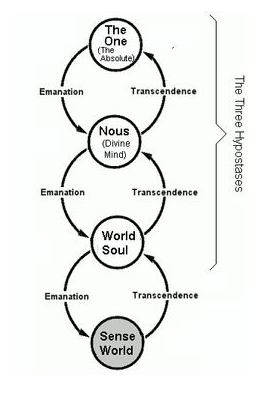
This hierarchical view is the foundation for his solution to the problem of evil. If all being is good, then evil cannot be a being or a substance at all.
Augustine of Hippo, the Confessions bk. 7-9 - Introduction to Philosophy
Let's return to Dr. Sadler's lecture on 'Confessions' Book VII. This section explains how Augustine uses the Neoplatonic framework to establish the fundamental goodness of all existence, setting the stage for his theory of privation.
Watch from 00:13:19 to 00:24:15. Focus on how the idea of a 'scale of being' allows Augustine to argue that everything, 'in so far as it exists... is good.' Note the crucial contrast with the Manichaean view that existence (especially material existence) is bad.
3. Reconstructing the Argument from Confessions
Now we arrive at the core of the lesson. You will read Augustine's own words from Book VII of the Confessions, where he lays out his argument step by step. This is a dense but rewarding piece of philosophical reasoning.
This PDF contains a direct excerpt from Book VII of Augustine's 'Confessions', followed by a clarifying passage from a later work, the 'Enchiridion'. Here you will find the classic formulation of evil as a privation of good.
Read the selection from the 'Confessions' (Chapter XII) very carefully. Then read the selection from the 'Enchiridion' (Chapters III and IV), which reinforces the same idea using the helpful analogy of sickness as a privation of health. As you read, try to trace the logic of his argument.
Having read the primary text, let's reconstruct the argument in a clear, step-by-step format, just as we practiced in our first module.
- Premise 1: All things that exist are good. Why? Because they were made by a supremely good God, who creates only good things. "Whatsoever is, is good."
- Premise 2: Some things are "corruptible." We experience this through decay, sickness, and sin.
- Premise 3: Corruption is harmful, and harm is a diminution of good. A thing cannot be harmed unless it has good to lose.
- Inference 1: Therefore, only good things can be corrupted. If a thing had no good in it at all, there would be nothing to corrupt. "Unless they were good they could not be corrupted."
- Conclusion 1: Evil, which we call "corruption," is therefore not a substance or a thing in itself. It is a privation: a lack or absence of the good that should naturally be there. Augustine gives the analogy of a wound or sickness, which is not a "thing" but the absence of health in the body.
- Thought Experiment: What if a thing were to become totally corrupt? It would be deprived of all good. But since to be is to be good, to be deprived of all good is to be deprived of all being. The thing would simply cease to exist.
- Final Conclusion: Therefore, evil has no independent being. It is necessarily parasitic on the good. Even the Devil, to exist at all, must possess some good (the nature of an angel, created by God), which his evil will has corrupted.
To see this argument explained with further examples, let's watch one more clip.
Augustine of Hippo, the Confessions bk. 7-9 - Introduction to Philosophy
This final clip from Dr. Sadler's lecture directly explains the concept of privation and illustrates it with practical, everyday analogies that make the abstract argument much clearer.
Watch from 00:24:43 to 00:40:16. Pay attention to how Augustine defines evil as a 'lack or privation of being.' Note the examples used, such as corrupted data, a bad cup of coffee, and moral corruption like dishonesty. These help demonstrate that evil isn't a 'thing' but a 'screwed up' version of something that ought to be good.
4. Synthesizing the Theodicy
Augustine's theory of privation is a powerful philosophical solution to the problem of evil. It allows him to uphold God's omnipotence and perfect goodness without denying the reality of suffering and moral evil. Evil is real, but it is real as a defect or wound in a creation that is fundamentally good.
Let's read a short passage from a secondary source that summarizes the key moves in Augustine's argument.
An Exposition of Augustine's Theodicy: From Its Influences to Its Modern Application
The paper 'An Exposition of Augustine’s Theodicy' provides a clear summary of the argument you just reconstructed. This will help solidify your understanding.
Read the sections titled 'Augustine’s most mature thoughts...' and 'Returning to the role of corruptibility...'. Notice how the author breaks down the argument from 'Confessions' VII, 12, emphasizing that beings are good as long as they exist and that evil cannot be a substance for two key reasons.
As the paper highlights, Augustine's account is logically cohesive. If evil were a substance, it would either be:
a) Incorruptible: In which case it would be a "supreme good," and therefore not evil.
b) Corruptible: In which case it must be good to begin with, because only good things can be corrupted.
Either way, the notion of "evil" as an independent substance is logically incoherent within Augustine's framework. The cause of evil, then, is not a substance, but the act of a created will turning away from the higher good (God) toward a lower good. This is moral evil, or sin, which introduces disorder and corruption into God's good creation.
Conclusion
In this lesson, you have delved into one of the most famous arguments in Western philosophy by reconstructing Augustine's account of evil as a privation of good. By carefully following his logic in Confessions Book VII, you have seen how he dismantled alternative views and built a sophisticated theodicy on a Neoplatonic foundation.
Key Takeaways:
- Augustine refutes the Manichaean idea of evil as a substance by arguing that an omnipotent, good God is the source of all being.
- The argument rests on the metaphysical principle that to exist is to be good. All of creation is good, participating in a hierarchy of being.
- Evil is not a substance but a privation—a lack, defect, corruption, or absence of the good that ought to exist in a thing.
- Evil is parasitic on the good. If a thing were to become totally evil (completely deprived of good), it would cease to exist.
- This framework solves the metaphysical problem of what evil is, allowing Augustine to attribute its origin to the misuse of free will by created beings (angels and humans).
In our next lesson, we will turn to another major figure of the early medieval period, Boethius. While in prison awaiting execution, he wrestled with a related problem: If God has perfect foreknowledge and knows what we will do, how can we truly have free will? We will reconstruct his attempt to solve this puzzle in The Consolation of Philosophy.
Can't find a good explanation? Sign up and we'll make it for you
Sign up