Hello! Welcome back.
In our last lesson, we explored the powerful and somewhat paradoxical idea that strategically limiting your own future options can be a source of strength. We used the "burning the bridges" analogy to see how an irreversible move can make your threats or promises credible, thereby influencing your competitors' actions.
Today, we move from the abstract to the concrete. This lesson is designed to help you with one of the most significant decisions you're facing right now: your CNC machine investment. We will analyze this investment not just as an operational purchase, but as a strategic commitment that will influence the behavior of your future competitors.
You'll learn to see this decision through the lens of game theory, treating your choice of machine as the first move in a game with other players in the woodworking market. This will connect the concepts of commitment directly to your goal of establishing a successful premium furniture business.
Your CNC Machine is More Than a Tool—It's a Signal
From a mechanical engineering perspective, a CNC machine is defined by its specifications: axes of motion, spindle speed, work envelope, and precision. These determine its production capability. In game theory, we bundle these capabilities under the term production capacity.
However, capacity in a strategic sense means more than just output volume. It defines your ability to compete in specific market segments. A specialized machine gives you high capacity in a narrow, premium niche, while a general-purpose machine gives you moderate capacity across a wider, more common market.
To understand this better, let's start with a foundational reading on capacity decisions.
Capacity Decisions and Commitment | Game Theory ...
This guide from Fiveable, titled 'Capacity Decisions and Commitment', provides a clear overview of how capacity choices function as strategic tools. It will help you frame your CNC purchase in game-theoretic terms.
Please read the first three main bullet points in the guide (starting from 'Determine production output...' and ending with '...sold-out popular products'). Focus on how capacity isn't just about output, but also about market entry strategies and flexibility.
As the reading highlights, your capacity choice signals your intentions. Let's map this to your specific situation:
- Investing in a large, 5-axis CNC optimized for complex hardwood carving: This gives you a high capacity for producing the unique, premium doors and cabinets you envision. It simultaneously gives you low capacity for mass-producing standard MDF cabinet boxes, as the machine would be inefficient and underutilized for such simple tasks.
- Investing in a standard, 3-axis CNC router: This would give you high capacity for standard cabinet construction but would severely limit your ability to produce the intricate, high-value items that define a premium brand.
Your investment is a public declaration of where you intend to compete. The more specialized and costly the machine, the more credible that declaration becomes.
Turning an Investment into a Credible Commitment
Why is a costly investment so much more credible than a simple announcement? Because it's irreversible. This is the business equivalent of burning your bridges. Once you spend a significant sum on a specialized machine, you can't easily undo that decision or recoup the cost. This locks you into your chosen strategy, which paradoxically gives you power.
Let's explore how this commitment influences other players.
Capacity Decisions and Commitment | Game Theory ...
Now, let's continue with the same guide, focusing on the section that directly links irreversible investment to competitive strategy. This part explains why your 'sunk cost' in a machine is what gives your move its strategic weight.
Please read the section titled 'Role of commitment in capacity'. Pay close attention to how an irreversible investment can serve as a 'credible threat' to deter market entry.
This idea of using capacity to influence competitors is central to your launch strategy. Your CNC investment can shape the competitive landscape in two main ways:
-
Deterring a Direct Competitor: Imagine a local artisan who also wants to serve the premium market but currently works with traditional tools. Your major investment in a high-efficiency, high-precision 5-axis CNC signals that you can produce at a quality and scale they can't easily match. You are credibly threatening to dominate the premium niche. Seeing this, they might decide against competing with you directly and instead focus on a different segment (e.g., one-off art pieces).
-
Accommodating an Indirect Competitor: Now consider a large company that mass-produces and installs mid-range kitchens. Your specialized machine signals that you are not a threat to their core business. You can't compete with them on price for standard cabinets because your equipment is wrong for the job. Recognizing you are focused on a different customer base, they are likely to ignore you, allowing you to establish your niche without provoking a price war or aggressive marketing campaign from a much larger player.
Your single investment decision sends two different signals to two different competitors, shaping their responses to your entry.
Test your understanding!
Suppose you are choosing between two investments:
- A large inventory of exotic hardwood: A significant, but somewhat liquid, investment. You could resell the wood if your plans change, perhaps at a small loss.
- Custom-built software: Software designed specifically to automate the design and toolpath generation for the unique, complex cabinet doors you plan to make. It has no value to any other business.
Which of these two investments is a stronger strategic commitment, and why would it have a greater influence on a potential competitor's decision to enter your niche market?
Show answer
The custom-built software is a much stronger strategic commitment. Its value is almost entirely sunk cost—it's irreversible because it cannot be repurposed or sold. A competitor sees this and understands you are completely dedicated to this specific production style.
The exotic hardwood inventory, while expensive, is a less credible commitment because it's more flexible. The competitor knows you could pivot and sell the wood if you faced tough competition. The software, on the other hand, signals you are locked in and prepared to defend your niche, making entry seem less attractive for the competitor.
Modeling Your Capacity Decision
Game theory provides frameworks to model these strategic interactions. Since your decision to invest happens before your competitors react, this is a sequential game. You are the "leader," and they are the "followers."
One of the classic models for this type of interaction is the Stackelberg model, where a market leader commits to a certain capacity level, and followers then make their decisions in response. We don't need the math behind it, but the concept is powerful.
Applying game theory to strategy practice
To see how this fits into a broader strategic context, let's look at a short piece from the consulting firm Kanvic. It discusses where game theory is applied in business, with 'Capacity Addition' being the very first example.
Please read the introductory paragraphs and the subsection 'Capacity Addition'. This will reinforce how central capacity decisions are to strategic competition.
To visualize this sequential game, we can use a game tree. Imagine you are the "Incumbent" (in this case, the entrant) and a potential local competitor is the "Rival." Your initial choice of CNC machine dictates the game that follows.
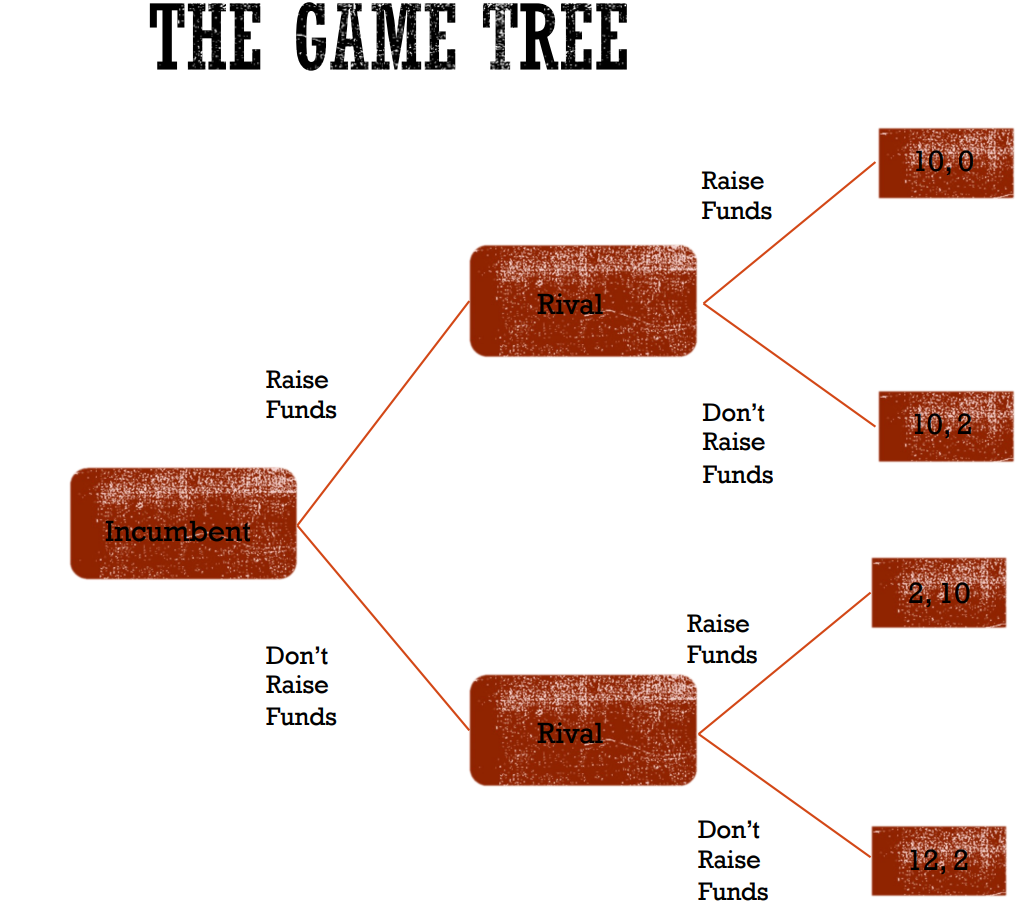
By thinking through the game tree, you are using backward induction, just as we've discussed before. You anticipate the rival's likely response to each of your potential moves and then choose the move that leads to the best outcome for you.
A Practical Framework for Your CNC Decision
Thinking in terms of game theory can feel abstract. Here is a step-by-step framework, adapted from the Kanvic article, to apply these concepts directly to your decision.
Applying game theory to strategy practice
This final reading provides a pragmatic 5-step process for applying game theory to a real-world business decision. This will serve as your action plan.
Please read the section 'Setting up and playing the game'. Focus on understanding the five steps: identify players, get in their heads, build a matrix of options, assess payoffs, and choose the optimum path.
Here's how you can use this framework for your CNC investment:
- Identify the relevant players: List your key potential competitors. Don't just think of other CNC shops. Include high-end custom builders, larger cabinet companies, and even designers who might compete for the same customer budget.
- Get into their heads: For each player, what is their primary motivation? Are they protecting market share? Chasing high margins? What does their current equipment and business model tell you about their likely reactions?
- Build a matrix of options:
- Your options: Invest in a highly specialized 5-axis machine, a flexible 3-axis machine, or perhaps even outsource CNC work initially.
- Their options: For each of your choices, what can they do? Ignore you? Start a price war? Try to copy your style? Launch a marketing campaign targeting your customers?
- Assess the payoffs: For each combination of choices, try to estimate the outcome. You don't need exact numbers. Use qualitative labels like "High Profit Niche," "Destructive Price War," or "Coexistence." What's the best and worst case for you and for them in each scenario?
- Choose the optimum path: Look at the game you've mapped out. If you make a major investment, what is the competitor's most rational response? Does that response lead to an outcome you find attractive? Use this analysis to select the investment strategy that initiates the most favorable game for your business.
This structured analysis transforms your engineering evaluation of a machine into a robust strategic decision.
Conclusion
Today we connected the abstract principle of strategic commitment directly to your tangible decision of purchasing a CNC machine. You've learned to analyze this investment as a game-theoretic move that signals your intentions and shapes the competitive field.
Key Takeaways:
- Your CNC machine choice is a strategic commitment: It's an irreversible investment that defines your production capacity and signals your market position.
- Capacity influences competitor behavior: By committing to a specialized, high-end machine, you can deter direct competitors and encourage indirect ones to accommodate your presence.
- Sequential thinking is crucial: You are making the first move in a game. By anticipating the rational responses of other players, you can choose the investment that leads to the best possible outcome for your business.
- A structured framework helps: You can systematically analyze this decision by identifying players, their motives, your respective options, and the likely payoffs.
Preview of the Next Lesson:
Your choice of machinery and your choice of product are deeply intertwined. Now that we have analyzed the investment in capacity, the logical next step is to analyze what you will do with that capacity. In our next lesson, we will evaluate your product line choice (doors vs. cabinets) based on market gaps and competitive reactions, building directly on the strategic analysis we've done today.