
Hello. In the previous lesson, you built a timeline from the late Zhou through the Han and learned not to treat a named thinker, a text’s earliest material, and its later received edition as the same historical event. We now turn from when these texts emerged to the pressures that made their central questions urgent.
This lesson explains how early Zhou institutions—kinship rule, ritual hierarchy, and the Mandate of Heaven—provided an inherited political vocabulary, and how their breakdown generated competing proposals for order. By the end, you should be able to connect a thinker’s question about virtue, ritual, standards, warfare, or non-action to a concrete feature of the Zhou world without reducing philosophy to mere historical circumstance.
The political inheritance: authority, territory, and Heaven
The Zhou conquered the Shang around 1046 BCE. Their problem was not only military victory; it was legitimation. Why should a new ruling house be obeyed? The Zhou answer became the doctrine of the Mandate of Heaven, tianming 天命. On this account, Heaven had withdrawn its support from the morally corrupt Shang rulers and granted authority to the Zhou.
This did two things at once. It justified conquest, but it also made political authority morally conditional. A ruler could not be justified solely by hereditary succession or superior force. His rule was supposed to display de 德: a difficult word often translated “virtue,” “power,” or “moral charisma.” The link among moral character, public order, and political authority would remain a basic issue for Confucian, Mohist, and later imperial thought.
At the same time, the Zhou king did not govern all territory through a uniform centralized bureaucracy. The early Zhou distributed territories to relatives, allies, and some former Shang elites under a system commonly called fengjian 封建, literally a system of enfeoffment or territorial grants. “Feudalism” is a rough and potentially misleading translation because it imports European institutions that were not identical to Zhou arrangements.
The essential political structure was nevertheless clear:
- The Zhou king stood at the apex and performed major ritual and political functions.
- Regional lords administered their own territories, collected resources, maintained order, and supplied military assistance and tribute.
- Authority was closely tied to kinship, hereditary rank, ancestral rites, and ritual distinctions in dress, sacrifice, and conduct.
- A shared ritual culture expressed a hierarchy that was simultaneously familial, social, and political.
MIT OpenCourseWare’s Lecture 3: The Western Zhou gives a concise visual account of the shift from a powerful Western Zhou kingship to a much weaker Eastern Zhou center.
Watch MIT OpenCourseWare’s “Lecture 3: The Western Zhou” to see how the Zhou political structure weakened over time and why the Mandate of Heaven mattered as more than a religious slogan.
Watch Zhou fragmentation for the move from royal land grants and nominal loyalty to increasingly autonomous regional states. Then watch Mandate of Heaven for the Zhou’s moral justification of replacing the Shang. Notice the distinction between a Zhou king and the later imperial title, which begins only with Qin unification in 221 BCE.
By the late Zhou, this inherited order was both a resource and a problem. It supplied thinkers with ideals—ancestral models, ritual roles, moral rulers, and a normatively ordered cosmos—but it no longer reliably coordinated political life.
From inherited order to philosophical problem
The following short reading supplies the historical bridge between the Zhou’s original political claims and the Warring States environment in which many philosophical texts were compiled.
Social and Political Thought in Chinese Philosophy (Stanford Encyclopedia of Philosophy)
Read the opening historical material from the Stanford Encyclopedia of Philosophy entry “Social and Political Thought in Chinese Philosophy.” It explains both the moral logic of the Mandate of Heaven and the institutional transformation from Zhou regional rule to large, competitive states.
First, in the introductory historical-context passage, read the historical frame. Track the linked changes: weakening Zhou authority, independent states, mass warfare, population, and more complex government. Then read the opening Mandate of Heaven discussion. Focus on moralized Heaven. The important point is not simply that rulers invoked Heaven, but that political success became connected with a claim about the ruler’s moral quality.
The reading helps us avoid two poor interpretations.
First, it would be mistaken to imagine that the Warring States was simply a period of senseless disorder that philosophers tried to end. It was also a period of institutional experimentation, economic expansion, military innovation, writing, travel, and intellectual debate. Its states were not merely failing; many were becoming far more capable.
Second, it would be equally mistaken to say that a political crisis mechanically “caused” a doctrine. Confucius did not deduce ritual ethics from a collapse in royal authority, and the Laozi was not simply an antiwar pamphlet. Historical conditions set problems, supply concepts, and make certain proposals intelligible. Thinkers then disagree, often radically, about what the problem really is.
The breakdown of Zhou authority
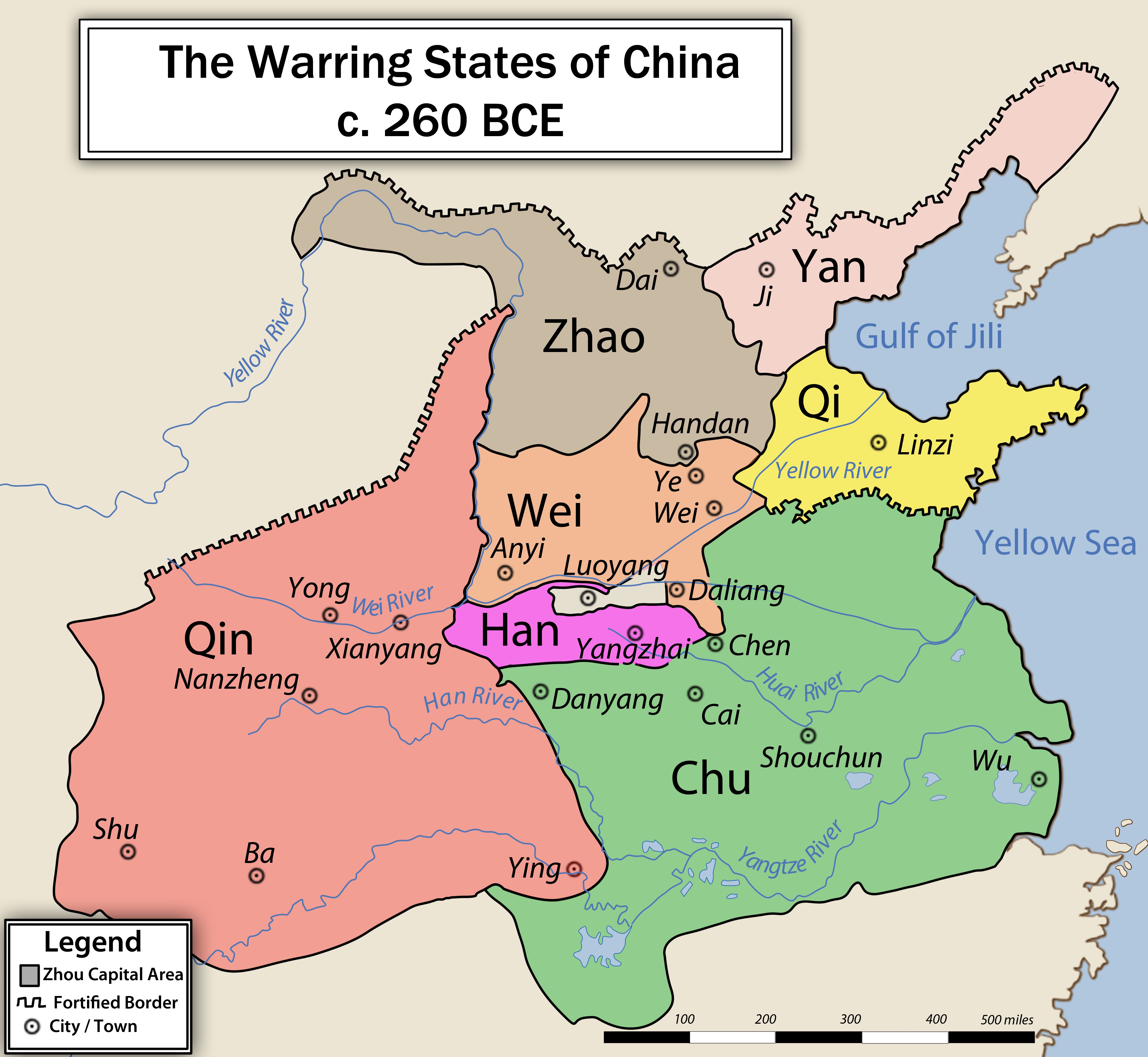
The Western Zhou capital fell in 771 BCE, and the royal court relocated east to Luoyang. This begins the Eastern Zhou. The king still existed, and regional rulers might still formally acknowledge his precedence, but effective power increasingly rested elsewhere.
During the Spring and Autumn period, powerful states could claim the role of hegemon: a leader among regional rulers who ostensibly protected the Zhou order while actually exercising substantial independent power. This arrangement retained the language of an older hierarchy, even as the hierarchy’s political reality weakened.
By the Warring States period, the old restraint had eroded much further. Major states increasingly treated one another as independent powers. They annexed smaller polities, fought extended wars, and built institutions capable of extracting taxes, mobilizing labor, collecting grain, and organizing armies. Aristocratic chariot warfare gradually gave way to much larger forces that depended on conscription, logistics, and administration.
This transition altered the central political question. In an older order, one could ask, “How should a hereditary ruler perform his role?” In the new environment, one also had to ask:
- How can a state coordinate a large population predictably?
- How can it feed and mobilize armies?
- How should offices be assigned and officials assessed?
- Can a ruler rely on personal virtue, or must government rest on impersonal standards?
- What makes a state worthy of allegiance when rival states compete for survival?
- Is expansionary warfare ever justified?
- Does deliberate political intervention cure disorder, or intensify it?
These are not marginal questions in early Chinese philosophy. They organize much of the debate.
Four institutional tensions behind early Chinese debates
1. Moral authority versus brute power
The Mandate of Heaven made authority morally intelligible: good rule was supposed to reflect de, not force alone. Yet the late Zhou world offered an obvious difficulty. Powerful rulers could prevail militarily while behaving badly; worthy people could be ignored, exiled, or defeated.
This tension helps explain why Confucian texts focus so persistently on the moral formation of rulers and officials. The question is not merely, “What traits are admirable?” It is: What could make political authority genuinely legitimate when inherited rank and military success are unreliable signs of moral worth?
Confucian thinkers often answer by shifting attention from Heaven’s dramatic intervention to visible human conduct. A ruler’s legitimacy becomes something displayed in humane treatment of people, correct ritual performance, trustworthy relationships, and an ability to inspire voluntary emulation.
But this answer introduces a further challenge: if virtuous conduct is required, how is it cultivated? That is why learning, ritual, music, family roles, and moral self-correction become political topics rather than merely private ones.
2. Kinship obligations versus larger political communities
The Zhou political order was built substantially through kinship. Political and family relationships therefore seemed structurally similar: both involved hierarchy, obligation, inheritance, and care. Confucian thought did not invent this connection; it philosophically reworked it.
Filiality, xiao 孝, could be extended from reverence toward parents and ancestors into a model for conduct toward social superiors. Ritual roles could provide a grammar for conduct: ruler and minister, parent and child, elder and younger sibling, husband and wife, friend and friend.
Yet the extension was not seamless. A person might face competing obligations to family and ruler. Should someone report a parent’s wrongdoing to public authorities? Does loyalty to a state override loyalty to kin? Can a ruler who fails in his responsibilities still demand obedience?
These tensions explain why early Confucian ethics cannot be reduced to the slogan “obey hierarchy.” Its central concern is also whether persons within a role—especially a ruler—are actually fulfilling the responsibilities that make that role ethically defensible.
3. Ritual formation versus public, uniform standards
Ritual, li 禮, organizes conduct through learned dispositions, patterned interactions, and sensitivity to context. It is not simply a list of regulations. In a ritual-centered view, a good ruler and well-formed people develop shame, restraint, and responsiveness; order is sustained from within.
But rapidly growing states needed coordination at a scale where personal relationships and cultivated sensibility might seem insufficient. This brought increasing attention to public standards, fa 法. The term can mean model, standard, method, or law, depending on context. A standard is attractive because it is explicit and shareable: officials can know what counts as success, and subjects can know the likely consequences of conduct.
The political dispute was therefore not just “morality versus law.” It was a dispute about mechanisms:
| Political problem | Ritual-centered response | Standard-centered response |
|---|---|---|
| People act selfishly or violently | Reform desires and character through education, example, and ritual | Establish clear expectations, rewards, and punishments |
| Officials exercise arbitrary judgment | Form morally capable persons who discern what is fitting | Define offices and assess performance against public criteria |
| A ruler needs allegiance | Win trust through humane conduct and moral charisma | Build reliable incentives, administration, and enforceable order |
| Social roles conflict or become unclear | Restore proper relationships and cultivated judgment | Specify distinct duties and institutional responsibilities |
Later texts will complicate every row of this table. Xunzi, for example, argues that ritual itself supplies standards, while the Han Feizi argues that a ruler cannot safely rely on individual virtue. For now, keep the underlying issue in view: Can political order depend on transformed character, or must it depend on systems that work even when people are unreliable?
4. Care for people versus the demands of state competition
Warring States governments had to sustain agriculture, extract resources, and mobilize people for defense and conquest. This put pressure on any ethical theory of government. A state may claim to serve its people while treating them primarily as taxable laborers and soldiers.
The Guanzi and related political writings often connect a stable state with material provision: people who have adequate food and security are more governable and more likely to display orderly conduct. Mencius later makes material security central to humane government as well, though he rejects reducing moral judgment to calculations of advantage.
Mohist thought pushes the challenge in another direction. If rulers and families pursue only their own partial interests, they produce mutual harm. This helps explain Mohist arguments for impartial concern, public standards, and opposition to offensive warfare. The relevant question is not merely “How do we win?” but “What policies genuinely benefit the world rather than one ruler, clan, or state at everyone else’s expense?”
The writings associated with Shang Yang and Han Fei offer a starkly different answer. In a dangerous competitive environment, they often treat the strength and order of the state as the necessary condition for anyone’s security. They focus on agriculture, military service, clear reward and punishment, and the suppression of private interests that might weaken public authority.
The disagreement concerns both morality and diagnosis. Does disorder arise mainly because people lack humane cultivation? Because they lack a single public standard? Because officials and rulers pursue private advantage? Because elaborate moral and political programs themselves create unnecessary desires and conflict? Each diagnosis yields a different political philosophy.
Why “order” became a contested ideal
Nearly every early Chinese tradition values some form of order, but they disagree over what order is and how it can be produced.
- Confucian traditions often connect order with cultivated relationships, ritual competence, moral exemplarity, and humane government.
- Mohist traditions emphasize shared standards, social benefit, coordinated judgment, and the harms of partiality and aggression.
- Administrative writings later grouped as “Legalist” stress institutional reliability: standards, incentives, official accountability, and the ruler’s capacity to govern without trusting personal virtue.
- The Laozi questions whether conspicuous moralizing, ambition, and intrusive state action may generate the very disorder they claim to remedy. Its ideal of wuwei 無為, often translated “non-action,” does not mean doing nothing; it challenges coercive, overmanaged intervention.
- The Zhuangzi is still more suspicious of confident political prescriptions. It asks whether officials, reformers, and disputants possess the standpoint needed to impose one supposedly final order on a complex world.
- Xunzi accepts the urgency of order but locates its solution in deliberate human cultivation. Ritual channels desire, establishes distinctions, and makes cooperative life possible.
Thus, the Warring States did not produce one shared “solution” called Chinese philosophy. It produced an argument about the sources of social disorder, the proper scope of government, the relation between family and state, the role of moral formation, and the authority of public norms.
A useful reading method for the rest of this course is to identify four elements whenever a text discusses government:
- The institutional setting: What kind of political world does the text assume—kinship hierarchy, rival states, a bureaucracy, an empire?
- The diagnosis: What does the author take to be the source of disorder—bad rulers, unchecked desire, partiality, unclear names, weak institutions, excessive intervention?
- The mechanism: What is supposed to produce order—ritual, exemplary virtue, standards, punishment and reward, material provision, withdrawal, or something else?
- The criterion: What ultimately justifies the proposal—humaneness, benefit, stability, harmony with the Way, Heaven, or preservation of state power?
This framework does not eliminate interpretation, but it prevents isolated sayings from becoming generic wisdom quotations. A line about ritual, law, simplicity, or humaneness acquires sharper meaning once we see the political problem it is trying to solve.
Key takeaways
The Zhou world supplied early Chinese thinkers with an inherited vision of politically meaningful morality: Heaven’s mandate, a ruler’s de, kinship hierarchy, ancestral practice, and ritual order. The weakening of Zhou royal power exposed the fragility of that vision. Regional states became autonomous, warfare expanded, and governments acquired new capacities to mobilize populations and administer territory.
These changes made political philosophy unavoidable. Thinkers asked whether order depends on virtuous rulers, ritual cultivation, material provision, objective standards, institutional incentives, non-coercive rule, or skepticism toward ambitious projects of reform. Their answers differed, but the shared historical setting explains why governance, social roles, war, and the formation of character are so deeply intertwined in early Chinese texts.
Next, we will refine a different but equally essential historical skill: distinguishing an early text from its attributed author, intellectual lineage, and later editorial layers.
Can't find a good explanation? Sign up and we'll make it for you
Sign up