
Hello again. In the previous lesson, you repaired fragments: groups of words that lacked a subject, a main verb, or a complete thought. This lesson addresses the opposite problem. A fused sentence or comma splice contains too much independent-clause material without an appropriate boundary between the ideas.
This matters in every academic subject. For instance, a lab observation, nutrition explanation, or psychology response may contain several related facts. Your task is not to make every sentence short; it is to show readers clearly where one complete thought ends and the next begins. By the end of this lesson, you should be able to identify fused sentences and comma splices and correct them using standard sentence boundaries.
Two complete thoughts, joined incorrectly
An independent clause has a subject and a verb and expresses a complete thought. It can stand alone as a sentence.
The student recorded her meals for three days.
The food record revealed a pattern.
Both lines are independent clauses. They can be kept as two sentences, or they can be combined correctly. Problems occur when a writer pushes them together without a valid connection.
A fused sentence (often called a run-on sentence) joins two independent clauses with no punctuation or connecting word:
The student recorded her meals for three days the food record revealed a pattern.
A comma splice joins two independent clauses with a comma alone:
The student recorded her meals for three days, the food record revealed a pattern.
The second version may look more polished because it has a comma, but it is still incorrect. A comma by itself is not strong enough to separate or connect two complete sentences.
A run-on is not simply a long sentence. A long sentence can be grammatically correct when its clauses are connected properly. Conversely, this short sentence is a fused sentence:
The heart pumps blood it has four chambers.
The key question is structural: Can you find two independent clauses that have been joined incorrectly?
Run-ons and comma splices | Syntax | Khan Academy
Watch “Run-ons and comma splices” from Khan Academy for a compact visual explanation of the two errors and the basic repair choices.
Watch run-on basics to see how two standalone clauses create a fused sentence when no proper boundary appears between them. Then watch comma splices for the distinction between a fused sentence and a comma splice, including repairs with a coordinating conjunction or semicolon. Finish with the recap and state the difference between the two errors in your own words.
First diagnose the clauses
Before editing punctuation, divide the sentence into its possible complete thoughts. Look for a subject paired with a verb, then test whether that group can stand alone.
Consider:
The microscope image was blurry the student adjusted the fine-focus knob.
There are two independent clauses:
- The microscope image was blurry.
- The student adjusted the fine-focus knob.
Because no boundary appears between them, the original is a fused sentence.
Now consider:
The microscope image was blurry, the student adjusted the fine-focus knob.
The same two independent clauses are present. The only change is a comma, so this is a comma splice.
This diagnosis prevents a common mistake: assuming that every comma between verbs creates a comma splice. Compare:
The student adjusted the fine-focus knob and examined the image again.
This has one subject, the student, with two coordinated verbs, adjusted and examined. It is not two independent clauses, so no comma is needed before and.
Likewise:
After the image became clear, the student labeled the tissue.
The opening words are a dependent clause, not an independent clause. The comma is correct because it separates an introductory dependent clause from the main clause. The previous lesson’s fragment work helps here: not every group containing a subject and verb can stand alone.
Four reliable ways to repair the boundary
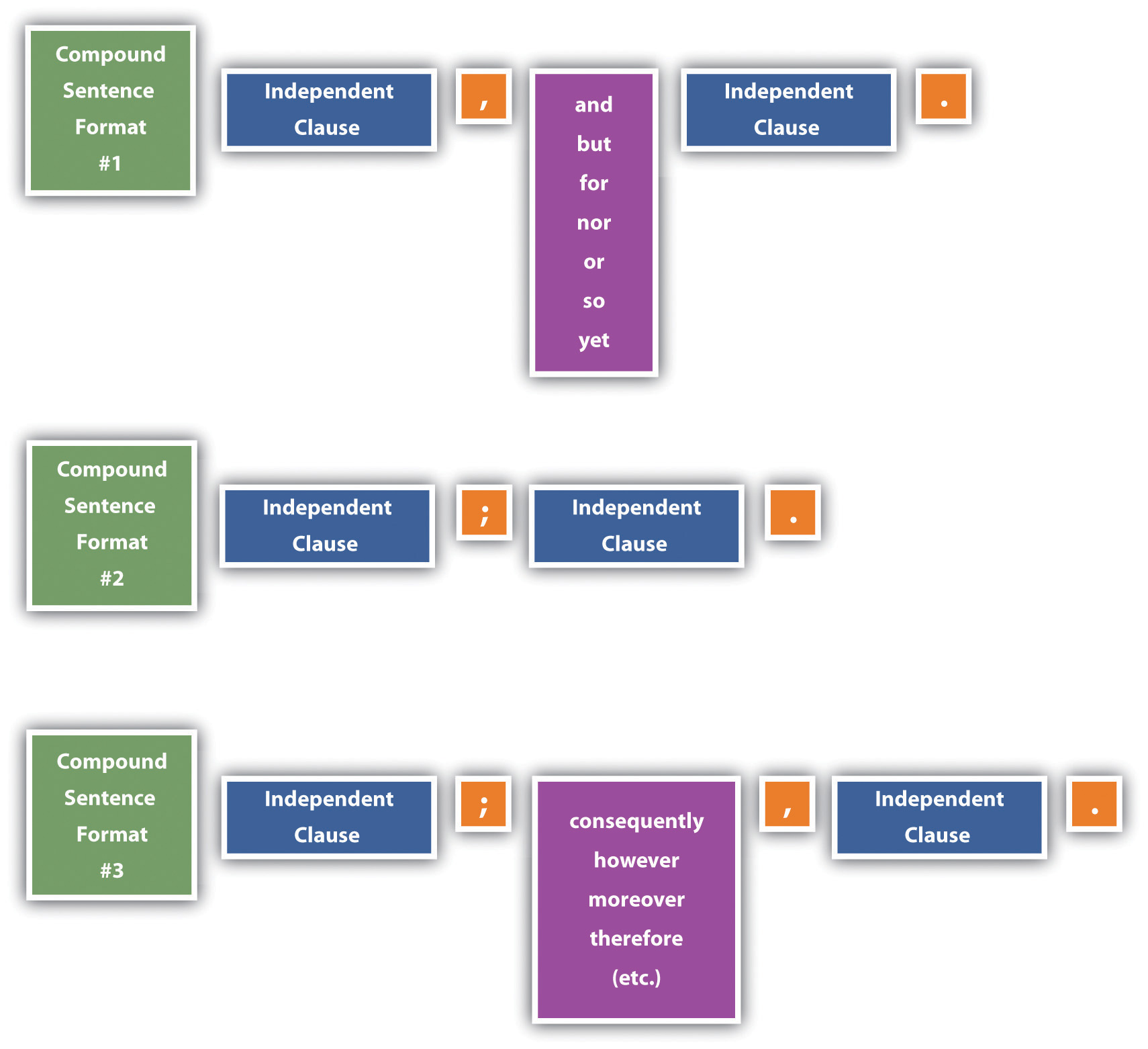
Once you have found two independent clauses, choose a boundary that reflects their relationship. The following methods are standard in academic writing.
1. Make two sentences
A period is often the clearest choice, especially when each idea deserves emphasis or when the relationship between them is simple.
Fused sentence: The patient reported fatigue the clinician ordered blood tests.
Corrected: The patient reported fatigue. The clinician ordered blood tests.
This is not a “less advanced” option. Clear sentence boundaries are often preferable to forcing two thoughts into one long sentence.
2. Use a comma plus a coordinating conjunction
Use a comma followed by a coordinating conjunction when you want to link two equally important independent clauses. The coordinating conjunctions can be remembered as FANBOYS:
| Conjunction | Typical relationship | Example |
|---|---|---|
| for | reason | The student took notes, for the lecture covered unfamiliar terms. |
| and | addition | The student reviewed the chapter, and she completed the practice questions. |
| nor | negative addition | The sample was not contaminated, nor was the equipment damaged. |
| but | contrast | The meal was high in protein, but it was low in fiber. |
| or | alternative | Wear closed-toe shoes, or do not enter the laboratory. |
| yet | unexpected contrast | The procedure was brief, yet it required careful attention. |
| so | result | The data were incomplete, so the researchers repeated the measurement. |
The pattern is:
Independent clause, coordinating conjunction independent clause.
For example:
Comma splice: The meal contained several vegetables, it lacked a whole-grain food.
Corrected: The meal contained several vegetables, but it lacked a whole-grain food.
The conjunction does meaningful work. But signals contrast; so signals a result; and signals addition. Do not add and automatically without considering the relationship.
3. Use a semicolon
A semicolon can join two closely related independent clauses without a coordinating conjunction.
The skeletal system provides support; it also protects several internal organs.
Both sides must be complete sentences. A semicolon is stronger than a comma but usually indicates a closer connection than a period.
Use it when the second clause directly develops, contrasts with, or parallels the first:
The class studied the digestive system first; the nutrition unit built on that knowledge.
Avoid using a semicolon merely to make writing look formal. If the connection between the clauses is weak, use a period instead.
4. Use a semicolon, a conjunctive adverb, and a comma
A conjunctive adverb expresses a logical relationship between two independent clauses. Common examples include however, therefore, consequently, moreover, and instead.
The pattern is:
Independent clause; conjunctive adverb, independent clause.
The volunteer followed the meal plan carefully; however, her energy intake was still too low.
The sample was stored at the required temperature; therefore, it remained suitable for analysis.
A frequent error is treating a conjunctive adverb like a coordinating conjunction:
Incorrect: The volunteer followed the meal plan carefully, however, her energy intake was still too low.
Because however is not a coordinating conjunction, the comma cannot do the job alone. Use a period or semicolon before it:
Correct: The volunteer followed the meal plan carefully. However, her energy intake was still too low.
Correct: The volunteer followed the meal plan carefully; however, her energy intake was still too low.
The choice between those two correct versions depends on how tightly you want the reader to connect the ideas.
Match the boundary to the meaning
Correct grammar is necessary, but good writing also selects punctuation deliberately. Consider this fused sentence:
The participant slept only four hours she had difficulty concentrating during the assessment.
Several corrections are possible:
The participant slept only four hours. She had difficulty concentrating during the assessment.
This version presents two clear observations.
The participant slept only four hours, so she had difficulty concentrating during the assessment.
This version presents the lack of sleep as a cause or likely explanation.
The participant slept only four hours; therefore, she had difficulty concentrating during the assessment.
This version makes the result relationship more explicit and formal.
Be careful not to imply a relationship you cannot support. If the information only shows that two events occurred, and or two separate sentences may be more accurate than so or therefore.
Similarly, a semicolon should connect ideas that genuinely belong together:
Appropriate: The respiratory rate increased; the patient had just completed a brief exercise test.
The second clause gives relevant context for the first.
Less effective: The respiratory rate increased; the library closes at nine.
Both sides are independent clauses, but the ideas are unrelated. Use separate sentences.
A quick editing routine
When you revise a draft, use this routine for each sentence that seems crowded or contains an internal comma.
-
Locate each subject–verb combination.
A sentence with two such combinations may contain two clauses. -
Test each potential clause.
Ask whether it could stand alone as a complete sentence. -
Identify the current boundary.
No punctuation between two independent clauses indicates a fused sentence. A comma alone indicates a comma splice. -
Choose a correction based on the relationship.
Use a period for separation, a comma plus FANBOYS for coordination, a semicolon for a close connection, or a semicolon plus a conjunctive adverb for an explicit logical relationship. -
Read the revised sentence aloud.
Check that the punctuation matches the meaning and that you have not created a fragment.
This guide from the UNC Writing Center provides a useful written reference for both repair choices and diagnosis.
Fragments and Run-ons – The Writing Center
Read the “Fragments and Run-ons” guide from the UNC Writing Center to reinforce how independent clauses create fused sentences and comma splices, and to review correction choices.
In the “Run-ons” section, begin at the sentence defining and repairing run-ons. Notice that the same two-clause error can be repaired in several ways, but that a comma alone creates a comma splice. Then, in the “Finding run-ons” section, read the diagnostic tests and the examples that follow. Use the yes-or-no question test only as a backup check; identifying the two independent clauses directly is usually faster during an exam or draft revision.
Worked revision: from error to polished prose
Read this short health-course passage:
The student compared two breakfast labels, both cereals contained added sugar. The first cereal provided more fiber it also had more sodium. She selected the second cereal; however it had less fiber.
There are three boundary problems.
Sentence 1:
The student compared two breakfast labels, both cereals contained added sugar.
Each side can stand alone:
- The student compared two breakfast labels.
- Both cereals contained added sugar.
The relationship is addition, so a comma plus and works:
The student compared two breakfast labels, and both cereals contained added sugar.
A period would also be correct.
Sentence 2:
The first cereal provided more fiber it also had more sodium.
This is fused. The two facts contrast in a way that requires the reader to weigh a benefit against a drawback:
The first cereal provided more fiber, but it also had more sodium.
Sentence 3:
She selected the second cereal; however it had less fiber.
The semicolon before however is correct, but a comma must follow the conjunctive adverb:
She selected the second cereal; however, it had less fiber.
The revised passage is:
The student compared two breakfast labels, and both cereals contained added sugar. The first cereal provided more fiber, but it also had more sodium. She selected the second cereal; however, it had less fiber.
Notice that the corrections clarify more than punctuation. They show that the two cereals share a feature, that one trade-off exists in the first cereal, and that the final choice has a limitation.
Common mistakes to avoid
A comma is not a universal connector
Incorrect: The lab group cleaned the work area, they disposed of the gloves.
Correct it with a period, a semicolon, or a comma plus an appropriate coordinating conjunction:
The lab group cleaned the work area, and they disposed of the gloves.
Do not place a comma before every and
Incorrect: The lab group cleaned the work area, and disposed of the gloves.
There is only one independent clause because the lab group performs both actions:
Correct: The lab group cleaned the work area and disposed of the gloves.
Do not use a semicolon before a dependent clause
Incorrect: The student drank water regularly; because the weather was hot.
The words because the weather was hot cannot stand alone. Connect it directly to an independent clause:
Correct: The student drank water regularly because the weather was hot.
Remember the comma after an introductory conjunctive adverb
Incorrect: The specimen was improperly labeled; therefore it could not be used.
Correct: The specimen was improperly labeled; therefore, it could not be used.
Key takeaways
A fused sentence joins two independent clauses with no proper boundary. A comma splice joins two independent clauses with a comma alone. Neither error is defined by sentence length; both are defined by how complete thoughts are connected.
When two independent clauses need correction, you can:
- separate them with a period;
- join them with a comma and a coordinating conjunction;
- connect closely related ideas with a semicolon; or
- use a semicolon, conjunctive adverb, and comma to show a logical relationship.
First identify the clauses, then choose punctuation that reflects the meaning. In the next lesson, you will focus on subject–verb agreement, ensuring that each verb correctly matches its subject even in longer, more complicated sentences.
Can't find a good explanation? Sign up and we'll make it for you
Sign up