
Welcome to the first lesson in the Basic Writing: Clear and Correct Sentences module. Clear sentences are the foundation for every later task in college writing: explaining an anatomy process, interpreting a nutrition label, or making a claim in a composition essay.
This lesson focuses on recognizing three categories:
- complete sentences, which communicate a finished idea;
- fragments, which are incomplete; and
- run-on sentences, which improperly crowd together complete ideas.
The immediate goal is diagnosis, not perfection: learn to see what kind of sentence unit you are looking at before trying to revise it.
The basic unit: a complete sentence
A complete sentence contains at least one independent clause. An independent clause can stand alone because it has:
- a subject: who or what the sentence is about;
- a verb or verb phrase: what the subject does, is, has, or experiences; and
- a complete thought: the reader does not need another clause to understand the central point.
Consider this short health-related sentence:
Sleep improves concentration.
The subject is sleep. The verb is improves. The sentence expresses a complete idea, even though it is short.
Now compare it with a longer sentence:
Sleep improves concentration during demanding study periods.
The core structure has not changed: sleep improves. The added words provide detail, but they do not create another complete sentence.
A sentence does not need to be long to be complete. Likewise, a group of words does not become a sentence simply because it begins with a capital letter and ends in a period.
SENTENCES, FRAGMENTS, & RUN-ONS | English Lesson
Watch “SENTENCES, FRAGMENTS, & RUN-ONS | English Lesson” by Kevin Spaans for a concise visual introduction to the three categories.
Watch sentence essentials to review subject, predicate, and complete thought. Continue with fragment examples, noticing that a subject and verb alone may still fail to create a finished idea. Finish with run-on basics, especially the point that a comma by itself cannot correctly join two independent clauses.
Identifying the core
In a longer sentence, locate the core before judging it. For example:
After reviewing the chapter, the student understood the main idea.
The opening words, After reviewing the chapter, add time and context. The main independent clause is:
the student understood the main idea
That portion has a subject (student), a verb (understood), and a finished idea.
Do not mistake “more than one verb” for “more than one sentence.” This is a complete sentence:
The patient rested and drank water.
It has one subject, patient, with two coordinated verbs, rested and drank. Nothing has been improperly joined.
A small exception is worth knowing: commands often have an understood subject, you.
Wash your hands before eating.
Although you is not written, the command is complete: “You wash your hands before eating.”
Fragments: sentences that are not yet complete
A fragment is an incomplete sentence. It may look substantial, but it cannot function as a complete, stand-alone thought in formal academic writing.
Fragments commonly occur in three forms.
| Type of fragment | Example | What is missing? |
|---|---|---|
| Missing subject | “Reviewed the anatomy notes before class.” | Who reviewed them? |
| Missing main verb | “The diagrams in the lab manual.” | What about the diagrams? |
| Incomplete dependent thought | “Because the lab began early.” | What happened because of that? |
The third type is often the hardest to recognize because it can contain both a subject and a verb:
Because the lab began early.
The subject is lab, and the verb is began. But the word because makes the clause dependent: it promises a reason and makes the reader expect the result. The thought feels unfinished.
Compare the fragment with a complete sentence:
Because the lab began early, the students arrived before 8 a.m.
The opening dependent clause now has an independent clause attached to it: the students arrived before 8 a.m.
Common words that can signal a dependent clause include:
- because
- although
- when
- while
- if
- since
- unless
- after
- before
These words do not automatically create fragments. They create fragments only when the dependent clause is left on its own.
When the instructor posted the review guide, the class began studying.
Complete sentence.
When the instructor posted the review guide.
Fragment.
Fragments and Run-ons – The Writing Center
Read “Fragments and Run-ons” from the UNC Writing Center. It reinforces the central distinction in this lesson: an independent clause gives a complete thought, whereas a fragment lacks a necessary part or depends on another clause.
In “The basics,” begin with the explanation that sentences may be short or expanded. Read the sentence examples and identify the core subject and verb beneath the added details. Then read “Sentence fragments.” Start at “A sentence fragment is an incomplete sentence” and read the explanation of fragment types. Continue through the examples beginning with dependent words. Focus on why each clause leaves the reader waiting for more information. Finally, read “Run-ons.” Read the definition and example. Then read the brief correction overview. For now, focus less on memorizing every repair option and more on recognizing that two complete clauses are present.
A useful caution about punctuation
A period does not magically turn words into a sentence.
During the nutrition lecture.
This has a period, but it is still a fragment. It names a time context without saying what happened.
Similarly, a fragment can be long:
Although the participant followed the recommended meal plan for several weeks.
It contains a subject and verb, but although leaves a contrast unfinished. The reader expects something like “Although the participant followed the recommended meal plan for several weeks, her energy level did not improve.”
In college writing, fragments sometimes occur because writers press “period” too soon. When proofreading, pay particular attention to sentences that begin with dependent words or end with phrases such as for example, such as, including, or in order to. These often need to remain connected to a nearby independent clause.
Run-ons: complete sentences joined incorrectly
A run-on sentence is not simply a long sentence. It is an error that occurs when two or more independent clauses are joined without a correct boundary.
There are two common forms:
- A fused sentence has no punctuation between complete clauses.
- A comma splice uses only a comma between complete clauses.
Consider these examples:
The student missed breakfast she felt tired during class.
Fused sentence.
The sentence contains two independent clauses:
- The student missed breakfast.
- She felt tired during class.
They have been pushed together without a proper boundary.
Now look at this version:
The student missed breakfast, she felt tired during class.
Comma splice.
The comma creates a pause, but it cannot by itself join two independent clauses.
The error is structural, not visual. A sentence can look short and still be a run-on. Conversely, a sentence can look long and remain correct:
Although the student missed breakfast, she packed a balanced lunch and drank water throughout the afternoon.
This sentence is long, but it is not a run-on. Its opening clause is dependent, and the rest is one complete independent clause with two coordinated verbs: packed and drank.
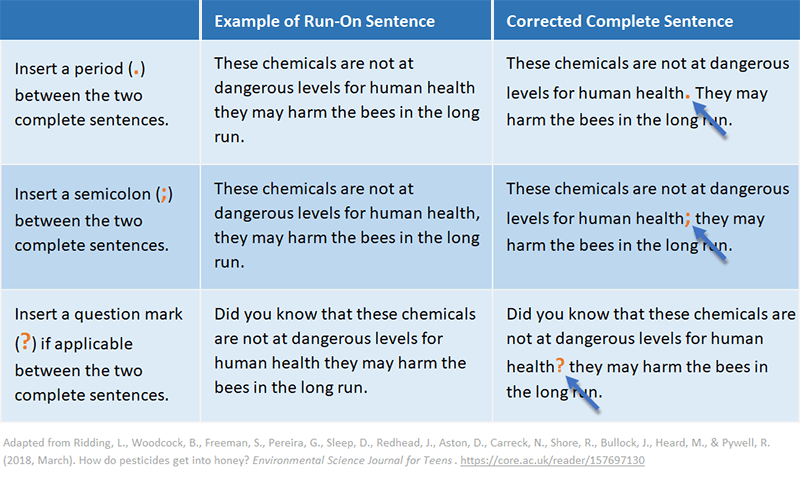
The table previews ways writers can repair run-ons. The important diagnostic point today is simpler: when you find two complete clauses, inspect the connection between them. No punctuation is a fused sentence; a comma alone is a comma splice.
A reliable classification routine
Use this four-step routine whenever a sentence feels questionable.
-
Find the verbs.
Look for actions or states: studied, is, were, will review, has improved. -
Identify the subjects attached to those verbs.
Ask who or what performs the action or is in that state. -
Check for a complete thought.
Does the group of words make sense by itself, or does it leave the reader waiting for an answer? Watch especially for words such as because, although, if, and when. -
Count the independent clauses and examine their boundary.
- No independent clause: likely a fragment.
- One independent clause: a complete sentence.
- Two or more independent clauses without a proper connection: a run-on.
Here are worked examples using that routine:
| Words on the page | Classification | Reason |
|---|---|---|
| “The body needs water.” | Complete sentence | Subject: body; verb: needs; complete idea. |
| “After the long exam.” | Fragment | A time phrase only; no main clause. |
| “The body’s need for water.” | Fragment | A noun phrase; no main verb. |
| “If dehydration becomes severe.” | Fragment | Has a subject and verb, but if creates an unfinished condition. |
| “Dehydration can cause fatigue it can also affect concentration.” | Run-on | Two independent clauses are fused together. |
| “Dehydration can cause fatigue, it can also affect concentration.” | Run-on | Two independent clauses are joined by a comma alone. |
This process is more dependable than judging by sentence length or by “what sounds right.” It also gives you a clear reason for every label, which matters when you begin revising your own paragraphs.
Key takeaways
A complete sentence has an independent clause: a subject, a verb, and a complete thought. A fragment is missing a required element or is a dependent clause left alone. A run-on contains two or more complete clauses that have not been separated or connected correctly.
Remember these contrasts:
- Fragment: too little complete structure.
- Complete sentence: one or more clauses connected correctly.
- Run-on: too much complete structure crowded together incorrectly.
- Length is not the test. Structure is.
In the next lesson, the focus shifts from recognizing fragments to correcting them by adding a missing subject, a verb, or a complete independent clause.
Can't find a good explanation? Sign up and we'll make it for you
Sign up