
The previous lesson established the ownership boundary: commerce owns the cart, order, payment, and fulfillment facts; Talon.One evaluates promotion logic and manages the Talon.One mechanisms you choose to use. That boundary has an operational consequence: if checkout waits for a Talon.One decision, promotion decisioning becomes a synchronous dependency in a customer-facing transaction path.
This lesson examines the risks that creates and the architectural controls that keep a slow, unavailable, or ambiguously completed promotion call from becoming a checkout outage or a financial inconsistency. The goal is not to eliminate synchronous promotion evaluation altogether. Live cart pricing, coupon validation, and eligibility often genuinely need an immediate answer. The goal is to make that dependency bounded, deliberate, and recoverable.
The dependency created by synchronous decisioning
A synchronous interaction means the caller sends a request and waits for a reply before it can complete its own work. In a Talon.One commerce flow, a typical example is:
- the commerce backend builds a current cart/session representation;
- it calls the Integration API;
- Talon.One evaluates rules and returns effects;
- the commerce backend applies the resulting promotion adjustments before responding to the storefront or continuing checkout.
The advantage is immediate, consistent customer feedback: a coupon can be accepted, a discount shown, or a free-item entitlement reflected in the cart. The cost is that the customer-facing flow now depends on the availability and response time of the promotion decision path.
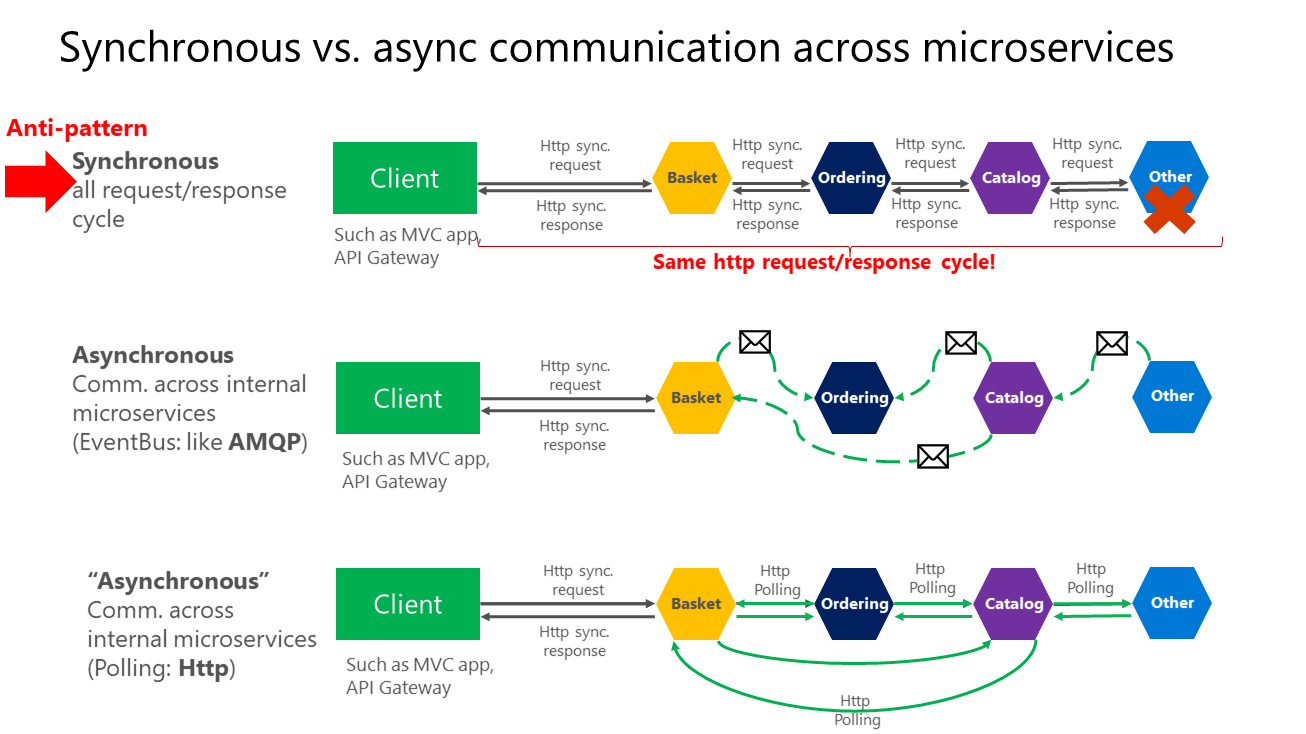
The diagram’s polling row is especially useful as a warning. Repeated HTTP polling is often called “asynchronous,” but each poll remains a synchronous request with its own latency, failure, and capacity cost. Polling does not remove the dependency; it can multiply it.
A sound commerce design therefore distinguishes two categories of work:
| Work that usually needs an immediate answer | Work that should usually be decoupled |
|---|---|
| Cart discount calculation | Analytics and reporting |
| Coupon acceptance or rejection | CRM updates |
| Eligibility messaging | Marketing notifications |
| Final promotion decision at order commitment | Fulfillment processing |
| Customer-visible loyalty redemption result | Noncritical audit enrichment |
The promotion decision itself can be synchronous without making every consequence of that decision synchronous.
Integration API best practices
Read Talon.One’s Integration API best practices as the platform-specific foundation for this lesson. It connects resilience controls to Integration API calls, session integrity, and retry safety.
In Resilience, read the resilience guidance. Focus on the ordering of timeout, retry, circuit breaker, and fallback decisions. Then read Customer sessions and customer profiles > Session integrity, especially the serialization rule. Finally, read Idempotency, including the idempotency details. Note the endpoint-specific nature of idempotency support and the 24-hour retention window.
The main risks in a checkout path
A synchronous Integration API call is not inherently an anti-pattern. The architectural problem arises when it is treated as infallible, unbounded, or independent of the rest of the transaction lifecycle.
1. Tail latency becomes customer latency
A promotion call adds time to the action the shopper is waiting for. Even if its average latency is low, a small number of unusually slow calls can dominate perceived checkout performance.
The relevant budget is not “how long Talon.One is allowed to take” in isolation. It is the remaining budget after the commerce platform has allowed time for its own required work, such as cart validation, tax calculation, payment initiation, and order persistence.
A practical implication follows: a timeout should be shorter than the whole checkout timeout, leaving enough time to choose and execute the fallback path. A request that waits until the browser, gateway, or load balancer times out has already lost control of the customer experience.
2. Availability coupling and cascading failure
If the checkout service waits indefinitely or retries aggressively when promotion decisioning is slow, a Talon.One connectivity problem can consume request threads, connection-pool capacity, and worker processes in the commerce platform. As the waiting requests accumulate, unrelated traffic can become slow as well.
This is a cascading-failure pattern:
- a dependency becomes slow or unreachable;
- commerce requests remain occupied while waiting;
- queues and connection pools fill;
- healthy commerce functions begin to fail due to resource starvation;
- retries add further load precisely when the dependency is already struggling.
A promotion outage should degrade promotional behavior according to policy. It should not make the catalog, cart, or payment experience unusable.
3. Retry amplification
A timeout does not prove that Talon.One did not receive or process the request. It only proves that the caller did not receive a timely response.
If the browser retries, the API gateway retries, the commerce service retries, and the promotion adapter retries, one customer action can produce several requests. This is particularly dangerous for operations that can affect stateful mechanisms, including coupon redemption, campaign budgets, giveaways, referrals, loyalty balances, and profile or session updates.
The general rule is:
Retry in one controlled layer, with a bounded policy. Do not let every layer independently retry the same operation.
Retries are appropriate for genuinely transient conditions such as connection interruption, timeout, or selected server errors. They are not a remedy for invalid requests, authorization failures, or a concurrency conflict caused by your own application sending simultaneous updates.
4. Ambiguous completion and duplicate commercial outcomes
Consider a shopper who selects Place order. The commerce service sends the final customer-session update to Talon.One. Talon.One processes it, but the response is lost on the network path.
At this point, the commerce service cannot safely infer either of these statements:
- “The request failed, so no promotion state changed.”
- “The request succeeded, so the order is finalized.”
The first may lead to duplicate processing on retry. The second may lead to an order record claiming a promotion outcome that the commerce service never actually applied.
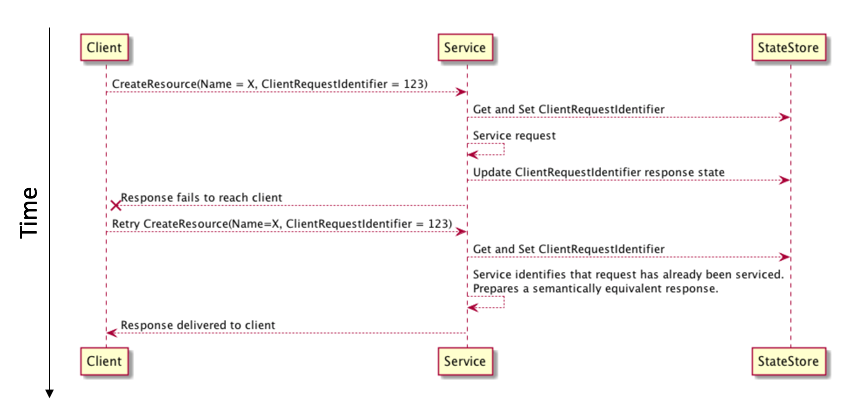
The same principle applies to an Integration API operation where idempotency is supported:
- Create and persist an idempotency key before the outbound request.
- Use that same key only for retries of the same logical operation and payload.
- Reuse the key if the response is lost or the request times out.
- Use a new key for a genuinely new cart revision, event occurrence, or session transition.
- Record the response and the commerce-side application outcome with the order or cart revision.
Talon.One documents that idempotent-response records expire after 24 hours. This means idempotency is a valuable recovery control, not a substitute for durable commerce-side order records and later reconciliation.
Also, idempotency of the API request does not automatically make your whole business flow exactly-once. Your own effect-processing logic must avoid applying the same returned discount, free item, or custom action more than once to an order.
5. Concurrent updates and session integrity failures
Cart activity is often naturally concurrent:
- the shopper changes quantity in two browser tabs;
- a coupon submission arrives while a cart update is in flight;
- an autosave action races with an explicit checkout action;
- an event is tracked in parallel with a profile update;
- mobile and web clients act on the same authenticated customer.
Talon.One protects data integrity by limiting concurrent Integration API updates for a customer profile or session. Its documented limit is not an invitation to use three parallel requests as normal throughput. It is a guardrail. Requests are queued sequentially only within a small limit; excess activity can receive a 409 Too many requests are updating this profile/session at the same time response.
Integration tutorial | Talon.One docs
Read these two parts of the Talon.One integration tutorial to connect the abstract concurrency and latency risks to specific Integration API behavior.
In Manage parallel requests, begin with the paragraph that starts “For data integrity purposes” and read the entire subsection. Pay particular attention to the request limit, the listed endpoints, and the example involving profile, session, and event updates. Then read Performance tips in full. Focus on the use of responseContent to avoid a follow-up read, and on the distinction between a dry request and a state-changing request.
The right design control is a backend serialization policy, not a hope that users will behave sequentially:
- Serialize updates for the same logical customer session.
- Consider profile-level serialization too when profile updates and session updates concern the same customer.
- Debounce and coalesce rapid cart edits before calling Talon.One.
- Treat one customer action as one event occurrence; do not emit several equivalent events in parallel.
- Apply a cart revision or version check before applying returned effects to the cart currently shown to the shopper.
- Handle
409as a controlled sequencing problem, not as an error to retry immediately and repeatedly.
6. Stale decisions applied to a newer cart
Every set of returned effects is a decision about the context sent in that particular request. If the submitted cart contained one jacket at USD 120.00, the response must not be blindly applied after the shopper has changed the quantity, selected another shipping method, or replaced the product.
This risk is easy to miss because the API response can be valid while still being invalid for the current commerce state.
A promotion adapter should associate each decision with:
- the commerce cart ID and revision;
- the Talon.One customer-session ID;
- the relevant customer-profile identity;
- the request correlation ID;
- the request idempotency key, when used;
- the submitted promotion-relevant cart snapshot or a secure hash; and
- the resulting effects that commerce actually applied.
Before applying the response, verify that the cart revision is still current. If it is not, discard that response for presentation and evaluate the current cart state instead.
7. Commitment mismatch around payment
The Talon.One guidance is to close the session at checkout, immediately before the shopper proceeds to payment. Closing can commit promotion-side outcomes such as coupon redemption, budget impact, or loyalty changes.
Payment success is still an external business fact, owned by the payment and order workflow. Therefore, a payment failure after session closure creates a temporary mismatch: promotion state may have been committed while the commercial transaction did not complete.
The architectural risk is not solved by extending the synchronous wait. It is solved by defining the compensating lifecycle behavior:
- the payment or OMS flow is authoritative for the failed transaction;
- it sends the appropriate session cancellation or reopening update;
- Talon.One returns promotion-side rollback outcomes;
- commerce reconciles those outcomes with customer-facing cart and order records.
This is one reason that “promotion decisioning completed” must never be treated as equivalent to “order paid and fulfilled.”
A risk register for design reviews
The following table is useful when reviewing a Talon.One checkout integration.
| Risk | Typical symptom | Unsafe response | Architectural control |
|---|---|---|---|
| Slow promotion evaluation | Cart or checkout spinner persists | Wait until the outer request times out | Tight, explicit timeout inside the promotion adapter |
| Dependency outage | Checkout errors rise with promotion errors | Keep calling the unavailable dependency | Circuit breaker and a defined fallback |
| Retry storm | Traffic spikes during partial outage | Retries at browser, gateway, and service layers | One retry owner, bounded exponential backoff, and jitter |
| Lost API response | Caller cannot determine whether the request completed | Retry with a new request identity | Reuse the idempotency key for the same logical operation where supported |
| Parallel updates | 409 responses or inconsistent cart display | Immediate retries from each client | Serialize and coalesce requests per profile/session |
| Stale effects | Discount applies to changed cart contents | Apply effects without checking cart version | Bind response to cart revision and validate before application |
| Extra read after update | Longer latency or stale state | Issue immediate read calls to verify a write | Use the write response and responseContent; avoid immediate reads |
| State committed before payment outcome | Coupon or budget state does not match an unpaid order | Assume Talon.One can infer payment failure | Send explicit cancellation or reopening lifecycle updates |
Design the synchronous boundary deliberately
The most resilient architecture keeps the synchronous path narrow:
- The storefront calls the commerce backend, never Talon.One directly.
- The commerce backend or a dedicated promotion adapter constructs the authoritative promotion-relevant context.
- The adapter calls Talon.One with a strict deadline, correlation data, and a controlled retry policy.
- The adapter returns normalized promotion outcomes to commerce.
- Commerce applies the outcomes only to the matching cart revision and persists the final applied adjustment at order commitment.
- Post-order actions are distributed through durable internal events or workflows rather than extending the shopper’s request path.
The adapter is important because it centralizes controls that otherwise become inconsistent across web, mobile, POS, and call-center channels:
- timeout values;
- circuit-breaker state;
- idempotency-key generation and persistence;
- request serialization;
- Talon.One effect interpretation;
- cart-revision validation;
- observability and correlation IDs; and
- fallback-policy enforcement.
The adapter should not become a second promotion engine. It should not recreate Talon.One campaign conditions in code. Its role is to make Talon.One’s decisioning service safe to consume.
Circuit breaker and bulkhead boundaries
A circuit breaker stops calls after a defined pattern of failure and allows occasional recovery probes after a cooldown. It prevents a known-bad dependency from consuming checkout capacity.
A bulkhead protects the rest of the commerce platform from promotion-related resource exhaustion. For example, the promotion adapter can have bounded connection pools, request queues, and worker capacity separate from order persistence and payment processing. If promotion traffic becomes slow, it should not consume every thread needed to accept orders or process payments.
Neither pattern changes the business decision. They preserve the system’s ability to follow the decision policy you defined.
Fallback is a commercial policy, not merely an error handler
“Fail open” does not simply mean “continue processing.” It means choosing what a customer is allowed to receive when current promotion decisioning is unavailable. That choice has financial, legal, and customer-experience consequences.
Define fallback behavior by promotion type and transaction stage.
| Situation | Possible fallback | Key constraint |
|---|---|---|
| Browsing or cart display | Suppress dynamic offer messaging and show normal prices | Do not claim an offer that cannot be verified |
| Standard promotion with an approved safe default | Apply a governed generic discount | Limit scope, value, and audit it as a fallback decision |
| Coupon validation unavailable | Allow purchase without applying the unverified coupon, or provide a recovery path | Do not mark a coupon accepted without a valid decision |
| Loyalty redemption unavailable | Defer redemption or require a later retry | Avoid spending points based on stale balance data |
| Scarce campaign budget, giveaway, or limited inventory reward | Do not use a stale cached entitlement | A cache cannot safely prove availability of scarce state |
| Talon.One circuit open | Skip calls until controlled recovery probes succeed | Do not continue sending traffic that the breaker is intended to protect against |
Cached decisions deserve special caution. A cache may be acceptable for a narrow, explicitly approved case, but only when its key includes the relevant cart revision, customer identity or eligibility scope, market, currency, promotion-code context, and validity period. It is usually unsuitable for stateful mechanisms such as unique coupons, budgets, giveaways, and loyalty redemptions.
Dry requests are useful for testing or previewing rule results without persisting Application changes. They are not a substitute for a production checkout decision because they do not commit the state changes associated with the final transaction, and Talon.One notes that dry requests do not support idempotency.
Latency controls that also improve correctness
Performance work here is not only about shaving milliseconds. Fewer calls mean fewer failure points and fewer opportunities to observe stale state.
When using the Integration API:
- Request the related information needed for the immediate decision with
responseContent, rather than issuing a separate read call. - Do not immediately read after a profile, session, or event write merely to verify it. Talon.One warns that some reads can use replicas that have not yet reflected the write.
- Use the Integration API write response as the decision result for that operation.
- Keep the request payload focused on fields used by promotion logic; large, unnecessary payloads add processing and privacy cost.
- Measure latency separately for the commerce adapter, network transport, Talon.One call, effect application, and total customer-visible action.
This is also where correlation matters. A single identifier should connect the storefront action, commerce cart revision, promotion request, Talon.One response, order record, and any later cancellation or return workflow. Without that trace, a timeout can become an expensive customer-service investigation.
Sandbox architecture activity
Use your sandbox and an existing campaign to produce a short synchronous-decisioning resilience sheet for one checkout journey. Keep it to one page, but make the operational choices explicit.
Include:
- the customer-visible action that requires a Talon.One response;
- the cart or session revision identifier used to prevent stale-effect application;
- the deadline for the Integration API call and the remaining checkout budget after timeout;
- the one component responsible for retries;
- the retryable failure classes and the maximum retry count;
- the idempotency-key lifecycle for a final session update;
- the serialization key for same-customer or same-session updates;
- the circuit-breaker trigger and recovery probe behavior;
- the fallback behavior for a normal discount, coupon, and loyalty redemption; and
- the explicit follow-up action if Talon.One promotion state is committed but payment later fails.
For a sandbox-only test, send multiple simultaneous updates against the same session only if you can safely observe the result. Use the outcome to validate that your integration would serialize and coalesce these requests in production rather than relying on the platform’s 409 guardrail.
Key takeaways
Synchronous promotion decisioning introduces a real but manageable dependency into a transaction flow.
- It adds latency and availability coupling to cart and checkout actions.
- Timeouts create ambiguous outcomes: a missing response does not establish that the request did not complete.
- Blind retries can amplify an outage or duplicate state-changing work; use bounded retries, backoff, jitter, and endpoint-supported idempotency.
- Parallel updates to the same profile or session create integrity risks and can receive
409responses. Serialize and coalesce them in your backend. - Effects apply only to the cart context that produced them. Bind decisions to a cart revision before applying them.
- Circuit breakers and bulkheads protect checkout capacity, but their value depends on a defined commercial fallback policy.
- A promotion decision and a paid order are separate facts. Payment failure, cancellation, and return workflows must explicitly reconcile Talon.One promotion state.
The next module moves from transaction-flow risk to the platform’s structural model: accounts, Applications, campaigns, rules, profiles, and sessions, and the architectural role each entity plays in a Talon.One implementation.
Can't find a good explanation? Sign up and we'll make it for you
Sign up