
Hello again. In the previous lesson, you compared two integers by using the number-line rule: values farther right are greater, and values farther left are less. Ordering is the same idea applied to a whole collection of integers.
By the end of this lesson, you will be able to arrange integers in ascending order (least to greatest) and descending order (greatest to least), whether or not you draw a number line. This is the final skill in this module; it brings together positive numbers, negative numbers, zero, absolute value, and comparison.
Two directions for ordering
A number line gives the meaning of both types of order:
- Ascending order means from the least value to the greatest value.
- Descending order means from the greatest value to the least value.

For example, consider the integers
In ascending order, begin with the value farthest left:
You can also show ascending order with inequality signs:
For descending order, use the same values in the opposite direction:
Or:
The words in the question tell you which direction to read:
| If the question says... | Start with... | Move on the number line... |
|---|---|---|
| ascending, least to greatest, smallest to largest | the least integer | left to right |
| descending, greatest to least, largest to smallest | the greatest integer | right to left |
Ordering Integers | Positive & Negative Numbers | Math with Mr. J
Watch “Ordering Integers | Positive & Negative Numbers” by Math with Mr. J. It models both ordering directions on a number line before you try the method yourself.
First watch the main rule: numbers increase to the right and decrease to the left. Then watch ascending order, noticing how he reads the plotted points from left to right. Finish with descending order, where the same number-line idea is read from right to left.
A dependable method for a mixed set of integers
You do not always need to draw a number line, but you should be able to picture one. For a mixed group of positive and negative integers, organize the numbers into three groups:
- Negative integers
- Zero, if it appears
- Positive integers
All negative integers are less than zero, and zero is less than all positive integers. So, in ascending order, the negatives must come first; in descending order, the positives must come first.
The part requiring the most care is sorting the negatives.
Sorting negative integers
For negative integers:
- The number farther from zero is smaller.
- The number closer to zero is greater.
For instance:
Although is greater than , negative twelve lies farther left on the number line, so it is the smaller integer.
Here is a useful pattern:
| Negative integers | Ascending order | Descending order |
|---|---|---|
For ascending order among negatives, begin with the negative having the greatest absolute value. For descending order among negatives, begin with the negative closest to zero.
Worked example: ascending order
Arrange the following integers from least to greatest:
First, separate the values mentally:
- Negatives:
- Zero:
- Positives:
Next, sort the negatives. The farthest left is , followed by , then .
Finally, place zero after the negatives and sort the positives normally:
A quick check is to read the list from left to right as a chain:
Every comparison is true, so the ordering is correct.
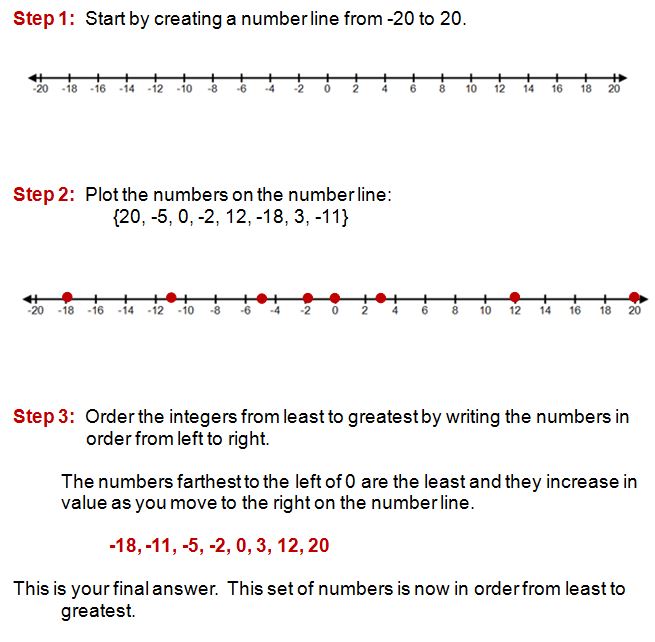
The diagram shows an important habit: when a number line is available, plot each number and simply read the points in the direction requested. For ascending order, read left to right.
Comparing and Ordering Integers | Definition, Examples, What? & How?
Read the “Comparing and Ordering Integers” explanation from Helping with Math for two complete worked examples: one ascending and one descending.
In the section “Ordering of Integers,” read the subsection “Ascending order of integers,” beginning with the definition and first illustration. Then follow the worked example beginning “Arrange the following numbers in ascending order” through its final ordered list. Next, read the subsection “Descending order of integers,” starting with the descending definition and illustration, and follow its example. Notice that the direction changes, but the number-line rule does not.
Worked example: descending order
Now arrange this set from greatest to least:
Because this is descending order, start with the greatest values. The positive integers come first, arranged from greatest to least:
Next comes zero:
The negative integers come last. Among negatives, the one closest to zero is greatest, so comes before :
Check the direction with inequality signs:
Notice that descending order is not “put all the numbers backward” without thinking. It means each new number must be less than or equal to the previous one.
Ordering integers in context
Ordering tells a story when integers represent real quantities.
Suppose these are morning temperatures in degrees:
From coldest to warmest, the temperatures are in ascending order:
From warmest to coldest, they are in descending order:
The negative temperatures are not ordered by their digits alone. A temperature of degrees is colder, and therefore smaller, than degrees.
The same reasoning works with elevations. For example, elevations of meters, meters, meters, and meters are ordered from lowest to highest as:
Avoid these common mistakes
Ordering negatives as though they were positive
This is incorrect:
as an ascending list, because is actually the greatest of the three. The correct ascending order is:
Forgetting that zero has a position
Zero is neither positive nor negative, but it belongs between them:
Do not leave it out or place it before a negative integer in ascending order.
Using absolute value as the final order
Absolute value measures distance from zero, not whether a number is greater. For example:
and
But that does not mean is greater than . In fact:
Absolute value is only a helpful shortcut when comparing two negative integers.
Dropping a repeated integer
If a list has the same integer more than once, include every occurrence. For example, ordering
in ascending order gives:
A final checking routine
After ordering a set, use these three checks:
- Count: Did every integer from the original list appear once in your answer?
- Direction: Does each number get greater in ascending order, or smaller in descending order?
- Negatives: Did you remember that among negatives, values closer to zero are greater?
For instance, if an ascending list ends
the order is wrong, because is less than . They should appear as:
Key takeaways
- Ascending order means least to greatest: read a number line from left to right.
- Descending order means greatest to least: read a number line from right to left.
- In ascending order, negative integers come first, then zero, then positive integers.
- Among negative integers, the one farther left is smaller:
- Check your result by reading adjacent numbers with for ascending order or for descending order.
Next, you will begin calculating with integers by adding two integers with the same sign.
Can't find a good explanation? Sign up and we'll make it for you
Sign up