
Welcome. This course begins where early Daoist thought began: not in a quiet mountain retreat, but amid political fracture, military mobilization, ambitious rulers, and ordinary people living with the consequences.
Over this first module, we will locate Daoism within that world, contrast it briefly with its major rivals, and then meet its two foundational texts. Today’s question is historical but already practical: when the usual political and social arrangements seem to be failing, what new ways of living become imaginable?
A note on spelling: Daoism and Taoism refer to the same tradition. “Dao” reflects the modern pinyin system of romanization; “Tao” is an older spelling you will still see often.
A broken center, many competing states
The Eastern Zhou dynasty lasted from about 770 to 256 BCE. Its king still carried prestige as a ritual and hereditary figure, but increasingly lacked the military power to command the regional lords. Over time, those lords became independent rulers in practice.
The broad chronological orientation is:
- Eastern Zhou: about 770–256 BCE
- Spring and Autumn period: roughly the eighth through fifth centuries BCE
- Warring States period: conventionally 475–221 BCE
- Qin unification: 221 BCE
These labels were developed later, and the boundaries between periods were not neat. What matters is the long transformation: a formerly shared political order lost its authority, while regional powers became larger, more organized, and more competitive.
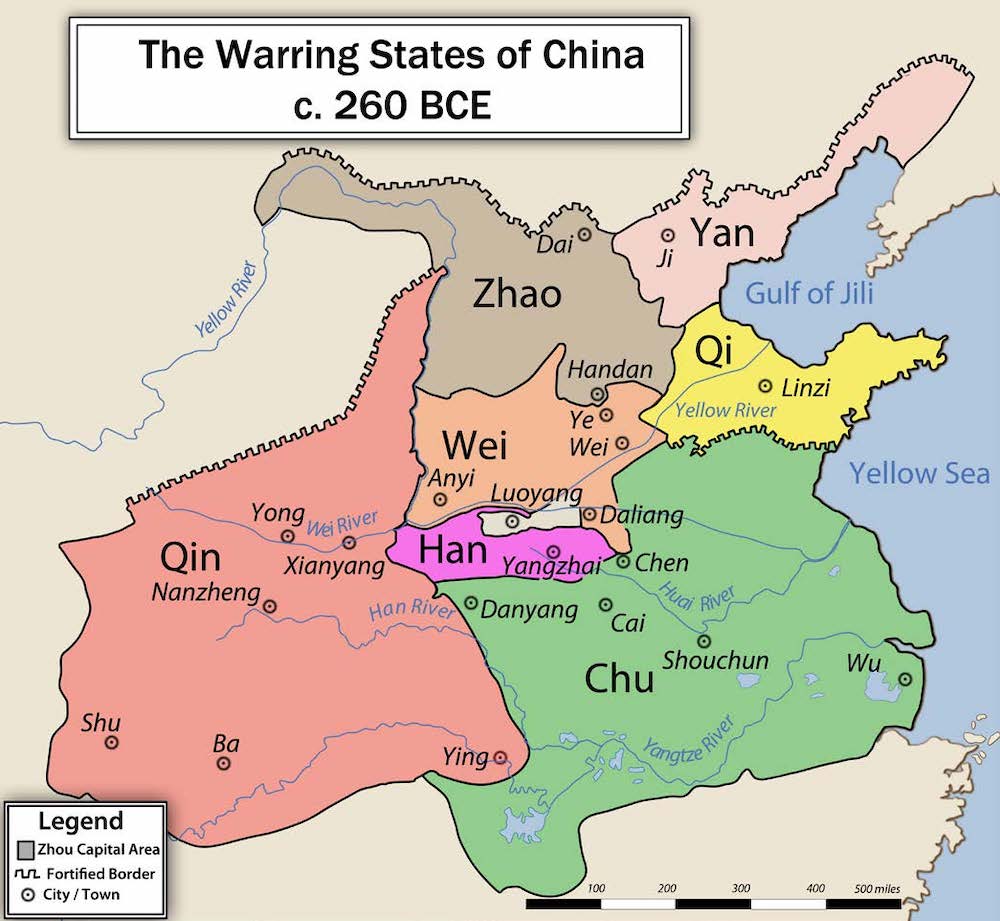
By the fourth century BCE, seven major states dominated the map: Qin, Chu, Qi, Yan, Zhao, Wei, and Han. Do not imagine them as modern nation-states with fixed national identities. Their borders shifted, alliances changed, and rulers competed for territory, resources, and survival. Still, they had become powerful enough that each needed armies, taxation, agriculture, diplomacy, and an increasingly capable administration.
Spend a minute looking at the map before continuing. Notice especially that the states are not evenly distributed: Qin has substantial western territory, Chu is geographically vast in the south, and several states press tightly against one another in the north-central region. That crowding made diplomacy and conflict inseparable.
The Philosophical Struggle That Defined China - Hundred Schools of Thought
Watch the opening of “The Philosophical Struggle That Defined China” by Cool History Bros for a quick orientation to the later label “Hundred Schools of Thought” and the competition among thinkers for rulers’ support.
Watch the opening overview. Focus on two points: intellectual traditions developed amid political division, and thinkers often tried to persuade particular rulers and courts, not simply “the public” in a modern democratic sense.
The phrase “Hundred Schools of Thought” is useful, but slightly misleading if taken literally. It does not mean that exactly one hundred tightly organized institutions existed, each with a membership card and a logo. It is a later umbrella label for a lively field of teachers, texts, advisers, debaters, technical specialists, and lineages. “Marketplace of ideas” is a helpful metaphor, provided we remember that the marketplace included royal courts whose patronage could be decisive.
Political fragmentation created a practical opening for thinkers. A ruler whose state was threatened wanted advice: How should officials be chosen? How should people be motivated? How should a ruler act? Can warfare be avoided, won, or rendered unnecessary? Meanwhile, a teacher rejected in one court could sometimes travel to another.
War was not background scenery
The word Warring in “Warring States” is not decorative. Conflict became larger, more sustained, and more demanding of entire societies.
Earlier aristocratic warfare had often centered on chariots and relatively limited elite forces. During this era, cavalry, iron weapons, crossbows, universal or broad conscription, siegecraft, espionage, and disciplined formations changed the scale of war. States could field very large infantry forces. Campaigns could last months or years, and their purpose was increasingly not a symbolic victory but the destruction of an opponent’s military capacity.
Warring States Period - World History Encyclopedia
Read “Warring States Period” from World History Encyclopedia for the political breakdown, the transformation of warfare, and the economic and social changes occurring alongside it. Read for the pattern connecting these developments, rather than trying to memorize every military figure.
In the “Background” section, read the political breakdown. Focus on how the weakening Zhou center and the consolidation of rival states made prolonged competition possible. Then read the full “A New Type of Warfare” section. Begin with the changing character of war. Notice the connections among new military technology, mass armies, and the growing demands placed on farmers and soldiers. Finally, in “Cultural Developments,” read economic and social change, followed by the passage on new ideas. Pay attention to urban growth, trade, administrators, and the possibility that talent could sometimes alter a person’s status.
For an ordinary household, these changes could mean disrupted crops, taxes, labor obligations, military service, invasion, or the loss of relatives. It is easy to romanticize philosophical debate from a distance. But the debate took place in a world where war could reach deeply into daily life.
At the same time, the period was not simply a collapse into misery. Competition also drove state-building and economic change:
- Better metalworking produced weapons, but also better agricultural tools.
- Irrigation, canals, and land development increased agricultural productivity.
- Walled cities, markets, and specialized production expanded.
- Merchants and state administrators gained importance.
- The lower aristocratic shi class could sometimes acquire influence through ability, service, and learning rather than only inherited land.
This is the crucial double movement: the same era produced both intensified coercion and new avenues for mobility, expertise, and debate.
A state fighting its neighbors needed grain, soldiers, roads, weapons, records, tax collection, and trustworthy officials. It therefore had strong incentives to make society more legible and manageable. But from the viewpoint of someone living within it, such efficiency could look less like progress than like being counted, ranked, conscripted, and commanded.
Why the crisis became a philosophical question
The Eastern Zhou crisis did not mechanically “cause Daoism,” as if a war automatically generates a philosophy. Early Daoist texts were shaped by many influences and were composed, edited, and transmitted over time. Nor were the thinkers of this period all responding to one identical problem in one identical way.
Still, the conditions made certain questions urgent:
- For a ruler: What makes a state stable and strong?
- For an official or adviser: How should one serve when rulers are reckless or violent?
- For a family: How can one live decently amid insecurity and shifting status?
- For a thinker: Is disorder caused by bad people, bad institutions, failed traditions, excessive desire, or mistaken ideas about human nature?
The “Hundred Schools” were competing diagnoses as much as competing solutions. Their disagreement was not merely abstract. Each diagnosis implied a different form of government, education, personal conduct, and social order.
Here is a compact comparison of three influential responses:
| Shared problem: how can a society escape disorder? | Diagnosis | Broad response |
|---|---|---|
| Confucian traditions | Leaders and subjects have neglected moral cultivation, ritual propriety, and proper relationships. | Educate character; renew li (ritualized conduct); lead through virtue and responsible example. |
| Legalist traditions | People respond primarily to incentives; weak, inconsistent rule allows disorder. | Build centralized institutions, clear laws, rewards, punishments, and administrative control. |
| Early Daoist traditions | Ambition, artificial striving, competition for status, and excessive interference can themselves intensify disorder. | Live more simply and in attunement with the Dao; reduce needless coercion and forcing. |
The first two approaches are especially easy to contrast. A Confucian might say: “The ruler should become morally exemplary, restore humane relationships, and guide people through ritual and education.” A Legalist might reply: “Good intentions are unreliable; give people clear rules and consequences.”
The early Daoist response takes the dispute in a more unsettling direction. It asks whether the urge to impose ever more control is part of the disease. When rulers glorify conquest, officials compete for rank, and people are taught to chase prestige and profit, perhaps social disorder is being manufactured by the very efforts meant to eliminate it.
This does not mean that Daoists simply said, “Do nothing; politics is pointless.” That would flatten a complex tradition into a slogan. Rather, early Daoist texts repeatedly question forced action: action driven by vanity, fear, rigid schemes, or the fantasy that a ruler can dominate life into harmony. Their alternative begins with Dao, “the Way,” the underlying course or pattern of reality, and with learning to act without needless strain or interference.
We will spend much more time with this idea of wu wei later. For now, keep one provisional formulation:
In the early Daoist view, a person or ruler may create additional trouble by trying too hard to control what should be allowed to develop in its own way.
That is a radical proposal in an age of mass armies and ambitious centralizers.
From fragmentation to a search for ways of life
It can be tempting to tell a too-neat story: chaos happened, then wise thinkers supplied answers. The reality was more interesting. War, administration, urbanization, social mobility, and court competition created a setting in which different answers could be tested, debated, borrowed, and sometimes turned into policy.
The period’s intellectual diversity was enabled by political plurality. No single authority could completely monopolize teaching while the states remained rivals. Courts competed for capable advisers; advisers competed for patronage; ideas traveled across borders with diplomats, officials, merchants, and wandering teachers.
That does not mean the environment was politically free. A ruler could reward an adviser, ignore one, exile one, or worse. Yet fragmentation made it harder for one doctrine to extinguish all rivals. Ironically, the road toward imperial unification was also the setting in which unusually diverse thinking flourished.
For Daoism, the historical context matters because it prevents a common misunderstanding. Daoist simplicity is not merely decorative minimalism, and non-forcing is not a productivity hack with bamboo wallpaper. In its earliest setting, these ideas carried a critique of a society organized around war, status, control, and relentless achievement.
A useful explanatory sentence to retain is:
As the Zhou political center weakened, rival states expanded warfare and administration, while cities, markets, and new social roles changed everyday life; thinkers responded by offering rival accounts of what humans, rulers, and communities should do.
Daoism was one of those answers. It did not stand outside its turbulent world. It emerged in conversation—and sometimes sharp disagreement—with the world’s strongest assumptions.
Key takeaways
- During the Eastern Zhou, the Zhou king’s authority weakened while regional states became independent rivals.
- The Warring States period brought destructive, large-scale warfare and placed heavy demands on ordinary people through military service, farming, taxation, and labor.
- Social transformation also mattered: urban growth, trade, state administration, and some new paths to status made old hereditary arrangements less secure.
- These pressures generated a search for practical and ethical answers to how to rule and how to live.
- Confucian, Legalist, and early Daoist traditions shared the problem of disorder but diagnosed it differently.
- Early Daoism questioned whether striving, competition, and excessive control might be causes of disorder rather than cures.
Next, we will take one shared problem—social order and effective leadership—and compare the early Daoist and Confucian responses more closely.
Can't find a good explanation? Sign up and we'll make it for you
Sign up