
Hello. In the previous lesson, you solved linear equations by preserving equality: every operation performed on one side had to be performed on the other. Rearranging a formula uses exactly that same principle, but with a different purpose. Instead of finding one numerical value of , you create a new, equivalent version of a formula with a chosen variable alone.
This is useful whenever a formula is given in an inconvenient form. For example, if and you know distance and speed, rearranging it to lets you calculate time directly. By the end of this lesson, you should be able to make a specified variable the subject in formulae involving operations, brackets, fractions, powers, and repeated appearances of the target variable.
The subject and the balance principle
The subject of a formula is the variable isolated on one side of the equals sign. In
is the subject. If the instruction says “make the subject,” the finished answer should look like
The formula itself does not change meaning. You are simply expressing the same relationship from a different viewpoint.
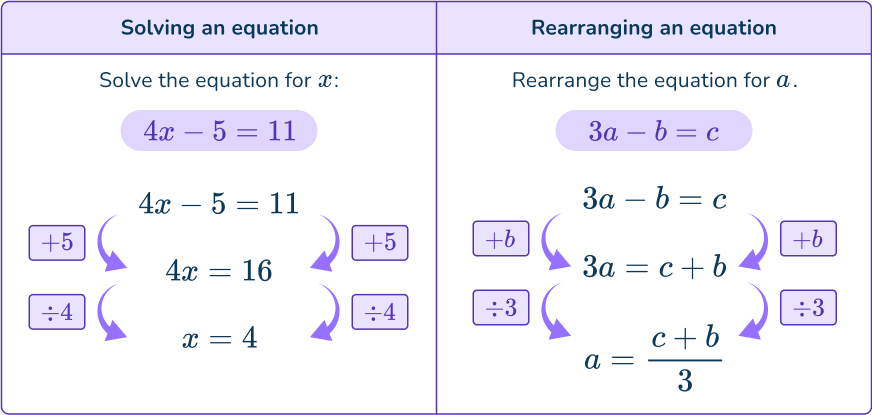
The essential rule is unchanged:
Apply the same operation to both sides of the equation.
A useful way to plan is to identify what is being done to the target variable, then undo those operations in reverse order.
Changing The Subject Of A Formula | Algebra | Maths | FuseSchool
Watch “Changing The Subject Of A Formula” by FuseSchool - Global Education for a concise visual explanation of the balance principle and inverse operations.
Watch the introduction to establish what “subject” means and why formulae are rearranged. Then watch the main example, focusing on why the entire expression on the other side must be divided by 2, not only one term. Finish with the recap for the main decision rule: begin with operations furthest from the target variable.
BBC Bitesize’s How to use formulae gives the same “reverse the operations” idea through function machines.
How to use formulae - GCSE Maths Revision - BBC Bitesize
Read this short introduction to connect formula rearrangement with the equation-solving method you used previously.
In the section “Changing the subject of a formula,” read from the function-machine explanation. Focus on the phrase “inverse operations”: a rearrangement is valid only when each operation is undone on both sides.
Isolating a variable that appears once
Consider:
Make the subject. The term is furthest from , so first add to both sides:
Now is multiplied by , so divide both sides by :
Notice that the whole expression is divided by . Writing
would be incorrect, because it divides only by .
Brackets: undo multiplication before removing what is inside
Suppose
and you need to make the subject.
The bracketed expression has been multiplied by . Divide by first:
Then add to both sides:
It would also work to expand the bracket first:
then add and divide by . But avoiding expansion is usually quicker here and creates fewer chances for sign errors.
Fractions: multiply the entire side
Now consider
To make the subject, subtract :
Then multiply both sides by :
You may leave this factorised form, or expand it:
Both are equivalent. The key error to avoid is writing : multiplying by applies to every term in .
GCSE Maths - How to Rearrange Formulas (2026/27 exams)
Watch “GCSE Maths — How to Rearrange Formulas” by Cognito for several short, exam-style examples with constants, division, and brackets.
Watch the first example, particularly the use of a fraction bar to show that all of y-4 is divided by 3. Then watch fractions and brackets; pause mentally before each step and name the inverse operation. If you want one more compact example, watch the final rearrangement, where multiplying by 2 distributes across the complete expression.
Powers and roots: use inverse operations carefully
Powers are also operations that can be undone. Squaring is undone by square-rooting; cubing is undone by cube-rooting.
Suppose:
and make the subject.
First square both sides to remove the square root:
Add to both sides:
Finally divide by :
Two details matter:
- Square the entire left side, giving .
- Divide the entire numerator by .
For a squared target, there can be two algebraic answers. For example:
Add :
Taking square roots gives
The is needed because both a positive and negative value of have the same square. However, a context can restrict the answer. If represents a physical length, only the non-negative value makes sense.
For instance, the area of a circle is
Making the subject gives
and therefore
A radius cannot be negative, so we use only the positive square root.
When the target variable appears more than once
The routine changes slightly if the chosen variable appears in several terms. You must first collect those terms on one side, then factorise the target variable.
Consider the surface-area formula for a cuboid:
Make the subject. The -terms are and . First subtract the term that does not contain :
Now factorise from the right-hand side:
The variable is now multiplied by the complete bracket . Divide both sides by that bracket:
This factorising step is essential. You cannot divide by , because is not multiplied only by ; it is involved in two separate terms.
A more abstract version follows the same pattern:
Make the subject. Factorise the left side:
Then divide by the full coefficient of :
This method is particularly important in higher-tier formula questions and in later geometry and measurement work.
Rearranging Equations - GCSE Maths - Steps & Examples
Use this guide as a structured revision reference for the full range of rearrangement methods, especially powers and factorising a repeated target variable.
Start with “How to rearrange formula to change the subject of the formula.” Read the five-step method, noting that fraction removal and factorisation are conditional steps rather than things to do automatically. Next, in “Rearranging equations examples,” compare the squared and factorisation examples, then read the misconception checklist. Finally, in the practice section, trace the fully worked derivation beginning with the fractional formula; it combines clearing a denominator, collecting terms, and factorising.
Checking a rearranged formula
Unlike solving an equation, a rearrangement usually gives an expression in variables rather than a single number. You can still check it in two reliable ways.
1. Reverse the algebra
Take your final form and reverse the operations until you recover the original formula. For example, from
subtract :
Multiply by :
Reversing the sides produces the original formula:
2. Use simple test values
Choose values that make arithmetic easy. Suppose
has been rearranged as
Let and . The rearranged formula gives
Test these values in the original formula:
This matches , so the rearrangement is supported.
Checking with numbers does not replace valid algebra, but it is excellent for catching missing brackets, incorrect signs, and incomplete division.
Restrictions to notice
Some rearrangements involve division. For example,
requires
Likewise, in
the denominator must not be zero, so
In many school exam questions, you will not need to state restrictions unless asked. Still, noticing them helps you avoid dividing by zero and deepens your understanding of what the formula can represent.
An exam-ready method
When asked to make a variable the subject:
- Identify the target and make sure your final line has only that variable on one side.
- Use inverse operations to remove terms furthest from the target first.
- Apply every operation to both sides, keeping brackets around a multi-term expression when multiplying or dividing it.
- Expand or factorise only when useful. Factorise when the target appears in more than one term.
- Handle powers last: square or square-root both sides only after isolating the squared or rooted expression.
- Check by reversing your steps or substituting convenient values.
The central distinction is now clear: solving produces a particular value, . Rearranging produces a new general formula,
Both rely on the same balance principle and on writing a clear sequence of equivalent statements.
You can now rearrange formulae with ordinary operations, brackets, fractions, powers, and repeated target variables. The most frequent exam errors are dividing only one term rather than a whole expression, forgetting the after square-rooting where both signs are possible, and failing to factorise when the target occurs in multiple terms.
Next, you will use exponent laws to simplify products, quotients, and powers with a common base.
Can't find a good explanation? Sign up and we'll make it for you
Sign up