
The previous lesson explained how the Great Depression damaged confidence in democratic government and weakened international cooperation. That crisis created an opening for radical politics, but it does not by itself explain what Nazi Germany intended to do with power. Nazi expansion was not simply a conventional attempt to revise the Versailles settlement or acquire markets. It was a racial project: the regime imagined a German “national community” that could grow, dominate, and supposedly survive only by conquering land in Eastern Europe and remaking its population.
This lesson examines that logic. By the end, you should be able to explain how Nazi beliefs about race, Jews, Slavs, Bolshevism, land, and national survival shaped both where Germany sought to expand and how it expected to rule conquered territory.
Race as a political map
Nazi racial ideology rested on false claims that humanity consisted of unequal biological “races” locked in permanent struggle. These claims were not legitimate science. The Nazis borrowed and distorted older racial theories, nationalism, antisemitism, and Social Darwinist language to create an ideology of domination.
At the center of this worldview was the Volk: a supposedly unified German racial-national community. Membership in the Volk was not defined merely by citizenship, language, or loyalty to Germany. It was defined through imagined ancestry and “blood.” Nazis represented people of supposedly German or “Germanic” descent as biologically valuable and entitled to political power, land, and reproduction.
This vision had two immediate implications:
- Germany’s alleged racial strength had to be protected from internal “enemies,” especially Jews, whom Nazis falsely portrayed as a racial threat rather than a religious or cultural minority.
- The German Volk had to expand externally, because Nazi leaders claimed that a growing, racially healthy people required more territory, food, and resources.
The ideology therefore turned international politics into a racial struggle. Other peoples were not treated as equal nations with rights to sovereignty. They were classified according to their supposed value or danger to German racial goals.
A crucial distinction follows. Many Germans opposed Versailles, wanted lost territory restored, or resented the postwar order without accepting the entire Nazi racial program. A conventional revisionist government might seek border changes, diplomatic influence, or military equality. Nazi ideology went much further: it imagined conquest as the means to create a permanent racial empire.
Nazi Imperialism: An Overview | Holocaust Encyclopedia
Read the United States Holocaust Memorial Museum’s overview to establish the ideological foundations of Nazi expansion in Eastern Europe. It usefully distinguishes imperial control from the Nazi ambition to settle conquered land with Germans.
In the Introduction, read the definition of imperialism and colonialism, then follow the discussion of Hitler’s vision of Eastern Europe. In “Nazi Motivations in the East,” read the three explanatory paragraphs on a fabricated German historical claim, the First World War, and the “Judeo-Bolshevik” myth. Focus first on the invented historical entitlement. Then read the conspiracy theory, noting how antisemitism and anti-communism were fused together.
Lebensraum: making conquest appear necessary
The key Nazi term was Lebensraum, usually translated as “living space.” In ordinary language, it could sound like a demand for adequate territory or resources. Under Nazism, however, it became a justification for conquest, demographic engineering, and racial violence.
The idea existed before Hitler. German geographer Friedrich Ratzel used the term in the early twentieth century amid a wider age of imperial competition. He and other thinkers wrongly applied Darwinian concepts of struggle and adaptation to states and peoples. In this distorted view, nations resembled organisms: strong nations expanded; weak nations declined. Autarky, or economic self-sufficiency, seemed essential because dependence on foreign food and raw materials supposedly left a nation vulnerable.
Nazi leaders inherited these ideas but radicalized them. They argued that Germany’s future could not rest on trade, overseas colonies, or peaceful economic cooperation. Instead, they claimed Germany needed a large, contiguous land empire in Europe itself.
Why Eastern Europe?
- It was imagined as agriculturally and materially abundant. Nazi leaders coveted the grain-producing lands of Ukraine, as well as forests, minerals, and other resources across the Soviet Union.
- It was close to Germany. The aim was not a distant colonial possession but a continental empire directly connected to the Reich.
- It fitted a mythic history. Nazis selectively invoked medieval German settlement in Eastern Europe to claim that the region was a “lost” German space awaiting recovery.
- Its inhabitants had been racialized as inferior. Slavic peoples and Jews were depicted as obstacles to German development rather than as communities with rights, histories, and states of their own.
- The Soviet Union was portrayed as an existential enemy. Nazi propaganda fused antisemitism with anti-communism through the false claim that “Jewish Bolshevism” controlled the Soviet state.
The First World War sharpened this thinking. Hitler interpreted Germany’s blockade experience and wartime shortages not as reasons to pursue international stability, but as evidence that Germany must conquer enough land and food-producing territory to avoid dependency. That conclusion was ideological, not inevitable. Germany could have pursued trade, diplomacy, agricultural reform, or cooperative security; the Nazis instead treated violent expansion as the natural solution.
Lebensraum | Holocaust Encyclopedia
This Holocaust Encyclopedia article traces the older intellectual roots of Lebensraum and shows how the Nazis transformed a language of space and self-sufficiency into a concrete program for conquest and colonization.
Begin in “Background.” Read the account of Ratzel and autarky, paying particular attention to the misuse of Darwinian ideas. In the following historical discussion, read the myth of a German East. Then move to “Lebensraum and World War I” and read from the paragraph beginning “Ironically” through Hitler’s comments on food, raw materials, and Ukraine. Finally, in “Lebensraum and the Nazi State,” read the discussion of Generalplan Ost. Focus on the link between colonization and starvation.
A propaganda map turns ideology into geography
Nazi propaganda often made expansion look like a natural, historical process rather than a program of aggression chosen by political leaders.
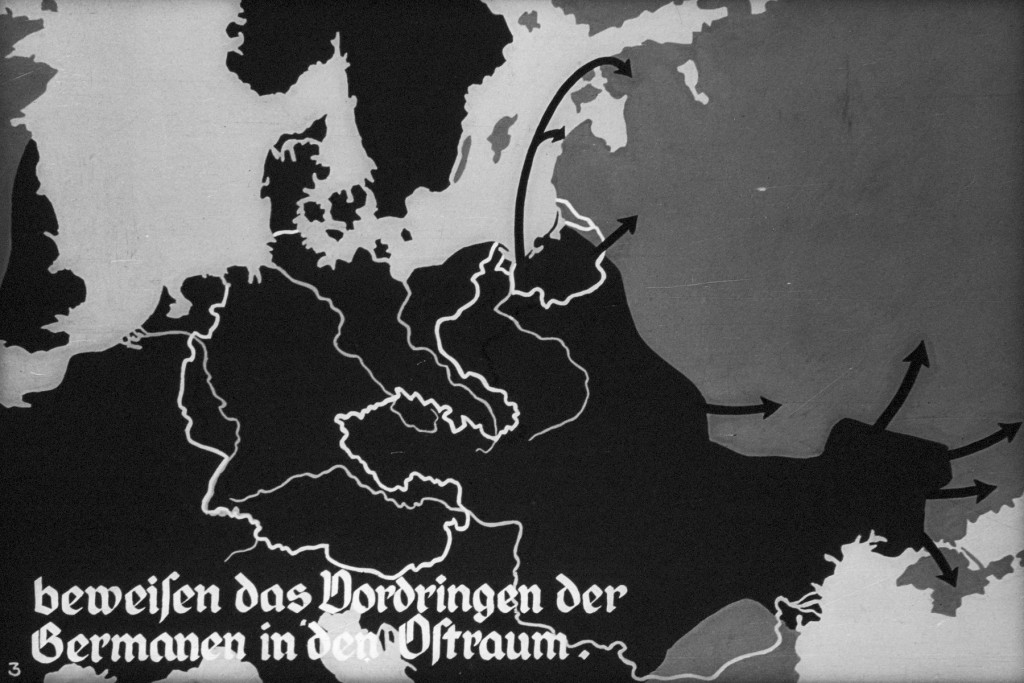
The map’s argument is visual as much as verbal.
- Its arrows imply motion, momentum, and inevitability. The viewer is invited to see German expansion as the continuation of a long historical movement.
- The large dark eastern space makes the region appear available for occupation.
- Political communities disappear. Poles, Ukrainians, Belarusians, Russians, Jews, and many others are not shown as people with claims, institutions, or rights.
- The caption turns a selective historical story into a territorial claim in the present.
This is why maps are powerful propaganda tools. They do not merely describe space; they can teach viewers whom to see as belonging, intruding, threatening, or disposable. The map is valuable evidence of Nazi political imagination, but it is not evidence that Eastern Europe was “naturally” German, that its peoples welcomed German rule, or that conquest was historically justified.
From racial theory to an imperial program
Nazi expansionism was therefore more than military conquest or economic exploitation. It was a form of settler-colonial imperialism. In a conventional empire, a powerful state may control territory and extract labor, taxes, or raw materials while leaving much of the local population in place. Nazi plans for the East included exploitation, but their ultimate ambition went further: to reshape the population itself so that Germans and people judged to have “Germanic blood” would settle and dominate the region.
The internal logic was brutally direct:
| Nazi ideological premise | Expansionist consequence |
|---|---|
| The German Volk needed to grow and remain “racially healthy.” | German settlement and population growth became state priorities. |
| Germany required self-sufficiency in food and resources. | Eastern Europe became a target for conquest and extraction. |
| Slavs were racially “inferior.” | Their political rights, landholding, and even survival could be treated as expendable. |
| Jews were depicted as a racial and political enemy. | Antisemitic persecution became connected to removing Jews from the Nazi racial empire. |
| The Soviet Union was falsely cast as “Judeo-Bolshevik.” | War against the USSR was framed as both a strategic and racial war of annihilation. |
This framework helps explain why Nazi plans envisioned not only annexation but also expulsion, forced labor, starvation, kidnapping of selected children for Germanization, mass shooting, and settlement by Germans. Such policies were not accidental side effects of a normal war. They followed from a worldview in which populations were ranked according to racial utility and land was thought to belong to whichever “race” had the power to seize it.
The later plan usually called Generalplan Ost illustrates the point. It was not a single fully implemented blueprint, but a family of long-term demographic and economic plans for German domination of Eastern Europe. Its premise was that millions of people would have to be removed, displaced, exploited, or allowed to die in order to make room for a German colonial future. Nazi Germany never achieved this envisioned racial empire; its implementation was fragmented, improvised, and shaped by the changing war. But the human consequences were catastrophic.
This does not mean every Nazi policy followed automatically from one document or one idea. Nazi rule involved institutions with competing interests, wartime improvisation, economic pressures, military decisions, and choices by individual perpetrators. Yet racial ideology established the regime’s goals and moral boundaries—or, more accurately, its lack of moral boundaries. It made mass violence seem not only permissible to Nazi leaders but necessary to the future they imagined.
Antisemitism, anti-Slavism, and “Judeo-Bolshevism”
Nazi antisemitism cannot be reduced merely to a tool for gaining land. It had deep roots in European antisemitism and occupied a central place in Hitler’s worldview. But expansion eastward and antisemitism became increasingly inseparable.
Nazis falsely portrayed Jews as a global racial enemy responsible both for capitalism and communism, for Germany’s defeat in 1918, and for cultural and political “decline.” This conspiracy theory made no logical sense, but it did political work. It allowed the regime to present a war against Poland and the Soviet Union as a defensive racial struggle against an invented Jewish-Bolshevik threat.
At the same time, Nazi leaders treated Slavic populations as inferior and Eastern Europe as land supposedly wasted under inferior rule. The result was a hierarchy of intended fates rather than a uniform policy for all occupied peoples. Some groups might be exploited as labor; some individuals might be classified as capable of Germanization; others might be deported, starved, or murdered. Jewish communities faced an escalating program of exclusion, persecution, deportation, and ultimately genocide.
The full development of occupation policy and the Holocaust will require separate attention later in the course. For now, the essential connection is this: Nazi racial ideology transformed territorial expansion into a project of population removal and racial reordering.
A useful explanation to carry forward
A concise but strong answer to this lesson’s question would make four points:
- Nazi ideology defined Germans as a racial Volk entitled to strength, growth, and dominance.
- Lebensraum identified Eastern Europe as the territory required for that growth, promising food, raw materials, farmland, and strategic independence.
- Antisemitism, anti-Slavism, and the myth of “Judeo-Bolshevism” defined Eastern peoples as enemies or obstacles, rather than as equal human communities.
- Conquest therefore implied colonial settlement and demographic transformation: annexation, exploitation, expulsion, starvation, forced labor, and mass murder were built into the regime’s long-term vision.
Key takeaways
Nazi racial ideology shaped Germany’s expansionist aims by deciding both the destination and the character of expansion. The regime looked east because it imagined Eastern Europe as Germany’s rightful Lebensraum: a continental empire that could make the German Volk self-sufficient, powerful, and racially dominant.
That ideology also made Nazi expansion uniquely destructive. Since Jews, Slavs, and other populations were portrayed as racially inferior, dangerous, or alien, their displacement, exploitation, and destruction could be imagined as prerequisites for German settlement. Nazi aims in the East were therefore imperial, colonial, economic, military, and genocidal at once.
Next, the course shifts to another major aggressor in the interwar world: Japan. We will examine how military autonomy and imperial ideology shaped Japanese expansionism, then compare the distinctive paths by which the Axis powers challenged the international order.
Can't find a good explanation? Sign up and we'll make it for you
Sign up