
Hello. The previous lesson examined why Fascist Italy targeted Ethiopia and how the 1935–36 war exposed the contradictions of the interwar order. Italy’s conquest was not an isolated colonial episode: it was the League of Nations’ second major test after Japan’s seizure of Manchuria.
This lesson compares those crises to assess why collective security failed. The essential question is not simply why the League “did nothing.” It did investigate, condemn, and, in Ethiopia’s case, impose sanctions. The deeper problem was that these measures did not create a credible expectation that aggression would bring costs greater than its expected gains. The Manchurian and Ethiopian crises therefore revealed a system dependent on member states’ political will rather than an institution able to compel them.
What collective security was supposed to do
Collective security was the League of Nations’ central promise. Rather than each state defending itself alone through alliances and armaments, all member states were meant to treat aggression against one as a threat to the international order as a whole. They would collectively pressure, sanction, and, if necessary, resist the aggressor.
In principle, this offered both a response to aggression and a deterrent against it. A potential aggressor should calculate that conquest would provoke united economic and military action by many states.
The Rise and Fall of the League of Nations | Quick History
Watch “The Rise and Fall of the League of Nations” from History Core for a concise definition of collective security before applying it to the two crises.
Watch the definition. Focus on the two categories of collective measures described: economic pressure and possible military action.
The League did not possess its own armed forces. Its authority therefore rested on whether its strongest members—above all Britain and France—would accept economic loss, military risk, or both in order to uphold its decisions. The United States, a major economic and naval power, never joined the League. This absence was particularly damaging in an Asian crisis involving Japan.
The distinction between condemnation and deterrence is crucial:
| A League response could include | But deterrence required |
|---|---|
| investigation, debate, and a formal report | action quickly enough to prevent a fait accompli |
| diplomatic condemnation | economic measures that major trading states actually enforced |
| non-recognition of conquest | credible readiness to impose escalating costs |
| sanctions by some member states | agreement among the strongest powers on what risks they would accept |
A fait accompli is an accomplished fact presented to the world after it has become difficult to reverse. Both Japan and Italy benefited from creating one: military conquest moved faster than League deliberation.
Manchuria: a rapid conquest and a delayed response
Japan’s army seized Manchuria, a large and resource-rich region of northeastern China, after the Mukden Incident of 18 September 1931. An explosion damaged a Japanese-controlled railway near Mukden. Japanese officers blamed Chinese forces and used the incident as a pretext for military action; evidence strongly suggests that Japanese officers themselves may have staged the incident.
Within months, Japanese forces had overrun Manchuria. In 1932, Japan declared the creation of Manchukuo, formally an independent state but in practice controlled by the Japanese military. China appealed to the League.
The Mukden Incident of 1931 and the Stimson Doctrine
Read this U.S. Department of State historical overview to establish the sequence of Japan’s seizure of Manchuria, the limited American response, and the League’s Lytton Report.
In the section “Japanese Invasion of China,” read the account of the invasion. Note how quickly Japan created military control before international institutions could respond. Then read the opening of “The Stimson Doctrine,” from the limits of outside action. Focus on why the Depression and a limited perception of national interest discouraged sanctions. Finally, in “Lytton Report,” read the League investigation and outcome. Track the contrast between the League’s legal judgment and the reality of Japanese control on the ground.
The League appointed the Lytton Commission to investigate. An investigation was not inherently unreasonable: Chinese and Japanese claims, railway rights, and regional politics were complicated. But it was disastrously slow in the circumstances. The commission travelled from Europe to East Asia, gathered evidence, and produced a report only after Japan had consolidated its occupation.
The Lytton Report rejected Manchukuo as a genuinely independent state and affirmed China’s territorial integrity. Yet it did not produce a coercive settlement. When the League endorsed the report in 1933, Japan withdrew from the League rather than surrender Manchuria. It retained the territory.
Why Manchuria exposed collective security’s weakness
Several factors overlapped.
First, the crisis was geographically distant from the states expected to act. Britain and France had imperial interests in East Asia, but Manchuria itself did not seem worth a major war. France’s overriding security concern was Germany. Britain feared that confrontation with Japan could endanger Hong Kong, Singapore, India’s sea routes, and its wider Asian empire.
Second, the League lacked key powers. The United States participated in discussions but was not a League member and was deeply isolationist. It announced the Stimson Doctrine, refusing to recognize territorial changes achieved by aggression. That preserved a legal principle but did not dislodge Japanese forces. The Soviet Union, another state with strong interests in Northeast Asia, was also outside the League at the time.
Third, the Great Depression made sanctions politically and economically difficult. Governments facing mass unemployment and collapsing trade were reluctant to disrupt commerce further. Sanctions would hurt not only Japan but also the states imposing them. Without American participation, trade restrictions could also be less effective because Japanese access to goods and markets might continue through non-participating states.
Finally, Japan’s military had already secured the decisive fact. The Japanese army moved rapidly, and civilian Japanese leaders had limited capacity to reverse military action without a severe domestic political confrontation. The League’s deliberative process could issue a judgment, but it could not quickly restore China’s position.
Manchuria thus showed that legal disapproval without enforceable consequences could not deter a determined expansionist power.
Ethiopia: stronger action, but still not enough
The Ethiopian crisis differed from Manchuria in important ways. Italy invaded Ethiopia in October 1935 after months of military preparation. Both states belonged to the League, and Italy’s aggression was more unambiguous than the tangled claims surrounding Mukden. The League therefore had less difficulty identifying Italy as the aggressor.
This time, the League did more than investigate. It imposed economic sanctions on Italy in November 1935. Dozens of states participated, and sanctions created real economic inconvenience. This matters because it prevents an overly simple conclusion that the League was wholly inactive.
Yet the sanctions did not include several vital materials, especially oil. Britain also kept the Suez Canal open to Italian shipping, even though closing it would have made it far harder for Italy to supply its East African armies. Italy continued its invasion, captured Addis Ababa in May 1936, and annexed Ethiopia.
The 1930s and the failure of the league of nations - Collective Security
Read this overview comparatively, using it to connect the limited response to Japan with the ineffective sanctions imposed on Italy.
Read the comparison of the two crises. Identify the contrast between a verbal rebuke in Manchuria and economic sanctions in Ethiopia, then ask why neither altered the aggressor’s policy. Then read the argument about political will. The key claim is that the League’s weakness was not merely procedural: its authority depended on whether powerful states were willing to incur real risks to stop aggression.
The Ethiopian case therefore demonstrates a more precise lesson: incomplete sanctions can fail in a way that is politically worse than no sanctions at all. They imposed enough cost to alienate Mussolini, but not enough cost to stop him. Italy moved closer to Nazi Germany, while the League’s credibility declined.
Britain and France hesitated because they feared a war with Italy in the Mediterranean and wanted to preserve Italy as a possible partner against Hitler’s increasingly dangerous Germany. Their secret consideration of the Hoare–Laval Plan—under which much of Ethiopia would have been conceded to Italy—made this contradiction public. The leading League powers appeared prepared to sacrifice a fellow member in order to preserve their own strategic position.
Comparing the crises: common structural failures, different immediate conditions
The following comparison helps separate broad causes from crisis-specific ones.
| Factor | Manchuria, 1931–33 | Ethiopia, 1935–36 | Significance |
|---|---|---|---|
| Aggressor’s objective | Japanese control of resource-rich Manchuria and strategic dominance in Northeast Asia | Italian colonial empire, prestige, and revenge for Adwa | Both aggressors judged expansion worth the diplomatic cost. |
| Speed of aggression | Very rapid occupation created a fait accompli before the investigation ended | Italy prepared openly, then conducted a large-scale invasion | The League was too slow in Manchuria and too cautious in Ethiopia. |
| League response | Lytton Commission, condemnation, non-recognition; no meaningful sanctions | Formal condemnation and economic sanctions | The Ethiopian response was stronger, but still not decisive. |
| Great-power priorities | Britain feared Japan; France focused on Germany; United States remained outside | Britain and France feared alienating Italy and risking Mediterranean war | National interests repeatedly overrode the collective commitment. |
| Economic context | Depression discouraged trade restrictions | Depression still limited willingness to bear economic costs | Economic crisis weakened international cooperation. |
| Result | Japan kept Manchuria and left the League | Italy conquered Ethiopia; sanctions collapsed | Aggressors learned that the League could be defied. |
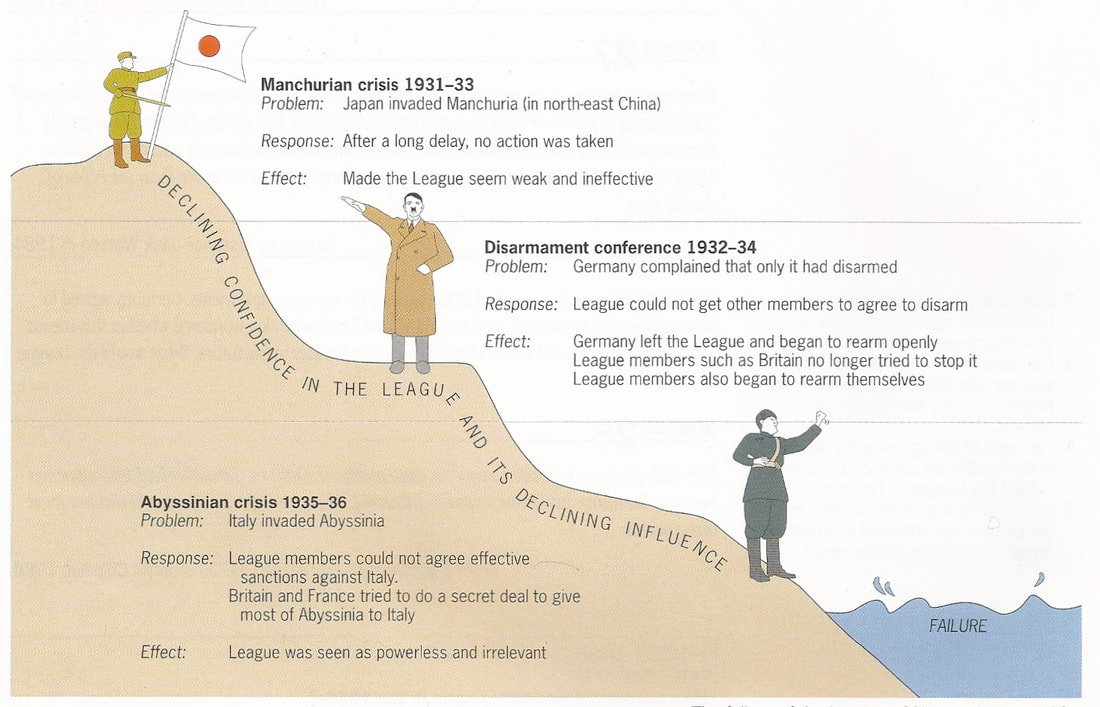
The diagram’s central insight is valuable: the crises did not stand alone. Japan’s success in Manchuria demonstrated that a state could reject League criticism and retain conquered territory. Italy’s invasion then tested whether the League had learned from that failure. Its incomplete sanctions suggested that it had not.
Still, treat the image as an interpretation, not proof by itself. The League was not doomed simply because it lacked an army or because the United States was absent. A stronger British-French decision, coordinated sanctions including oil, or a credible threat to restrict access through Suez might have altered Mussolini’s calculation. The institutions mattered, but political choices made by states mattered more.
A defensible assessment
A strong overall judgment is:
Collective security failed in Manchuria and Ethiopia because the League could not turn legal condemnation into credible coercion. Its major members would not consistently subordinate national, imperial, economic, and strategic interests to the defense of distant victim states.
This explanation has several layers:
-
Institutional weakness: the League had no forces of its own and depended on member cooperation. Its procedures encouraged delay when rapid action was needed.
-
Missing or unreliable great-power support: the United States was outside the League; the Soviet Union was absent during the Manchurian crisis; Britain and France were unwilling to undertake the risks needed to enforce League decisions.
-
Economic crisis: the Great Depression reduced enthusiasm for sanctions and made cooperation harder.
-
Conflicting imperial interests: Britain and France defended an international order that also preserved their own empires. This made their defense of Chinese and Ethiopian sovereignty appear selective and weakened moral authority.
-
Aggressor calculations: Japan and Italy had concrete strategic, ideological, and domestic reasons for expansion. Each concluded, correctly, that international opposition would remain limited.
-
Different regional priorities: Manchuria seemed remote to European powers, while Ethiopia was connected to Mediterranean and imperial strategy. Yet greater proximity in Ethiopia did not produce greater resolve; it produced additional caution because Britain and France feared the consequences of confronting Italy.
The final point is particularly important. The League did not fail because its members lacked information about aggression. It failed because they could not agree to pay the price of stopping it. Collective security is therefore not a substitute for power or political will; it is a means of organizing them.
Key takeaways
Manchuria and Ethiopia revealed the same central weakness of collective security: the League’s rules depended on member states enforcing them.
- In Manchuria, Japan conquered territory quickly while the League investigated slowly. Condemnation and non-recognition did not reverse the conquest.
- In Ethiopia, the League imposed sanctions, but excluded crucial materials and did not close the Suez Canal. The measures irritated Italy without preventing conquest.
- The Great Depression, the absence of the United States, conflicting British and French priorities, imperial double standards, and fear of war all undermined a united response.
- The failures were cumulative. They reduced faith in the League, encouraged further aggression, and helped make later diplomacy increasingly dependent on direct great-power bargaining.
Next, we turn to appeasement and assess the strategic constraints that shaped British and French policy toward Germany in the later 1930s.
Can't find a good explanation? Sign up and we'll make it for you
Sign up