
Hello, and welcome to the course. We begin by examining the world that World War II inherited. This first module asks why the peace made after 1918 proved unstable: not because another war was inevitable, but because the settlements created new states, new borders, unresolved minority questions, and a new but fragile system for preventing conflict.
By the end of this lesson, you should be able to identify the principal territorial and political changes created by the postwar settlements of 1919–23, while distinguishing between what the treaties formally decided and what was settled later through war, revolution, and diplomacy.
A settlement system, not simply “Versailles”
“Versailles” is often used as shorthand for the post–First World War peace. Strictly speaking, the Treaty of Versailles, signed with Germany on 28 June 1919, was only the most famous element in a wider set of agreements. Together, they attempted to reorganize central Europe, the Balkans, the Middle East, and former German colonial possessions.
The principal treaties were:
| Treaty | Signed with | Main significance |
|---|---|---|
| Versailles (1919) | Germany | Redrew German borders, imposed military restrictions, transferred colonies into mandates, and created the League of Nations framework. |
| Saint-Germain (1919) | Austria | Confirmed the dissolution of Austria-Hungary and reduced Austria to a small republic. |
| Neuilly (1919) | Bulgaria | Reduced Bulgaria’s territory, including its access to the Aegean Sea. |
| Trianon (1920) | Hungary | Broke up the Hungarian half of the Habsburg Empire and transferred large territories to neighboring states. |
| Sèvres (1920) | Ottoman Empire | Proposed a far-reaching partition of Ottoman lands; it was resisted and largely superseded. |
| Lausanne (1923) | Turkey | Replaced Sèvres and recognized the borders of the modern Turkish republic. |
The agreements emerged from competing aims rather than one coherent plan. French leaders sought security against a future German attack. Britain wanted a stable European balance while protecting imperial interests. Woodrow Wilson promoted national self-determination and a League of Nations. Italy and Japan sought territorial rewards for joining the victorious side. These goals overlapped at times, but they frequently clashed.
A central tension ran through the whole settlement: could peace be made both punitive toward defeated powers and stable enough to prevent a future war?
The 'Other' WW1 Peace Treaties: St Germain, Trianon, Neuilly, Sèvres - GCSE & IGCSE History Revision
Watch “The 'Other' WW1 Peace Treaties” by Mr Allsop History for a compact overview of the treaties beyond Versailles. It is especially useful for seeing how Austria-Hungary and the Ottoman Empire, not Germany alone, were transformed.
Watch the overview for the treaty framework. Then follow the territorial breakup of Austria in Saint Germain, Hungary in Trianon, and Bulgaria in Neuilly. Finish with Sevres and Lausanne, focusing on why the Ottoman settlement did not remain in force.
Redrawing Europe: Germany, the Habsburg lands, and the new eastern states
The most immediate transformation was geographical. Before 1914, much of central and eastern Europe was dominated by large multinational empires. By the early 1920s, that imperial map had been replaced by a much denser patchwork of nation-states.
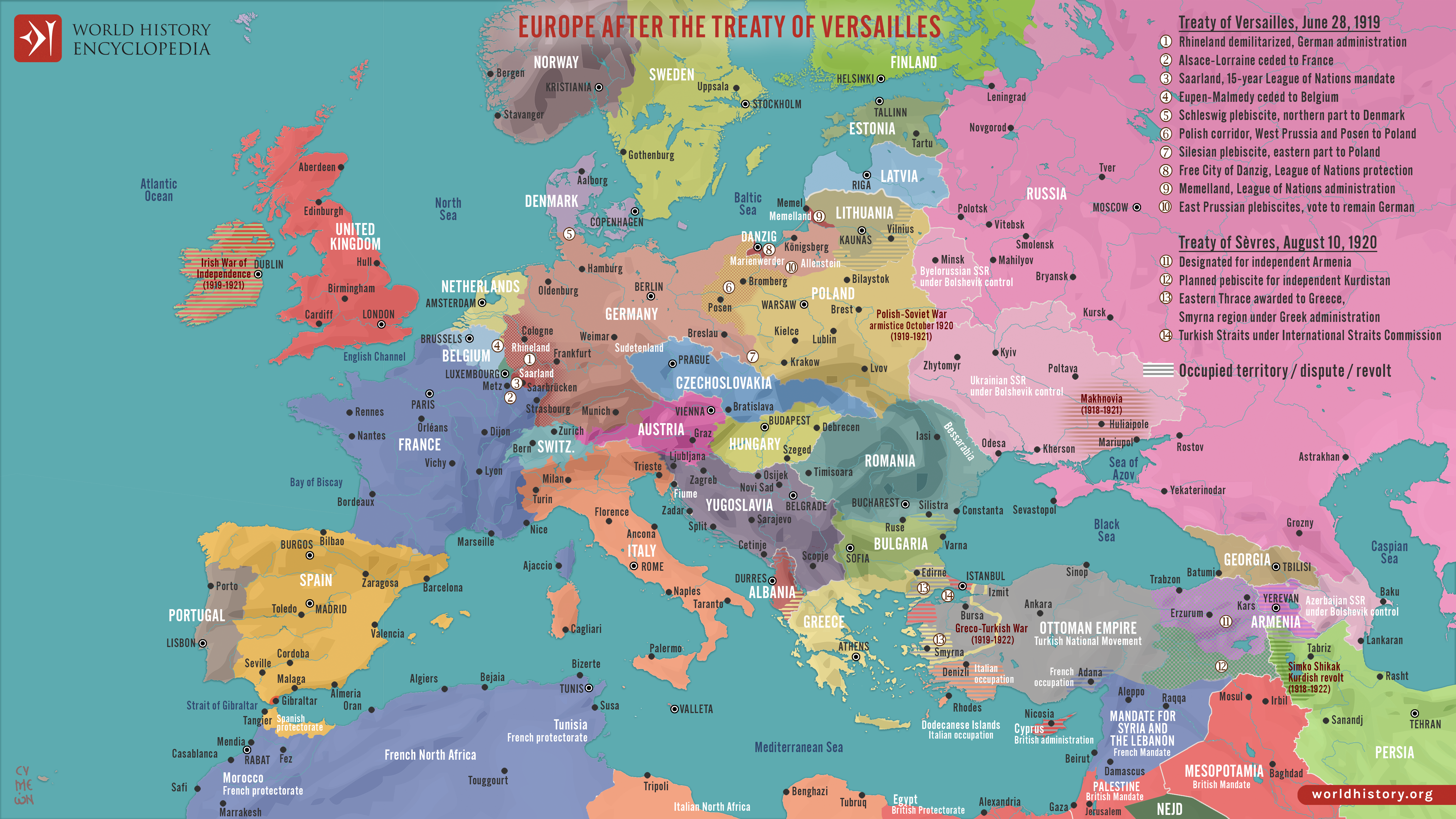
Treat the map as a snapshot of an ongoing settlement, rather than a final answer. It includes the proposed Sèvres arrangements for the Ottoman Empire, several of which did not survive, and it marks disputed or unstable areas. Its greatest value is that it makes visible how radically Europe’s political geography had changed.
Germany: reduced, constrained, and territorially fragmented
Germany lost territory in several directions:
- Alsace-Lorraine returned to France.
- Eupen-Malmédy went to Belgium.
- Northern Schleswig went to Denmark after a plebiscite.
- Posen, much of West Prussia, and part of Upper Silesia went to the restored Polish state.
- The Polish Corridor gave Poland access to the Baltic Sea, but separated East Prussia from the rest of Germany.
- Danzig was not annexed by Poland; it became the Free City of Danzig under League of Nations supervision, while Poland received important rights there.
- The Saar was placed under League administration for fifteen years, while France received its coal mines.
- The Rhineland remained German territory, but it was demilitarized and temporarily occupied by Allied forces.
These arrangements had strategic as well as symbolic importance. France recovered Alsace-Lorraine, lost to Germany in 1871, and sought security through the demilitarization of the Rhineland. Poland gained access to the sea and a more viable economic position. But these choices also left substantial German-speaking populations outside Germany and made the eastern frontier a focal point of German revisionism.
Germany also lost all of its overseas colonies. They were not formally annexed outright by the victorious powers. Instead, they were distributed as League of Nations mandates. In practice, the mandate system transferred imperial control to Britain, France, Japan, South Africa, Australia, New Zealand, and Belgium under an international legal label.
Politically, Germany had already become a republic during the revolution of 1918–19, replacing the imperial monarchy with the Weimar Republic. Versailles did not create that revolution, but it shaped the republic’s circumstances: military restrictions, reparations, territorial losses, and the prohibition of union with Austria all became potent issues in German politics.
The collapse of Austria-Hungary
The disappearance of the Habsburg Empire was arguably the most dramatic European change. Austria-Hungary had governed Germans, Hungarians, Czechs, Slovaks, Poles, Ukrainians, Croats, Serbs, Slovenes, Romanians, Italians, and others. Its collapse created a political vacuum across central Europe.
Several principal outcomes followed:
- Austria became a small, landlocked republic centered on Vienna.
- Hungary became a separate state but lost roughly two-thirds of its former territory and a large share of its prewar population.
- Czechoslovakia was created from the Czech lands of Bohemia and Moravia, Slovakia, and Ruthenia.
- The Kingdom of Serbs, Croats, and Slovenes, later called Yugoslavia, united Serbia with South Slav lands previously ruled by Austria-Hungary.
- Romania gained Transylvania and other territories, more than doubling in size.
- Italy gained South Tyrol, Trentino, Trieste, and Istria, extending its northern and eastern frontiers.
- Poland gained Galicia, formerly part of the Habsburg Empire.
The new map thus contained both smaller successor states and larger composite states. Czechoslovakia and Yugoslavia were not simple nation-states: each contained multiple linguistic, religious, and regional communities. Their makers hoped that democratic institutions and common interests would hold them together. Yet their internal diversity later became politically contentious.
Poland, the Baltic states, and the Russian frontier
The postwar settlement also saw the restoration or emergence of states between Germany and Soviet Russia:
- Poland reappeared after more than a century of partition among Russia, Prussia, and Austria.
- Finland, Estonia, Latvia, and Lithuania became independent from the former Russian Empire.
Here, an important distinction is necessary. The Paris peacemakers could shape Germany’s western and eastern borders, but farther east their authority was limited. The Russian Revolution and civil war, as well as the Polish-Soviet War of 1919–21, influenced the final map. Poland’s eastern frontier, for example, lay considerably farther east than the line initially recommended by the Allies.
Thus, the settlement was not imposed uniformly from Paris. It was a mixture of treaty clauses, local national movements, military victories, civil wars, and diplomatic compromise.
History of Europe - WWI, Aftermath, Treaty of Versailles | Britannica
Read these concise sections from Britannica to connect the treaties’ stated ideals with the practical redrawing of Europe and the Middle East. Focus on the tension between self-determination and the problem of minorities.
In the section “The mood of Versailles,” read Versailles and its ideals. Notice that punishment of Germany and Wilsonian self-determination existed together from the outset. In the following section, read the whole discussion of central Europe, especially the successor states. Locate each state on the map before continuing. Then read the section on the former Ottoman Empire, beginning with the Ottoman collapse. Finally, in the section on minorities and instability, read the minority problem. Track the examples of Czechoslovakia, Romania, Poland, and Yugoslavia.
Self-determination and its limits
The postwar settlement claimed to organize Europe around national self-determination: the idea that peoples should govern themselves rather than be ruled by distant imperial dynasties. This principle helped legitimize the independence of Poland and the Baltic states, and the creation of Czechoslovakia and Yugoslavia.
But self-determination was impossible to apply neatly. Languages, ethnic identities, trade routes, railways, industrial districts, strategic mountain ranges, and historic claims did not align along clean territorial lines. Every border decision involved trade-offs.
Consider four examples:
| State or region | The problem |
|---|---|
| Czechoslovakia | Included about three million German speakers in the Sudeten borderlands, as well as Slovaks, Hungarians, Ruthenians, Jews, and others. |
| Poland | Included large Ukrainian, Belarusian, German, and Jewish populations; its neighbors contested several frontiers. |
| Romania | Gained Transylvania, where many Hungarians lived alongside Romanians and Germans. |
| Yugoslavia | United South Slav peoples, but Serbs, Croats, Slovenes, Bosnian Muslims, Macedonians, and others differed in religion, political traditions, and regional interests. |
The new borders were therefore not simply “unfair lines drawn by outsiders,” nor were they the pure fulfillment of national wishes. Some reflected local demands; others reflected French security concerns, Italian territorial claims, British strategic interests, and the desire to create economically viable states. Yet the mismatch between states and populations gave politicians in several countries a powerful language of grievance.
For later World War II history, it is essential not to treat these grievances as an automatic cause of aggression. A border dispute does not mechanically produce war. Political choices, ideology, military power, economic crisis, and the failure of international institutions all mattered. Still, the settlement created issues that revisionist leaders could later exploit: German claims over the Sudetenland, Hungarian demands for revision of Trianon, Italian dissatisfaction with the Adriatic settlement, and conflicts over Polish frontiers.
The Middle East and the transformation of empire
The fall of the Ottoman Empire produced another major reorganization, one whose consequences extended far beyond Europe.
The Treaty of Sèvres proposed to strip the Ottoman state of most of its remaining territories and influence. Greece was to receive Eastern Thrace and administer Smyrna, also known as Izmir. An Armenian state was envisaged, Kurdish autonomy was proposed, and the Straits were to be subject to international control. Britain and France gained dominant positions across former Ottoman Arab lands.
However, Turkish nationalists led by Mustafa Kemal rejected Sèvres. Their military success against Greek forces and their political revolution produced a renegotiated settlement at Lausanne in 1923. Lausanne recognized a sovereign Turkish republic controlling Anatolia and Eastern Thrace. The projected Armenian and Kurdish arrangements in Sèvres did not materialize.
The former Arab provinces were reorganized into mandates:
- Britain administered Iraq, Transjordan, and Palestine.
- France administered Syria and Lebanon.
A mandate was presented as a temporary international trusteeship, supposedly preparing peoples for self-government. In reality, it often preserved or extended European imperial influence. Britain’s mandate in Palestine, in particular, incorporated incompatible commitments to Jewish national aspirations and to the Arab population already living there. Its political tensions would deepen across the interwar period and beyond.
The map also changed beyond Europe and the Middle East. Japan retained former German rights in China’s Shandong province at Versailles, provoking anger in China and contributing to the May Fourth Movement. Japan also received former German Pacific islands north of the equator as League mandates. These outcomes helped establish Japan as a stronger regional power while intensifying Chinese distrust of the international order.
The language of self-determination was therefore selective. It helped dismantle defeated European empires in parts of Europe, but it did not end colonialism. In many places, imperial rule changed administrators rather than disappearing.
The new political order: the League of Nations
The most important institutional innovation was the League of Nations. Its Covenant was incorporated into the postwar treaties. The League was designed to make peace a collective responsibility: states were expected to submit disputes to discussion, arbitration, or international pressure rather than immediately resorting to war.
It had several roles in the settlement itself:
- administering the Saar and supervising the Free City of Danzig;
- overseeing the mandate system;
- handling some minority-protection arrangements;
- providing a forum for international disputes.
The League represented a significant departure from the pre-1914 system of secret diplomacy, armed alliances, and balance-of-power politics. But it also had profound weaknesses from the beginning. Most consequentially, the United States Senate refused to ratify Versailles, so the United States never joined the institution Wilson had done so much to create. The League had no independent armed force, and major powers retained the freedom to decide whether they would actually enforce its decisions.
This lesson is not yet an assessment of why the League failed. For now, the key point is that the settlements created a new international political ideal—collective security—without reliably supplying the power and unity needed to make that ideal effective.
A framework for remembering the settlement
Rather than memorizing every village transferred by treaty, use four organizing questions whenever you study a postwar border:
-
Which empire or state lost control?
Germany, Austria-Hungary, Bulgaria, the Ottoman Empire, or the former Russian Empire. -
Who gained territory or independence?
France, Poland, Czechoslovakia, Yugoslavia, Romania, Italy, Greece, the Baltic states, Turkey, Britain, France, Japan, and others. -
What political mechanism accompanied the change?
A new republic, a successor state, a League-administered territory, a mandate, a plebiscite, demilitarization, or an imposed military restriction. -
What unresolved issue remained?
A minority population, a disputed border, a strategic resource, a claim for revision, or a contradiction between self-determination and imperial control.
This framework preserves the complexity of the settlement. The postwar order was neither a simple “victors’ carve-up” nor a completed Wilsonian world of national freedom. It was an unstable combination of both.
Key takeaways
The post–First World War settlements:
- reduced Germany’s territory, disarmed it heavily, removed its colonies, and restricted union with Austria;
- dissolved the Habsburg Empire, creating Austria and Hungary as separate states while enlarging or creating Poland, Czechoslovakia, Yugoslavia, Romania, and Italy;
- recognized or consolidated independent states on the former Russian imperial frontier, including Finland, Estonia, Latvia, and Lithuania;
- altered Balkan borders, particularly at Hungary’s and Bulgaria’s expense;
- dismantled Ottoman rule in Arab lands, while the Treaty of Lausanne established the core territory of modern Turkey;
- created a mandate system that redistributed former German and Ottoman territories without ending imperial control;
- established the League of Nations as an attempt to provide collective security;
- left substantial minority populations and contested claims inside the new political map.
In the next lesson, we turn from borders to economics and political stability: the Great Depression, and the way it weakened international cooperation and democratic governments during the 1930s.
Can't find a good explanation? Sign up and we'll make it for you
Sign up