
Hello again. In the last lesson, you learned to read a source’s provenance: its author, audience, date, and context. Those details tell you where the source comes from. This lesson turns to the source itself and asks a different question: what is its central point?
By the end, you should be able to state a written, visual, or cartoon source’s main message in one accurate sentence using your own words. This is a core Social Studies skill: before you can explain evidence, compare viewpoints, or judge reliability, you need to understand what each source is really saying.
The main message: the source’s central argument
A source’s main message is its overall point about an issue. It is not simply the topic.
For example, if a source is about public transport:
| Level | Example |
|---|---|
| Topic | Public transport |
| Detail | Some buses are overcrowded at peak hours. |
| Main message | The government should improve bus services because overcrowding makes commuting difficult for residents. |
The topic tells you what the source is about. The message tells you what the creator wants you to understand about that topic.
A strong main-message statement usually contains:
- the subject of the source;
- the creator’s main viewpoint or claim about it;
- a key reason, consequence, or contrast if that is central to the source.
For a direct exam prompt such as “What is the message of Source A?”, begin simply:
The main message of Source A is that…
Then complete the sentence in your own language.
Do not confuse message with the creator’s purpose. A message is what the source says. Purpose is why the creator made the source and what response they wanted. Purpose comes later in the course; for now, stay focused on the source’s central argument.
The distinction can be seen here:
| Question | Appropriate response |
|---|---|
| What is the source’s message? | “Residents should reduce their use of disposable plastic.” |
| What is the source’s purpose? | “To encourage residents to reduce their use of disposable plastic.” |
The first identifies the point. The second adds an intention and audience response, so it goes beyond the message.
Main message is not a quotation or a list of details
A source may contain many details, but not every detail is its main message. Details are the building blocks; the main message is the completed structure.
Consider this invented source:
“Our city has spent heavily on new roads, yet many elderly residents still struggle to reach clinics and markets. Affordable and frequent bus services would give them greater independence. The city should invest more in buses rather than adding more roads.”
A weak response might be:
“The source says that elderly residents struggle to reach clinics and markets.”
This is true, but it is only a detail.
Another weak response might be:
“The source is about buses and roads.”
This identifies only the topic.
A stronger main-message statement is:
The source argues that the city should prioritise improving bus services because this would make daily travel more accessible for elderly residents.
This sentence gathers the source’s separate points into one overall claim. It does not copy the whole source, and it does not merely repeat a single sentence.
The reading below gives a useful general framework: distinguish the main idea from supporting details, then annotate the points that recur or seem most important.
How to find the main idea | DoodleLearning
Read DoodleLearning’s “How to Find the Main Idea” for a clear explanation of the difference between a central idea and the details that support it. Use its reading process to slow down just enough to identify the source’s overall point rather than choosing the first striking detail.
In the section “What exactly is the main idea?”, read the definition. Then move to “How to find the main idea in five easy steps.” Focus on Steps 2 to 4, especially the annotation advice. In an exam, your annotations can be only a few underlined words, symbols, or brief margin notes.
A reliable method for finding the message
When you meet a source, do not immediately choose the most dramatic word or image. Work through four short stages.
1. Identify the topic
First ask:
What issue, group, policy, event, or situation is this source about?
For the transport source, the topic is access to public transport for residents, especially older people.
For a cartoon showing a student carrying a huge pile of homework, the topic may be student workload.
For a poster showing a reusable bottle beside a polluted beach, the topic is plastic waste.
The topic is only your starting point. It should usually be a short phrase, not your final answer.
2. Notice the source’s direction
Next, work out the creator’s attitude or position. Is the source mainly:
- supportive or critical?
- approving or disapproving?
- optimistic or worried?
- praising, warning, blaming, or calling for change?
Tone can help, particularly in cartoons, posters, speeches, and opinion pieces. However, do not stop at a tone word such as “the author is angry.” Explain what the anger is about.
For example:
| Observation | Too limited | Main-message direction |
|---|---|---|
| A writer calls a policy “short-sighted.” | “The writer is angry.” | “The writer criticises the policy as harmful in the long term.” |
| A poster uses bright colours and the slogan “Our Clean City.” | “The poster is positive.” | “The poster presents keeping the city clean as a shared civic responsibility.” |
| A cartoon contrasts a grand promise with poor reality. | “The cartoon is mocking.” | “The cartoon criticises the failure to fulfil an important promise.” |
3. Group related details
Ask yourself: Which details are really making the same larger point?
In the transport example, these details belong together:
- roads have received a great deal of spending;
- elderly residents struggle to travel;
- buses should be affordable and frequent;
- the city should invest more in buses.
Together, they suggest one message: investment should shift towards bus services to meet residents’ needs.
If you have two or three related ideas and are unsure which is most important, connect them carefully. Words such as because, so, therefore, although, and instead can help you form a complete claim.
For instance:
“Public transport needs improvement” is vague.
“The city should improve affordable public transport because it is necessary for elderly residents’ independence” captures a fuller message.
4. Write one whole-source sentence
Now turn your thinking into a sentence that covers the source as a whole:
The source conveys that [subject] is [main claim] because/so that [central reason or consequence].
This is a flexible frame, not a formula you must force into every answer. If the source is mainly critical, a useful version may be:
The source criticises [issue] because it has led to [consequence].
If the source is positive:
The source presents [policy/group/action] as beneficial because it has [positive result].
If the source compares expectation and reality:
The source suggests that [reality] falls far short of [expectation].
Your aim is not to use impressive vocabulary. Your aim is to make the source’s meaning accurate and clear.
Putting the message into your own words
“Own words” does not mean replacing every source word with a complicated synonym. It means showing that you understand the meaning rather than copying a sentence without processing it.
Suppose a blogger writes:
“This policy traps young workers in low-paid jobs with no way out.”
A copied answer would be:
“The policy traps young workers in low-paid jobs with no way out.”
That repeats the source’s language without showing interpretation.
A main-message statement in your own words could be:
The blogger argues that the policy unfairly prevents young people from improving their employment prospects.
The original phrase “traps” has been interpreted as unfairly prevents progress. The message remains the same, but it is now your sentence.
What you may keep
You do not need to replace:
- names of people, organisations, places, policies, or events;
- necessary technical terms;
- short labels that cannot reasonably be changed without becoming unclear.
For example, if the source is about the Green Plan 2030, it is fine to use that name. The “own words” requirement applies mainly to the source’s argument, judgment, and explanation.
What you should usually change
Try not to copy:
- slogans;
- emotionally loaded phrases;
- whole sentences from a written source;
- captions from a cartoon;
- long strings of source wording.
Here is a quick comparison:
| Source wording | Mere copying | Own-words message |
|---|---|---|
| “A cruel tax on ordinary families” | “The tax is a cruel tax on ordinary families.” | “The source portrays the tax as unfairly burdening lower- and middle-income households.” |
| “Too little, too late” | “The response was too little, too late.” | “The source argues that the authorities responded inadequately and only after the problem had worsened.” |
| “Bring your own bottle. One habit, less plastic.” | “Bring your own bottle for less plastic.” | “The source suggests that individual everyday choices can reduce plastic pollution.” |
Be careful not to make the message stronger than the source. If a source says a policy “may cause problems,” do not write that it “will definitely fail.” Keep your wording at the same level of certainty as the evidence allows.
Reading visual sources: turn observations into an argument
For a visual source, you cannot quote a paragraph. Instead, identify what you see, then decide what those details collectively suggest.
The National Archives’ Analyze a Poster worksheet separates observation from interpretation: first notice words, colours, pictures, and symbols; then decide what they mean together.
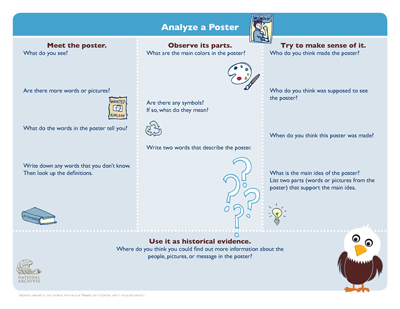
For a poster, look especially at:
- the largest words or slogan;
- the object, person, or group placed at the centre;
- symbols and their likely associations;
- contrast, such as clean versus polluted or safe versus dangerous;
- what is exaggerated, absent, or made visually important.
Imagine a poster with a large image of a reusable bottle standing beside a beach covered in plastic litter. Its slogan reads: “One habit, less plastic.”
You might make these observations:
- a reusable bottle is central and appears clean;
- discarded plastic surrounds the beach;
- the slogan connects a personal habit with less waste.
A weak response would be:
“The poster shows plastic on a beach.”
That is an observation, not the message.
A stronger response would be:
The poster conveys that people can help reduce plastic pollution by choosing reusable bottles instead of disposable ones.
Notice that the answer turns visual details into a claim. It does not need to describe every object in the poster.
The following sections of Mr Seow’s video demonstrate this exam skill for both written and cartoon sources. The first part defines message as the overall argument rather than an answer to a narrow question. The later example shows how a cartoon’s separate visual details combine into one criticism.
Skill: Message and Purpose (Social Studies)
Watch “Skill: Message and Purpose” by Mr Seow (History & Social Studies). It is closely aligned with Social Studies source-based questions and shows how to build a main-message statement from several linked ideas.
Start with defining message to see why a message question requires the source’s broad central argument. Then watch linking ideas, focusing on the method of joining related observations into one claim when more than one idea seems important. Finally, watch the cartoon example. Notice how the contrast between an expected soldier and a recruit doing chores becomes a message about disappointment and inadequate training, rather than remaining a list of visual observations.
A worked cartoon example
Imagine a cartoon about housing. On the left, a government official holds a shiny model flat beneath a large sign saying “Promise.” On the right, a family stands in heavy rain outside a leaking, unfinished building labelled “Reality.”
Start by separating observation from meaning.
| What you observe | What it may suggest |
|---|---|
| A shiny model flat under “Promise” | The official presents an attractive plan. |
| A leaking unfinished building under “Reality” | Actual housing conditions are poor. |
| A family is outside in the rain | Residents suffer from the failure. |
| The contrast between panels | There is a gap between official claims and actual results. |
A weak main message:
“The cartoon shows houses.”
This gives only the topic.
Another weak response:
“The official is holding a model flat while the family is in the rain.”
This accurately describes the cartoon but does not interpret it.
A strong main message:
The cartoon criticises the government for making attractive housing promises that do not match the poor living conditions experienced by residents.
This works because it includes:
- the issue: housing;
- the viewpoint: criticism of the government;
- the central contrast: promises versus reality;
- the consequence: residents face poor conditions.
It also uses original wording rather than merely repeating the labels “Promise” and “Reality.”
A final check before you write
Before committing to a main-message answer, use this brief check:
| Check | What to ask yourself |
|---|---|
| Whole source | Does my sentence account for the source overall, not just one detail? |
| Claim | Have I said what the creator thinks, argues, praises, criticises, or suggests? |
| Accuracy | Does my wording match the source’s strength and tone? |
| Own words | Have I interpreted rather than copied a whole phrase or sentence? |
| No purpose drift | Have I stated the point of the source without adding what the creator wanted the audience to do? |
If the question asks only for the message, a precise one-sentence answer is often better than a long paragraph full of description. However, always return to the question command and mark allocation, as you practised in the first lesson. If the question specifically asks for evidence or explanation, you must meet those extra requirements.
Key takeaways
A source’s main message is its central argument, not merely its topic, a quotation, or one memorable detail.
To identify it:
- identify the topic;
- determine the creator’s overall direction or viewpoint;
- group related words, details, or visual features;
- state the resulting claim in one accurate sentence using your own words.
For visual sources, move from what you can see to what those details collectively mean. For written sources, translate the author’s language into a clear claim without changing its meaning or certainty.
Next, you will build on this skill by selecting precise source evidence that supports your interpretation.
Can't find a good explanation? Sign up and we'll make it for you
Sign up