
Welcome back. In the previous lesson, you used a RACI matrix to clarify who owns specific onboarding decisions and deliverables. That matrix becomes real at the moment an account changes hands: the post-sale handoff.
A handoff is not a calendar invite, an introduction email, or a dump of CRM notes. It is a controlled transfer of customer understanding from the people who sold the solution to the people responsible for helping the customer realize value. Done poorly, it forces the customer to repeat themselves, hides commercial promises, and turns the kickoff into rediscovery. Done well, it preserves momentum while making uncertainty visible and actionable.
In this lesson, you will learn to produce a handoff document that preserves five essentials:
- Customer context — why they bought and what problem triggered the purchase.
- Success criteria — what observable result counts as value.
- Stakeholders — who pays, decides, administers, influences, and may block progress.
- Commitments — what was contractually agreed, promised, implied, or still needs clarification.
- Risks and gaps — what could prevent a credible launch or first-value milestone.
By the end, you will be able to structure, quality-check, and confidently discuss a post-sale handoff in a SaaS interview or operating review.
The handoff’s real purpose: transfer understanding, not ownership alone
Sales has learned something expensive during discovery: the customer’s language, politics, urgency, alternatives, constraints, and definition of success. If that knowledge stays in an Account Executive’s memory, the company effectively starts over after every closed-won deal.
The immediate cost is awkward: a CSM asks, “What are you hoping to achieve?” after the customer spent three discovery calls explaining it. The deeper cost is operational. Technical requirements emerge late, an informal promise resurfaces during implementation, or the actual executive sponsor never appears again.
A strong handoff lets the post-sale team begin with three kinds of truth:
| Type of truth | What it answers | Example |
|---|---|---|
| Customer truth | What does the customer need and why now? | “Our compliance team spends two days each month compiling audit evidence.” |
| Commercial truth | What did the customer purchase and under what terms? | “Enterprise plan, 80 seats, one standard HRIS integration, annual term.” |
| Delivery truth | What must happen, who must act, and what could derail it? | “SSO needs the customer’s IT lead; security review must finish before the June deadline.” |
These truths overlap, but they are not interchangeable. A signed contract does not explain why the customer bought. A discovery note does not prove that a feature was included. And a sales promise does not automatically become an implementation plan.
The receiving team needs all three.
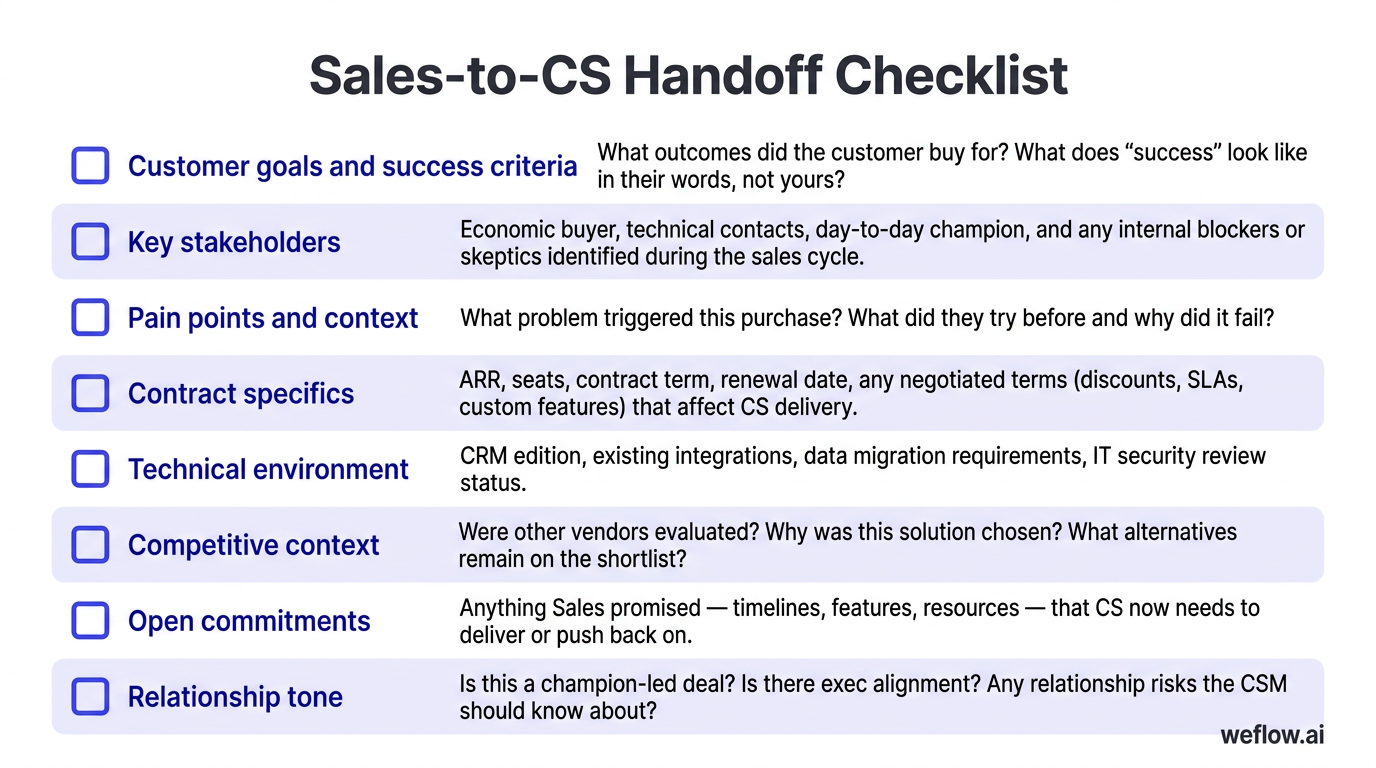
Sales to Customer Success Handoff Checklist for SaaS
Read OnRamp’s discussion of what a strong Sales-to-CS handoff transfers and how an internal handoff meeting protects customer momentum. It reinforces the idea that the receiving team needs context and risk awareness, not merely notes.
In the section “What does a strong sales to customer success handoff look like?”, read the core context CS must receive. Then, in “What is the relationship map — and why does it matter for handoff?”, read the relationship-map guidance. Finish with “What must happen in the internal handoff before customer kickoff?”, from the internal meeting. Focus on the questions that reveal hidden relationship and execution risk.
The Sales-to-CS Handoff Checklist below provides a useful field-level summary. Treat it as a prompt for what must be transferred, not as proof that a handoff is complete merely because every box has text.
Design the document around evidence and uncertainty
A handoff record should be compact enough to use and detailed enough to act on. The most reliable pattern is a structured document in the CRM or connected onboarding workspace, linked to its supporting evidence: discovery recordings, contract or statement of work, technical scoping notes, business case, and relevant customer emails.
Do not paste full call transcripts into the document. A transcript contains raw evidence, not a usable plan. The handoff should summarize what matters and show where that summary came from.
For every important item, capture three things:
- Status: Is it confirmed, unclear, or not discussed?
- Source: Where did this information come from?
- Owner / next action: Who will validate, resolve, or use it?
This is a deceptively important discipline. Teams often treat blank fields as harmless omissions. In reality, a blank may mean at least three very different things:
| Status | Meaning | Appropriate response |
|---|---|---|
| Confirmed | The customer explicitly stated it or confirmed it in writing. | Use it to prepare the onboarding plan. |
| Unclear | It was discussed but remains unresolved or contradictory. | Log the gap, assign an owner, and set a resolution point. |
| Not discussed | There is no reliable evidence that the topic was covered. | Do not invent an answer; validate it before or during kickoff. |
For example, suppose an AE’s notes say “Customer needs SSO,” while the contract contains no implementation scope for SSO and no technical call occurred. “SSO needed” is confirmed as an expectation only if the customer stated it clearly; its requirements and delivery plan are still unclear. Calling the whole item “confirmed” creates false confidence.
This distinction lets a handoff carry uncertainty forward without concealing it.
Sales-to-CS handoff: Playbook, template, and checklist
Read Avoma’s practical workflow and handoff-document structure. It is especially useful for seeing a handoff as an accepted or returned operational deliverable rather than an informal transfer of notes.
Start in “What is a Sales-to-CS handoff process?” and read the six-step workflow. Next, in “The Sales-to-CS handoff document: structure, example, and acceptance checklist,” read the status model, followed by the eight sections. Finally, in “How to handle gaps and risk before and during kickoff?”, read the four gap categories and note which ones should halt a kickoff versus become owned follow-up work.
The anatomy of a usable SaaS handoff
A durable handoff document usually has eight sections. The exact labels may vary by company, but removing any one of these creates a predictable failure mode.
1. Customer overview and purchase trigger
Begin with a short, factual account narrative:
- Who is the customer: industry, size, operating environment, relevant team?
- What triggered evaluation now?
- What had they tried before?
- Why did they choose this product rather than maintaining the status quo or selecting an alternative?
This section prevents generic onboarding. “Customer wants to improve efficiency” is not useful context. “The prior workflow is being retired on September 30, leaving the payroll team unable to produce a weekly exception report” is useful context because it gives the team a business event, affected users, and urgency.
2. Desired outcomes and success criteria
This is the most important section because it anchors onboarding in value rather than setup.
Record the outcome in the customer’s own terms, then translate it into testable success criteria. A strong entry includes:
- the desired business or operational change;
- the user group affected;
- baseline and target where available;
- time frame;
- evidence that will show the outcome occurred;
- the first-value milestone that onboarding should aim to reach.
| Weak entry | Strong entry |
|---|---|
| “Improve reporting.” | “Within 45 days, the Operations team produces its weekly capacity report from the platform rather than consolidating spreadsheets. The Operations Director validates that the report is usable for Monday planning.” |
| “Increase adoption.” | “By the end of the first month after launch, 35 named managers complete the approval workflow weekly, measured by completed approvals in product data.” |
Remember the earlier distinction: a configured account is not the same as a customer receiving value. The handoff should make that distinction visible before the onboarding plan is built.
3. Use case, scope, and exclusions
This section translates the purchase into what onboarding will actually deliver.
Document:
- primary use case and any secondary use cases;
- products, modules, seat counts, or service package purchased;
- rollout group or implementation phase;
- configuration required;
- explicitly excluded use cases or deferred phases;
- contract terms that affect delivery, such as service levels, a paid implementation package, or custom terms.
The phrase “scope” should never mean “whatever the customer believes is included.” It should mean the supported, mutually understood set of deliverables connected to the contract or statement of work.
Explicit exclusions are particularly valuable. If financial reporting is planned for phase two, write that down. It is far better to manage a known deferral than discover later that different teams assumed it was part of initial launch.
4. Technical environment and delivery dependencies
Technical context must be legible to Implementation, Solutions, and Support—not merely “integration needed.”
Capture, at the appropriate level of detail:
- systems to integrate and intended data flow;
- SSO, security, legal, or procurement requirements;
- data migration scope and data-quality concerns;
- technical contacts on the customer side;
- required approvals, access, or test environments;
- assumptions from pre-sale scoping;
- dependencies that only the customer can complete.
A useful test is: could an Implementation Lead identify what needs technical validation before committing to a launch date? If not, the entry is too vague.
5. Stakeholder and relationship map
A list of names is not a stakeholder map. The receiving team needs to understand each person’s role in the buying and adoption system.
At minimum, identify:
| Stakeholder role | Why it matters |
|---|---|
| Economic buyer / budget owner | Can protect funding and influence renewal or expansion. |
| Executive sponsor | Connects the work to organizational priority and resolves cross-team barriers. |
| Day-to-day champion | Drives internal momentum and often coordinates the customer’s tasks. |
| Administrator | Controls setup, access, and operational configuration. |
| Technical owner | Manages integrations, security, data, or identity requirements. |
| End users / team leads | Must change behavior for the customer to realize value. |
| Skeptic, blocker, or alternative sponsor | May resist the change, prefer another solution, or expose risk early. |
For each person, document more than job title: their influence, stance, expectations, availability, and relationship history. “VP Finance, executive sponsor, wants a 30-day executive update; supportive but has limited time” is operationally meaningful. “VP Finance” is not.
Be candid but professional. Replace vague or judgmental notes such as “difficult stakeholder” with observable facts: “The IT Director declined a meeting until security documentation is reviewed; security approval is on the critical path.”
6. Timeline, milestones, and customer dependencies
Record dates with their source and degree of confidence. A “go-live by July” may be a hard deadline tied to a regulatory event, a desired target, or an unsupported promise made during negotiation. Those require very different responses.
Document:
- contract signature and onboarding start;
- desired or committed launch date;
- fixed customer business events;
- rollout phases;
- customer-side actions and owners;
- dependencies and their latest acceptable completion dates.
At this point, you are not building the full mutual action plan yet. You are preserving the timeline assumptions from sales so the onboarding team can validate and convert them into a credible plan.
7. Commitments and commercial promises
This section deserves its own treatment because many handoffs fail here. A promise made in a call can be as consequential to the customer as a term in the contract, even when it is not enforceable in the same way.
Log each commitment separately:
| Field | Example |
|---|---|
| Commitment | “A configuration workshop will occur in the first 10 business days.” |
| Source | Customer email dated May 4; AE call summary. |
| Type | Contractual, service commitment, product expectation, or informal statement. |
| Status | Confirmed, unclear, or disputed. |
| Delivery implication | Requires an Implementation consultant in week one. |
| Owner / decision | Implementation Lead confirms capacity by May 9. |
| Customer communication | CSM confirms date after capacity is validated. |
Do not silently normalize a promise into a vague “expectation.” If a commitment is unsupported, out of scope, or infeasible, the handoff must expose it early enough for Sales and post-sale leaders to decide how to address it. Hiding it simply transfers the conflict to the CSM or implementation team later.
8. Risks, gaps, and open questions
A handoff does not need to be perfect before it can be useful. It does need to be honest about what remains unknown.
Separate a risk from a gap:
- A gap is missing or unresolved information: “Migration volume has not been scoped.”
- A risk is a plausible event that could harm outcomes: “The customer’s IT team has a six-week security-review queue, which may prevent the June launch.”
The most common handoff risks fall into four categories:
| Category | Typical example | Likely response |
|---|---|---|
| Scope | Customer assumes a custom dashboard is included. | Confirm scope in writing; involve Sales if expectations conflict. |
| Technical | Data migration or integration requirements remain undefined. | Scope with Solutions or Implementation before committing dates. |
| Stakeholder | No customer owner exists for implementation decisions. | Ask the AE to secure and introduce an accountable customer owner. |
| Timeline | Go-live depends on a business event not surfaced during sales. | Validate date, dependencies, and trade-offs with the customer. |
A risk log turns these insights into a managed operating object.
| Risk or gap | Category | Severity | Resolution point | Owner | Current status |
|---|---|---|---|---|---|
| SSO requirements not documented | Technical gap | High | Before kickoff | Solutions Lead | Unclear |
| Customer IT review may take six weeks | Timeline risk | High | Before launch plan is approved | Customer Technical Owner, coordinated by CSM | Open |
| Executive sponsor has not met post-sale team | Stakeholder risk | Medium | At kickoff | CSM | Open |
| Phase-two analytics scope is not yet detailed | Scope gap | Low | During onboarding planning | CSM | Not discussed |
Use severity consistently:
- Blocking: The post-sale team cannot responsibly accept or plan the account.
- High: Scope, feasibility, customer expectation, or timeline may be materially affected.
- Medium: The handoff can proceed if the item has an owner and resolution point.
- Low: The item can be resolved during normal onboarding without endangering kickoff readiness.
The key is not to eliminate every low-priority unknown. The key is to prevent unknowns from masquerading as facts.
Make handoff acceptance a decision, not a courtesy
The previous lesson’s RACI answers who is responsible and accountable. The handoff process answers when the receiving team may accept responsibility.
A practical workflow looks like this:
- Capture during sales. The AE adds context, commitments, stakeholders, and risks as they arise—not after the deal closes.
- Compile from evidence. Populate the handoff record using CRM fields, discovery artifacts, technical notes, customer correspondence, and the contract.
- Review commercial accuracy. The AE checks that the document reflects what was discussed and purchased.
- Review for delivery readiness. CS and/or Implementation assess scope, requirements, dependencies, and open risks.
- Accept, accept with open items, or return. The receiving team records a clear decision.
- Use the accepted record to build kickoff. Kickoff validates known items and resolves only the questions that genuinely remain.
A handoff should be returned when a blocking or high-severity gap has no resolution point. Common examples include:
- no accountable customer owner for the work;
- an unscoped integration that is essential to the promised use case;
- a major conflict between the customer’s expectation and signed scope;
- an immovable launch deadline with no validated delivery path.
It may be accepted with open items when medium- or low-severity uncertainties have an owner and a date or event by which they will be resolved.
This prevents two dysfunctional extremes:
- Perfectionism: delaying every onboarding until every possible detail is known.
- Optimism theater: accepting incomplete deals and assuming the post-sale team will “sort it out.”
Worked example: completing a handoff record
Consider HarborPoint Logistics, a 400-person logistics firm that has purchased a workflow SaaS platform.
During discovery, Sales learned that dispatch supervisors currently compile delivery-exception updates from several spreadsheets. The customer wants a single daily exception workflow before peak season. They bought 60 seats, standard configuration, one integration to their transportation-management system, and a paid onboarding package.
Below is what a strong abbreviated handoff could look like.
| Section | Status and source | Handoff entry | Owner / next action |
|---|---|---|---|
| Customer overview | Confirmed — discovery call | Current spreadsheet process produces delayed exception reporting. Peak season begins September 1. | CSM uses this context in kickoff. |
| Desired outcome and success criterion | Confirmed — customer email | By August 15, 25 dispatch supervisors complete the live exception workflow daily; Dispatch Director reviews the dashboard each morning. | CSM verifies first-value evidence after launch. |
| Scope and exclusions | Confirmed — order form and discovery notes | 60 seats, standard configuration, one transportation-management-system integration. Financial forecasting is phase two and not part of initial onboarding. | Implementation plans phase one only. |
| Technical environment | Unclear — technical discovery | Customer requires SSO. Integration API access was discussed, but data fields and authentication method were not confirmed. | Solutions Lead scopes API and SSO before kickoff. |
| Stakeholders | Confirmed — discovery call | Economic buyer: COO. Executive sponsor: Dispatch Director. Champion: Operations Systems Manager. Technical owner: IT Integration Manager. Potential blocker: Security Manager requires vendor documentation before approval. | CSM includes sponsor and technical owner in kickoff; sends security materials through approved channel. |
| Timeline | Unclear — AE notes | Customer requested August 15 launch due to peak season, but delivery feasibility has not been validated. | Implementation Lead validates plan after technical scope. |
| Commitments | Unclear — AE call summary | AE stated that the company would “help configure supervisor workflows.” Paid onboarding includes configuration workshops, but workshop count and timeline are not yet confirmed. | AE and Implementation Lead reconcile commitment with purchased package before kickoff. |
| Risks and gaps | High — internal handoff review | SSO, integration scope, and security review may delay the August milestone. | Create risk-log items with owners and resolution points. |
Notice what this example does not do:
- It does not claim that August 15 is a committed go-live date.
- It does not pretend SSO and the integration are fully scoped.
- It does not bury the AE’s workflow-support statement in a generic notes field.
- It does not describe “success” as account configuration.
It preserves the customer’s urgency and intended value while protecting the post-sale team from making unsupported commitments.
Run the internal handoff meeting as a risk review
The document is the system of record; the internal handoff meeting is where the team turns it into coordinated action. For a moderate- or high-touch account, Sales and the post-sale owner should hold a dedicated review before customer kickoff.
A focused agenda takes roughly 20–30 minutes:
- Why did the customer buy? Sales explains the customer’s trigger, desired outcome, and decision logic.
- What does success look like? The receiving owner reads back the planned value milestone and checks for ambiguity.
- Who matters? Review economic buyer, sponsor, champion, technical owner, end users, and relationship risks.
- What was sold or said? Compare commitments and assumptions against contract and scope.
- What could cause failure? Discuss technical, scope, stakeholder, and timeline risks.
- What remains open? Assign owners, severity, and resolution points.
- What happens next? Decide acceptance status, confirm customer introduction, and prepare kickoff.
One question is especially useful:
Why might this customer fail to realize value even if the product works as designed?
It moves the conversation beyond product setup. Answers may expose lack of executive sponsorship, insufficient customer capacity, weak change management, a missing data owner, or a timeline chosen for political rather than operational reasons.
The external transition should then maintain confidence. Ideally, the kickoff is scheduled before or immediately after the warm introduction. The customer should see continuity: Sales remains visibly supportive where appropriate, while the CSM or Implementation Lead becomes the clear day-to-day owner.
Quality control: audit a handoff before it reaches the customer
Before accepting the handoff, use this review standard.
Context and value
- Is the purchase trigger clear and specific?
- Can the post-sale owner explain the customer’s desired outcome in the customer’s language?
- Does success include observable evidence, a user group, and a time frame?
- Is the initial value milestone distinct from technical setup tasks?
Scope and commitments
- Do purchased products, services, and exclusions match the contract or statement of work?
- Are technical requirements documented at a level suitable for validation?
- Does each important commitment have a source and an owner?
- Are informal assurances clearly labeled instead of quietly treated as contracted scope?
People and risk
- Are the executive sponsor, economic buyer, champion, administrator, and technical owner identified where relevant?
- Are stakeholder influence and relationship risks captured factually?
- Are high-severity technical, scope, stakeholder, or timeline gaps assigned before kickoff?
- Does every open item have a resolution point?
Process integrity
- Has the receiving team explicitly accepted, conditionally accepted, or returned the handoff?
- Is there one accessible system of record rather than conflicting notes across a CRM, Slack, and personal documents?
- Does the kickoff agenda reflect what is already known and what requires customer validation?
This kind of audit is also how a SaaS organization improves the handoff over time. Repeated missing fields, returned handoffs, and late-discovered commitments are not merely individual mistakes; they are process signals. They may indicate weak discovery, poor CRM design, misaligned Sales incentives, an unclear packaging model, or insufficient technical qualification before close.
Key takeaways
A post-sale handoff is a structured transfer of context, commercial truth, delivery reality, and managed uncertainty.
- Preserve the customer’s purchase trigger, desired outcome, measurable success criteria, scope, technical environment, stakeholders, timeline, commitments, and risks.
- Distinguish confirmed, unclear, and not discussed information. Uncertainty should be logged and owned, not guessed away.
- Treat commitments as individual records with a source, classification, delivery implication, and owner.
- Build a true stakeholder map: identify decision power, day-to-day execution, technical control, sponsorship, and potential resistance.
- Use a severity-based risk and gap log. Blocking and unowned high-severity issues should trigger return or escalation rather than a casual acceptance.
- Make handoff acceptance explicit, then use the accepted record to create a kickoff that advances the customer’s value path rather than repeats discovery.
In the next lesson, you will use these handoff and ownership concepts to diagnose why an onboarding failed—separating expectation, process, product, and change-management gaps.
Can't find a good explanation? Sign up and we'll make it for you
Sign up