
Welcome back. In the previous lesson, you saw that a full-range constant-product LP position changes its token composition as relative prices move: an ETH/USDC LP sells ETH into an ETH rally and accumulates ETH during a decline. The resulting shortfall relative to holding the original assets is impermanent loss.
That price effect is only one part of the LP result. This lesson separates the three quantities often collapsed into a single advertised “APR” or “yield”: trading-fee returns, impermanent loss, and token-incentive returns. By the end, you should be able to inspect a pool’s return claims and identify what actually generated them.
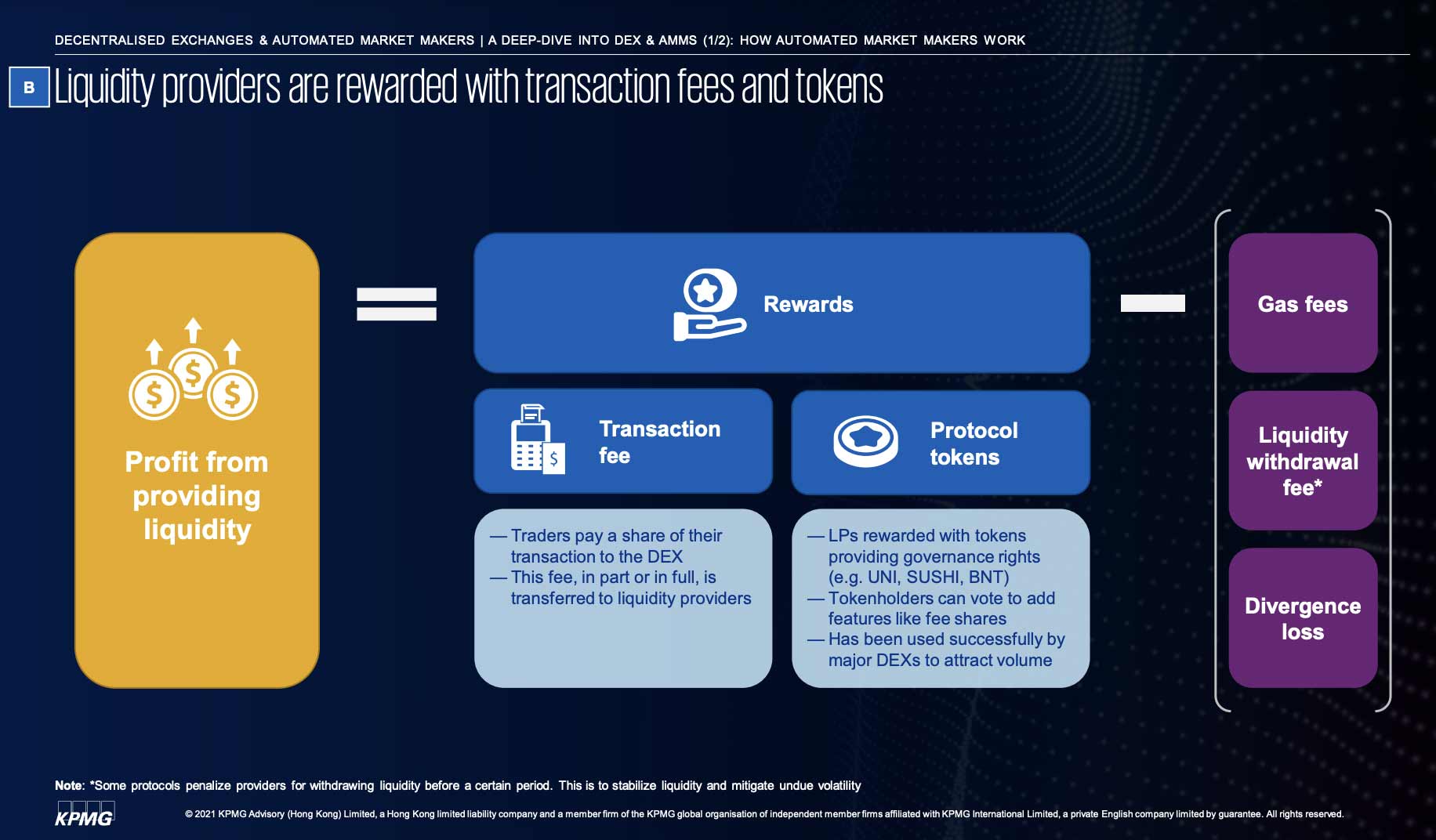
Three distinct economic mechanisms
An LP can finish with a profit, a loss, or an apparently attractive yield for different reasons. The key is to ask four questions for each return component:
- Who pays it?
- What event produces it?
- How is it measured?
- What risks can change its value?
| Component | What it is | Who ultimately provides it? | Main driver |
|---|---|---|---|
| Trading-fee return | Your share of swap fees paid to trade through the pool | Traders | Trading volume, fee tier, your liquidity share |
| Impermanent loss | LP underperformance relative to holding the deposited assets | No one explicitly pays it; it arises from AMM rebalancing | Relative price divergence |
| Token-incentive return | Extra tokens distributed for supplying liquidity or staking LP tokens | Protocol treasury, newly issued tokens, or reward budget | Emission rate and reward-token value |
The distinction matters because these components mean very different things.
Trading fees are organic revenue from usage
Every swap normally includes a fee. The trader pays it as part of execution, and the portion allocated to LPs belongs to the pool’s liquidity providers according to their shares. In some AMMs, fees remain in the pool and increase the value of the LP claim; in others, they accrue separately and must be collected.
A simplified representation is:
This is called organic yield because it depends on users actually paying for a market service: exchanging one token for another.
Importantly, trading volume alone is not fee income. A pool may process high volume but have:
- a very low fee tier;
- intense competition from other pools;
- a protocol-level fee that diverts part of the fee stream away from LPs;
- so much liquidity that your individual share is small.
Impermanent loss is a relative-performance measure
Impermanent loss is not a fee charged by the protocol, and no separate “IL transaction” removes funds from your wallet. It is the difference between:
- the value of your rebalanced LP position; and
- the value of the original token quantities had you simply held them.
For the ETH/USDC example from the prior lesson, you began with:
When ETH rose from USDC to USDC, holding would be worth:
The fee-free LP claim was worth approximately:
So the impermanent-loss component was:
That USDC is not necessarily an absolute loss on the original deposit. The LP position may still have increased in dollar terms. It is specifically an opportunity cost relative to holding as ETH appreciated.
Token incentives are subsidies, not trading revenue
A protocol can distribute additional tokens to LPs to attract liquidity. This practice is often called liquidity mining or yield farming. For example, an LP may receive a governance token every block, day, or epoch, either directly or after staking an LP receipt token in a separate rewards contract.
The source of those rewards is not necessarily trading demand. They may come from:
- newly minted tokens, which increase token supply;
- tokens previously allocated to a treasury;
- tokens reserved for a time-limited incentive campaign.
Thus, a reward-token APR may be economically real to the recipient while still being a subsidy from the protocol’s perspective. If rewards are funded by new issuance, existing token holders bear dilution; if funded from a treasury, the treasury balance is being spent.
Why a headline APY can mislead
A dashboard might show a pool offering 40% APR. That number may combine fee estimates and reward-token emissions without showing their sources separately.
Suppose the advertised 40% consists of:
| Advertised component | Annualized estimate |
|---|---|
| Trading-fee APR | 6% |
| Reward-token APR | 34% |
| Displayed total APR | 40% |
The pool is not necessarily generating a 40% return from exchange use. Only the 6% fee portion reflects traders paying for swaps at the observed rate. The remaining 34% depends on a reward program continuing and on the reward token retaining its assumed market price.
A useful mental model is:
Costs can include gas, bridge costs, claim costs, swap costs required to rebalance rewards, and any protocol-specific deposit or withdrawal fee.
This is a valuation framework, not a universal smart-contract accounting identity. Fees may accumulate inside pool reserves, fee levels can affect pool state, reward tokens may not yet be claimable, and values vary with time. Still, the decomposition prevents a basic analytical mistake: treating every positive line item as the same kind of yield.
What is Liquidity Mining? DeFi rewards, risks, and examples
Read “Liquidity mining: fee income vs. token emissions” from Cube Exchange to sharpen the distinction between fee-based yield and reward-token subsidies.
In the section “Fee income vs. token emissions: which makes liquidity sustainable?”, begin with the comparison table. Then read the explanation of organic and subsidized yield. Focus on why fee income signals actual pool use, whereas emissions can be useful for bootstrapping but may not persist.
The practical implication is not that incentives are inherently bad. Incentives can be rational when a new pool needs liquidity before it can provide good execution and attract organic volume. The analytical question is narrower:
If incentive payments decline or end, will users still trade enough for fee income to compensate LPs for the risk they bear?
A complete worked return decomposition
Return to the earlier position, valued when ETH is USDC.
| Item | Value in USDC | Meaning |
|---|---|---|
| Hold benchmark | Value of holding ETH and USDC | |
| Fee-free LP claim | LP value after price-driven AMM rebalancing | |
| Trading fees earned | Value of the LP’s share of swap fees | |
| Reward tokens earned | Current market value of incentive tokens | |
| Gas and claim costs | Costs of entering, exiting, or claiming |
A stylized final value is:
Relative to holding:
The LP outperformed holding by USDC in this scenario. But that conclusion should not be phrased as “there was no impermanent loss.” The components remain distinct:
| Component relative to holding | Value in USDC |
|---|---|
| Impermanent loss | |
| Trading-fee return | |
| Token-incentive return | |
| Costs | |
| Net result relative to holding |
Fees and incentives offset impermanent loss financially; they do not eliminate the underlying price-divergence exposure.
This distinction becomes especially important if the reward token falls in price. If the reward tokens in the example are later worth only USDC rather than USDC, the same position becomes:
The LP would then underperform holding despite the same swap activity and the same nominal number of reward tokens received.
What each component tells you about a pool
Each return component answers a different question about the protocol and market.
Fee return: “Are traders using this liquidity?”
A meaningful fee stream can indicate demand for the pool’s service. To assess it, examine:
- swap volume over a relevant time window;
- the pool’s fee tier;
- liquidity depth and your share of it;
- whether some fees go to a protocol treasury rather than LPs;
- whether the volume is persistent or driven by a temporary event.
High volume is not automatically good. Some volume can be highly volatile, incentive-driven, or generated by arbitrage. But fees paid by traders are fundamentally different from rewards printed by the protocol.
Impermanent loss: “How much relative-price risk is this inventory strategy bearing?”
For a full-range constant-product pool, impermanent loss grows as the price ratio of the two assets diverges. It is generally small for tightly correlated assets and potentially substantial for a volatile token paired against a stablecoin.
The prior lesson’s formula remains the reference point:
where is the current relative price divided by the relative price at deposit.
The formula measures the fee-free effect. It tells you nothing about whether actual fees or rewards were sufficient compensation.
Incentive return: “What subsidy is the protocol paying, and for how long?”
A reward-token value depends on more than the number of tokens distributed. Review:
- the tokens emitted per day or per block;
- the end date, reduction schedule, or governance-controlled nature of emissions;
- whether rewards vest or can be immediately sold;
- the liquidity and market value of the reward token;
- the token’s dilution from ongoing emissions;
- whether the reward must be staked, locked, or compounded.
A 100% incentive APR can collapse even if the protocol keeps distributing exactly the same number of tokens: the reward token’s market price may simply fall. Conversely, an incentive program that pays fewer tokens may retain value if the token price rises. Token count and token value must be treated separately.
How DeFi liquidity pool works: Yield farming, Liquidity mining and Token swap
Watch “How DeFi liquidity pool works: Yield farming, Liquidity mining and Token swap” by Susan Creation for a compact visual summary of how swap fees and extra protocol-token rewards are intended to compensate LPs.
Watch LP compensation. Focus on the sequence of ideas: traders pay swap fees, LPs receive a proportional share, fee income may or may not exceed divergence loss, and some protocols add separate token rewards through liquidity mining.
A disciplined way to evaluate pool yield
When a pool displays a total APR, do not begin with the total. Reconstruct it from components.
1. Establish the correct benchmark
Record the quantities deposited, not just their dollar value. The relevant comparison is usually the value of holding those original token quantities at the current price.
For a deposit of ETH and USDC:
where is the current ETH price in USDC.
2. Separate fee APR from incentive APR
Ask whether the dashboard shows:
- a historical fee yield based on recent volume;
- a projected fee yield based on annualizing a short period;
- a reward-token yield based on current token price;
- a combined total that assumes both components continue unchanged.
Annualizing a single day of unusually high volume or an unusually high token price can produce a large number with little predictive value.
3. Value rewards realistically
For incentive tokens, distinguish:
- accrued tokens, which may not yet be claimable;
- claimable tokens, which you can withdraw;
- market value, which depends on a price that can move;
- realizable value, which may be lower if selling a large amount incurs price impact.
A reward is not the same as a stablecoin payment. It introduces another asset exposure.
4. Treat fees as compensation, not a guarantee
Trading fees are earned because the LP makes execution available to traders. The same activity that produces fees can coexist with significant price divergence and impermanent loss. A volatile pool with high fees may be attractive, but only after comparing both quantities over the same time window.
5. Include operational costs
For a small position, gas and transaction costs can dominate nominal yield. On a multichain position, bridge fees and the operational risks of moving funds may also matter. A correct net-return estimate subtracts costs rather than hiding them outside the APR calculation.
Common category mistakes
A few statements are worth rejecting immediately:
-
“Impermanent loss is the fee I pay for using the pool.”
No. It is a relative-performance shortfall caused by the AMM’s changed asset composition after price divergence. -
“The protocol’s 50% APR is its revenue.”
Not necessarily. The figure may be mostly reward-token emissions rather than fees paid by traders. -
“My fee income proves that liquidity provision was profitable.”
Not by itself. Fees must be compared with impermanent loss, incentive value, and costs. -
“Token rewards make a pool safe from impermanent loss.”
No. They are additional compensation whose own market value and duration are uncertain. -
“If I made a dollar profit, impermanent loss did not occur.”
Not necessarily. You can be profitable in absolute terms while still underperforming the original assets held outside the pool.
Key takeaways
Liquidity-provider returns are best treated as a decomposition, not one yield number.
- Trading fees are paid by traders and reflect usage of the pool. They are organic revenue for LPs, subject to the fee tier, trading volume, liquidity share, and any protocol fee allocation.
- Impermanent loss is the LP position’s shortfall relative to holding the original assets. It results from AMM rebalancing during relative-price divergence; it is not a separately charged protocol fee.
- Token incentives are additional protocol-funded rewards. They can bootstrap useful liquidity, but they are not evidence of durable fee demand and expose the LP to the reward token’s price, dilution, and emission schedule.
- A meaningful net comparison values every component at the same point in time:
Next, you will examine how concentrated liquidity changes this trade-off: capital can earn fees more efficiently inside an active price range, but the LP’s exposure becomes more range-dependent and requires closer management.
Can't find a good explanation? Sign up and we'll make it for you
Sign up