
Hello! Welcome to your next lesson on Product-Led Growth (PLG) flywheels.
In our last session, we analyzed Loom's growth model, seeing how the act of asynchronous communication itself becomes a viral loop. The medium was the marketing.
Today, we shift our focus to a company that is a canonical example of explosive PLG: Dropbox. Our learning outcome is to examine Dropbox's dual growth strategy, combining a file-sharing viral loop with an incentivized referral program to drive user acquisition.
We will deconstruct two distinct but interconnected flywheels. The first is an organic loop, inherent to the product's core function of sharing files. The second is an engineered loop, a deliberately designed referral system that supercharged their growth. This case is a masterclass in how to layer growth mechanisms for a synergistic effect.
1. The Foundation: A Product People Needed
Before any growth flywheel can spin, there must be a compelling reason for it to start. In the mid-2000s, moving files between computers was cumbersome, involving USB drives, email attachments with size limits, or complex FTP clients. Dropbox solved this with a deceptively simple proposition: a "magic folder" that was always in sync across all your devices.
This addressed a real, widespread pain point. The initial demand was validated not with a full product, but with a simple demo video targeted at early adopters on Hacker News. This video drove the waitlist from 5,000 to 75,000 overnight, confirming immense product-market fit before the major growth engineering began.
With this foundation, Dropbox was perfectly positioned for a Product-Led Growth (PLG) strategy.
Going Viral: How Dropbox Used a Product Led Growth ...
To understand the strategic framework Dropbox used, let's read an analysis from Openview Partners, a venture capital firm that specializes in PLG. This article, 'Going Viral: How Dropbox Used a Product Led Growth Strategy...', explains the core tenets of their approach.
Please read the sections 'PLG’s Bottoms-up Approach – Is It Right for You?' and 'Dropbox’s One-two PLG Punch'. Focus on the three criteria for a PLG strategy and how Dropbox's 'one-two punch' maps to the two distinct growth loops we're examining.
As the article highlights, Dropbox's strategy was a "one-two punch." Let's break down each part.
2. Punch One: The Organic File-Sharing Loop
The first flywheel is built directly into the product's core use case: collaboration. When you need to share a large file or a folder of files with someone, the easiest way to do it with Dropbox is to... share it via Dropbox. This creates an organic, self-propagating loop.
This loop is often called an "embedded" or "product" loop because the act of using the product is what drives exposure and acquisition. It works like this:
- Create/Share: An existing user shares a file or folder with a non-user.
- Exposure: The non-user receives an email with a link to the shared content.
- Value Experience: They click the link and can immediately view or download the file, experiencing the product's value (easy file access) without friction.
- Conversion: To collaborate on the file or save it to their own cloud storage, the non-user is prompted to create a free Dropbox account, thus becoming a new user.
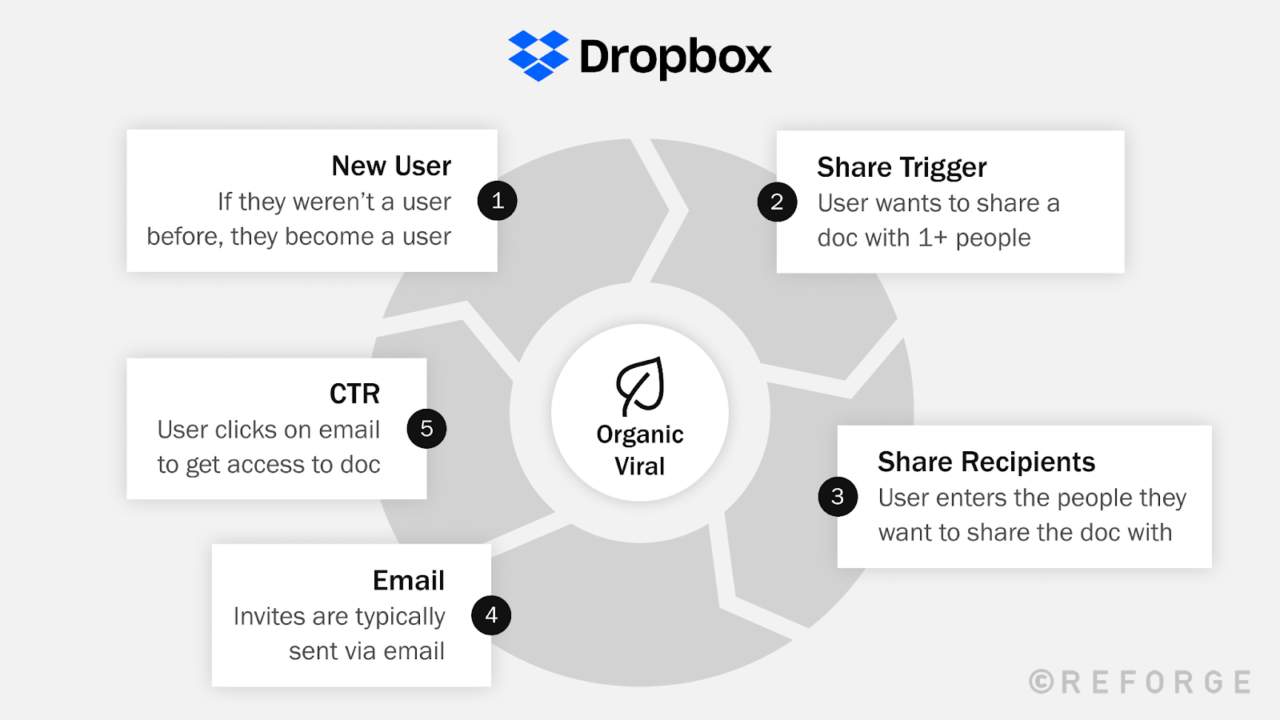
This loop is powerful because it's driven by user intent, not a marketing campaign. It's a natural consequence of the product's utility. The "viral factor" mentioned in the Openview article is this very mechanism. Shared folders, in particular, are "broken without your friends," making collaboration the primary driver of virality.
3. Punch Two: The Incentivized Referral Loop
The organic loop created steady growth, but Dropbox wanted to achieve market dominance quickly. They experimented with paid advertising, but as you'll see in the reading below, the economics were unsustainable. Their Customer Acquisition Cost (CAC) via search ads was over $230 for a $99/year product. This negative unit economic situation forced them to find a more scalable and cost-effective channel.
The solution was to engineer a second, explicit flywheel: a two-sided referral program.
How the Dropbox Referral Program Led to 3900% Growth
The article 'How the Dropbox Referral Program Led to 3900% Growth' from Referral Rock provides a fantastic deep-dive into the economics and mechanics of this second flywheel.
Please read the following sections: 'Dropbox referral program: How it began': Note the inspiration from PayPal. 'Referrals: More powerful than paid acquisition': Focus on the CAC analysis. 'How does the Dropbox referral program work?': Understand the basic mechanics. 'The Dropbox viral loop': See how the referral program creates its own loop. 'A deep dive into the Dropbox referral program': This is the most critical section. Pay close attention to the breakdown of why it was so successful, especially the nature of the reward and the integration into onboarding.
The success of this program wasn't accidental; it was the result of meticulous design. Let's watch a short video that summarizes the key tactics.
How to Create a Referral Program With Insane Results in 5 Steps
The video 'How to Create a Referral Program With Insane Results in 5 Steps' by Wishpond offers a concise summary of the key execution details that made Dropbox's program work so well.
Watch the segment from 00:25 to 03:32. As you watch, map the five tips mentioned back to the principles you just read about in the Referral Rock article (e.g., 'Make the referral program part of the onboarding process').
Deconstructing the Referral Flywheel's Success
Based on the resources, we can distill the program's effectiveness down to a few core principles:
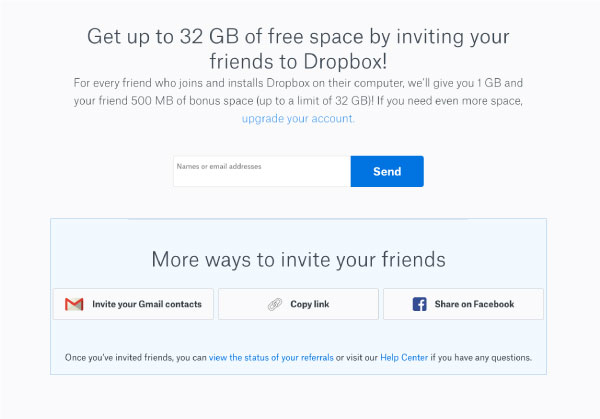
- A Brilliant Incentive: The reward was not cash, but more of the product itself—storage space.
- For Dropbox: The marginal cost of providing extra storage was near zero, making the CAC for referred customers incredibly low.
- For the User: The reward had high perceived value. Users who needed to refer were likely those who were hitting their storage limits, so the incentive directly solved a problem for them. It also increased their dependency on the product, improving retention.
- Double-Sided Motivation: Both the referrer and the new user received bonus space. This removed the social friction of asking friends for something; instead, you were giving them something of value. This is a key lesson from PayPal's original "give $20, get $20" model.
- Seamless Integration: The referral program wasn't hidden on a separate marketing page. It was a core part of the product experience:
- It was a step in the user onboarding checklist.
- A dedicated, easy-to-find tab showed referral status.
- Emails confirming a successful referral immediately prompted the user to invite more friends.
- Frictionless Sharing: Dropbox made it trivial to send invites by integrating with email contact lists (Gmail, Yahoo), providing a unique link, and enabling social media sharing.
4. Synthesis: Two Flywheels are Better Than One
The genius of Dropbox's strategy lies in how these two flywheels worked together.
- The organic file-sharing loop was the engine of discovery and value demonstration. It ensured a constant influx of new users who had already experienced the product's core benefit. This created a large, active, and satisfied user base.
- The incentivized referral loop was the accelerator. It targeted the most engaged and enthusiastic users from the organic loop and gave them a powerful reason and a simple tool to become active evangelists for the product.
The organic loop fed the referral loop with potential advocates. The referral loop then poured high-quality, low-CAC users back into the ecosystem, who would then start their own organic sharing, further fueling the entire system. This synergy created a powerful, compounding growth engine that traditional marketing channels could not match.
Conclusion
In this lesson, we examined Dropbox's iconic dual growth strategy. We saw how they layered a natural, product-embedded viral loop with a brilliantly engineered and incentivized referral program.
Key Takeaways:
- Dual Strategy: Dropbox's growth was not the result of a single hack, but a synergistic system of two flywheels: an organic file-sharing loop and an incentivized referral loop.
- Organic Foundation: The file-sharing loop created a base of users who understood and valued the product, which was essential for the referral program's success.
- Cost-Effective Acceleration: The referral program was a highly efficient alternative to paid marketing, leveraging a low-cost, high-value incentive (storage space) to achieve a very low Customer Acquisition Cost.
- System Design: The success of the referral program hinged on its double-sided nature, its deep integration into the product onboarding and user experience, and the removal of all friction from the sharing process.
In our next module, we will shift our focus from flywheels driven by user-to-user interactions to those powered by data. We'll begin by analyzing the classic data network effect of Google Search and contrast it with the modern feedback loops being built by AI-native products like Perplexity.
Can't find a good explanation? Sign up and we'll make it for you
Sign up