
Hello! Welcome to the penultimate lesson of your course.
In our last session, we focused on how to construct a professional vulnerability report, covering the five essential components: a descriptive title, a clear summary, a reproducible proof-of-concept, a compelling impact statement, and actionable remediation advice.
One of the key elements we touched upon was assessing a vulnerability's "criticality" or "impact." Today, we will formalize that process. To be a professional, you need to speak the same language as the rest of the industry. The Common Vulnerability Scoring System (CVSS) is that language. It's the global standard for capturing a vulnerability's characteristics and producing a numerical score to reflect its severity.
Our learning outcome for this lesson is to assign a CVSS score to a vulnerability based on its technical characteristics and impact. Mastering this will not only make your reports more professional but will also help you justify higher bounties and better articulate risk to clients.
1. Understanding the CVSS Framework
At its core, CVSS provides a transparent and standardized way to rate vulnerabilities. It generates a score from 0.0 to 10.0, which maps to qualitative severity ratings:
| Severity | CVSS Score Range |
|---|---|
| None | 0.0 |
| Low | 0.1 - 3.9 |
| Medium | 4.0 - 6.9 |
| High | 7.0 - 8.9 |
| Critical | 9.0 - 10.0 |
CVSS is structured into three metric groups:
- Base Metrics: These represent the intrinsic qualities of a vulnerability that are constant over time and across different environments. This is what you, as the finder, are primarily responsible for calculating.
- Temporal Metrics: These reflect characteristics that change over time, such as the availability of an exploit kit or an official patch.
- Environmental Metrics: These account for factors specific to a particular organization's environment, like the presence of mitigating controls or the importance of the affected system.
The Temporal and Environmental scores are typically adjusted by the product vendor or the organization's security team to reflect their specific context. Our focus will be squarely on the Base Score.
Let's watch a short video to solidify these foundational concepts and see where to find the official calculator.
#CVSS Calculator | CVSS V3.X Calculator | CVSS Scoring System
The video '#CVSS Calculator' provides a great introduction to the purpose of CVSS, its severity ratings, and the three metric groups.
Watch from the beginning to 02:43. Pay attention to: The definition of CVSS and the score ranges. How to find the official CVSS calculator on the FIRST.org website. The distinction between the Base, Temporal, and Environmental metric groups.
2. Deconstructing the CVSS v3.1 Base Score
The Base Score is calculated from eight metrics, which can be divided into Exploitability metrics and Impact metrics. We'll use the industry-standard CVSS version 3.1 for our main analysis, as it is still the most widely used.
The article "Bug Bounty Hunting Process" provides a concise, text-based reference for these metrics. It's a useful resource to have open as we go through them.
This article, which you may have seen referenced before, has an excellent section explaining why CVSS is important in a bug report. It also contains a clear breakdown of the CVSS v3.1 Base Metrics.
Briefly read the sections 'Why include CWE & CVSS?' and 'Using the CVSS v3.1 calculator (Base Score focus)'. Keep this page open as a quick reference for the metric definitions.
Now, let's dive into each metric with a more detailed walkthrough.
#CVSS Calculator | CVSS V3.X Calculator | CVSS Scoring System
Let's return to the '#CVSS Calculator' video for a detailed explanation of each of the eight Base Metrics, using a practical example to illustrate the process.
Watch from 02:43 to 14:30. This is the core of the lesson. For each of the eight metrics below, focus on understanding what question it answers. Feel free to follow along using the official FIRST CVSS v3.1 calculator. Exploitability Metrics: Attack Vector (AV): How remote must an attacker be? Attack Complexity (AC): Are there conditions beyond the attacker's control? Privileges Required (PR): Does the attacker need an account? User Interaction (UI): Does the victim need to do something? Impact Metrics: Scope (S): Does the vulnerability impact components beyond its own security authority? Confidentiality (C): Is information disclosed? Integrity (I): Can data be modified? Availability (A): Is the service disrupted?
Understanding the "Scope" Metric
The Scope (S) metric is often the most confusing. Think of it this way: "Does the exploit allow an attacker to break out of the vulnerable component's 'box' and impact a different one?"
- Scope: Unchanged (U): The vulnerability and the impact are contained within the same security authority. For example, a SQL injection that lets you read from the application's own database.
- Scope: Changed (C): The vulnerability allows you to affect a component with a different security authority. The classic example is a Stored Cross-Site Scripting (XSS). The vulnerability is in the server-side application (it fails to sanitize input), but the impact occurs in a completely different component—the victim's web browser. The server vulnerability has escaped its scope to impact the client.
3. Practical Scoring Examples
Let's apply this knowledge to some real-world examples. The "Bug Bounty Hunting Process" article provides excellent, fully-explained CVSS assessments for common web vulnerabilities.
Let's analyze the Stored XSS example from the article together.
Vulnerability: Stored XSS in an admin panel that affects other admins.
CVSS Vector: CVSS:3.1/AV:N/AC:L/PR:H/UI:N/S:C/C:L/I:L/A:N
Score: 5.5 (Medium)
Here is the breakdown, justifying each choice:
- AV: Network (N): The admin panel is accessible over the internet.
- AC: Low (L): No special conditions needed; the attacker just needs to store the payload in a field.
- PR: High (H): The attacker must already be an administrator to access the vulnerable function and plant the payload. This significantly lowers the score. If
PRwereNone, the score would be much higher. - UI: None (N): Another admin visiting the page is a passive victim; they don't need to be tricked into performing an unusual action. They are just using the application normally.
- S: Changed (C): The server-side vulnerability (improper sanitization) impacts the client-side component (the victim's browser). This is a classic scope change.
- C: Low (L): The attacker can read some data from the victim's browser context (e.g., session cookies, data on the page). It's not a full system compromise, so it's not
High. - I: Low (L): The attacker can make limited modifications in the victim's browser, like altering the page appearance or performing actions on the victim's behalf. It doesn't corrupt all data, so it's not
High. - A: None (N): This specific XSS attack doesn't cause a denial of service.
Test your understanding!
In the previous lesson, we outlined a report for an Insecure Direct Object Reference (IDOR) vulnerability. By changing id=123 to id=124 in a URL, an authenticated user could view another user's order details.
Using the CVSS v3.1 calculator, determine the Base Score for this vulnerability. Justify your choice for each of the eight metrics.
Show answer
The correct scoring for this IDOR vulnerability would be:
CVSS Vector: CVSS:3.1/AV:N/AC:L/PR:L/UI:N/S:U/C:L/I:N/A:N
Score: 4.3 (Medium)
Breakdown:
- Attack Vector (AV): Network - The vulnerability is exploitable over the internet.
- Attack Complexity (AC): Low - No special conditions are required. The attacker just needs to change a parameter in the URL.
- Privileges Required (PR): Low - The attacker needs to be an authenticated user (a standard privilege level), but not an administrator.
- User Interaction (UI): None - The attack requires no interaction from any other user.
- Scope (S): Unchanged - The vulnerability and its impact are contained within the same security authority (the web application). The attacker is accessing data that the application manages, not escaping to another system.
- Confidentiality (C): Low - The attacker can access some restricted information (other users' order details), but not all data on the system. This constitutes a "loss of confidentiality." The impact isn't
Highbecause it doesn't grant access to all data or system-level secrets. - Integrity (I): None - The vulnerability only allows reading data, not modifying it.
- Availability (A): None - The vulnerability does not impact the availability of the service.
4. The Future is Here: A Glimpse at CVSS v4.0
The industry is currently transitioning from CVSS v3.1 to the newly released CVSS v4.0. As a professional, you need to be aware of this evolution. CVSS v4.0 aims to provide a more granular and intuitive scoring process, addressing some of the ambiguities of v3.1 (like the Scope metric).
You don't need to master v4.0 today, but you should understand the key changes.
The official 'CVSS v4.0 Examples' document from FIRST.org is the best source for understanding the new standard. We will look at a few key changes it introduces.
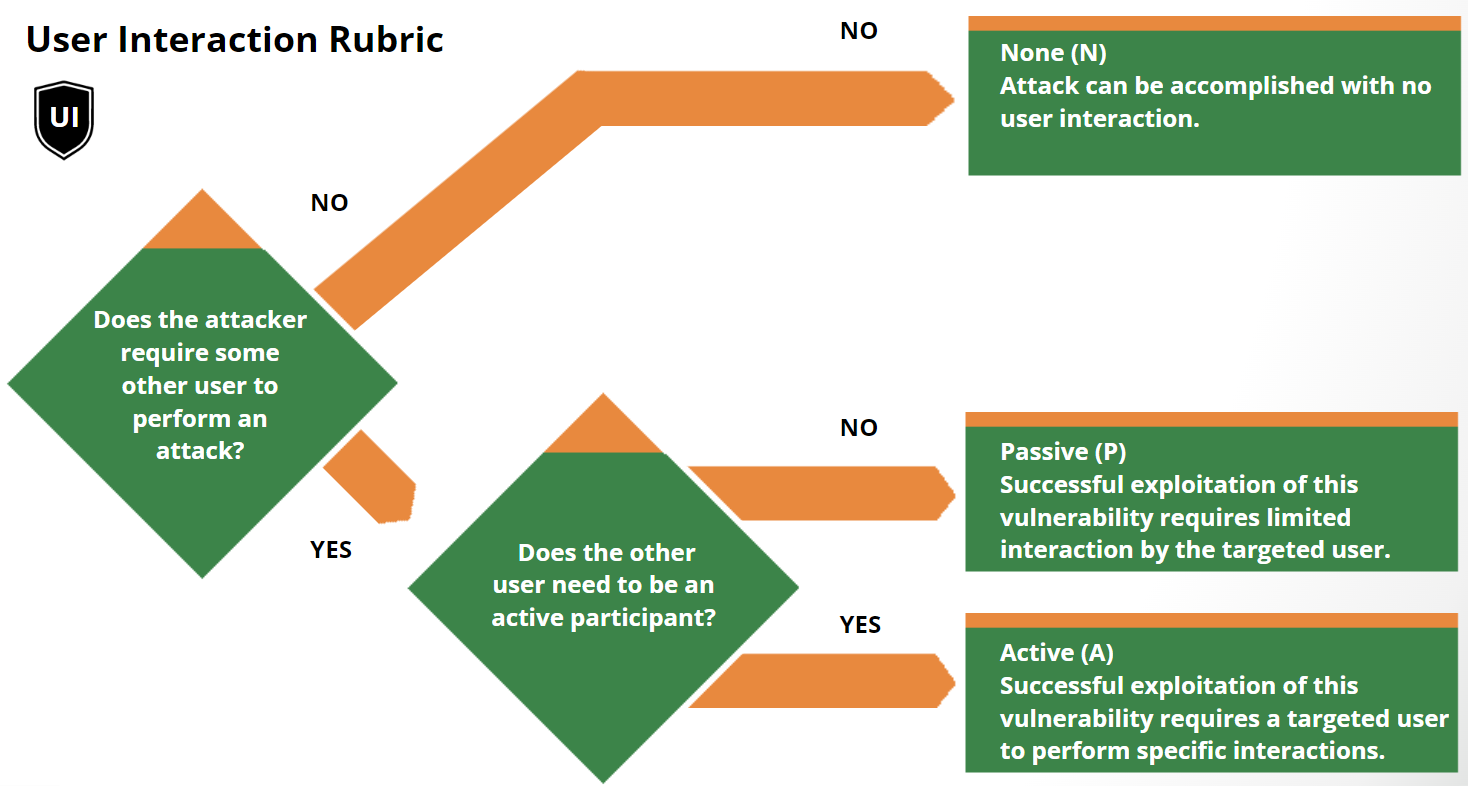
Skim through the following sections to get a feel for the major improvements in CVSS v4.0: New Metric – Attack Requirements (AT): (Section titled 'New Metric – Attack Requirements') Notice this adds granularity to Attack Complexity, covering situations like race conditions. Revised Metric – User Interaction (UI): (Section titled 'Revised Metric – User Interaction') See how UI is now None, Passive, or Active. New Metric – Subsequent System Impacts: (Section titled 'New Metric – Subsequent Confidentiality, Availability, Integrity') Observe how this replaces the confusing Scope metric by explicitly splitting impacts into the 'Vulnerable System' and 'Subsequent System(s)'.
Key improvements in CVSS v4.0 include:
- Finer-grained Exploitability:
Attack Complexityis now supplemented byAttack Requirements (AT)to better capture preconditions. - Granular User Interaction: The
User Interactionmetric is now more descriptive with three values: None, Passive, and Active. - Clarity on Impact: The confusing
Scopemetric is replaced by a clear distinction between impacts on the Vulnerable System (VC, VI, VA) and impacts on Subsequent Systems (SC, SI, SA). This makes scoring XSS, for example, much more logical: the impact on the Subsequent System (the browser) is high, while the impact on the Vulnerable System (the server) is none.
Conclusion
You now have the tools to quantitatively assess the severity of a vulnerability, a non-negotiable skill for a security professional. A well-justified CVSS score elevates your report from a simple observation to a structured, defensible risk assessment.
Key Takeaways:
- CVSS is the standard: It provides a common language for describing vulnerability severity.
- Focus on the Base Score: As a finder, your primary responsibility is to calculate the Base Score based on the vulnerability's inherent characteristics.
- Justify Everything: In your report, don't just state the score; include the vector string (e.g.,
AV:N/AC:L/...) and a brief justification for each metric choice, especially for contentious ones like Privileges Required or Scope. - v4.0 is on the horizon: While v3.1 is the current de facto standard, being familiar with v4.0's concepts will keep you ahead of the curve.
Next Lesson Preview:
We have reached the final lesson of this course. You've built a lab, learned reconnaissance, exploited networks and web apps, escalated privileges, and written professional reports. In our next lesson, we will tie all of this together. The final learning outcome is to develop a personal methodology for approaching a new target in a bug bounty or penetration testing engagement. This will be your strategic blueprint for success.