
Welcome back. In the previous lesson, you evaluated exact numerical expressions by following the order of operations. That skill remains important today: estimation still preserves the structure of a calculation, even though the numbers are replaced by easier nearby values.
This lesson develops two connected ideas. First, you will make sensible estimates to judge the likely size of an answer. Second, you will turn a rounded value into an error interval, stating precisely which original values could have produced it. These are useful throughout O Level Mathematics and later when Physics and Chemistry questions involve measured data.
Estimation is controlled approximation, not guessing
An estimate is a deliberately approximate answer. You round awkward values to nearby values that are easy to calculate mentally, then retain the original operations.
Use the approximation symbol , rather than the equals sign, because an estimate is not exact.
For example, estimate
Choose convenient values:
Then retain the multiplication and division:
So the estimated value is
The estimate does not claim that the exact answer is . It tells you the answer should be in that general region. If a calculator later gives , for example, you immediately know that a keying or method error is likely.
How to Estimate in Maths (2026/27 exams)
Watch How to Estimate in Maths from Cognito for a concise explanation of why estimation is a calculation method rather than a guess, followed by a worked fractional example.
Watch the purpose to distinguish estimating from guessing. Then watch the worked estimate, focusing on how every awkward number is replaced with a nearby, calculation-friendly value while the fraction’s structure is kept intact.
Choosing sensible rounded values
In many exam questions, rounding each number to one significant figure is a reliable starting point. A significant figure begins at the first non-zero digit.
For instance:
However, the real aim is not a mechanical “one significant figure” rule. It is to make the arithmetic manageable without making the estimate absurdly rough.
For example:
can be estimated as
For a product such as
the convenient estimate is
When a question includes units, include them in the estimate:
The squared unit matters because an area is being estimated.
A short estimation routine
When asked to estimate a calculation:
- Identify the operations, brackets, and fractions first.
- Round each value to a nearby convenient number.
- Carry out the simplified calculation using the same order of operations.
- State the answer with and the correct unit where needed.
- Check whether the final size is plausible.
Do not round only some numbers and then treat the result as exact. Also, do not round every value upwards: that tends to create a systematic overestimate. In a sensible estimate, some values may round up and others down.
From a rounded number to an interval
Estimation asks, “What is a sensible approximate answer?” An error interval asks a more precise question:
If a reported value has been rounded, what original values could it represent?
Suppose a distance is recorded as , correct to the nearest .
The neighbouring multiples of ten are , , and . The halfway points are and .
- rounds to , so it is included.
- Any value below , such as , rounds to .
- rounds to , so it is not included.
Therefore, if the true distance is ,
The lower bound is : the smallest possible value.
The upper bound is : the boundary above which the rounded value changes.
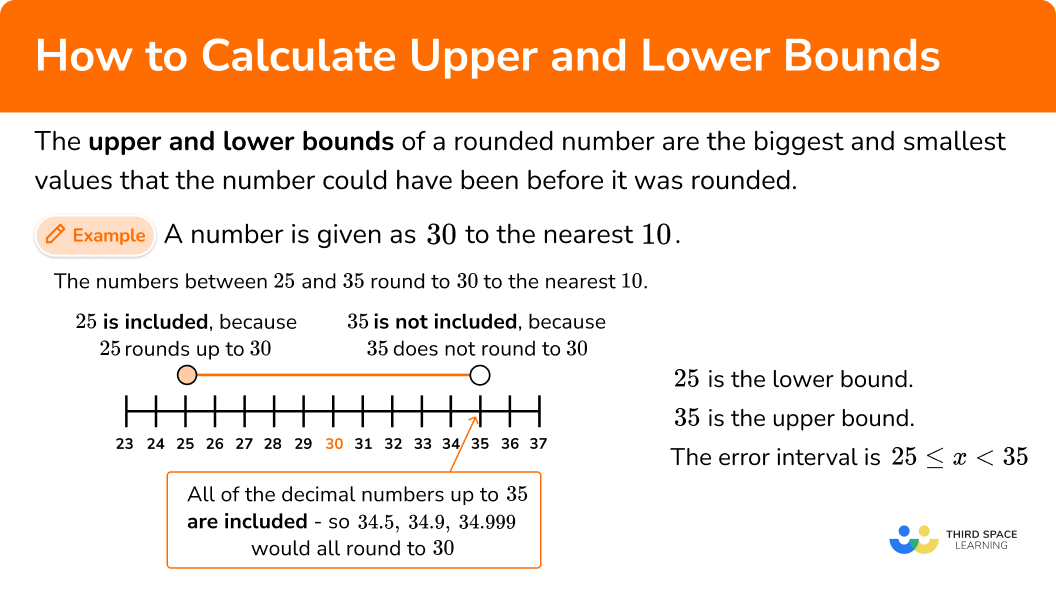
This is why ordinary rounding intervals nearly always have the form
The left inequality includes equality; the right inequality does not.
Lower and Upper Bounds - Corbettmaths
Watch Lower and Upper Bounds from Corbettmaths to see the same boundary rule applied to a range of stated accuracies, including whole units, decimal places, and significant figures.
Begin with nearest ten to see why the lower boundary is included but the upper boundary is excluded. Then watch nearest centimetre and one decimal place. Finish with significant figures, noting that the size of the rounding step, rather than the number of zeroes, determines the bounds.
The half-the-rounding-unit rule
There is a general method behind every ordinary rounding interval.
If a value is rounded to the nearest unit , the uncertainty on either side is half that unit:
So the interval is
The important step is identifying , the rounding unit.
| Stated accuracy | Rounding unit | Half-unit |
|---|---|---|
| nearest integer | ||
| nearest | ||
| nearest | ||
| nearest |
Consider a mass of , correct to one decimal place. One decimal place means the nearest , so the half-unit is .
Thus, for true mass ,
Notice that the bounds have more decimal places than the stated measurement. This is normal: the boundaries lie halfway between the recorded values.
A time of , correct to the nearest , similarly has half-unit :
Keep trailing zeroes when they communicate the stated precision. For example, is different in meaning from if the question says the former was recorded to two decimal places.
Significant figures: identify the place value first
Bounds involving significant figures can look less familiar because the rounding unit depends on the size of the number.
Suppose a length is , correct to two significant figures. The two significant digits are and . The second significant digit, , is in the hundreds place. Therefore, the value has been rounded to the nearest .
The half-unit is
So:
If is the true length,
Here is another useful example. A value is , correct to two significant figures. The significant digits are and , and the is in the thousandths place. Therefore the rounding unit is , not .
Its half-unit is
The error interval is therefore
A dependable method for significant-figure bounds is:
- Locate the last stated significant digit.
- Find its place value.
- Halve that place value.
- Subtract it for the lower bound and add it for the upper bound.
- Use at the lower boundary and at the upper boundary.
Common errors and how to prevent them
Using the full rounding unit instead of half
If is correct to the nearest kilogram, the true value is not between and . The boundaries are halfway to those neighbouring whole-number values:
Including the upper boundary
For a value rounded by the usual rule, the upper boundary belongs to the next rounded result. Thus:
is correct for to the nearest integer, but
is not.
Ignoring the stated degree of accuracy
The values , , and may represent different precisions when a question explicitly states decimal places. Always read the phrase after the number: “nearest centimetre,” “one decimal place,” “two significant figures,” and so on.
Mixing up an estimate and an error interval
These ideas both involve approximation, but they answer different questions.
| Idea | Given | What you produce |
|---|---|---|
| Estimate | A calculation with inconvenient values | A manageable approximate answer |
| Error interval | A rounded measurement or number | The full range of possible original values |
For example, estimating a journey time might give approximately . If a stopwatch reading is correct to the nearest minute, its interval is instead
Exam presentation
For an estimate, show the substitutions clearly:
For bounds, make the accuracy and half-unit visible:
This makes your reasoning easy to check and reduces sign errors in the inequality.
Key takeaways
Estimation replaces awkward values with sensible nearby numbers while preserving the calculation’s structure and units. It gives a reasonableness check, not an exact result.
For a normally rounded value, find half the rounding unit. Subtract it to obtain the included lower bound and add it to obtain the excluded upper bound:
For significant figures, first identify the place value of the final significant digit. In the next lesson, you will shift from numerical approximation to Chemistry and use kinetic particle theory to explain diffusion and changes of state.
Can't find a good explanation? Sign up and we'll make it for you
Sign up