
Hello. In the previous lesson, you converted between denary, binary, and hexadecimal, using binary place values such as . Now you will use those same place values to calculate with binary.
This lesson covers binary addition, logical left and right shifts, and overflow when a result cannot fit in the fixed number of bits available. At O Level, questions commonly use eight-bit unsigned binary values, so we will use that format throughout.
Binary addition: the same principle, a different base
Addition works in any place-value system. In denary, when a column totals or more, we write a digit and carry into the next column. In binary, each column can contain only or , so carrying happens much sooner.
There are four rules to memorise:
| Binary calculation | Result written | Carry |
|---|---|---|
| none | ||
| or | none | |
The last two rules make sense when checked in denary:
So write in the current column and carry into the next column to the left.
Similarly:
So write and carry .
Always add from right to left, beginning at the least significant bit (LSB).
Worked example: addition within eight bits
Calculate:
Write the values in aligned columns:
The answer is:
A denary check confirms this:
The important point is that carries are not special “binary tricks.” They follow naturally from the fact that binary is base .
Read BBC Bitesize's “Binary addition and binary shift” to consolidate the four addition rules, see worked column additions, and connect a final carry to overflow.
In the section “Binary addition and binary shift”, begin at the introduction to binary addition. Read through the examples of two-number and three-number addition. Then continue to the subsection “Overflow”, ending with the eight-bit overflow example. Focus on where each carry is placed and why a carry beyond the leftmost available column matters.
Fixed width and overflow in addition
A binary answer only overflows when there is a limit on the number of bits that can be stored.
For an unsigned eight-bit value:
and the greatest possible value is:
In general, an unsigned -bit value can represent values from to:
If an addition produces a ninth bit, it cannot be stored in an eight-bit location. That lost carry is called overflow.
Worked example: overflow
Add:
Mathematically, the full answer is:
The full answer needs nine bits:
But if only eight bits are available, the leftmost cannot be stored. The stored result is therefore:
This is overflow. It does not mean that ; it means that the hardware lacked enough bits to store the correct result.
For unsigned addition, use either of these equivalent checks:
- A carry leaves the most significant bit (MSB).
- The denary total is greater than for eight-bit values.
Keep the specified bit width in your final answer. Writing only when the question requires an eight-bit result misses the practical consequence: overflow.
Exam language: “Overflow occurs because the result requires nine bits, but only eight bits are available” is a precise explanation.
Logical binary shifts
A logical shift moves every bit a stated number of positions and fills newly empty positions with .
For this lesson, numbers are unsigned: they represent only zero or positive values. Later, signed values use two’s complement and require a different interpretation.
The two directions are:
| Shift | What happens | Numerical effect, if no important bit is lost |
|---|---|---|
| Logical left shift | Bits move towards the MSB; zeros enter at the right | Multiply by for each place |
| Logical right shift | Bits move towards the LSB; zeros enter at the left | Divide by for each place, discarding any remainder |
The multiplication and division effects follow directly from place value. Moving a from the column to the column doubles its contribution. Moving it from to halves it.
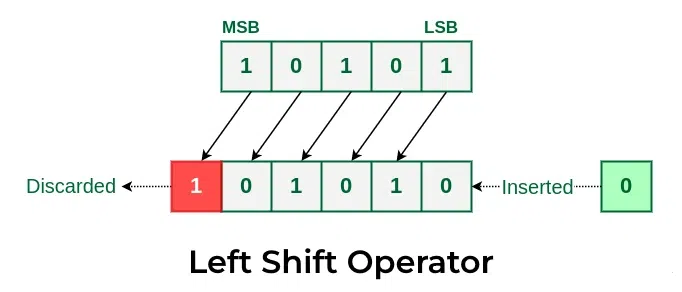
Logical left shift
Consider the eight-bit value:
A logical left shift by one place gives:
The new value is:
Thus:
A left shift by two places multiplies by , provided the result still fits:
More generally, shifting left by places multiplies by:
However, this rule is valid only when no bit is shifted out of the left side.
Overflow in a left shift
Now shift this eight-bit number left once:
A was removed from the MSB, so overflow has occurred.
Mathematically, doubling gives:
But is outside the unsigned eight-bit range of to . The computer retains only the eight bits that fit:
The stored answer is therefore not the true doubled value.
For a left shift of places, inspect the leftmost original bits:
- If they are all , no overflow occurs.
- If any one of them is , that bit will be lost, so overflow occurs.
Logical right shift
In a logical right shift, every bit moves towards the LSB. A is inserted at the MSB end.
Start with:
Shift right once:
So the value has been divided by :
A two-place right shift divides by . For example:
Right shifts can discard a remainder
Unlike left shifting, a right shift can lose information from the right side. Consider:
Shift right once:
The last has been discarded:
Yet:
Binary integers cannot store the fractional part in this format, so the result becomes . In effect, a logical right shift performs whole-number division by a power of , discarding any remainder.
Do not call this overflow. In the O Level context, overflow refers to a being lost from the MSB during a left shift, or to a calculation needing more bits than are available.
1.2.4 Binary Shifts - Revise OCR GCSE Computer Science
Watch “1.2.4 Binary Shifts” from Revise Computer Science for a visual explanation of why moving bits changes their place values and why right shifts can lose precision.
Watch left shifts to see one-place and two-place shifts become multiplication by 2 and 4. Then watch right shifts, focusing on the example where discarded bits make the result an integer approximation rather than an exact division.
A reliable exam method
For any question involving binary addition or shifts, use this sequence.
- Identify the width. If the question says eight bits, keep exactly eight result bits.
- For addition, align the LSBs and work right to left, recording carries carefully.
- For a left shift, move bits left, insert zeros at the right, and check whether a left the MSB.
- For a right shift, move bits right, insert zeros at the left, and note whether a was discarded from the LSB end.
- Check in denary when time permits. This is particularly useful for detecting an unexpected overflow.
Here is a compact summary.
| Operation | Eight-bit example | Result | Key issue |
|---|---|---|---|
| Addition without overflow | All carries fit | ||
| Addition with overflow | stored | Carry beyond eighth bit | |
| Left shift by one | Multiplies by | ||
| Left shift with overflow | A leaves the MSB | ||
| Right shift by one | LSB is lost; remainder discarded |
Key takeaways
Binary addition uses four rules:
Add from right to left and carry exactly as in denary, but at a total of rather than .
For unsigned eight-bit values, the available range is:
An addition overflows when it produces a carry beyond the eighth bit. A logical left shift overflows when a is shifted out from the MSB.
Logical shifts insert zeros:
- a left shift by places multiplies by , unless overflow occurs;
- a right shift by places divides by , discarding any fractional remainder.
The next Computer Science lesson extends binary representation to signed integers using two’s complement, where the leftmost bit has a new role.
Can't find a good explanation? Sign up and we'll make it for you
Sign up