
Welcome back. In our last two lessons, we've delved deep into Dynamic Programming, culminating in solving the 2D Longest Common Subsequence problem. You've honed the ability to dissect a complex problem, define its recurrence relation, and implement an efficient solution. However, in a high-stakes technical interview, producing correct code is only half the battle. The other half—and often the deciding factor for senior roles—is how you structure your thinking and communicate your solution.
This lesson bridges that gap. We will introduce a systematic framework called UMPIRE (Understand, Match, Plan, Implement, Review, Evaluate) to guide you through any algorithmic challenge. Mastering this framework will enable you to articulate your thought process with clarity and confidence, transforming the interview from a high-pressure test into a collaborative problem-solving session. This skill is not just for interviews; it's a hallmark of an effective senior engineer.
1. Why You Need a Framework
As an experienced developer, you know that diving straight into code without a plan can lead to architectural dead-ends. The same is true in a coding interview. Interviewers are evaluating your problem-solving methodology as much as the final code. A structured approach demonstrates methodical thinking, professionalism, and helps you stay calm and organized under pressure.
Many successful problem-solving strategies exist, and they share common elements. The popular "Cracking the Coding Interview" method, for example, follows a similar path.
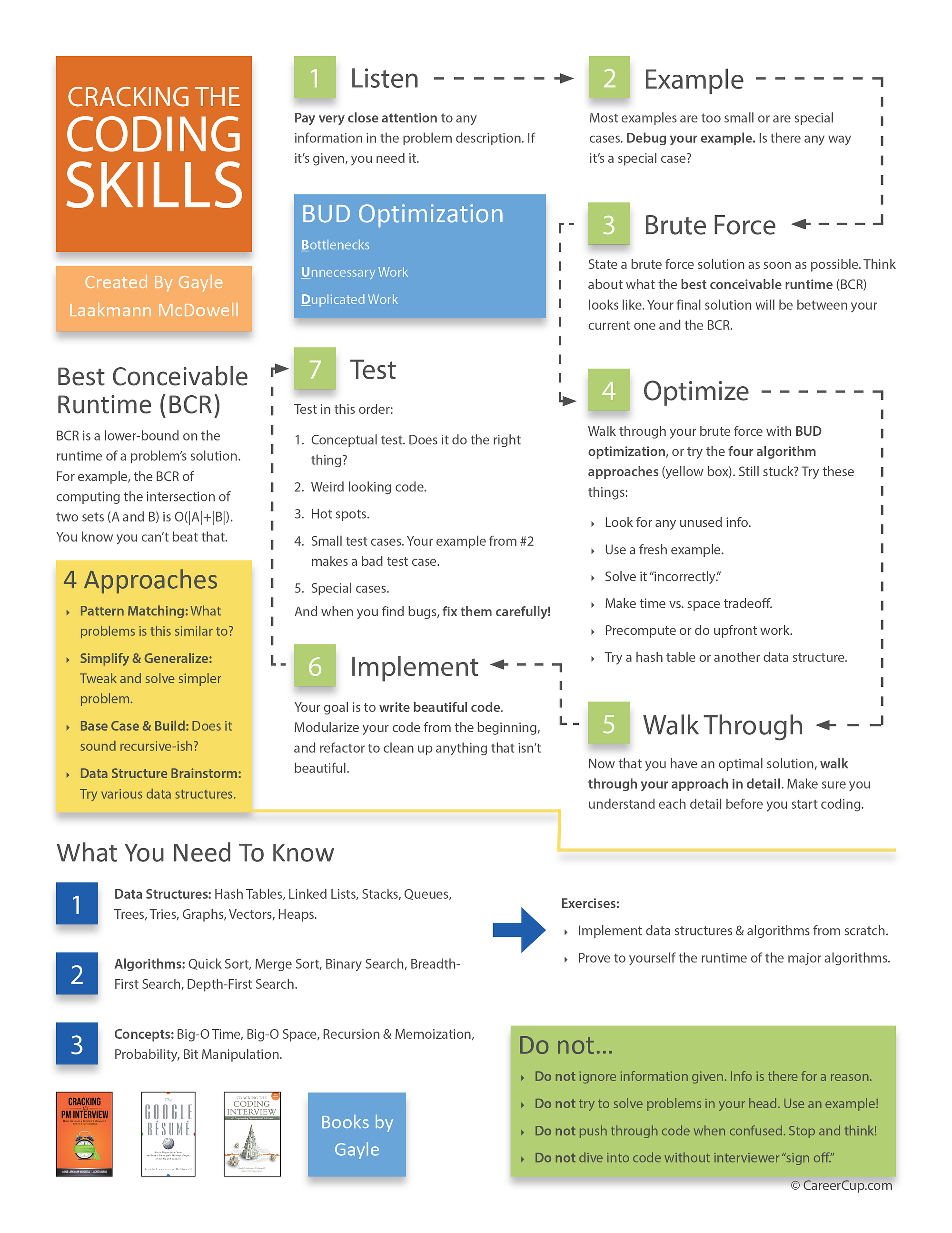
The UMPIRE method provides a memorable acronym for a robust, step-by-step process. To get a quick sense of what each step entails, this video provides a great introduction.
💻 Leetcode Series (EP. 1 - PART 1) | Series Intro and Explanation of UMPIRE Problem Solving Strategy
In this video, Antonella introduces the UMPIRE framework and explains the motivation behind using a structured approach to avoid feeling lost or intimidated by a new problem.
Watch the segment from something else. This will give you a high-level overview of the entire six-step process, from understanding the problem to evaluating the final solution's performance.
Now, let's explore each step in detail, using a simple problem as a running example to see the framework in action.
2. A Deep Dive into the UMPIRE Framework
We'll use the "Pair with Target Sum" problem: Given a sorted array of integers and a target sum, find the indices of two numbers in the array that add up to the target.
The DesignGurus article, "Mastering the UMPIRE Interview Strategy," provides a fantastic, practical guide through this exact scenario. We will refer to it as we break down each step.
Mastering the UMPIRE Interview Strategy in Coding
This article provides a complete, step-by-step application of the UMPIRE framework to a real coding problem. It's a perfect template for how to structure your communication in an interview.
I recommend keeping this article open as we go through the steps below. We will be referencing its example throughout. Start by reading the introduction, which defines the UMPIRE acronym.
U: Understand the Problem
Your first goal is to ensure you and the interviewer are on the same page. Do not make assumptions.
- Action: Rephrase the problem in your own words.
- Action: Manually work through a simple example provided. Then, create your own examples, including edge cases.
- Happy path:
[1, 2, 3, 4, 6],target = 6->[1, 3] - Edge case (no solution):
[1, 2, 3],target = 7->[-1, -1] - Edge case (empty array):
[],target = 1->[-1, -1] - Edge case (duplicates): What if there are multiple pairs? Return the first one? All of them?
- Happy path:
- Action: Ask clarifying questions about constraints.
- "Are the numbers always integers? Can they be negative?"
- "What is the expected range of the array size and the numbers within it?"
- "What should I return if no pair is found?"
This phase is not about solving; it's about defining the problem space. Refer to the Understand section in the DesignGurus article to see exactly how this is done. The CodePath guide also offers excellent examples of clarifying questions.
UMPIRE Interview Strategy | CodePath Cliffnotes
This guide from CodePath provides another excellent example of the "Understand" phase, applied to a linked list problem.
Read the Understand section. Notice how it combines creating test cases with asking targeted questions like "Should this be done in place?" and "Does the ordering matter?".
M: Match the Pattern
With a clear understanding, you now connect the problem to known algorithmic patterns. This demonstrates your breadth of knowledge.
- Action: Think out loud. "The input array is sorted, and I need to find a pair. This immediately suggests a few patterns."
- Possible Matches for our example:
- Brute-Force: For each element, iterate through the rest of the array. (Mention this first to show you can always find a solution).
- Binary Search: For each element
x, search fortarget - x. - Two Pointers: Since the array is sorted, we can use one pointer at the start and one at the end, moving them inwards.
- Hash Map: We can iterate through the array, storing elements in a hash map and checking if
target - current_elementalready exists.
Explicitly name these patterns. In an interview, you'd say something like, "Given the sorted nature of the array, the Two Pointers pattern seems very efficient here, likely offering an O(N) solution."
See the Match section in the DesignGurus article for a concise example of this step.
P: Plan the Solution
Before writing a single line of production code, outline your chosen approach. Get the interviewer's buy-in.
- Action: Verbally describe the algorithm. "I'll initialize a
leftpointer at index 0 and arightpointer at the last index. I'll loop as long asleftis less thanright. In each step, I'll calculate the sum. If it's the target, I'm done. If it's too small, I'll incrementleftto get a larger sum. If it's too large, I'll decrementrightto get a smaller sum." - Action: Write down pseudocode or draw a diagram. This solidifies your plan and ensures there are no logical gaps.
- Action: Analyze the complexity of your proposed plan. "This approach involves a single pass through the array, so the time complexity will be O(N). Since I'm only using a few variables for pointers, the space complexity will be O(1)."
The Plan section of the DesignGurus article walks through this process, including comparing different approaches and writing pseudocode.
I: Implement the Code
Now, and only now, do you start coding. Your implementation should be a clean translation of the plan you just agreed upon.
- Action: Write clean, readable code. Use meaningful variable names.
- Action: Narrate your code as you write. This keeps the interviewer engaged and shows you're being deliberate. For example: "Okay, I'm creating my function
find_target_sum_pair. First, I'll initializeleft = 0andright = len(arr) - 1..." - Action: If you realize your plan needs a small adjustment, communicate it. "I initially planned to return
None, but the problem asks for[-1, -1], so I'll adjust my return statement for the 'not found' case."
Refer to the Implementation section in the DesignGurus article to see the final code.
R: Review Your Code
Once you've written the code, do not immediately say "I'm done." The most professional thing you can do is to validate it yourself.
- Action: Manually trace your code with one of the examples you created in the "Understand" phase. Verbally step through the loops, tracking the values of your pointers and variables.
- Action: Consider your edge cases. "Let's quickly check the empty array case. My
while left < rightcondition would immediately be false, and it would correctly return[-1, -1]. That works." - Action: The best way to review is to write and run actual test cases if an execution environment is provided. This demonstrates a strong engineering mindset.
The following clip from an interview analysis highlights why this step is so critical.
Senior Engineer Breaks Down Dynamic Programming Interview
Alex Golick, a former engineering manager at Google and Reddit, explains why writing test cases is a powerful signal in an interview.
Watch the segment from how important this is. Pay attention to how he frames testing not just as a way to find bugs, but as a way to confidently present your solution without needing to ask, "Is this right?"
E: Evaluate the Solution
This is your final summary. You state the performance characteristics and discuss potential trade-offs.
- Action: Confidently state the final time and space complexity. You already planned this in the 'P' step, but now you confirm it based on your final code.
- Action: Briefly compare your solution to the alternatives you mentioned in the 'M' step. "So, the final time complexity is O(N) and space is O(1). This is more efficient than the O(N log N) binary search approach and uses less space than the O(N) space hash map approach, making it optimal for a sorted input array."
- Action: Proactively mention limitations or potential improvements. "This solution relies on the array being sorted. If it were unsorted, the hash map approach would be a better choice at O(N) time and space."
Volunteering this analysis without being prompted is a strong sign of seniority. The same interview analysis video emphasizes this point.
Senior Engineer Breaks Down Dynamic Programming Interview
Here, the evaluator discusses the importance of a candidate proactively providing runtime analysis.
Watch from this is a good example. This reinforces that you should always volunteer the complexity analysis as part of your solution presentation.
If you find yourself running out of time, focus on clearly articulating your plan and evaluation. A well-explained optimal algorithm that isn't fully coded is often better than a perfectly coded brute-force solution.
Conclusion
Solving a problem is one skill; communicating the solution is another. For senior engineering roles, the latter is just as important. The UMPIRE framework provides the structure to do this effectively.
Key Takeaways:
- Structure is Key: UMPIRE (Understand, Match, Plan, Implement, Review, Evaluate) provides a reliable roadmap for any algorithmic problem.
- Communicate Proactively: Narrate your thought process at every step. Don't wait to be asked for complexity analysis or edge cases.
- Plan Before Coding: Get buy-in on your approach before writing code. This prevents wasted time and shows you think before you act.
- Review is Non-Negotiable: Always validate your own code by tracing it with examples. This demonstrates ownership and a professional engineering mindset.
- Evaluate Trade-offs: Discussing the performance of your solution and comparing it to alternatives showcases your depth of understanding.
By consistently practicing this framework, it will become second nature. You'll enter interviews not with anxiety, but with a clear plan of attack to demonstrate your skills.
In our next module, we will shift gears from individual algorithmic problems to the broader challenge of system design. We will begin by exploring the foundational concepts of latency and throughput. You will find that the structured communication skills you've honed in this lesson are directly applicable to discussing and defending large-scale architectural decisions.