
Welcome back. In the previous lesson, you separated needs, requirements, functions, behavior, architecture, and design—the technical artifacts that make an engineering argument explicit. This lesson focuses on the people and coordination responsibilities that make those artifacts useful in a real project.
Systems engineering does not happen in isolation. A team must maintain technical coherence across disciplines, plan and control technical work, manage interfaces and risks, and keep technical decisions aligned with stakeholder value, cost, and schedule. By the end of this lesson, you should be able to distinguish technical leadership, systems management, and the systems engineering activities they guide—while recognizing where they overlap with project management.
Three lenses on the same project
The terms in this lesson refer to different lenses on a common undertaking, not three isolated departments.
- Systems engineering activities are the technical life-cycle activities performed to define, realize, verify, validate, transition, operate, and eventually retire a system.
- Technical leadership gives the technical effort direction and coherence. It integrates disciplines, frames technical decisions, manages tradeoffs, and keeps the system aligned with its intended mission.
- Systems management organizes and controls the technical work: planning it, monitoring it, managing technical information and changes, coordinating reviews, and supplying reliable technical evidence to project-level decisions.
The project manager, systems engineer, technical lead, chief engineer, engineering manager, and specialist engineers may distribute these responsibilities differently depending on the organization. On a small project, one person may hold several of these roles. What matters is that the responsibilities are explicit and performed.
NASA emphasizes that systems engineering is integrative: it balances contributions from multiple specialties rather than allowing one discipline to dominate the overall solution.
SEH 2.0 Fundamentals of Systems Engineering - NASA
Read NASA's “SEH 2.0 Fundamentals of Systems Engineering” to establish what technical leadership means in a systems context and how systems engineering relates to Project Planning and Control.
In the opening discussion on the NASA page, read the opening definition. Then continue with the role discussion, focusing on the lead systems engineer's responsibility for technical fulfillment of needs and requirements. Finally, read the project-organization passage, paying close attention to the respective contributions of SE, PP&C, and the project manager.
A useful way to remember the distinction is:
| Lens | Central question | Typical concern |
|---|---|---|
| Systems engineering activities | What technical work must be done? | Requirements, architecture, integration, verification, validation |
| Technical leadership | What technical direction and decisions keep the whole system coherent? | Tradeoffs, interfaces, technical risk, mission fit |
| Systems management | How will the technical work be planned, coordinated, evidenced, and controlled? | Technical plans, reviews, baselines, status, change control |
| Project management | How will the full project deliver value within constraints? | Team, scope, resources, cost, schedule, stakeholders |
These are not rigidly sequential. For example, a technical risk may be discovered during integration; technical leadership evaluates its system consequences, systems management organizes the assessment and tracks the mitigation, and project management decides whether resources or dates must change.
Systems engineering activities: the technical work of the life cycle
Systems engineering is not merely “writing requirements” or “drawing architecture diagrams.” It comprises a coordinated set of activities across the system life cycle.
NASA’s framing groups these activities into three broad areas:
| Activity area | Typical activities | Primary technical purpose |
|---|---|---|
| System design processes | Define stakeholder expectations, define technical requirements, decompose logically, define solution concepts | Establish what system is needed and how it should be organized |
| Product realization processes | Implement, integrate, verify, validate, transition | Produce and demonstrate a system that meets requirements and operational needs |
| Technical management processes | Technical planning, requirements management, interface management, technical risk management, configuration management, technical assessment, decision analysis | Keep the technical effort controlled, integrated, and evidence-based |
The earlier lesson concentrated mainly on the first area: converting stakeholder needs into requirements, behavior, architecture, and design. The second area asks whether the resulting elements can actually be built, integrated, verified, validated, and placed into use. The third area keeps both of those areas coordinated over time.
A crucial CSEP-style distinction follows:
Technical management processes are still systems engineering activities.
They do not replace project management, but they provide the technical planning, assessment, and control needed for project management to make sound decisions.
For example, an updated interface requirement affects more than an engineering drawing. It may affect integration order, test procedures, supplier work, schedule reserve, technical risk, configuration baselines, and the system’s verification argument. Requirements management, interface management, risk management, configuration management, and technical assessment make these effects visible and manageable.
Technical leadership: preserving technical coherence
Technical leadership is the responsibility for guiding the technical effort toward a system that fulfills validated needs and requirements within real constraints. It is not simply seniority, personal charisma, or being the person who knows the most detail about one subsystem.
A technical leader must continually work at the system level. This includes:
-
Establishing technical direction
The technical leader helps ensure that the ConOps, stakeholder needs, requirements, architecture, and verification strategy form a consistent engineering argument. -
Integrating specialist perspectives
Mechanical, electrical, software, safety, cybersecurity, human-factors, manufacturing, operations, and maintenance specialists may each have valid local concerns. Technical leadership balances these concerns against overall system objectives. -
Framing and resolving technical decisions
When alternatives compete, the technical leader ensures that the decision considers criteria, assumptions, evidence, risks, interfaces, and stakeholder priorities—not merely the preference of the most influential discipline. -
Maintaining technical integrity through the life cycle
The technical leader asks whether the system is still feasible, coherent, safe, verifiable, and suitable for its operational purpose as new information emerges. -
Communicating technical consequences clearly
Project leadership needs usable technical information: what changed, why it matters, what alternatives exist, what risk remains, and what cost or schedule consequences follow.
This responsibility is often held by a lead systems engineer, chief engineer, or technical manager. However, titles are not decisive. NASA notes that the same systems-engineering responsibilities may be carried out by different people as a project’s size, complexity, and life-cycle phase change.
Technical leadership therefore differs from line management. A technical leader may have no direct reports, yet still lead critical technical decisions, facilitate technical reviews, resolve interface issues, and integrate the work of multiple teams. Conversely, a people manager may have direct reports without being the technical authority for system-level tradeoffs.
What technical leadership is not
Technical leadership should not become unilateral technical control. A lead systems engineer does not personally “own” every design choice or replace specialist engineering judgment. Instead, technical leadership establishes the conditions for sound collective judgment:
- the right stakeholders participate;
- decisions use appropriate evidence;
- interfaces and life-cycle effects are considered;
- assumptions and uncertainties are recorded;
- consequences are communicated to decision-makers;
- the selected path remains traceable to needs and requirements.
That is why a technically strong but narrowly focused subsystem decision can still be a poor system decision.
Systems management: making technical work executable and controlled
In this course, systems management means the management of the systems-engineering effort and its technical information. It should not be confused with operating or administering a delivered system in the field.
Systems management turns “we need to do systems engineering” into a planned and controlled technical effort. It addresses questions such as:
- Which systems-engineering activities are needed for this project?
- Who is responsible for each activity and technical decision?
- What technical products, models, reviews, and baselines are required?
- When is each technical product needed to support a decision gate or integration event?
- How are requirements, interfaces, risks, and changes controlled?
- What evidence will show actual technical progress?
- How will technical status be communicated to project leadership?
The principal planning artifact is commonly called a Systems Engineering Management Plan or SEMP. It defines the technical processes, methods, responsibilities, work products, reviews, technical measures, and relationships with other project activities.
The Project Management Plan or PMP is broader. It is the master plan for the project as a whole, including technical and nontechnical work. A SEMP must be consistent with the PMP: a verification campaign cannot be technically credible if no budget, facilities, personnel, hardware, or schedule time exist to perform it.
Systems Engineering and Project Management - Relationships ...
Read this SEBoK article to see why systems engineering and project management overlap, why role ambiguity is common, and how the SEMP and PMP help establish an explicit working relationship.
In the section “Overlap,” read the overlap discussion. Notice that both the systems engineer and project manager plan, monitor, manage risk, and deliver value, but do so with different scopes of responsibility. In “Defining Roles and Responsibilities,” read the planning-document discussion. Then read the following paragraph through the systems-engineer capability discussion, focusing on the management skills needed to lead technical work.
Systems management does not mean that the systems engineer personally executes every management task. A project may have dedicated configuration managers, risk managers, planners, data managers, quality personnel, and project controllers. The systems engineer must nevertheless ensure that the technical content supplied to those functions is accurate, current, and sufficient for decisions.
For example, Project Planning and Control may report a two-month schedule impact. Systems engineering must be able to explain the technical basis: perhaps a newly discovered interface incompatibility requires redesign, procurement, reintegration, and regression verification. The schedule report alone is not the full technical story.
Where SE, PP&C, and project management overlap
The NASA diagram below is helpful because it shows an important reality: Systems Engineering and Project Planning and Control have distinct centers of gravity, but they share several concerns.
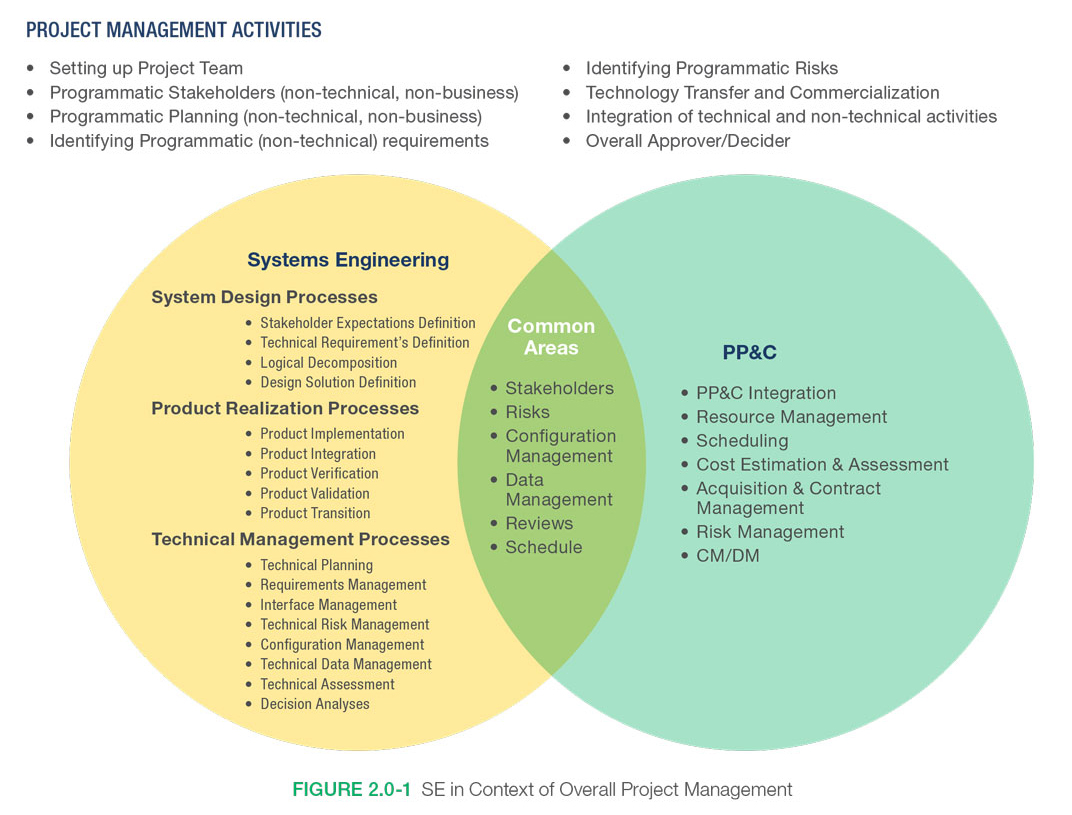
On the Systems Engineering side, the diagram includes system design, product realization, and technical management processes. On the PP&C side, it includes resource management, scheduling, cost estimation and assessment, acquisition and contract management, risk management, and configuration/data management.
The shared region does not mean that every overlap activity has equal ownership or that all organizations must use the same reporting structure. It means effective projects need integrated inputs.
Consider each shared concern:
| Shared concern | Systems engineering contribution | PP&C or project-management contribution |
|---|---|---|
| Stakeholders | Clarifies technical needs, operational context, and technical consequences | Coordinates broader programmatic stakeholders and commitments |
| Risk | Identifies technical causes, consequences, mitigations, and residual risk | Tracks exposure, resources, schedule effects, and project-level response |
| Configuration management | Defines technical configuration items, baselines, relationships, and technical change impacts | Maintains change-control discipline, records, and governance processes |
| Data management | Specifies needed technical data, models, evidence, and traceability | Ensures controlled access, retention, delivery, and reporting |
| Reviews | Defines technical entry criteria, evidence, and technical conclusions | Plans review events, resources, decision authority, and program commitments |
| Schedule | Estimates technical sequencing, dependencies, maturity, and verification effort | Integrates all work into the controlled project schedule |
A recurring exam trap is to treat cost and schedule as concerns only for a project manager. That is incorrect. Systems engineering must understand the technical basis of cost and schedule: architecture complexity, interface maturity, testability, supplier dependencies, integration risk, and rework potential. PP&C and the project manager then integrate that information into the project’s overall commitments and controls.
A practical case: a networked medication cabinet
Continue the temperature-controlled medication cabinet from the previous lesson. The hospital now proposes a change:
Connect each cabinet to the hospital network so temperature-excursion alarms can be routed to the central facilities-monitoring service.
This sounds like a modest feature. A systems view quickly shows that it affects cybersecurity, patient safety, network reliability, alarm response procedures, privacy, electromagnetic compatibility, interface requirements, configuration control, testing, and potentially schedule.
The systems-engineering activities
The technical team may need to:
- identify affected stakeholders, including pharmacy staff, facilities staff, cybersecurity personnel, maintainers, and hospital IT;
- refine or add interface, security, alarm, availability, and operational requirements;
- update the system context and architecture;
- define behavior for loss of network connectivity and alarm acknowledgement;
- perform trade studies on local alarms, network protocols, redundancy, and data retention;
- analyze technical risks;
- update verification methods, test environments, and success criteria;
- control the changed requirement, architecture baseline, and interface information.
Those are systems engineering activities. They produce technical evidence and updated technical artifacts.
The technical-leadership responsibility
The technical leader makes sure the team does not reduce the change to “add a network port.” They frame the system-level question:
How can the cabinet provide timely and dependable alarm notification without creating unacceptable safety, cybersecurity, operational, cost, or verification consequences?
The technical leader ensures that the relevant specialists participate, that assumptions are surfaced, and that alternatives are evaluated against explicit criteria. They may recommend a preferred architecture, but the recommendation should be traceable to the mission, needs, requirements, risks, and available evidence.
The systems-management responsibility
Systems management makes the technical response executable and visible:
- include the analysis, modeling, and test work in the technical plan;
- assign technical owners and review responsibilities;
- establish a change package and baseline-control path;
- coordinate dependency dates with hospital IT and facilities teams;
- define technical progress measures, such as interface maturity or verification readiness;
- identify resource and schedule consequences;
- provide decision-quality status to PP&C and the project manager.
The same person may be both technical leader and systems manager on a small project. On a large program, the responsibilities may be distributed across a chief engineer, lead systems engineer, systems-engineering manager, project manager, risk manager, configuration manager, and planner.
The correct conclusion is not “one role owns the change.” It is that each role contributes a distinct form of accountability.
Technical leadership, systems management, and MBSE
MBSE in SysML and Cameo can strengthen all three areas—but it does not replace them.
A Cameo model can support systems engineering activities by representing requirements, behavior, structure, interfaces, allocations, constraints, and verification relationships. It can support technical leadership by making alternatives, assumptions, interfaces, and tradeoff consequences visible across specialties. It can support systems management by providing controlled technical baselines, traceability, change-impact analysis, and technical maturity evidence.
For the medication-cabinet change, a model can make several questions easier to answer:
| Model evidence | Decision or management use |
|---|---|
| Requirement relationships | Identify which needs, system requirements, and verification cases are affected |
| Context and internal block diagrams | Identify the new hospital-network interface and elements touched by the change |
| State-machine behavior | Examine cabinet behavior when connectivity fails during an alarm condition |
| Allocation relationships | Clarify which logical and physical elements must support the new capability |
| Verification relationships | Identify tests, analyses, demonstrations, or inspections requiring revision |
| Model baseline and change record | Establish exactly which technical configuration was reviewed or approved |
However, a model does not automatically decide whether the hospital should accept a schedule slip, whether a residual cybersecurity risk is tolerable, or whether an operational procedure is realistic. Those require technical judgment, stakeholder engagement, and project governance.
The following short video provides a useful framing: systems engineering bridges stakeholders, project management, and specialist engineering, and it does so through iterative communication rather than a one-way handoff.
What Is Systems Engineering? | Systems Engineering, Part 1
Watch MATLAB’s “What Is Systems Engineering? | Systems Engineering, Part 1” for a concise explanation of how systems engineering connects stakeholder goals, project constraints, and specialist engineering work.
Watch the stakeholder bridge, which introduces the distinct viewpoints of stakeholders, project management, and engineering specialists. Then watch iterative coordination, focusing on why trade studies, architecture models, and ongoing communication are needed when objectives conflict.
An exam-ready way to classify responsibility
When a scenario asks who should act, first identify the type of problem, then identify the role or function best positioned to handle it.
| Scenario wording | Most relevant responsibility |
|---|---|
| “Ensure the system technically fulfills stakeholder needs and requirements.” | Technical leadership, usually led by the lead systems engineer |
| “Develop requirements, manage interfaces, conduct technical trade studies, plan verification.” | Systems engineering activities |
| “Plan, coordinate, monitor, assess, and control the SE effort and technical information.” | Systems management or technical management |
| “Control total project cost and schedule, manage the team, and deliver the overall project commitment.” | Project management with PP&C support |
| “Resolve a technical tradeoff with safety, performance, and interface consequences.” | Technical leadership, using specialist evidence and stakeholder input |
| “Assess the project impact of a technical change and update controlled plans and baselines.” | Shared: SE provides technical impact; systems management and PP&C organize control; project governance authorizes as appropriate |
Three cautions improve accuracy:
-
Do not infer responsibility from job title alone.
A project manager may also serve as technical lead on a small project; a chief engineer may have broad technical authority without personnel-management responsibility. -
Do not confuse technical management with project management.
Technical management concentrates on the systems-engineering effort and its technical integrity. Project management integrates that effort with all project commitments. -
Do not treat technical leadership as a life-cycle phase.
It is a continuous responsibility, from mission framing through transition, operation, change, and retirement.
Key takeaways
Systems engineering activities are the technical work required to develop and sustain a system across its life cycle. They include system design, product realization, and technical management processes.
Technical leadership supplies system-level direction and judgment: it integrates disciplines, manages tradeoffs, maintains technical coherence, and ensures that the realized system remains connected to stakeholder needs and requirements.
Systems management makes the technical effort executable and controlled through technical planning, coordination, monitoring, assessment, information management, review preparation, baseline control, and communication of credible technical status.
Project management, PP&C, systems engineering, and technical leadership overlap because technical decisions affect cost, schedule, risk, and stakeholder value. Their responsibilities should therefore be explicitly defined and continuously coordinated—not assumed from titles.
Next, you will consolidate the terminology from this module by using INCOSE language to explain a simple embedded-system case clearly and precisely.
Can't find a good explanation? Sign up and we'll make it for you
Sign up