
Welcome back. In the previous lesson, you examined hierarchy, interactions, interdependencies, feedback, and emergence. The key habit was to look beyond an inventory of components and ask how relationships produce whole-system outcomes.
Now we apply that habit to a proposed change. A technically sound local improvement can still create delayed burdens elsewhere: for users, maintainers, suppliers, the environment, or a future life-cycle stage. This lesson develops a practical method for identifying those consequences before a decision is committed or a design is baselined.
By the end, you should be able to take a proposed change, trace its plausible effects across system boundaries and life-cycle activities, distinguish direct effects from indirect and delayed ones, and state what must be checked, managed, or monitored.
Whole system, whole life cycle, whole stakeholder community
A proposed change is usually presented in a narrow form:
“Replace the existing heating system with smart electric heat pumps and improve the building fabric to reduce carbon emissions and energy use.”
That statement expresses an intended outcome, but it does not yet demonstrate systems thinking. It says little about the operational environment, the installation process, occupants, electrical infrastructure, maintainers, suppliers, end-of-life recovery, or effects that appear only over time.
A holistic systems approach expands the question from:
“Will this change achieve its immediate technical target?”
to:
“What does this change alter across the whole system, over the relevant life cycle, for the stakeholders who experience its benefits and burdens?”
SEBoK frames this as considering the whole system, whole lifecycle, and whole stakeholder community, particularly to avoid negative unintended consequences and sub-optimization. Sub-optimization occurs when one part of a system improves its own measure of success while degrading overall mission or service performance.
Overview of the Systems Approach
Read the opening of SEBoK’s “Overview of the Systems Approach.” It establishes why systems engineering must look beyond the immediate system element and avoid simply moving a burden elsewhere.
In the section “Systems Approach and Systems Engineering,” read from the sentence beginning the whole-system framing through the discussion of transferred burden and sub-optimization. Focus on the three scopes: whole system, whole life cycle, and whole stakeholder community.
Consequence, risk, and requirement are not the same thing
Keep these concepts separate:
| Concept | Meaning in change analysis |
|---|---|
| Intended effect | A benefit the change is meant to produce, such as lower operational heating demand. |
| Unintended consequence | A plausible effect not originally sought, beneficial or harmful, such as increased summer overheating risk after fabric improvements. |
| Risk | An uncertain future event or condition that may affect objectives. A consequence may become a risk when its occurrence or magnitude is uncertain. |
| Requirement | A binding, verifiable statement of what the system must do or be. Consequence analysis may reveal a need for a new or changed requirement. |
For example, “reduced heating demand” is an intended operational effect. “Poor indoor air quality if ventilation is not adapted” is a potential unintended consequence. Whether it occurs depends on factors such as the building condition, design, commissioning, occupant use, and maintenance; therefore it can be managed as a risk. The analysis may then lead to a requirement concerning ventilation performance, monitoring, or commissioning evidence.
The point is not to predict the future perfectly. It is to expose important assumptions early enough to make informed decisions.
Start with a change hypothesis, not a solution slogan
A useful analysis begins by making the proposed intervention explicit. A vague statement such as “improve energy efficiency” gives little to test. A better formulation identifies:
- The intervention — what will be changed?
- The intended mechanism — how is the change expected to produce benefit?
- The success measures — what outcome matters, to whom, and over what period?
- The scope — which system, interfaces, life-cycle activities, and stakeholders are included?
For the building example:
| Item | Initial statement |
|---|---|
| Proposed change | Install heat pumps, improve insulation and airtightness, and introduce smart heating controls. |
| Intended mechanism | Reduce heat loss and replace combustion-based heating with electrically supplied heat. |
| Intended outcomes | Lower heating energy use, lower operational emissions, maintain thermal comfort. |
| System of interest | Building heating and environmental-control capability in its operational context. |
| Important external systems | Electricity network, installers, heat-pump suppliers, maintenance providers, occupants, regulators, weather, waste and recycling services. |
This is not a complete architecture. It is a disciplined starting point that prevents a team from treating a component substitution as if it were the entire change.
The initial boundary should be broad enough to discover consequences, then narrowed deliberately to support a decision. Expanding the boundary indefinitely is not holism; it is loss of focus. The appropriate boundary is the one that includes factors capable of materially affecting the stated decision and its measures of success.
Trace effects through relationships, not through component lists
The supplied systems map illustrates why a simple component list is inadequate.
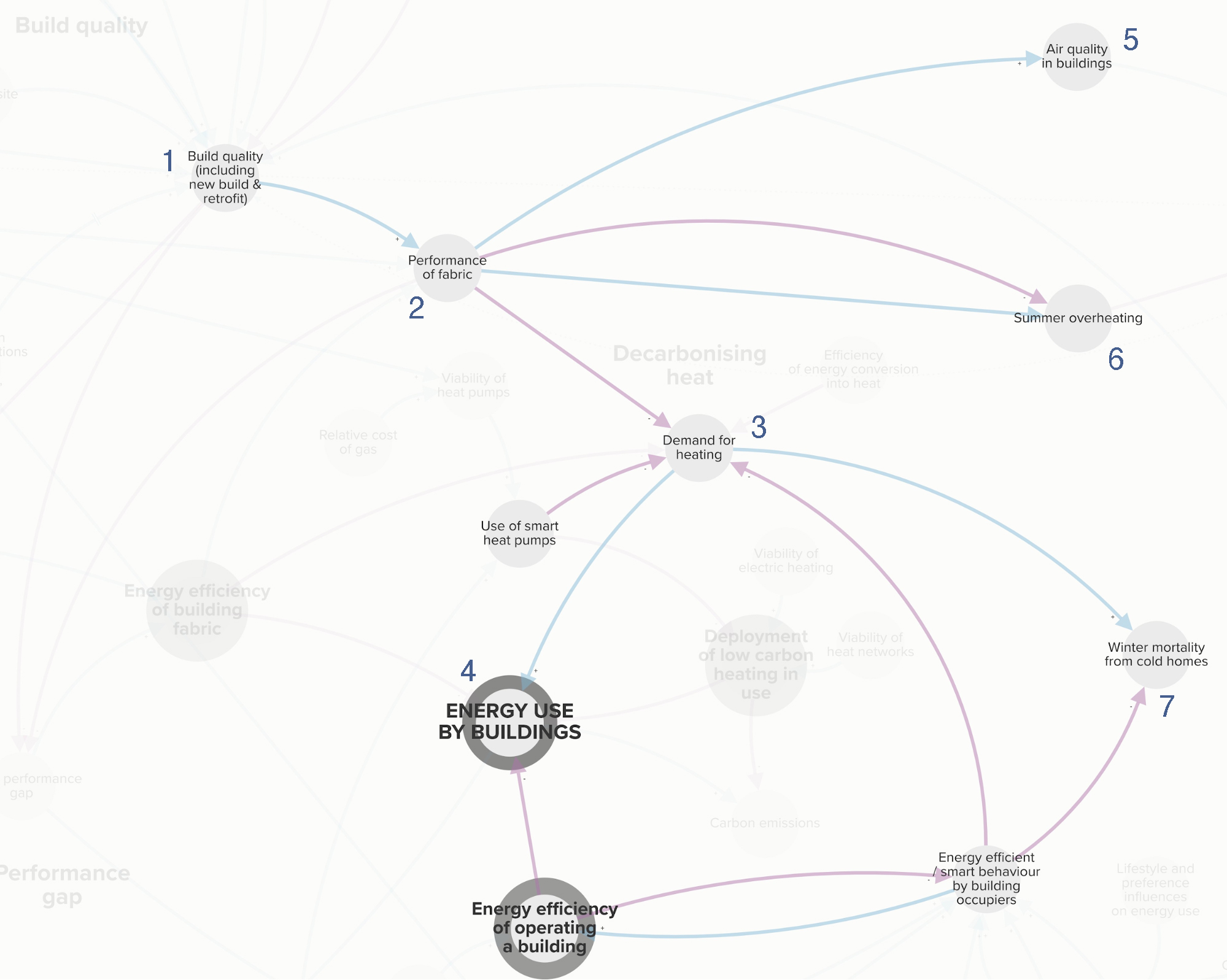
The numbered nodes offer a useful reading path:
- Build quality affects performance of fabric.
- Fabric performance influences demand for heating and, through other relationships, conditions such as air quality in buildings and summer overheating.
- Heating demand contributes to energy use by buildings.
- Operational behavior and building controls also influence energy use and the practical results occupants experience.
- Health outcomes may be connected to thermal conditions, not merely to annual energy consumption.
Do not treat the map as a proof that every link applies, or applies equally, to every building. It is a prompt for questions. Its value lies in making relationships visible that a narrow “replace the boiler” viewpoint may omit.
A simple chain of consequence
Consider the fabric-improvement portion of the change.
- Insulation and airtightness can reduce uncontrolled heat loss.
- Reduced heat loss can lower heating demand and improve winter comfort.
- Airtightness can also reduce incidental ventilation.
- If adequate designed ventilation, commissioning, and maintenance are absent, indoor pollutant or moisture concentrations may increase.
- If occupants respond by opening windows during cold periods, some anticipated energy savings may be lost.
- The building may therefore meet a narrow fabric target while failing a wider comfort, health, or energy-performance objective.
This is not an argument against insulation or airtightness. It is an argument for treating fabric, ventilation, controls, occupant behavior, commissioning, and maintenance as interacting parts of one operational system.
The same reasoning applies to smart controls. Their functions may be correct in isolation, yet system performance can suffer if occupants cannot understand them, connectivity fails, tariff assumptions change, or maintainers cannot diagnose faults. In each case, the overlooked item is usually a relationship, condition, or life-cycle activity rather than a missing physical component.
A structured scan across the life cycle
When reviewing a change, scan each relevant life-cycle activity. You are not trying to create an exhaustive hazard log in one sitting. Instead, identify consequential relationships that deserve evidence, mitigation, a design adjustment, or monitoring.
| Life-cycle perspective | Questions that expose consequences | Building-change examples |
|---|---|---|
| Concept and definition | Which outcomes are being optimized? Which stakeholder measures could conflict? | Operational carbon is reduced, but are affordability, resilience, comfort, and indoor air quality also success measures? |
| Development and design | Which assumptions, interfaces, and constraints change? | Is available electrical capacity sufficient? Are ventilation, acoustic, condensate, and control interfaces defined? |
| Procurement and installation | What new capabilities, disruptions, materials, or quality dependencies are introduced? | Installer competence, access to homes, temporary loss of heat, supply-chain availability, workmanship and commissioning quality. |
| Operation | How do users, environment, procedures, and external systems affect outcomes? | Occupant interaction with controls, cold-weather performance, peak electricity demand, response to faults, summer comfort. |
| Maintenance and support | What skills, spares, access, inspections, calibration, and data are needed? | Heat-pump service skills, replacement components, software updates, sensor reliability, ventilation-filter maintenance. |
| Retirement and disposal | What must be recovered, made safe, reused, recycled, or disposed of? | Refrigerant handling, removal of obsolete equipment, insulation disposal, data deletion from connected controls. |
A narrow appraisal might compare only annual operational energy before and after installation. A life-cycle view asks whether savings survive installation quality, seasonal conditions, user behavior, service arrangements, replacement cycles, and end-of-life obligations.
Four prompts that make this scan practical
For every material consequence, record four features:
| Prompt | Why it matters |
|---|---|
| Who experiences it? | Benefits and burdens often fall on different stakeholders. |
| Where does it appear? | The impact may occur in an external system, such as the electricity network or waste chain. |
| When does it appear? | Effects may be immediate, delayed, cumulative, or seasonal. |
| What relationship causes it? | Naming the interface, dependency, rule, or feedback mechanism makes the analysis testable. |
This prevents a common error: noting “maintenance impact” without identifying which maintenance capability is needed, who provides it, when it is needed, and what happens if it is absent.
Direct, indirect, delayed, and transferred effects
A change has a direct effect when it alters the target condition relatively immediately. A heat pump replacing a gas boiler directly changes the means by which heat is generated.
An indirect effect occurs through one or more intervening relationships. Electrification can alter electricity demand; demand patterns can affect network constraints, tariffs, or the need for local infrastructure upgrades. Those conditions can then affect affordability and adoption.
A delayed effect becomes visible only after time has passed. Examples include declining performance from poor maintenance, later difficulty obtaining replacement parts, or a gradual rise in occupant dissatisfaction with difficult controls.
A transferred effect is a burden moved from one system area, stakeholder, location, or life-cycle phase to another. Reducing emissions at a building may impose a new burden on a constrained electricity network; minimizing installation cost may transfer burden to occupants through poor usability or to maintainers through inaccessible equipment.
The following short segment provides a useful set of questions for widening temporal and spatial boundaries, then looking for feedback and accumulating conditions.
Watch “The Value of Systems Thinking” from the Centers for Disease Control and Prevention. The speaker presents a compact way to broaden the boundaries of a problem, examine system dynamics, and refine a shared model rather than rely on an untested intuition.
Watch boundary and dynamics. Focus on the questions about consequences beyond the immediate focus area, conditions that accumulate over time, and reinforcing or balancing feedback. Then watch shared model for the emphasis on making assumptions visible and iteratively improving the model.
Feedback can reverse an apparently successful intervention
Suppose a new heating-control strategy lowers energy use by allowing indoor temperatures to fall during certain periods. Initially, this may meet its energy target. But if occupants find the controls confusing or experience discomfort, they may override schedules or use portable electric heaters. This can raise electricity use, increase bills, and reduce trust in the system. Reduced trust makes correct use still less likely.
That is a potential reinforcing pattern: a short-term control decision changes behavior, behavior changes the measured result, and the result changes future behavior.
Conversely, good onboarding, comprehensible controls, responsive support, and visible comfort improvements may create a beneficial reinforcing pattern: confidence encourages correct use, which improves outcomes and sustains confidence.
The important systems-engineering question is not “Is there definitely a feedback loop?” It is:
“Could this intervention change stakeholder behavior or system conditions in a way that later changes the effectiveness of the intervention itself?”
If the answer is plausibly yes, the feedback should be made explicit and tested.
A lightweight method for consequence analysis
For early analysis, use a consequence ledger. It is deliberately simpler than a detailed risk register or a full system-dynamics model, but rigorous enough to support a design review or decision meeting.
| Change or relationship | Plausible consequence | Stakeholder and life-cycle location | Assumption to test | Possible action or indicator |
|---|---|---|---|---|
| Increased airtightness | Lower heating demand; possible reduced indoor-air exchange | Occupants; operation and maintenance | Ventilation is adequate and maintained | Define ventilation performance; inspect commissioning evidence; monitor air-quality complaints or measurements |
| Heat-pump installation | Lower direct fuel combustion; changed electrical load | Occupants, network operator; operation | Electrical service and local network capacity are adequate | Assess peak demand and electrical-interface constraints |
| Smart control introduction | Better scheduling; possible user override or confusion | Occupants, support team; operation | Users understand controls and support is available | Usability trial; monitor overrides, comfort reports, support calls |
| New equipment technology | Improved performance; dependency on specialist support and spares | Maintainers; sustainment | Competent service provider and parts are available over expected service life | Maintenance plan, support agreement, spares and training strategy |
| Equipment replacement | End-of-life waste and material-handling obligations | Contractors, waste handlers; disposal | Recovery and disposal routes exist and meet regulations | Disposal plan and contractual responsibilities |
The ledger should preserve both benefits and adverse effects. Systems thinking is not a search for reasons to reject change. It is a way to improve the intervention, choose among alternatives, and establish evidence that the system achieves its intended outcomes without unacceptable collateral effects.
Use explicit hypotheses, not assertions
A useful format is:
If we make a specified change, then we expect a defined effect on a system condition, because a stated mechanism is believed to operate. We also expect specified effects elsewhere in the system, which will be checked using identified evidence.
For example:
If the retrofit includes correctly sized ventilation and verified commissioning alongside airtightness measures, then indoor air quality will remain within the agreed performance limits, because planned ventilation replaces the reduced incidental air exchange. This will be checked through commissioning records, inspection, and selected operational indicators.
This wording does three things:
- separates the intervention from the expected outcome;
- exposes the causal assumption;
- identifies what evidence could prove the team wrong.
That is much stronger than “airtightness improvements will not affect air quality.”
Map first, formalize selectively in MBSE
A causal or systems map is not a substitute for SysML. It is an exploratory view used to expose relationships, stakeholder concerns, and dynamics before the model becomes formally structured.
The GOV.UK toolkit gives a practical approach: define the purpose and boundaries of the map, follow important downstream effects, identify loops, and validate the emerging story with people who operate or are affected by the system.
An introductory systems thinking toolkit for civil servants - GOV.UK
Read two parts of the GOV.UK systems-thinking toolkit. The first explains how causal-loop mapping exposes important interdependencies; the second turns a proposed intervention into direct effects, ripple effects, assumptions, and monitoring questions.
First, in “Tool 6. Creating a causal loop diagram: mapping your system,” read the explanation of the purpose of a causal loop diagram and the numbered “How” guidance. Pay particular attention to setting boundaries, tracing downstream effects, checking the logic of loops, and refining the map with stakeholders. Then go to “Principle 5: Monitor, evaluate and learn with the community,” specifically “Tool 11. Monitoring and evaluation strategy.” Read the intervention stress test, followed by the eight numbered steps under “How.” Focus especially on the distinction between direct impacts and indirect ripple effects, and on choosing indicators that reveal whether the expected outcome is actually occurring.
In Cameo, convert only the stable and decision-relevant insights into formal model elements. For the building example:
| Systems-thinking insight | Suitable MBSE representation | Purpose |
|---|---|---|
| The building depends on occupants, the electrical network, maintainers, and regulators | Context view and Block Definition Diagram | Establish scope and external systems |
| Electrical power, temperature data, control commands, and maintenance information cross boundaries | Internal Block Diagram with ports, connectors, and item flows | Make interfaces and exchanged items explicit |
| Heating-control operation depends on occupant actions and fault response | Activity or state-based behavior view | Examine operational scenarios and off-nominal behavior |
| Comfort, energy, air quality, and electrical constraints interact | Requirements and, where useful, parametric constraints | Preserve traceability and support analysis |
| A consequence is accepted only if it is detected and managed | Requirement verification links, measures, and operational monitoring information | Connect design intent with evidence during use |
A formal model can falsely imply certainty if it contains only the engineering team’s initial assumptions. Keep the exploratory map, stakeholder evidence, and formal SysML views connected conceptually. The model should make major assumptions, interfaces, and decision rationales easier to examine, not hide uncertainty behind polished diagrams.
A decision-ready review: what to report
Before approving a proposed change, summarize the analysis in a form decision-makers can use:
-
State the intended benefit and measure of success.
Include the system-level outcome, not only a local technical metric. -
State the relevant scope.
Name the system of interest, affected external systems, life-cycle activities, and stakeholder groups considered. -
Identify the most material consequence pathways.
Include beneficial effects, adverse effects, dependencies, delays, and possible transferred burdens. -
List the critical assumptions and evidence gaps.
Separate known facts from hypotheses that need testing. -
Recommend actions.
These may include design changes, interface agreements, operational procedures, training, support arrangements, requirements, trials, or monitoring indicators. -
Define what will reveal a problem early.
Do not wait for final mission failure if earlier indicators can expose a weakening relationship or an emerging burden.
A concise conclusion for the retrofit case might be:
The proposed change is likely to reduce operational heating demand and direct combustion emissions, provided that electrical capacity, ventilation performance, commissioning quality, control usability, and maintenance capability are addressed as integrated system concerns. Decision approval should therefore be conditional on evidence for these dependencies and on operational indicators that detect comfort, air-quality, support, and peak-demand issues after deployment.
That statement is not a complete design. It is a whole-system argument for why the change is viable, what it depends on, and where unintended consequences could appear.
Key takeaways
Holistic systems thinking asks whether a proposed change improves the whole system over its relevant life cycle, rather than merely optimizing a local component or short-term measure.
To identify overlooked consequences:
- make the intervention, intended mechanism, success measures, and boundaries explicit;
- trace altered relationships across stakeholders, interfaces, life-cycle activities, and time;
- distinguish direct effects from indirect, delayed, and transferred effects;
- look for dependencies, behavior changes, accumulation, and feedback;
- record assumptions, evidence gaps, mitigating actions, and early indicators;
- formalize decision-relevant relationships in SysML only after the system story is understood.
In the next lesson, you will sharpen the language used to carry these insights forward by distinguishing needs, requirements, functions, behavior, architecture, and design.
Can't find a good explanation? Sign up and we'll make it for you
Sign up