
Welcome back. In the previous lesson, we used Rovee-Collier’s mobile paradigm to show that even very young infants learn action–outcome contingencies and retain them in a cue-dependent way. That is real learning and memory—but it is not yet the same as an adult’s ability to recall a particular event flexibly: what happened, where it happened, and how it relates to other experiences.
This lesson explains how the hippocampus gradually helps make that richer form of memory possible. The key word is gradually. Infant memory does not switch overnight from “implicit” to “explicit” at a particular month. Several memory systems operate together from early life, while hippocampal circuits, their connections, and the infant’s experience become more capable of supporting durable, relational, and flexible memories.
Two kinds of memory—and an important caution
A useful starting distinction is between implicit (nondeclarative) and explicit (declarative) memory.
| Memory form | What it does | Everyday adult example | Infant evidence |
|---|---|---|---|
| Implicit / nondeclarative | Changes behaviour without requiring conscious report of an event | A practiced typing sequence or a conditioned response | Habituation, action–outcome learning, motor routines |
| Explicit / declarative | Represents information that can later be flexibly accessed and, in adults, consciously reported | Recalling where you parked, or what happened at a meeting | Recognition, deferred imitation, memory for relations among people, objects, and places |
Explicit memory is usually divided further:
- Episodic memory is memory for personally experienced events: “Yesterday we visited Grandma, and I played with her red ball.”
- Semantic memory is general knowledge: “A ball rolls,” or later, “Dogs are animals.”
For a preverbal baby, we cannot directly ask, “Do you consciously remember yesterday?” So developmental researchers do not diagnose explicit memory by asking for a verbal report. Instead, they look for behavioral signatures associated with hippocampal memory in adults and older children:
- Longer retention of an event after learning.
- Relational memory—linking people, objects, actions, and places.
- Flexible retrieval when one cue or context changes.
- Deferred imitation—reproducing an observed action sequence later, without seeing it again.
These measures are informative, but they are not perfect windows into a baby’s subjective experience. It is more scientifically careful to say that an infant shows evidence of a developing hippocampal-dependent memory process than to claim that the infant has an adult-like autobiographical recollection.
The mobile task from the prior lesson illustrates why this distinction matters. A young infant can learn:
That learning is meaningful, yet it may be tied tightly to the original mobile, crib, and sensory setting. A more mature hippocampal memory system increasingly supports something like:
This binding of separate elements into an organized event is central to explicit memory.
The hippocampus: an event-binding system, not a storage box
The hippocampus lies deep in each temporal lobe. It is part of the medial temporal lobe memory system, along with nearby regions such as the entorhinal, perirhinal, and parahippocampal cortices.
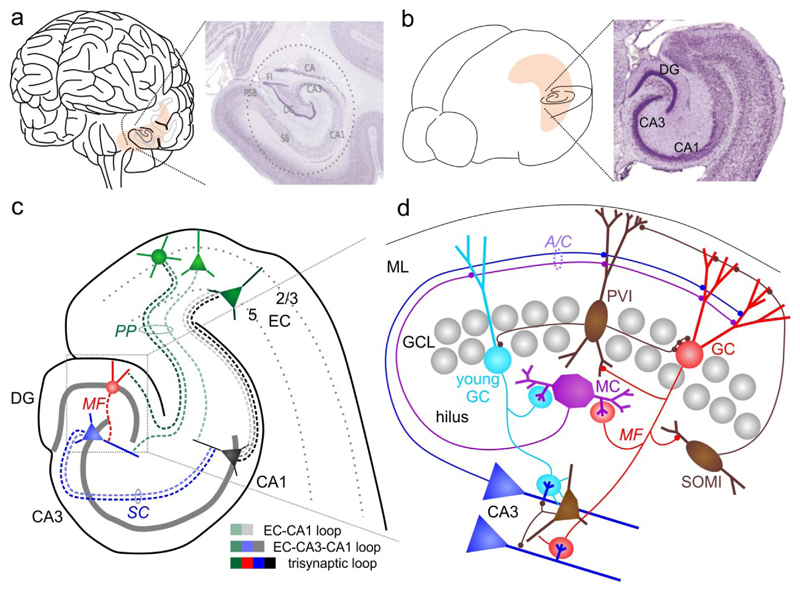
A simplified account of its role is this:
- Different brain systems process different parts of an experience: sights, sounds, touch, movement, location, and emotion.
- The hippocampus helps bind these elements into a representation of one event.
- Later, a partial cue can help reactivate the wider event representation.
For an adult, the smell of sunscreen might trigger a linked recollection of a particular beach, a family member, the weather, and a conversation. The cue is not identical to the full event, but it can retrieve the larger network.
This differs from a very cue-specific memory. In a cue-specific representation, changing the background, object colour, room, or person may disrupt retrieval because the original experience is encoded as one tightly fused package. The hippocampus helps build more relational representations: information is connected, but its parts can be accessed and recombined more flexibly.
A practical analogy from analytics is useful here. Imagine an early memory as a single, highly specific conversion record:
It can work reliably in the original conditions but may not generalize. A relational system is closer to a structured dataset: it connects users, pages, actions, and contexts in a way that permits new queries. The hippocampus does not literally operate like a database, but its value lies similarly in linking elements so they can be used beyond one exact situation.
Why the infant hippocampus is capable—but not adult-like
It would be wrong to think of a newborn hippocampus as absent or inactive. Much of the hippocampal formation develops before birth. However, the system is unevenly mature: some pathways are relatively advanced early, while others continue developing through infancy and childhood.
The especially important slow-developing structure is the dentate gyrus.
Accounting for change in declarative memory: A cognitive neuroscience perspective - PMC
Read the “Brain development” section for the anatomical basis of the argument: the hippocampus is partly mature early, but the dentate gyrus and inhibitory circuitry have a longer developmental timeline.
In “Brain development,” begin with the developmental contrast between the hippocampal formation and the dentate gyrus. Then continue through the paragraph beginning the dentate gyrus timeline. Focus on why “present” and “fully mature” are very different claims in neuroscience.
The dentate gyrus is one major input route into the hippocampus. In the classic hippocampal circuit, information from the entorhinal cortex reaches the dentate gyrus, then influences CA3, then CA1, and finally flows onward to other cortical regions. This is often called the trisynaptic circuit.
That schematic leaves out many reciprocal connections, but it captures an important developmental point: the dentate gyrus and parts of the downstream CA3 pathway mature relatively slowly compared with some routes that project more directly to CA1 and the subiculum.
Why might this matter for memory?
- The dentate gyrus is strongly implicated in distinguishing similar experiences from one another—such as two visits to similar-looking rooms.
- CA3 is highly recurrently connected and is often linked to associating and retrieving patterns of information.
- CA1 helps integrate hippocampal processing with information arriving from cortical regions and with output to other brain systems.
- Developing inhibitory interneurons help regulate timing and stability in these networks. Without mature inhibition, a network may be less precise in separating, stabilizing, and retrieving memories.
These functional labels are simplifications, and no one subregion “contains” one kind of memory. But they help explain why a child may have substantial learning capacity long before being able to encode and retain an event with adult-like precision.
Rapid myelination during the first year also supports faster, more coordinated neural communication. This does not independently create explicit memory; rather, it is one contributor to the broader improvement in encoding, retention, and retrieval.
From tightly bound cues to flexible relations
The most visible behavioral change during infancy is not that babies suddenly start remembering. They already remember. Instead, memory becomes less dependent on an exact match between learning and test conditions.
Consider a deferred-imitation study. An experimenter demonstrates a sequence with a particular puppet, such as:
- Remove a mitten from the puppet’s hand.
- Shake the mitten.
- Put it back.
A younger infant may reproduce the sequence a day later when given the same puppet in the same setting, but fail if the puppet or the setting changes. That result does not necessarily mean the event was erased. It may mean that the new cues do not adequately retrieve the original representation.
As hippocampal circuitry matures, infants increasingly show retention across changes in context. Research summarized in the curated review found patterns such as:
- At around 6 months, changing key retrieval cues can readily disrupt performance.
- By around 9 months, infants can sometimes tolerate larger context changes than younger infants.
- By around 12 months, evidence for retrieval across major context changes becomes stronger.
- Flexibility continues improving well into the second year and beyond; even 18-month-olds may struggle when the test object differs too much from the original.
Accounting for change in declarative memory: A cognitive neuroscience perspective - PMC
This portion connects the developmental evidence to the proposed hippocampal mechanism: relational representations make it possible to use a memory when its original cues are incomplete or changed.
In the “Retrieval” section, read the relational-memory account. Then read the infant sensory-preconditioning example, beginning the puppet experiment. Notice the logic of its control group: both groups saw each puppet, but only one group had learned the relationship between the two puppets.
The puppet experiment is particularly instructive. Six-month-olds first saw two puppets together repeatedly. Later they watched an action sequence performed on Puppet A. At test, they could imitate the sequence with Puppet B—even though they had not seen the target actions performed on B.
Infants who had seen the same two puppets separately, rather than together, did not show this transfer.
That comparison matters. It suggests that the successful infants had formed a relationship between A and B, then used that relationship to access the action memory in a new situation. This is a basic form of flexible relational memory.
It also prevents an overly simple story such as, “The hippocampus does nothing until the second year.” Under supportive conditions, infants as young as six months can show surprisingly flexible associations. The better conclusion is that hippocampal and surrounding medial temporal lobe functions are developing, not absent.
Is there really a transition around 8–9 months?
Developmental scientists have often identified roughly 8–9 months as a period of noticeable memory change. This is near the age when many infants become more mobile through crawling, creeping, or purposeful movement around their environment.
Independent locomotion may matter because it gives an infant far richer information about space:
- An object remains in one part of a room while the infant moves away.
- A caregiver can be located in relation to furniture, doors, and sounds.
- The same place can be approached from multiple routes.
- Different experiences can be connected to the same location.
This experience may help build the “where” component needed for event memory. But crawling is not a magic switch, and babies develop motor skills on different timelines. It is more accurate to treat mobility as one source of experience that works alongside neural maturation.
Learning to remember: The early ontogeny of episodic memory - PMC
Read this review’s discussion of developmental patterns and its caution against treating infancy as a sharp switch between two separate memory systems.
In Section 2.2, “The emergence of declarative memory,” start with the three developmental patterns: encoding speed, retention duration, and cue flexibility. Then read the paragraph beginning the gradual-development interpretation. The central question is whether the data require a replacement of one system by another, or fit a rapidly strengthening and increasingly efficient system.
The most defensible current account is therefore:
Not:
Implicit and explicit processes coexist throughout life. Adults still rely heavily on habits, conditioning, motor memory, and cue-driven responses. What changes in infancy is the growing capacity to link experiences across cues, contexts, and time.
Brain imaging evidence: useful, but not a shortcut

A subsequent-memory effect asks a clever question: when an infant is first exposed to something, does brain activity at that moment predict whether the infant will later show behavioral evidence of remembering it?
The supplied figure compares these effects across infant age groups. It is consistent with the idea that hippocampal involvement in successful encoding strengthens over development.
However, fMRI should be interpreted carefully:
- It measures indirect changes associated with blood oxygenation, not individual neurons firing.
- It identifies group-level statistical patterns; it does not diagnose the memory ability of one particular baby.
- More hippocampal activity does not by itself prove a complete transition to adult-like episodic memory.
- Behavioral experiments remain essential because a memory system is defined by what it enables the child to do: retain, relate, generalize, and retrieve.
The strongest science comes from combining anatomy, behavioral evidence, electrophysiology, and imaging—not from relying on any one method.
What this means for your 8-month-old
At eight months, your son is in a period where the relevant systems are very much in development. He can already form meaningful expectations, learn routines, recognize familiar people and objects, and retain some action–outcome experiences. He may also be beginning to show more flexible memory as he encounters the same people, toys, and routines in varied situations.
But avoid reading adult-style memory into every behavior. If he recognizes a bath routine, anticipates feeding, or searches in the direction of a familiar toy, that demonstrates learning and memory. It does not tell us exactly whether he is experiencing a verbal-like recollection of a past episode.
A supportive everyday implication follows from the science:
- Repeat meaningful sequences. A stable sequence—familiar words, an action, then an outcome—creates reliable retrieval cues.
- Allow active participation. Let him reach, choose, drop, open, shake, crawl toward, or signal. Active engagement gives memory multiple linked elements.
- Introduce manageable variation. Use a familiar toy in another safe room, or let two caregivers participate in a similar play routine. Variation can help memory become less tied to one exact context.
- Do not turn this into memory training. Ordinary responsive play, caregiving routines, sleep, nutrition, safety, and exploration are the foundations. There is no evidence-based need to drill flashcards or test whether he “remembers.”
A useful observation is to notice how he responds when one feature of a familiar routine changes. If he seems uncertain in a new room or with a slightly different object, this is often a normal retrieval and generalization challenge—not evidence that he has lost a skill.
Conclusion
The hippocampus helps transform memory from a highly cue-bound record into a more connected and flexible representation of experience.
The central takeaways are:
- Early infancy includes real learning and memory, including implicit learning and some surprisingly sophisticated associations.
- The hippocampus is present early, but its subcircuits mature on different timelines.
- The dentate gyrus, CA3-related pathways, inhibitory circuitry, and broader brain connectivity develop substantially across infancy and childhood.
- As this system matures, infants tend to encode faster, retain information longer, and retrieve memories more flexibly across changing contexts.
- Around 8–9 months is best understood as a developmental period of change, not a sharp handoff from implicit to explicit memory.
- By 8 months, your son is building a growing network of memories through repeated action, social interaction, movement, and exploration.
Next, we will use this bridge from memory to behavior: how reinforcement can turn early action–outcome learning into the beginnings of goal-directed actions.
Can't find a good explanation? Sign up and we'll make it for you
Sign up