
Hello again. In the previous lesson, you used coordination to join ideas of roughly equal importance: The evidence is limited, but the pattern is consistent. Coordination helps prose avoid a choppy, sentence-by-sentence march.
Sometimes, however, the ideas are not equal. One idea is your point; the other gives a reason, a limitation, a condition, or a time frame. Subordination lets you make that hierarchy visible:
Although the evidence is limited, the pattern is consistent.
The limitation matters, but the sentence directs attention toward the main claim: the pattern is consistent. In this lesson, you will use subordinate clauses to express cause, contrast, condition, and time clearly while controlling emphasis and punctuation.
Main clauses carry the point; subordinate clauses provide the frame
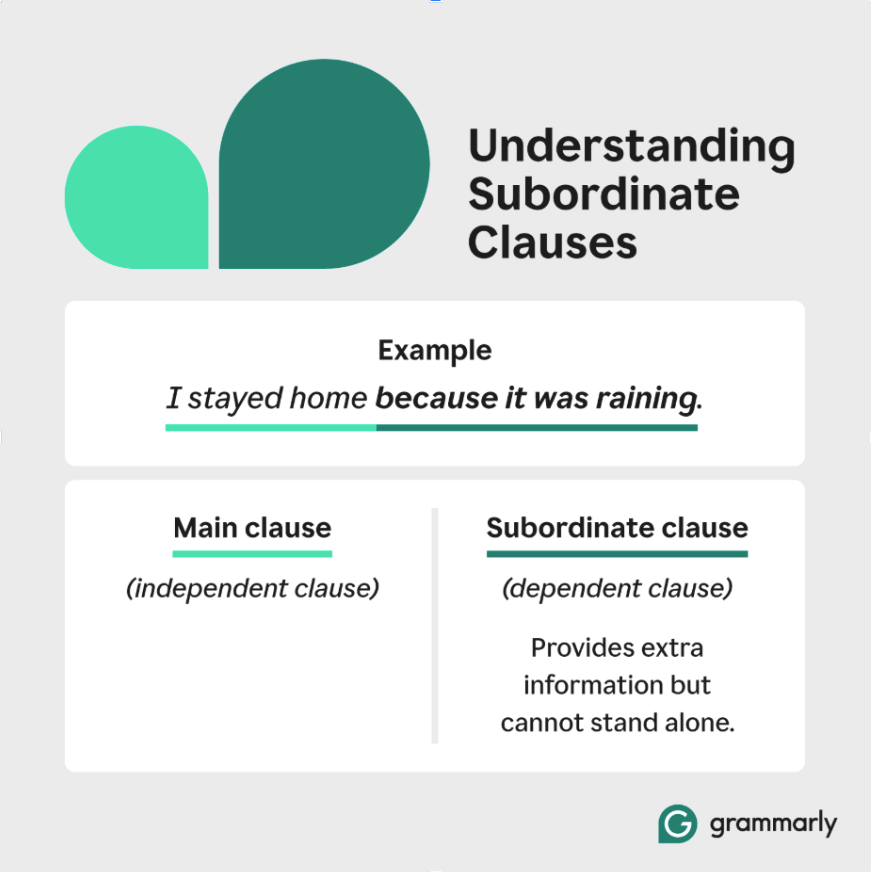
A main clause (or independent clause) can stand as a complete sentence:
The town reopened the library.
A subordinate clause contains a subject and verb but cannot stand alone because a subordinating conjunction makes it depend on another clause:
Because the town received a grant . . .
The word because makes the reader expect the result. Complete the thought, and you have a complex sentence:
The town reopened the library because it received a grant.
Subordination is therefore not just a way to make sentences longer. It is a way to tell the reader how one idea relates to another and which idea deserves the foreground.
G. Coordination and Subordination – UNM Core Writing Grammar Guide
Read “Coordination and Subordination” from the UNM Core Writing Grammar Guide for the central distinction between equal coordination and unequal subordination, then for its practical punctuation rule and conjunction chart.
In the “Subordination” section, read the Tracy example. Notice which fact becomes the main clause and which becomes background. Next, under “Subordinating Punctuation,” read the punctuation rule. Then continue into “Subordinating Conjunctions” and study the conjunction chart, concentrating on cause, concession, condition, and time.
A useful diagnostic is the stand-alone test. Remove the subordinating conjunction and see whether the remaining words form a complete thought.
| Complete main clause | Incomplete subordinate clause |
|---|---|
| The audience became silent. | when the speaker entered |
| The proposal may fail. | unless the council revises it |
| The narrator remains hopeful. | although the setting is bleak |
Do not use the test mechanically, though. Your real decision comes first: What relationship do you want the reader to understand?
Choose the conjunction that names the relationship
Subordinating conjunctions are precise. They do not merely connect material; they tell readers how to interpret it.
Cause: explain why something happens
Use because when the subordinate clause gives the direct reason for the main clause.
The character leaves the celebration because she feels excluded.
This sentence does more than report two facts. It makes a claim about motivation: exclusion causes the departure.
Since can also express cause:
Since the source provides no data, the claim remains unconvincing.
In formal essays, because is often the safest choice when you mean cause, because since can also refer to time: Since the article appeared, the debate has changed.
Avoid using because when you really mean a different relationship. This sentence is logically weak:
The policy is unfair because many people oppose it.
Opposition does not itself prove unfairness. A clearer causal sentence explains the actual reason:
The policy is unfair because it charges low-income residents a fee they cannot reasonably pay.
The subordinate clause should supply a real reason, not an unsupported restatement of the claim.
Contrast: acknowledge a fact without surrendering the main point
Use although, even though, though, while, or whereas when the subordinate clause presents a fact that might make the main clause surprising, limited, or more nuanced.
Although the novel ends peacefully, its final image remains unsettling.
The novel’s final image remains unsettling although it ends peacefully.
Both sentences contrast a peaceful ending with an unsettling effect. The first arrangement foregrounds the concession, then lands on the main analytical point. The second states the point first and adds the concession afterward.
Use even though when the contrast feels particularly strong:
Even though the witness sounds confident, her account changes several times.
Use whereas when comparing two clearly different cases:
The first speaker appeals to emotion, whereas the second relies on statistical evidence.
A common error is to use two contrast signals where one is enough:
Incorrect: Although the setting is bleak, but the narrator remains hopeful.
Correct: Although the setting is bleak, the narrator remains hopeful.
Correct: The setting is bleak, but the narrator remains hopeful.
The first correct version subordinates the bleak setting. The second coordinates two equally weighted observations.
Condition: state what must, may, or will happen under a circumstance
Use if to make one situation dependent on another:
If schools provide clear guidance, students can evaluate sources more responsibly.
The sentence does not claim that guidance guarantees responsible evaluation. It says guidance is a condition under which that result becomes possible.
Use unless to mean roughly if not:
The argument will remain incomplete unless the writer addresses the strongest objection.
In other words, if the writer does not address the objection, the argument remains incomplete.
Because unless already carries a negative meaning, avoid an unnecessary second negative:
Awkward: Unless the writer does not address the objection, the argument will remain incomplete.
Clear: Unless the writer addresses the objection, the argument will remain incomplete.
Conditions are especially useful in argumentative essays because they prevent overstatement. Instead of claiming that one policy will always succeed, you can state the circumstances needed for it to succeed.
Time: arrange events and actions clearly
Use time conjunctions to show sequence, overlap, or a deadline.
| Relationship | Useful conjunctions | Example |
|---|---|---|
| One event happens earlier | before, until | The narrator hesitates before she answers. |
| One event follows another | after, once | After the storm passes, residents assess the damage. |
| Events occur at a particular moment | when, as soon as | When the evidence changes, the conclusion must change as well. |
| Events overlap | while | While the speaker describes the past, the scene shifts to the present. |
Time conjunctions are valuable in narrative writing, but they also strengthen literary analysis and explanation. They help readers track the order in which a text reveals information:
Before the narrator names the threat, the author creates suspense through sound and setting.
The time clause frames the sentence; the main clause presents the analytical claim.
Place the subordinate clause deliberately
A subordinate clause can come before or after the main clause. The order affects rhythm and emphasis.
Make Your Writing Flow | Sentences: Transitions, Subordination, and Modification
Watch “Make Your Writing Flow” by Writing with Andrew for a visual explanation of how main and subordinate clauses create smoother syntactic flow in a paragraph.
Watch clause roles for the distinction between independent and dependent clauses. Then watch the paragraph revision. Focus on how subordination saves the reader from having to infer every relationship between a chain of short, separate sentences.
Put the subordinate clause first to establish context
Because the narrator withholds key facts, the reader questions his reliability.
The reader receives the reason first and arrives at the conclusion second. This structure works well when the context is necessary for understanding the claim or when you want the main point to land with force at the end.
Put the main clause first to state the point immediately
The reader questions the narrator’s reliability because he withholds key facts.
This version is direct. It works well when you want the claim to lead and the explanation to follow naturally.
The same choice applies to contrast:
Although the speech sounds optimistic, its repeated warnings create anxiety.
Its repeated warnings create anxiety although the speech sounds optimistic.
Neither order is universally better. Choose based on what the reader needs first:
- Put the subordinate clause first when it provides useful background, a concession, or a scene-setting condition.
- Put the main clause first when the claim should arrive immediately.
- Avoid beginning every sentence with a subordinating conjunction. Variety matters, and an essay can become overly dependent on introductory clauses.
Punctuate by position, not by length
The core punctuation pattern is simple.
When a subordinate clause comes before the main clause, use a comma:
When the debate became public, the committee revised its proposal.
Although the data is incomplete, it suggests a consistent trend.
When the subordinate clause comes after the main clause, you generally do not need a comma:
The committee revised its proposal when the debate became public.
The data suggests a consistent trend although it is incomplete.
The comma marks the boundary after an introductory dependent clause. It is not a signal that a sentence is sophisticated; it simply helps the reader see the sentence’s structure.
Be careful not to leave a subordinate clause alone as a fragment:
Fragment: Because the character fears rejection.
Complete sentence: Because the character fears rejection, she avoids telling the truth.
Also distinguish a subordinating conjunction from a preposition. A conjunction is followed by a clause containing a subject and verb:
Because the roads flooded, the school closed.
Although the roads flooded, the school remained open.
A preposition is followed by a noun phrase, not a full clause:
Because of the flooding, the school closed.
Despite the flooding, the school remained open.
This distinction prevents errors such as despite the roads flooded. The correct version is despite the flooded roads or although the roads flooded.
Revise for hierarchy, not just variety
Consider this flat series of sentences:
The article uses statistics. The statistics are limited. The article still presents a convincing argument. The writer explains how the numbers affect local families.
A writer could combine every sentence, but that would obscure the argument. Instead, identify the relationships.
- The limited statistics contrast with the argument’s persuasiveness.
- The explanation of families helps account for that persuasiveness.
- The statistics and explanation belong inside one focused analytical claim.
A controlled revision might read:
Although the article relies on limited statistics, it presents a convincing argument because the writer explains how those numbers affect local families.
This sentence is longer, but each added clause has a job:
- Although the article relies on limited statistics acknowledges a limitation.
- it presents a convincing argument gives the main claim.
- because the writer explains how those numbers affect local families explains why the claim is reasonable.
That is the difference between elaboration and inflation. Elaborate writing does not pile up clauses. It organizes ideas so that the reader can follow the reasoning without having to guess at the connections.
When revising, use this brief process:
- Find two nearby sentences that concern the same subject.
- Decide whether one is the main point and the other is cause, contrast, condition, or time.
- Choose a conjunction that states the actual relationship.
- Put the main clause where its emphasis serves the paragraph.
- Check the comma rule and read the sentence aloud once.
If the sentence becomes difficult to follow, do not force it to remain one sentence. A clear full stop is better than a crowded attempt at sophistication.
Key takeaways
Subordination combines a main clause with a dependent clause in order to show that one idea frames, qualifies, explains, or times another.
Keep these patterns in view:
- Use because for cause: The claim fails because the evidence is unreliable.
- Use although or even though for contrast: Although the evidence is limited, the claim is plausible.
- Use if or unless for condition: Unless the evidence is verified, the claim remains uncertain.
- Use after, before, when, while, or once for time: After the evidence is verified, the writer can revise the claim.
- Use a comma after an introductory subordinate clause; usually omit it when the subordinate clause follows the main clause.
- Let the relationship between ideas determine the conjunction. Do not use subordination merely to make a sentence seem more advanced.
You have now completed the module on clear, flexible sentences. Next, you will begin working on sentence length and rhythm: choosing when a short sentence should create emphasis and when a longer sentence should carry a more developed movement of thought.
Can't find a good explanation? Sign up and we'll make it for you
Sign up