Hello! Welcome to our session on evaluating long-form content.
In our last lesson, we focused on structuring a thought leadership article to challenge the status quo. That type of content succeeds by presenting a bold, contrarian viewpoint. Today, we'll turn our attention back to the more traditional B2B white paper, but with a critical eye. While a white paper's primary goal is to educate and build trust, many fail to hold the reader's attention long enough to do either.
Our learning outcome for this session is to evaluate a section of a real B2B white paper to identify where it succeeds or fails at maintaining reader engagement. This is a vital skill for any copywriter. Before you can improve your own writing, you must be able to diagnose what's working—and what isn't—in the content around you.
What Makes a Reader Give Up?
A B2B buyer is busy and skeptical. They are looking for valuable information, but they have little patience for content that is boring, confusing, or self-serving. When a white paper fails to engage, it's usually for a few predictable reasons.
Let's start by looking at a "post-mortem" of a genuinely bad white paper. The analysis is witty but also full of sharp insights into the common mistakes that kill reader engagement.
The article 'Worst. White. Paper. Ever.' by Gordon Graham (That White Paper Guy) breaks down the failings of a real white paper from HP. It provides a perfect catalog of what not to do.
Please read the sections titled 'Worst practice #1: Boring or misleading title,' 'Worst practice #3: Poor design or typography,' 'Worst practice #5: Too much hype, too little proof,' 'Worst practice #6: Sales pitch in disguise,' and 'Worst practice #7: Weak flow of ideas.' As you read, notice how each failure directly impacts a reader's willingness to continue.
As you saw, the failures go far beyond simple typos. They violate the fundamental contract with the reader: a promise of valuable, educational content. A misleading title, a "wall of text," unsubstantiated claims, and a bait-and-switch sales pitch are all guaranteed ways to lose your audience's trust and attention.
A Framework for Critique: The Engagement Checklist
To evaluate a white paper effectively, we need a simple, consistent framework. The following checklist covers the key areas that determine whether a reader will stick with your content or abandon it.
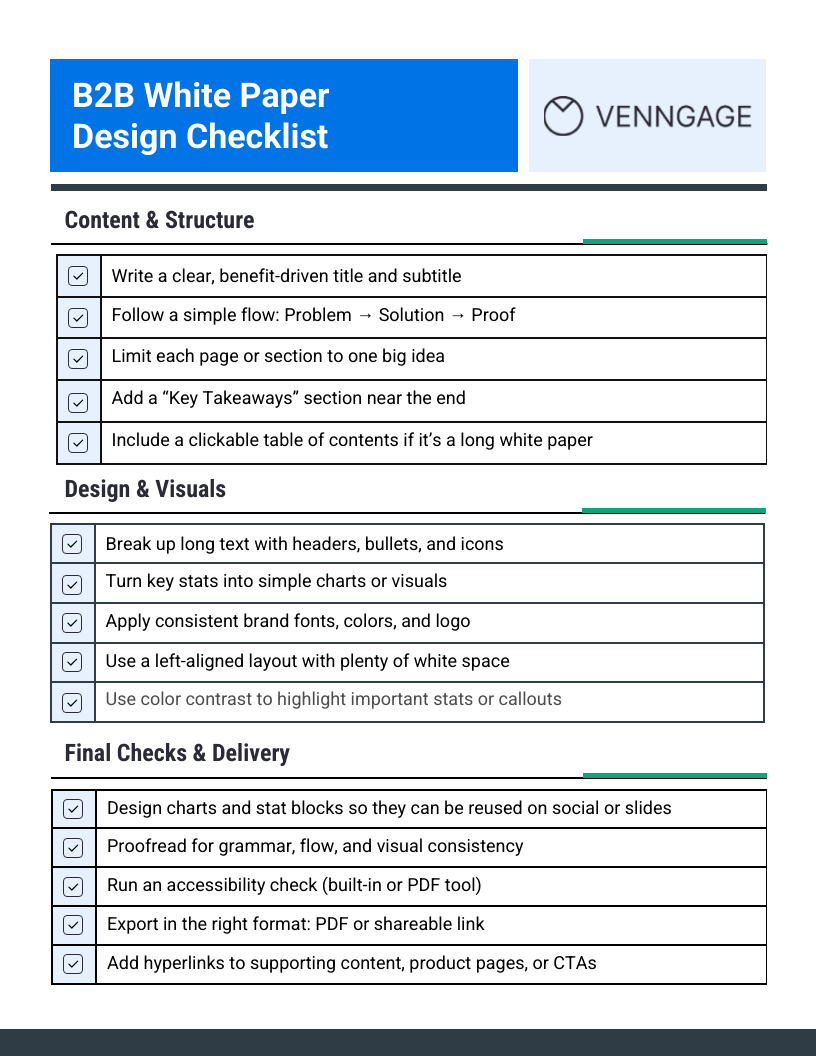
This checklist gives us a powerful tool. It turns a vague feeling of "this is boring" into a specific diagnosis, like "The text isn't broken up with subheadings or visuals, creating a 'wall of text' that increases cognitive load."
Your Turn: Evaluate a Real-World Example
Now it's time to put this into practice. The article you just read, "Worst. White. Paper. Ever.," contains a link to the actual HP white paper it critiques.
Your Task:
- Open the article "Worst. White. Paper. Ever." again and click the cover image to download the PDF of the white paper titled "IT Professional’s Guide to Color Imaging and Printing."
- Look at only the first page of content (the page after the table of contents).
- Using the "B2B White Paper Design Checklist" above, identify three specific failures on that page that would hurt reader engagement.
- For each failure, briefly explain why it would cause a busy professional to lose interest or trust.
Take about 10 minutes for this analysis. Focus on making a clear connection between a specific flaw and its negative impact on the reader's experience.
Debriefing the "Worst White Paper"
Excellent. This is a great exercise for sharpening your critical eye. A busy IT professional would likely abandon that document in under a minute. Here’s a breakdown of the key failures on that first page, aligning with our checklist:
-
Failure 1: Bait-and-Switch Content (Content & Structure)
- What's wrong: The title promises an "IT Professional's Guide," but the first paragraphs are pure sales-speak about "the breadth and depth of HP's portfolio" and "HP's printing and imaging innovations." It breaks the promise of education from the very first sentence.
- Why it fails: The reader came for objective guidance, not a brochure. This immediate switch from education to sales pitch feels dishonest and destroys credibility. The reader feels their time is being wasted.
-
Failure 2: "Wall of Text" (Design & Visuals)
- What's wrong: There are no subheadings, no bullet points, no bolded text, and no images to break up the dense paragraphs. The lines of text are also very wide, which makes them harder to read.
- Why it fails: This design is visually intimidating. A busy reader will scan a document first to see if it's worth their time. A solid wall of gray text signals a difficult, time-consuming read, prompting them to close the document before they even start.
-
Failure 3: Vague Hype Over Substance (Content & Structure)
- What's wrong: The copy is filled with unsubstantiated marketing fluff like "significant investments," "uniquely positioned," and "hallmarks of this legacy." These phrases offer no specific information or proof.
- Why it fails: B2B buyers, especially technical ones like IT professionals, are allergic to hype. They are looking for data, evidence, and clear explanations. Vague, self-congratulatory language signals that the document will not provide the concrete details needed to make a business decision.
By applying a simple checklist, we can move from a gut feeling ("this is bad") to a precise, actionable critique. This is the same process you will use to edit and improve your own long-form content.
Conclusion
In this lesson, we transitioned from creating content to critiquing it. You learned to use a practical framework to evaluate how well a B2B white paper maintains reader engagement, and you applied it to a real-world example of what not to do.
Key Takeaways:
- Reader engagement is lost when a white paper breaks its promise of education, is visually difficult to read, or uses unsubstantiated hype instead of credible proof.
- A critique checklist helps you diagnose specific failures in content, structure, and design.
- The most common and damaging failure is the "bait-and-switch," where an educational document is revealed to be a poorly disguised sales pitch.
Preview of the Next Lesson:
So far, our evaluation has been qualitative. But how do we know for sure what headline, email, or call-to-action will perform best? In our next lesson, we will move into the world of quantitative analysis. You will learn how to design a simple A/B test for a B2B headline, email, or CTA, and define its success metrics. This will give you the tools to let the data, not just your intuition, guide your copy decisions.