
Welcome back. Previously, we separated tensile strength, extensibility, and elastic recovery: resistance to breaking, available stretch, and return after stretch. Moisture adds another layer because it can alter both the fibre itself and the geometry of the yarn or fabric. A yarn that seems stable, crisp, or well balanced while dry may relax, swell, felt, or take a temporary set when wet.
For blend development, “moisture management” is not a single property. You need to distinguish vapour held within fibres, liquid water moving between fibres, and the structural changes that water permits. By the end of this lesson, you should be able to predict how those mechanisms affect fibre preparation, wet finishing, next-to-skin comfort, drying, and dimensional stability.
Regain: moisture held by the fibre, not water sitting in the yarn
Moisture regain is the mass of moisture in a fibre expressed relative to its oven-dry mass:
A fibre with a regain of contains g of moisture for every g of completely dry fibre. Regain is therefore not a fixed label such as “wool has regain.” It changes with relative humidity and, to a lesser degree, temperature.
Wool is strongly hygroscopic: it absorbs and releases water vapour as surrounding conditions change. Its complex keratin structure provides many sites that attract water molecules. At high humidity, wool can absorb substantially more moisture vapour than cotton and far more than conventional polyester, while still not necessarily feeling wet.
This is the first distinction to internalise:
- Regain concerns water molecules absorbed within the fibre structure.
- Liquid water retention concerns water held on fibre surfaces and in the spaces between fibres and yarns.
- Wicking concerns the movement of liquid water through those spaces.
- Drying rate depends on both the amount of water retained and the evaporation conditions: temperature, humidity, airflow, exposed area, fabric thickness, and construction.
A fibre may have high regain but poor liquid wicking. Wool commonly has just this combination in its untreated state: it can absorb moisture vapour internally, while its naturally lipid-coated outer surface resists liquid water to a degree. That is useful, but it does not make a wool yarn or fabric waterproof. The openness of the yarn and fabric, applied finishes, pressure from rain, and duration of exposure all matter.
Read the following short technical account before applying these distinctions to handspun yarns.
[PDF] The wool fibre and its applications - Woolwise
In these Woolwise course notes, Dr Geoff Naylor explains wool’s moisture absorption, the meaning of regain, and why moisture buffering affects perceived comfort. Read it to establish a precise distinction between absorbing vapour and merely becoming wet.
In the section “Water in wool” on printed pp. 6–7, read absorption and heat. Focus on the fact that wool continually adjusts toward an equilibrium moisture content as humidity changes. Then continue through “Moisture buffering” on printed pp. 7–9. Read the regain explanation. Note both the definition of regain and the reason that buffering a change in humidity can improve comfort.
Moisture buffering and comfort
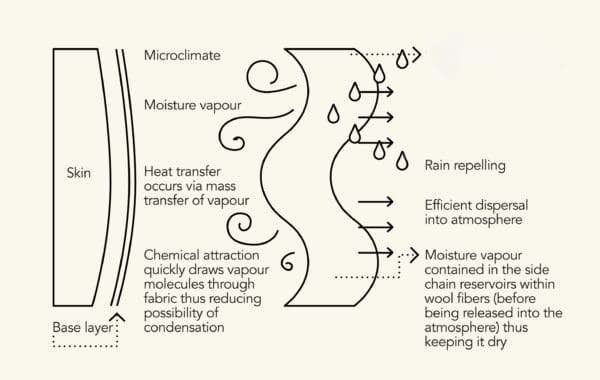
The air next to skin, inside clothing, is a small microclimate. During exertion, its humidity can rise quickly as sweat evaporates. A fibre with high moisture regain can temporarily take up some of that vapour, slowing the rise in humidity near the skin. When the air later becomes drier, the fibre releases some vapour again.
That is the basis of wool’s moisture-buffering contribution to comfort. It does not mean that wool makes sweat disappear, nor that it remains equally comfortable when saturated with liquid water. Rather, under ordinary changes in humidity, it moderates the rapid shift that often produces a clammy sensation.
When wool absorbs moisture, a small amount of heat is released. This is an exothermic absorption process: water molecules become associated with chemical sites in the fibre, releasing energy. The effect is real, but it is a temporary response while moisture content is changing, not a source of continual heat. Once wool is heavily wet, evaporative cooling and lost air insulation can become more important than this initial heat release.
Vapour absorption is not wicking
“Breathable,” “moisture-wicking,” and “quick-drying” are often used as if they mean the same thing. They describe different mechanisms.
| Mechanism | What moves? | Where does it occur? | Practical blend implication |
|---|---|---|---|
| Moisture regain | Water vapour | Within the fibre | Affects humidity buffering, handle, fibre flexibility, and mass under humid conditions. |
| Wicking | Liquid water | Along fibre surfaces and through capillary spaces | Depends strongly on surface chemistry, yarn structure, density, and applied finishes. |
| Evaporation | Water becomes vapour | From exposed wet surfaces | Depends heavily on airflow, temperature, humidity, and the amount of retained water. |
| Water resistance | Liquid water is resisted | At surfaces and interfaces | May come from natural surface lipids, a dense construction, a coating, or a durable water-repellent finish. |
Cotton, flax, and other cellulosic fibres generally have relatively high surface energy, so liquid water is readily attracted to their surfaces and can wick effectively through an appropriate yarn or fabric. Untreated wool, by contrast, often wicks liquid water poorly because its surface lipids are relatively hydrophobic, even though the interior of the fibre is strongly receptive to water vapour.
This difference is crucial in a wool-led blend. Adding a cellulosic component may make a preparation or finished textile take up and spread liquid moisture more readily. It may also increase the amount of water retained after washing. Whether that is desirable depends on use: a towel and a close-fitting hiking base layer do not have the same moisture-management requirements.
Wet is a changed material state
For blend design, the essential question is not merely, “Does this fibre absorb water?” Ask instead:
What changes when this component moves from its normal conditioned state to a humid, damp, soaked, steamed, washed, or dried state?
Water acts as a plasticiser for wool. In practical terms, moisture makes parts of the fibre structure more mobile and pliable. This is why steam allows wool fabric to be pressed into shape, why a crease can be removed more easily with steam than with a dry iron, and why wet finishing has consequences that dry handling does not reveal.
The change may be temporary, useful, or damaging, depending on temperature, stress, and mechanical action.
Fibre swelling
Hydrophilic fibres generally swell much more in diameter than in length when wet. Woolwise’s comparative figures illustrate this pattern: wool, cotton, silk, viscose, and nylon all show relatively modest lengthwise swelling but appreciable transverse swelling, with viscose particularly high.
At yarn level, transverse swelling can:
- alter yarn diameter and compactness;
- change the friction between component fibres;
- change the spacing of knitted loops or woven yarns;
- reduce air spaces temporarily;
- alter handle, thickness, and drape while wet;
- contribute to reversible changes in width or length as the textile wets and dries.
The effect is never solely a fibre property. A loosely spun woollen yarn has much more room for internal rearrangement than a compact, firmly twisted combed yarn. A relaxed knitted fabric can move differently from a dense woven fabric even when both are made from the same blend.
Dry feel is not identical to dry mass
A wool textile can hold appreciable moisture internally and still feel comparatively dry because absorbed vapour does not behave like a film of free liquid water on the surface. A wet-feeling sensation often involves rapid heat transfer from the skin as liquid moisture evaporates or spreads.
However, do not turn this useful distinction into the myth that wet wool is “dry.” A thoroughly soaked yarn is heavier, has reduced loft, and can lose a substantial part of its insulating performance because water replaces air within the textile structure. It may feel less clammy than another equally wet material under some conditions, but it is still wet and needs sensible drying and protection from wind.
The next reading distinguishes internal vapour absorption from surface wicking, then connects moisture, heat, and shape-setting in wool.
[PDF] The wool fibre and its applications - Woolwise
Continue with Dr Geoff Naylor’s Woolwise notes for a technically careful account of dampness, drying, wicking, and wool’s response to heat plus moisture. These sections are especially useful because they correct the common assumption that high regain and fast liquid wicking are the same property.
In “Dampness and drying” on printed pp. 10–11, read dampness and drying. Focus on why the sensation of dampness and the time required to dry are not simple rankings of fibre types. Next, read the “Wicking” section on printed pp. 11–13, beginning with the wicking discussion. Keep track of the difference between attraction at the fibre surface and vapour absorbed within a fibre. Finally, in “Tailorability, drape, style and setting” on printed pp. 19–21, read moisture-assisted setting. Concentrate on the practical role of steam, cooling, and re-wetting in temporary shape setting and relaxation.
Moisture during processing and finishing
In hand processing, it is tempting to treat moisture only as a nuisance: humidity causes static to change, washed fibre behaves differently from a dry combed top, and a finished skein never quite looks like it did on the bobbin. Those observations are evidence of real changes in fibre and yarn behaviour.
Conditioning before preparation
A fibre sample has a conditioning history. It may have been stored dry, compressed in a plastic bag, exposed to a damp studio, freshly washed, or steam-finished. These states can change apparent softness, cohesion, spring, and ease of opening even when the fibre identity is unchanged.
For meaningful comparisons, condition candidate fibres and samples similarly before judging them. For example, do not compare a freshly washed, still-damp Southdown sample with a long-stored, very dry mohair top and conclude that their apparent drafting cohesion is purely intrinsic. Record whether each sample was dry, normally conditioned, lightly humidified, or freshly washed.
For handspinning, moderate, even conditioning can make a dry preparation easier to handle. But adding water is not automatically benign:
- Excess moisture can encourage clumping, neps, and uneven distribution during blending.
- Wet wool subjected to rubbing, compression, and repeated agitation can begin to felt.
- A blend containing components with very different wet swelling or surface behaviour may redistribute differently when wetted and dried.
- Wet samples need to be dried without unintended tension if you want to assess their relaxed dimensions.
Steam, pressing, and temporary set
When wool is damp or exposed to steam, its structure becomes more pliable. If you impose a shape, then cool and dry the wool while it is held in that shape, it can acquire a cohesive or temporary set. A steam-blocked knitted swatch, a pressed seam, and a skein whose twist liveliness is calmed by finishing all show versions of this principle.
Temporary does not mean useless. It is extremely valuable in finishing because it can:
- smooth a yarn surface;
- improve drape;
- flatten a seam or establish a crease;
- reduce excessive twist liveliness;
- help a fabric sit in its intended shape.
But a temporary set can be removed or changed by later steaming or wetting. If you stretch a wet swatch aggressively while blocking, it may look stable when dry because the new dimensions have been temporarily set. On the next wash it can return toward its relaxed dimensions. That is relaxation shrinkage, not necessarily felting.
For your own samples, the practical discipline is simple: always record whether a measurement was taken before washing, after a soak, after agitation, after drying flat, or after drying under tension. “After finishing” is too vague to be useful.
Five different sources of dimensional change
“Shrinkage” is another overly broad word. Woolwise distinguishes five mechanisms, and they need different diagnoses and controls.
This Woolwise finishing note separates the mechanisms of dimensional change in wool fabrics and explains why normal regain matters in finishing. Read it to avoid diagnosing every post-wash size change as felting.
In Section 24.2, “Dimensional stability of wool fabrics,” read the five mechanisms. Then read the short subsections on relaxation, consolidation, swelling, felting, and hygral expansion. Focus on the trigger for each mechanism and whether the change is reversible. In the “Conditioning” subsection, read conditioning and raising. This gives a useful industrial example of why wool’s moisture content changes pliability and fibre loss during a mechanical process. In the “Pressing” subsection, read the pressing passage. Notice that its surface and handle effects are described as temporary when the fabric is later wetted.
1. Relaxation shrinkage
Relaxation shrinkage occurs when water releases strains that were imposed during spinning, plying, knitting, weaving, winding, stretching, or drying. It can occur in water without agitation and is non-reversible once the textile has settled into its more relaxed geometry.
A handspun example is a skein dried under tension. It may be longer and smoother than its natural state. After soaking and drying without tension, it can shorten and bloom. That is not proof that the yarn has felted. It may simply have released imposed strain and allowed twist, crimp, and yarn geometry to settle.
Control: finish and dry samples in a repeatable, minimally tensioned way before comparing dimensions. If a final object must be dimensionally stable, swatch and wash it under realistic care conditions before committing to measurements.
2. Consolidation shrinkage
Consolidation shrinkage is further compaction released by gentle agitation. Fibre-to-fibre and yarn-to-yarn contacts initially resist movement; water plus motion lets the structure settle more densely.
Knitted fabrics are particularly susceptible because loops can rearrange. A lofty handspun yarn in an open knitted structure may shorten, thicken, and become denser after several washes even if obvious felting has not occurred.
Control: distinguish an intended bloom from unwanted compaction. Use a larger swatch than seems necessary, measure both length and width, and assess thickness and drape as well as dimensions.
3. Swelling shrinkage
Swelling shrinkage comes from the physical swelling of hydrophilic fibres, especially across their diameter. It is generally reversible: the dimensions change on wetting, then move back toward their prior state on drying.
In a blend, unequal swelling can produce a temporary change in yarn geometry. Consider a wool–viscose yarn: both components respond to water, but viscose can swell particularly strongly. The yarn may become denser, less airy, or differently balanced while wet. That does not automatically make the blend unsuitable; it tells you that wet assessment belongs in the design process.
Control: inspect both wet and dry handle. For a yarn intended for frequent washing, the dry skein alone is an incomplete sample.
4. Felting shrinkage
Felting shrinkage is the irreversible compaction specific to untreated wool and related animal fibres with suitable scale structure, differential friction, and opportunity for movement. Water, detergent, heat, and mechanical action all influence it, but mechanical action and repeated fibre migration are central.
This is the mechanism most handspinners already recognise: the surface becomes denser, stitch definition softens, individual fibres become less distinct, and the textile progressively loses openness. Felting is not an all-or-nothing event. It can range from gentle, desirable fulling to a severe loss of size and drape.
Control: use low agitation, avoid abrupt temperature changes, select machine-wash-treated wool where appropriate, and test the actual blend. A non-felting component does not automatically prevent the wool portion from felting; it may simply change the rate, appearance, and final density.
5. Hygral expansion
Hygral expansion is a reversible change in dimensions as moisture regain changes with relative humidity. A wool-rich textile can measure differently in a very dry heated room than in a damp environment, even without being washed.
This matters for your reference library. If you weigh or measure samples at different times of year, apparently small differences may reflect conditioning rather than a meaningful difference in fibre supply or spinning.
Control: when precision matters, condition samples in the same indoor environment for a similar period before comparing mass, length, or handle. Record the date and the environmental conditions if they are strikingly dry or humid.
A practical prediction framework for wool-led blends
When you encounter a proposed component, avoid asking only, “Will it make the yarn warmer?” Instead assess its moisture behaviour across the sequence of use.
| Design question | Fibre and yarn features to inspect | Likely consequence |
|---|---|---|
| Will the yarn buffer humidity near skin? | Regain, fibre mass in the blend, yarn openness, fabric contact with skin | Wool-rich blends generally contribute more vapour buffering than low-regain synthetic-rich blends. |
| Will liquid moisture spread through the textile? | Surface energy, fibre finish, capillary spaces, twist, fabric density | Cellulosic components and hydrophilic treatments can increase wicking; untreated wool surfaces may resist it. |
| Will it feel different when wet? | Swelling, retained water, loft loss, yarn structure | A bulky yarn can become denser and heavier; drape and surface feel may change temporarily. |
| Will it change size after first washing? | Residual strain, fabric construction, agitation, wool felting propensity | Relaxation, consolidation, or felting may dominate; do not assume a single cause. |
| Can steaming or wet blocking establish a shape? | Wool content, temperature, regain, applied pressure or tension | Wool allows useful temporary setting; the result can change after later wetting. |
| Will different components create wet-state mismatch? | Relative swelling, regain, surface wetting, recovery, finishing response | The blend may change texture, distribution, or dimensions in ways that are invisible in dry sampling. |
A few design-level predictions follow.
A soft wool–silk blend for a draping scarf. Both fibres absorb moisture and swell transversely when wet. The yarn can become denser and more fluid during washing, then regain a soft dry handle. A relaxed, lightly finished outcome may be desirable; tight control of blocked dimensions may be less important than it would be for a fitted garment.
A lofty wool–nylon sock blend. Wool contributes moisture buffering and comfort, while nylon contributes properties that will be examined later. Moisture-wise, the important point is that nylon and wool do not respond identically to water. Swatch washing must test not only wear resistance but also recovery, stitch dimensions, and whether the wool-rich structure compacts or felts around the nylon.
A wool–cellulose blend intended for summer fabric. The cellulosic component can increase liquid-water affinity and alter wet handle; wool can still buffer vapour. The design question is not which component is “better at moisture.” It is whether the combined yarn gives the desired balance of absorbency, drying behaviour, drape, recovery, and maintenance requirements.
Build a wet-behaviour record for one existing sample
Add one compact entry to your developing reference library. Use either a small knitted swatch or two identical lengths of yarn from a blend you already have. A swatch is preferable because it shows structural change more clearly.
Keep the procedure deliberately modest and repeatable:
- Condition and document the dry sample. Leave it in your normal workroom overnight. Record dry dimensions, mass if you have a scale accurate enough, thickness or loft, surface character, and degree of twist liveliness.
- Soak one sample without agitation. Immerse it in lukewarm water for a fixed time, such as minutes. Lift and support it rather than wringing it. Observe its wet dimensions, density, drape, and whether the yarn opens or compacts.
- Dry without imposed tension. Lay it flat in a consistent shape. Once dry, re-measure and compare it with the original record. This first comparison reveals mainly relaxation and swelling effects.
- Use the second sample for a controlled agitation comparison. Wash it with a defined amount of gentle hand movement, using the same water temperature and drying method. Compare the result with the soak-only sample, not merely with the original dry sample.
- Write a mechanism-based note. For example: “The soak-only swatch shortened slightly and became fuller, indicating relaxation and structural settling. The agitated swatch became appreciably denser and less distinct at the surface, suggesting additional consolidation or early felting.”
Do not treat this as a laboratory shrinkage test. Its value is comparative: it trains you to observe which kind of wet change has occurred and to connect it to a fibre-and-yarn explanation.
Key takeaways
- Moisture regain is moisture absorbed within a fibre relative to its dry mass. It varies with humidity and temperature; it is not the same as liquid water held in a yarn.
- Wool’s high regain gives it strong moisture-buffering capacity, which can moderate humidity changes in the microclimate next to skin.
- Wicking moves liquid water along surfaces and capillary spaces. It is distinct from vapour absorption and depends on surface chemistry, construction, and finishing.
- Wet wool can feel pliable and can be temporarily shaped by steam, pressure, cooling, and drying. That useful set may change when the textile is wetted again.
- Dimensional change has multiple causes: relaxation, consolidation, swelling, felting, and hygral expansion. Not every post-wash change is felting.
- For blend development, evaluate samples both dry and after a controlled wet finish. Record conditions so that you can distinguish intrinsic fibre response from effects introduced by yarn structure and finishing.
Next, we will separate fibre density from assembled loft. That distinction will let you predict why a yarn can feel light, warm, bulky, dense, or drapey without confusing the density of the component fibres with the air structure created by spinning and construction.
Can't find a good explanation? Sign up and we'll make it for you
Sign up