
Good to continue from the causal model. In the previous lesson, we separated what the fibre is from what preparation, spinning, plying, and finishing make it do. Length is an especially useful test of that distinction: a fibre can be objectively long, yet feel awkwardly short in a damaged or highly hooked preparation; conversely, a carefully aligned preparation can make a modest-length fibre remarkably manageable.
This lesson distinguishes three related but non-interchangeable ideas—staple length, effective spinning length, and length distribution—and turns them into a practical way to anticipate control during drafting. The aim is not to find a universal “good” length, but to learn what questions to ask before combining fibres.
Three meanings of “length”
When a supplier says that a wool has a “4-inch staple,” that statement is useful, but incomplete. It tells you something about the raw or prepared fibre assembly, not everything you need to know about how it will draft.
1. Staple length: the length of the visible fibre bundle
A staple is a coherent bundle of fibres grown or assembled together. In a fleece lock, it runs from the cut end toward the tip. In a combed top, a pulled-out section can give an approximate sense of the retained fibres’ length.
Staple length is the length assigned to that bundle under a particular measurement convention. It is often an average, not a promise that every fibre is that length.
For wool, it is important to distinguish:
- the apparent length of a relaxed, crimped lock;
- the length of a staple gently extended for measurement;
- the actual lengths of the individual fibres within it.
Individual fibres inside a staple do not all end at the same place. Some are shorter, some longer, and crimp means their path along the fibre is longer than the visible, relaxed distance from one end of the staple to the other. Thus, a fleece with a stated 80 mm staple does not contain a population of identical 80 mm fibres.
For blend work, record both the number and the method: for example, “approximately 85 mm relaxed staple, measured from ten locks,” rather than simply “85 mm.”
2. Processed fibre length: a useful industrial distinction
Industrial wool processing uses a term, hauteur, for the mean individual fibre length in a processed top, measured by number. It is not another name for raw staple length. Combing removes some short material, while carding, combing, and drawing can also break fibres. The fibre population that enters spinning may therefore have a quite different length profile from the original fleece.
[PDF] 28. Effect of Fibre Properties on Processing Performance - Woolwise
Read this Woolwise discussion to sharpen the distinction between greasy-wool staple length and the lengths of fibres retained after processing. It is industrial in context, but the central lesson applies directly at hand scale: preparation can change the population you actually spin.
In Section 28.4, find the subsection “Staple length.” Read the staple-length discussion. Focus on two points: fibres within a staple have a range of lengths, and processing can cause breakage even while longer starting staples still tend to produce longer retained fibres.
This distinction helps avoid a common error: treating the length printed on a fibre label as though it were an exact description of the preparation in your hands. A commercial combed top may be comparatively length-regular because combing removed much of the shorter material. A carded batt made from the same wool may retain more short pieces, locks, hooks, and variable alignment.
3. Effective spinning length: the length that governs your hands
Effective spinning length is a practical, operational term rather than a single laboratory measurement. It means:
The length behaviour of the prepared fibre assembly that determines how far apart your hands need to be, how readily fibres release, and how reliably the draft remains controlled.
It is influenced by actual fibre length, but it is not identical to staple length. It also depends on:
- Preparation and alignment: Parallel combed fibres behave differently from the same fibres in a carded rolag or a compressed batt.
- Hooks, folds, and entanglement: These can shorten the distance over which fibres behave as though they are free to move.
- Breakage and short fibres: A preparation can have a long-looking staple but contain a disruptive tail of short pieces.
- Crimp and surface friction: These affect whether fibres hold together or slip past one another.
- Your drafting system: Short-forward drafting, long draw, supported methods, and the amount of twist admitted near the draft all alter what “controlled” feels like.
So, staple length is a description of a fibre assembly. Effective spinning length is a description of the relationship between that assembly and a particular drafting setup.
A useful rule is:
They often correlate, but they are not interchangeable.
Length becomes visible in the drafting zone
In a hand draft, you are not pulling isolated fibres apart. You are managing a shifting network of overlapping fibres. Some are still held by the fibre supply, some are being pulled forward, and some have become incorporated into the twisted yarn.
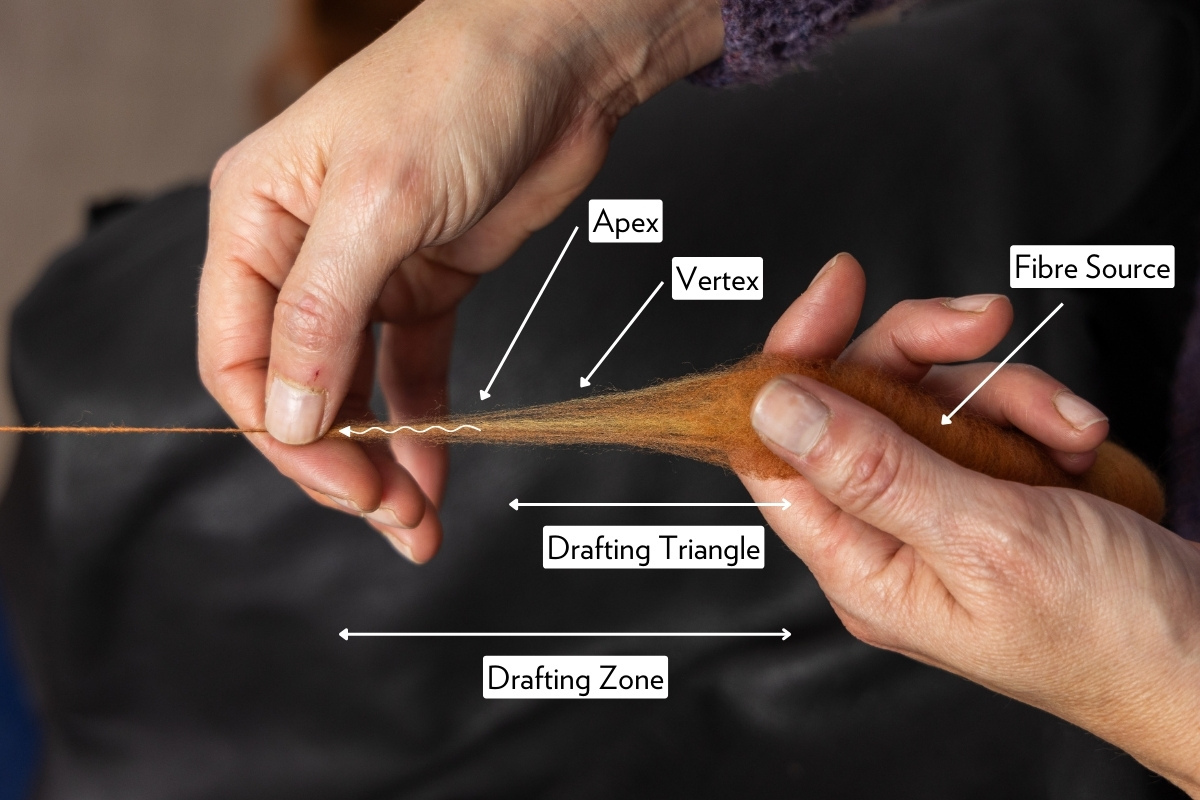
The image separates two useful ideas:
- The drafting zone is the broader working distance between the hand controlling fibre supply and the hand controlling the forming yarn.
- The drafting triangle is the fanned, tapering region of fibres within that zone. It becomes wider or narrower as you alter the amount of fibre being drafted.
The terminology vertex and apex is not used consistently by every spinner or teacher. What matters is the mechanics: fibres leave the source, are attenuated through the open zone, and are then captured by twist at the narrow end.
Why hand distance matters
A fibre that is long relative to your hand spacing can be held simultaneously by both hands. Instead of drafting, you are effectively pulling on opposite ends of the same group of fibres. The result is a resistant, locked-feeling draft.
A fibre that is short relative to a very wide drafting zone may do the opposite: many fibres can release at once before you have established sufficient control at the front. The result is a sudden flood of fibre, thinning, or a draft that feels evasive.
This is why hand spacing is not merely a matter of comfort. It is a control setting.
Staple length. Spinning basics.
In “Staple length. Spinning basics,” Amy King demonstrates this relationship directly with fibres of contrasting lengths. Watch it as a visual calibration exercise rather than as a set of fixed measurements for every fibre type.
Begin with defining staple length, noting the distinction between an average length and the length of every individual fibre. Then watch drafting comparisons. Pay particular attention to what happens when her hands are too close for the longer BFL and Wensleydale, and too far apart for the short cashmere top.
The video’s examples make the principle tangible:
| Relative relationship | Likely drafting sensation | First adjustment to test |
|---|---|---|
| Hands too close for the effective fibre length | Resistance; fibres seem locked; little or no attenuation | Increase the distance between control points |
| Hands approximately suited to the preparation | Measured, repeatable release | Refine hand pressure and fibre supply |
| Hands too far apart for a short or low-cohesion preparation | Sudden release; thinning; fibre floods forward | Narrow the zone or increase support |
| Preparation contains both long and short populations | Alternation between locking and flooding | Identify the distribution before blaming twist |
The last row is particularly important for blend design. A blend may contain a long component that establishes the minimum workable drafting distance and a shorter component that wants to release much earlier. If the two are well distributed and have adequate cohesion, the long fibres can act as a partial carrier for the shorter ones. If they are poorly distributed, layered, or very different in surface behaviour, the same nominal percentages may draft erratically.
Length distribution: the information hidden by an average
A single average length is often a poor predictor of drafting behaviour. Consider two fibre supplies, each with a mean individual length of 60 mm:
- Supply A: most fibres are between 55 and 65 mm.
- Supply B: roughly half are 30 mm and half are 90 mm.
Their mean is identical. Their drafting demands are not.
Supply A has a narrow distribution: most fibres begin and stop contributing to the draft in a similar range of positions. Supply B has a broad, bimodal distribution: the short fibres may release quickly, while the long fibres may remain held across a much wider zone.
A length distribution describes the spread and shape of individual fibre lengths in a supply. When inspecting a fibre for hand spinning, the most decision-useful features are usually:
- Central tendency: What length is typical?
- Range: What are the shortest and longest fibres you can find?
- Short-fibre tail: Is there a meaningful population that is much shorter than the rest?
- Shape: Is the supply fairly uniform, broadly variable, or composed of two distinct length groups?
- Cause: Is variation natural to the fibre, deliberately blended, introduced by breakage, or changed by combing?
A numerical shorthand for spread is the coefficient of variation:
where is the standard deviation of the individual lengths and is their mean. A higher value means more spread relative to the mean. You do not need to calculate this for every hand-spinning sample yet; at this stage, recognizing distribution shapes is more valuable than pretending that one number fully describes them.
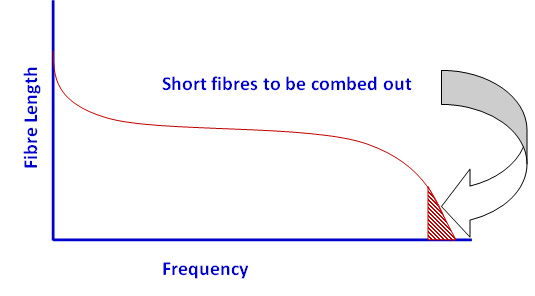
Distribution is not automatically a defect
Broad length distribution is sometimes treated as inherently bad. That is too simple.
In industrial worsted processing, a broad distribution can correlate with poor combing, fibre breakage, weakness, or a large short-fibre fraction. But the distribution itself is not necessarily the direct cause of every problem. It can also arise from intentional blending, natural fleece variation, or a preparation designed for a woollen rather than a worsted result.
[PDF] 29. Effect of Fibre Properties on Processing Performance: Top to Yarn
This Woolwise section puts length and length variation in an industrial drafting context. Its machinery-specific thresholds do not transfer directly to hand spinning, but its distinction between mean retained length, short-fibre content, and distribution is valuable.
On p. 29-5, in the subsection “Hauteur (H),” read the discussion of hauteur and drafting. Then continue into “Length distribution (CVH)” and read the caution about distribution. Separate the robust principle—poorly controlled short fibres can matter—from the overreach that one ideal distribution number should govern every fibre or spinning system.
For your purposes, the practical conclusion is:
A broad distribution is a design variable and a diagnostic clue, not a verdict.
A deliberate blend of long lustre wool and short cashmere may have a broad or even bimodal distribution, yet be entirely appropriate for a supported, softly spun yarn. The same distribution may be troublesome in a smooth, fine, tightly controlled short-forward draft if the shorter component repeatedly escapes control.
Predicting drafting behaviour before you spin
When you pick up a new fibre or proposed blend, use this short sequence before deciding that it “should” spin one way or another.
Step 1: Look at the preparation, not only the fibre label
Ask:
- Is this lock, carded batt, rolag, roving, sliver, or combed top?
- Does it contain visible short second cuts, neps, weathered tips, or broken sections?
- Are fibres parallel, broadly crossed, folded, or tangled?
- Does the preparation include fibres of obviously different lengths?
The same underlying wool can acquire different effective spinning lengths after carding, combing, repeated blending, or breakage.
Step 2: Identify the fibres that will control the extremes
Find both the long and short ends of the range.
- The longest substantial fibres often determine how narrowly you can set your hands before the draft locks.
- The shortest substantial fibres often determine how much support is needed to prevent sudden release, shedding, or uneven incorporation.
The word substantial matters. One stray short piece in an otherwise sound combed top is not equivalent to a visible population of short broken fibres throughout the preparation.
Step 3: Make a provisional drafting prediction
State it in conditional language:
- “This relatively uniform, aligned top should tolerate a consistent, wider short-forward zone.”
- “This batt has a broad distribution and crossed alignment, so I expect it to work better with supported drafting than with a very smooth, narrow, worsted-style draft.”
- “The long fibres may set the hand spacing, while the shorter component may need the long fibre to carry it.”
- “If the draft floods despite apparently adequate length, low crimp or low surface friction may be contributing; length is not the only control variable.”
This keeps the diagnosis appropriately narrow. A difficult draft is not automatically a length problem. Crimp, diameter, surface friction, moisture, preparation density, and twist management all matter. But length tells you where to begin looking.
Build an “effective-length map” by hand
For the kind of systematic reference library you want to build, make effective spinning length observable rather than intuitive-but-unrecorded. This is a short exploratory protocol, not a universal test.
Choose one preparation and use the same wheel, take-up, and general drafting method throughout. Work with a narrow, consistent strip of fibre and test several hand spacings, beginning narrower than you expect to use and increasing in small, repeatable increments.
For each spacing, record:
| Observation | What it suggests |
|---|---|
| Draft will not open without a hard pull | Long fibres are held across the zone, or the preparation is compact and entangled |
| Fibre releases in a smooth, measured way | The spacing is currently compatible with the effective spinning length and cohesion |
| Fibre surges forward | Zone may be too wide for the short fibres, or cohesion is low |
| Draft alternates between resistance and flooding | A broad distribution, uneven preparation, or distinct blend components may be involved |
| Fibre separates into visibly different streams | Components may not be sufficiently integrated, or their lengths and friction differ sharply |
Do this first with a single fibre supply. Then repeat with a second preparation of the same fibre—for example, carded versus combed, or a hand-combed sample versus commercial top. That comparison reveals how much of the behaviour belongs to length itself and how much belongs to preparation.
For a blend, keep the total fibre mass, preparation method, and spinning setup constant while changing only the proportion of one component. A 10%, 25%, and 40% addition often teaches more than jumping immediately to a single “final” ratio, because the point at which the minority fibre begins to alter draft control is often non-linear.
A compact working vocabulary
Use these terms precisely in your notes:
| Term | Working meaning | Do not confuse it with |
|---|---|---|
| Staple length | Length of a visible fibre bundle under a stated measurement method | The exact length of every fibre |
| Individual fibre length | Actual length of one fibre, usually measured after isolating and extending it | Relaxed lock length |
| Hauteur | Industrial mean individual fibre length by number in a processed top | Raw greasy-wool staple length |
| Effective spinning length | The length behaviour that governs workable hand spacing and release in a particular preparation and draft | A fixed supplier specification |
| Length distribution | The range and pattern of lengths in the fibre population | The mean length alone |
| Short-fibre content | The proportion below a defined length threshold | Any fibre that merely feels short in a given draft |
The key takeaway is that staple length describes a bundle, length distribution describes a population, and effective spinning length describes what that prepared population does between your hands. A long-looking fibre can be difficult if your drafting zone is too narrow; a short component can be manageable when supported by an appropriate carrier fibre and preparation; and two supplies with the same average length can demand entirely different drafting control.
Next, we will add another major predictor to this model: fibre diameter and bending stiffness. That will help explain why fibres of similar length can still produce very different softness, coverage, body, and handle in the finished yarn.
Can't find a good explanation? Sign up and we'll make it for you
Sign up