Hello! Welcome to the fifth lesson in your "Venture Finance and Valuation" module.
In our last lesson, we dissected the capitalization table and saw how an initial valuation is the critical input that determines ownership and dilution for every stakeholder. The entire structure of a deal hinges on that first number. This naturally leads to the question we ended with: For a pre-seed startup with little to no revenue, how do investors determine that initial valuation in the first place?
Today, we will answer that question. Your learning outcome is to compare common pre-seed valuation methods, such as the scorecard, comparables, and VC method. Valuing a pre-revenue company is often described as more art than science, relying on frameworks and assumptions rather than concrete financial data. Mastering these frameworks is essential for you as a future accelerator manager and fund GP. You will use them constantly to structure your investments, justify terms to founders, and ultimately, to explain your investment strategy to your own Limited Partners (LPs).
1. The Challenge of Valuing Potential
Traditional businesses are often valued based on tangible assets, revenue, and profits. Pre-seed startups, especially in deep tech or AI, typically have none of these. They have a team, an idea, and perhaps a prototype. So, what is an investor actually valuing? They are valuing potential, and trying to quantify the risk associated with that potential.
This is a fundamentally different exercise from valuing an established company. There are no hard and fast rules, only methods to create a structured and defensible argument for a specific valuation.
To set the stage, let's watch a short video that frames this challenge.
How Startup Valuations Work | The Fundamentals You Need to Know
The video 'How Startup Valuations Work' by Engenesis uses a great 'magic black box' analogy to explain the basis of valuation and highlights why this becomes so difficult for startups that aren't yet generating revenue or profit.
Watch the segment from 06:29 to 08:05. Pay attention to how the speaker contrasts traditional valuation with the reality of 'startup land' and emphasizes that early-stage valuation is largely about what investors are willing to pay.
As the video points out, investors have developed several methods to navigate this uncertainty. We will now explore the three most common ones used at the pre-seed stage.
2. Method 1: The Scorecard Method
If you can't use financial metrics, what can you use? The Scorecard Method (sometimes called the Checklist Method) replaces financial analysis with a qualitative assessment. It works by first establishing a baseline valuation for a typical pre-seed company in a specific market and geography, and then adjusting that valuation up or down based on a weighted "score" of the startup's key attributes.
The core idea is to systematically compare the target startup to the "average" funded startup.
Professor Claudia Zeisberger provides a clear walkthrough of this approach.
Understanding Valuation In Venture Capital | Part#1| Comps, Checklists & Score Card
In 'Understanding Valuation In Venture Capital', Professor Zeisberger explains how VCs use checklists and scorecards to assess a startup's strengths and weaknesses against a set of predefined criteria.
Watch from 03:35 to 08:49. Notice the key factors VCs evaluate: Strength of the Team/Founders: Experience, cohesion, domain expertise. Size of the Opportunity (Market): Is it a massive, urgent problem? Product/Technology/IP: Is it defensible? Is it a viable solution? Competitive Environment: Is it a crowded market or a 'blue ocean'? Observe how a score is assigned to each factor, which then modifies a base valuation.
To see how this looks in practice, let's examine a typical scorecard breakdown. The weights assigned to each category reveal what investors at this stage prioritize most highly.

As you can see, the Strength of the Team is the most heavily weighted factor (30%). At the pre-seed stage, investors are betting on the founders' ability to navigate uncertainty and execute more than anything else.
The Berkus Method is an even simpler predecessor to the Scorecard. It assigns a value of up to $500k for each of five key factors (sound idea, prototype, quality team, strategic relationships, and initial sales), capping the total pre-money valuation at $2.5 million. It's a quick, back-of-the-envelope method useful for the very earliest stages.
3. Method 2: The Comparables (Comps) Method
The Scorecard method relies on finding an average valuation. The Comparables Method gets more specific by looking at what investors have recently paid for individual, similar companies. This is one of the most intuitive and widely used approaches. The logic is simple: if a company very similar to yours just raised money at an $8M valuation, your company is likely worth something in that neighborhood.
Investors typically look at two types of "comps":
- Comparable Transactions: Recent funding rounds of private companies in the same industry, stage, and geography.
- Precedent Transactions: The price at which similar companies were acquired.
Understanding Valuation In Venture Capital | Part#1| Comps, Checklists & Score Card
Professor Zeisberger also covers the logic behind using comparable company analysis and precedent transactions to anchor a valuation.
Watch from 08:49 to 11:10. Focus on the definition of a 'peer company' (similar industry, geography, size, stage) and how ratios can be used. Then, from 11:10 to 12:45, listen to the explanation of using a 'last round' from a portfolio company or a peer as a valuation benchmark.
The biggest challenge with this method is finding truly comparable companies. No two startups are identical. One might have proprietary IP while another doesn't, which would justify a significant difference in valuation. Data can also be hard to find, as private company financing details are not always public. Tools like PitchBook, Crunchbase, and AngelList are essential for sourcing this data.
Test your understanding!
You're evaluating a pre-seed AI-powered CRM startup. Through your research on Crunchbase, you find three similar AI CRM startups that raised pre-seed rounds in the last 6 months:
- Company A raised $500k at a $5M post-money valuation.
- Company B raised $750k at a $6M post-money valuation.
- Company C raised $600k at a $5.5M post-money valuation.
What is a reasonable valuation "ballpark" for the startup you are evaluating, based purely on these comps?
Show answer
Based on these comparable transactions, a reasonable valuation range would be between $5M and $6M post-money. This range provides a strong, market-validated starting point for your own valuation discussions. You would then use other factors (like team strength or product progress) to argue for a valuation at the higher or lower end of that range.
4. Method 3: The Venture Capital (VC) Method
While the Scorecard and Comps methods look at the present, the VC Method is entirely forward-looking. It answers the question: "What is the maximum price I can pay for this company today to achieve my fund's required return upon exit?"
This method works backward from a hypothetical future exit. It is the most direct expression of a venture fund's economic model.
The article 'How to do a startup valuation using 8 different methods' from Brex provides a concise explanation of the VC Method, including the formulas used.
Read section 7, 'Venture capital method'. Pay close attention to the two formulas and the steps involved: Estimate the 'Terminal Value' (the startup's expected selling price in 5-10 years). Determine the 'Anticipated ROI' (the multiple of return your fund needs, e.g., 20x, 30x). Calculate the Post-Money Valuation today.
Let's walk through an example to solidify this:
- You believe an AI startup could realistically be acquired for $200 million in 8 years (Terminal Value).
- Your fund's model requires a 40x return on high-risk pre-seed investments (Anticipated ROI).
- Post-Money Valuation = Terminal Value / Anticipated ROI
- $200,000,000 / 40 = $5,000,000
- If you plan to invest $1 million, the pre-money valuation would be $4 million ($5M post-money - $1M investment).
The VC method forces you to be explicit about your exit expectations and required returns, directly linking your investment decision to your fund's strategy.
5. Triangulation: Combining Methods for a Defensible Range
As you've seen, each method provides a different lens on the same problem. A sophisticated investor never relies on a single method. Instead, they triangulate: they use multiple methods to arrive at a defensible range for the valuation.
For example, the Comps method might suggest $6M, the Scorecard $5M, and the VC method $4.5M. The investor now has a well-reasoned zone between $4.5M and $6M to negotiate within.
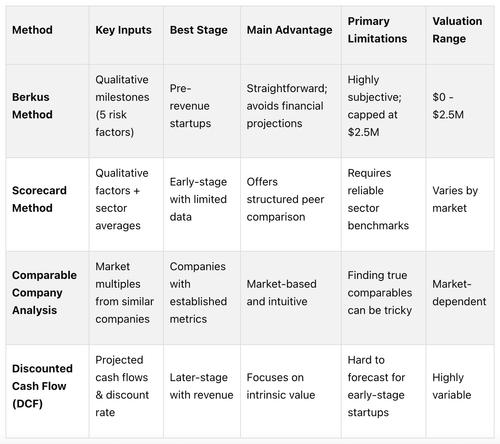
Finally, it's also important to know which methods are not used for pre-seed valuation. The most famous is the Discounted Cash Flow (DCF) method, a standard in corporate finance where you project future profits and "discount" them to a present value. For a pre-seed startup, any financial projection is pure speculation, making the DCF model a case of "garbage in, garbage out."
This summary table provides a great overview of the methods we've discussed and their ideal use cases.
Conclusion
Today we've unpacked the "art" of pre-seed valuation and turned it into a structured process. You now have a toolkit of methods used by VCs to put a number on early-stage potential.
Key Takeaways:
- Pre-seed valuation is about pricing risk and potential, not analyzing existing financial performance.
- The Scorecard Method provides a qualitative assessment by benchmarking a startup against the average, focusing on factors like team, market, and technology.
- The Comparables Method is a market-based approach, using recent funding rounds and acquisitions of similar companies as an anchor.
- The VC Method is an investor-centric, returns-driven approach that works backward from a potential exit to determine a maximum present-day valuation.
- Sophisticated investors triangulate using multiple methods to establish a defensible valuation range, rather than a single point estimate.
Preview of the next lesson:
Now that you understand the theory behind these common valuation methods, it's time to put them into practice. In our next lesson, you will apply a valuation framework to an early-stage startup scenario to arrive at a valuation range. We will work through a case study, using the methods you've learned today to build a complete valuation argument for a hypothetical company.