Hello! Welcome to your third lesson in the "Venture Finance and Valuation" module.
In our previous two lessons, we built a foundational toolkit for assessing a startup's financial health. We started by learning to calculate burn rate and runway, which answers the question, "How long can the company survive?" Then, we dove into unit economics (LTV and CAC) to answer the more strategic question, "Is this a viable and scalable business model?"
Now that you can distinguish a healthy business from an unhealthy one, we'll tackle the next logical step in the investment process: pricing the deal. This lesson addresses the fundamental question, "What is this company worth in the context of a funding round?"
Our goal today is to explain how pre-money and post-money valuations are calculated in a funding round. These terms are the basic language of venture deals. Understanding their mechanics is non-negotiable for structuring investments, advising founders, and ultimately, running your own accelerator.
1. The Core Concepts: Pre-Money and Post-Money Valuation
When a startup raises money, investors don't just hand over a check; they buy a piece of the company. Valuation is the mechanism used to determine how big that piece is. The two most important terms in this exchange are pre-money valuation and post-money valuation.
- Pre-Money Valuation: The value of the company before an investor's capital is added. Think of this as the value the founders have created to date.
- Post-Money Valuation: The value of the company immediately after the investor's capital is added.
The relationship between them is simple arithmetic:
Pre-Money Valuation + Investment Amount = Post-Money Valuation
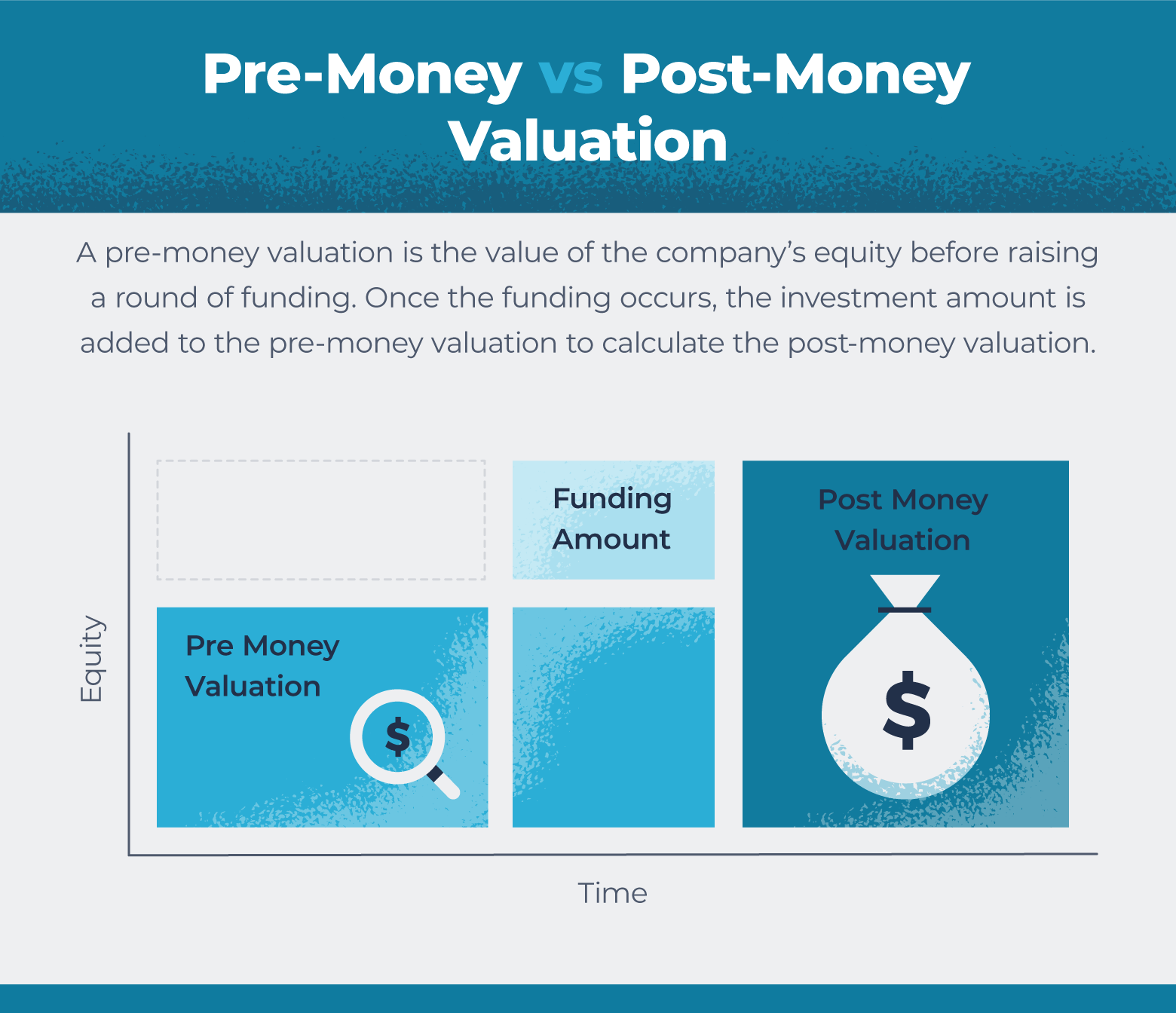
To see a quick, visual walkthrough of these concepts, let's watch a short video.
Pre-Money & Post-Money Startup Valuation - Explained Visually
The video 'Pre-Money & Post-Money Startup Valuation' from Fundable Startups provides a very clear and concise visual explanation of these core terms and their relationship.
Watch the entire video (it's only about 2 minutes). Focus on how the 'pie' representing the company's ownership changes after the investment is made.
2. Why Valuation Matters: Calculating the Investor's Stake
The primary function of these valuation figures in a funding round is to determine how much ownership an investor receives for their investment. The key formula to remember is:
Notice that the post-money valuation is the denominator. This is a critical point. From an investor's perspective, the post-money valuation is what truly defines the price they are paying for their percentage of the company.
Let's walk through a simple example:
A startup is raising $2 million. You and the founders agree on an $8 million pre-money valuation.
-
Calculate the Post-Money Valuation:
- $8,000,000 (Pre-Money) + $2,000,000 (Investment) = $10,000,000 (Post-Money)
-
Calculate the Investor's Ownership:
- $2,000,000 (Investment) / $10,000,000 (Post-Money) = 0.20 or 20%
In this deal, the investors would collectively own 20% of the company, and the existing shareholders (founders, employees, previous investors) would now own the remaining 80%.
3. "Shark Tank Math": Calculating Implied Valuation
In the real world, and as you've likely seen on shows like Shark Tank, deal terms can be presented in a different way. A founder might say, "I'm looking for $500,000 for 10% of my company." As an investor, you need to quickly translate this into pre- and post-money valuations.
Valuation of Early Stage Startups (Part 1) - Overview for Investors | Crowdwise Academy (315)
The video 'Valuation of Early Stage Startups (Part 1)' from CrowdWise offers a great segment on how to do this 'Shark Tank math' in your head to quickly understand the implied valuation of a deal.
Watch the section from 13:38 to 15:45. The video provides a simple multiplier trick to calculate the implied post-money valuation from the founder's ask.
Let's formalize the calculation from the video. If you know the investment amount and the equity percentage offered, you can find the post-money valuation first.
Using the "Shark Tank" example: raising $500,000 for 10%.
-
Calculate the Implied Post-Money Valuation:
- Post-Money Valuation = Investment Amount / Ownership Percentage
- $500,000 / 0.10 = $5,000,000
-
Calculate the Implied Pre-Money Valuation:
- Pre-Money Valuation = Post-Money Valuation - Investment Amount
- $5,000,000 - $500,000 = $4,500,000
So, a founder asking for $500k for 10% is implicitly stating they believe their company has a pre-money valuation of $4.5 million.
Test your understanding!
You are evaluating two different pre-seed investment opportunities.
Startup A: The founders are raising $750,000 at a $3 million pre-money valuation.
- What is the post-money valuation?
- What percentage of the company will the new investors own?
Startup B: The founders are raising $400,000 in exchange for 20% equity.
- What is the implied post-money valuation?
- What is the implied pre-money valuation?
Show answer
Startup A:
- Post-Money Valuation: $3,000,000 (Pre-Money) + $750,000 (Investment) = $3,750,000
- Investor Ownership: $750,000 / $3,750,000 = 20%
Startup B:
- Implied Post-Money Valuation: $400,000 / 0.20 (Ownership %) = $2,000,000
- Implied Pre-Money Valuation: $2,000,000 (Post-Money) - $400,000 (Investment) = $1,600,000
4. Strategic Perspectives and Price Per Share
Understanding the calculations is the first step. The next is understanding the strategic implications for both founders and investors.
Pre-Money vs Post-Money Valuation Formulas
The article 'Pre-Money vs Post-Money Valuation Formulas' from Allied Venture Partners clearly breaks down the different perspectives and provides a practical, step-by-step example of how these valuations work in a seed round.
First, read the section 'Pre-Money vs Post-Money Valuation Comparison', focusing on the subsection 'Pros and Cons for Founders and Investors'. This explains the strategic tension in negotiations. Then, read 'Example 1: Seed Round Valuation' under the 'Step-by-Step Examples' section. This will show you how the valuation translates into a share price, which is a crucial next step.
As you read, here are the key strategic points to internalize for your future roles as a consultant and investor:
- Founder's Focus: Founders want to maximize their pre-money valuation. A higher pre-money valuation means they sell a smaller percentage of their company for the same investment amount, thus minimizing their ownership dilution.
- Investor's Focus: Investors anchor on the post-money valuation because it directly determines their ownership percentage. While they care about the pre-money valuation, their stake in the company is ultimately defined by the post-money figure.
From Valuation to Share Price
The article introduces another critical concept: price per share. A valuation is an abstract number; a funding round involves the concrete action of issuing new shares to investors. The valuation determines the price of these new shares.
The formula is:
Using the numbers from the article's seed round example:
- Pre-Money Valuation: $8.0 million
- Pre-Investment Shares: 2,000,000
- Price Per Share: $8,000,000 / 2,000,000 = $4.00 per share
The investors will then buy new shares at this price. To raise $2.0 million, the company issues 500,000 new shares ($2,000,000 / $4.00 per share) to the investors.
This concept of share price and the total number of shares is the bridge to our next topic.
Conclusion
Today, you've mastered the fundamental mechanics of a startup funding round. You can now fluently speak the language of pre-money and post-money valuation, a critical skill for structuring any investment.
Key Takeaways:
- Valuation in a funding round is defined by two key terms: pre-money (value before investment) and post-money (value after investment).
- The core formula is Pre-Money Valuation + Investment = Post-Money Valuation.
- Investor ownership is always calculated based on the post-money valuation: Ownership % = Investment / Post-Money Valuation.
- Founders aim for a high pre-money valuation to minimize dilution, while investors focus on the post-money valuation to secure their desired ownership stake.
- The valuation ultimately determines the price per share at which new equity is issued to investors.
Preview of the next lesson:
We calculated an investor's ownership as a percentage (e.g., 20%). But how is this ownership—along with the founders' and employees' stakes—formally tracked? In our next lesson, we will analyze a capitalization table (or "cap table") to understand ownership structure and the impact of dilution, moving from a high-level percentage to the detailed ledger of who owns what.