
Welcome back. In the previous lesson, you classified observable features under the four IELTS Writing Task 2 criteria: Task Response, Coherence and Cohesion, Lexical Resource, and Grammatical Range and Accuracy. The central habit was to identify the primary issue by asking what the writer needs to change: content, organisation, vocabulary, or grammar.
This lesson completes the assessment-literacy module. You will now turn a diagnosis into concise, evidence-based feedback: one genuine strength and one high-priority improvement area, expressed in language that reflects the official band descriptors. The goal is not to estimate a band score from a short extract. It is to make feedback accurate, specific, and useful.
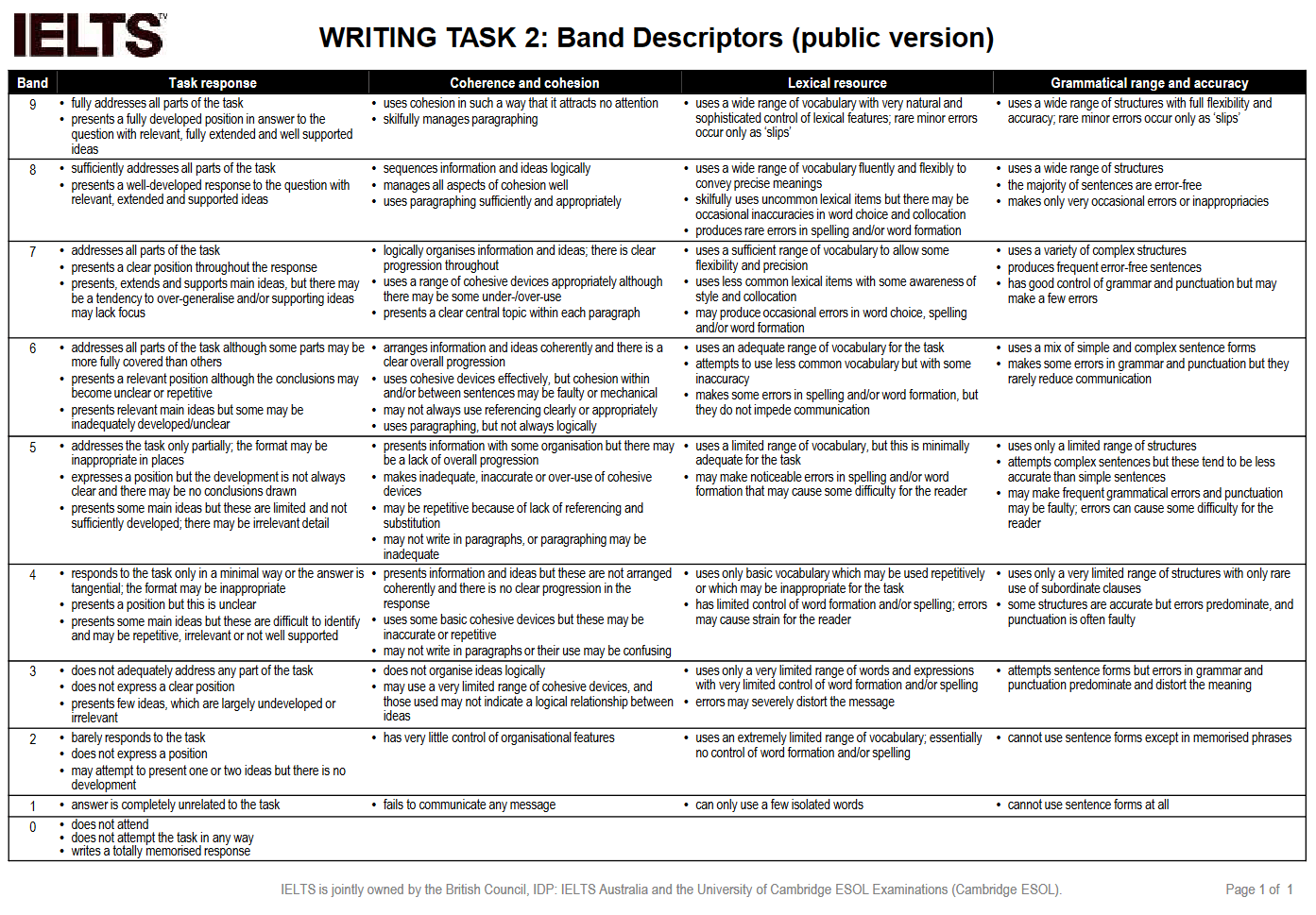
Band descriptors are reference points, not a phrase bank for guessing scores
The descriptors describe performance across a complete response. An examiner does not find one impressive sentence and assign a high score, or find one error and assign a low score. They look for patterns across the essay: how fully the task is answered, how ideas progress, how vocabulary is used, and how consistently grammar is controlled.
This matters when you assess a short sample. A three-sentence extract may show evidence of a strength, but it cannot show whether that strength is sustained throughout an essay. Similarly, one inaccurate verb form is evidence of an error, but it cannot prove that grammatical errors are frequent across a response.
Use careful language:
| Avoid | Prefer |
|---|---|
| “This is Band 6.” | “This feature reflects wording in the Band 6 descriptor.” |
| “The grammar is weak.” | “This sentence contains a subject–verb agreement error.” |
| “Your coherence is bad.” | “The connection between these two ideas is not made clear.” |
| “The vocabulary is excellent.” | “The phrase reduce commuting time is precise and appropriate for the topic.” |
The official descriptors are still valuable because they give you a shared vocabulary for feedback. Their wording helps you move beyond general comments such as “develop your ideas” or “use better vocabulary.”
Writing Task 1 Band Descriptors
Read the official IELTS descriptors for Bands 7 and 6. These adjacent bands are especially useful for learning the language of strengths and priorities: they distinguish clear, generally effective control from incomplete development, faulty cohesion, limited flexibility, or recurring errors.
On page 1, find the row headed Band Score 7 and read the Band 7 row across all four criteria. Notice words such as clear, developed, logically organised, flexibly, and frequent. Then move to page 2 and locate Band Score 6. Read the Band 6 row. Focus on the qualifying language: some may be insufficiently developed, faulty or mechanical, lack of precision, and flexibility is limited. Do not try to memorise every line; underline a phrase you could use to describe a strength and one you could use to describe a priority.
One caution is essential: a descriptor is not a checklist of isolated items. For example, using one complex sentence does not establish “a variety of complex structures,” and writing one logical paragraph does not prove “clear progression throughout the response.” Your feedback must fit the amount of evidence available.
A practical language toolkit for feedback
Good feedback has three elements:
- A criterion — which assessment area is involved?
- Evidence — what exactly in the writing demonstrates the feature?
- Descriptor-based judgement — why is this a strength or an improvement priority?
The table below adapts useful official wording into feedback language. The phrases are intentionally selective; use only those supported by the sample.
| Criterion | Strength language | Improvement-priority language |
|---|---|---|
| Task Response | “A position is presented that is directly relevant to the prompt.” / “The main parts of the prompt are addressed.” | “Some main ideas are insufficiently developed.” / “Supporting arguments or evidence are inadequate.” / “The position is unclear or repetitive.” |
| Coherence and Cohesion | “Information and ideas are logically organised.” / “There is a clear overall progression.” | “Cohesion is faulty or mechanical.” / “The central topic is not always clear.” / “Paragraphing is not always logical.” |
| Lexical Resource | “Vocabulary is generally adequate and appropriate for the task.” / “There is awareness of style and collocation.” | “There is a lack of precision in word choice.” / “Word choice or word formation contains errors.” / “The range does not permit much variation in expression.” |
| Grammatical Range and Accuracy | “A mix of simple and complex sentence forms is used.” / “Grammar and punctuation are generally well controlled.” | “Flexibility is limited.” / “More complex structures are not as accurate as simple structures.” / “Errors in grammar or punctuation occur.” |
The wording must match the evidence. For instance, if a paragraph includes the sentence below, you can identify a local grammatical strength:
Although remote work reduces commuting time, it can make informal collaboration more difficult.
A justified comment would be:
Grammatical Range and Accuracy — strength: The writer uses an accurate complex sentence to express contrast.
It would be too broad to say, “A wide range of structures is used with full flexibility and control,” because one sentence cannot demonstrate a wide range across a whole essay.
Likewise, if a paragraph contains sustainable transport network, you can say that the phrase is precise and topic-appropriate. You cannot yet claim that the writer uses “a wide range of vocabulary” unless the wider extract consistently supports that judgement.
From a feature to one focused feedback priority
A short response usually contains several things to improve. Useful feedback does not list every possible weakness with equal importance. Instead, choose the issue that most limits the writer’s ability to answer the task clearly and effectively.
A sensible priority order is:
-
Incomplete task coverage or an unclear position
If the writer has not answered a required part of the prompt, Task Response is usually the priority. -
Undeveloped or unsupported main ideas
A relevant claim needs explanation, consequences, or a specific illustration. Repeating the claim in different words is not development. -
Unclear organisation or logical relationships
Prioritise Coherence and Cohesion when the reader cannot follow the progression of ideas or when a paragraph has no clear focus. -
Vocabulary or grammar that obscures meaning
Inaccurate vocabulary and grammar deserve priority when they make the message difficult to understand or recur as a pattern.
This is not an absolute ranking. If a sample responds fully to the task but repeatedly uses inaccurate vocabulary that changes the meaning, Lexical Resource may be the most useful priority. The point is to select the change with the greatest impact, not to search mechanically for the “lowest” criterion.
A productive feedback note follows this pattern:
Priority — Task Response: The main idea about social isolation is relevant, but it is insufficiently developed. The writer should explain how reduced face-to-face contact affects teamwork or employees’ well-being.
Notice what this comment does:
- It names the criterion.
- It uses descriptor-based language: relevant and insufficiently developed.
- It identifies the exact idea.
- It gives a realistic revision direction without writing the essay for the candidate.
Watch descriptor language being applied
The following sections of E2 IELTS’s The IELTS Writing Task 2 Marking Criteria EXPLAINED show how an assessor connects observable evidence to Task Response and Coherence and Cohesion. Treat the video’s examples as illustrations; the official descriptors remain the final reference for exact wording.
The IELTS Writing Task 2 Marking Criteria EXPLAINED
Watch E2 IELTS explain how a clear position, full task coverage, development, logical progression, referencing, and cohesive devices affect assessment. Listen particularly for the difference between an idea being present and an idea being sufficiently developed.
Watch Task Response to review the importance of answering every part of a prompt, maintaining a clear position, and supporting claims. Then watch coherence and cohesion for examples of faulty or mechanical linking and unnecessary repetition caused by weak referencing. As you watch, note one phrase that could become a precise feedback comment rather than a predicted score.
Worked diagnosis: choosing one strength and one priority
Consider this Task 2 question:
Many employees now work from home for some or all of the week. Is this a positive or negative development?
Now read this short sample:
Working from home has become common in many professions. Although this arrangement saves employees time, it is a negative development overall because it can reduce informal communication. First, staff members do not need to commute, so they have more time for their families. This benefit is important. However, people cannot make friends at work. They stay at home, and it is bad.
Start with evidence, not a score.
Step 1: Find a strength
The writer clearly states a position:
“It is a negative development overall…”
That position directly answers the question. A suitable feedback note is:
Task Response — strength: A position is presented that is directly relevant to the prompt: the writer clearly judges remote work to be a negative development overall.
This is specific and defensible. It does not claim that the whole response has a fully developed position, because the extract is too short to establish that.
Step 2: Identify the issue with greatest impact
The two points are relevant: commuting time and reduced informal interaction. However, neither point is properly explained. Saying “This benefit is important” does not show why it matters, while “They stay at home, and it is bad” asserts a negative outcome without explaining it.
The most useful priority is therefore Task Response, not grammar or vocabulary:
Task Response — improvement priority: The main ideas are relevant, but they are insufficiently developed. The writer should explain why extra family time is beneficial and how reduced informal contact can affect workplace relationships or collaboration.
This feedback is stronger than “Add more details.” It identifies the missing reasoning and uses language found in the descriptors.
Why not make grammar the priority?
The final sentence is simple and somewhat imprecise, but it is understandable. Improving it would help:
Employees may have fewer opportunities to build informal professional relationships, which can weaken collaboration within teams.
However, the larger problem is not the sentence form itself. The writer needs a clearer explanation of the claim. This is a useful example of the principle from the previous lesson: classify the issue according to the main repair required.
The strength–priority routine
Use this short routine whenever you assess a paragraph or extract.
1. Read for the writer’s message
Before looking for errors, identify the writer’s main claim and the role of each sentence. A paragraph that seems grammatically accurate may still fail to answer the task, while an imperfect paragraph may contain a clear and relevant position.
2. Mark one observable strength
Choose something you can quote or describe precisely:
- a direct position;
- a relevant, developed idea;
- logical sequencing;
- an accurate reference word;
- a precise collocation;
- an accurately controlled complex sentence.
3. Match it to one criterion and descriptor phrase
For example:
Coherence and Cohesion — strength: Information is logically organised: the paragraph moves from a claim about commuting time to its effect on family life.
4. Find the highest-impact limitation
Ask: What single revision would make this response substantially clearer, more complete, or more convincing?
5. State a concrete next action
Compare these two comments:
| Vague feedback | Actionable descriptor-based feedback |
|---|---|
| “Improve your ideas.” | “The main idea is relevant but insufficiently developed; explain how lower commuting costs could benefit employees with limited incomes.” |
| “Use better linking words.” | “The connector however introduces a result rather than a contrast; replace it with a result relationship or combine the sentences.” |
| “Vocabulary needs work.” | “The word thing is too vague here; use a precise noun such as workplace interaction or professional collaboration.” |
| “Check grammar.” | “The complex sentence contains a subject–verb agreement error: employees needs should be employees need.” |
The last stage matters. A priority is not merely a negative judgement; it should tell the writer where to direct the next revision.
What careful feedback sounds like
For short IELTS samples, these sentence frames are reliable:
To identify a strength
- “The writer presents a clear position by stating that…”
- “The main idea is relevant to the prompt because…”
- “The paragraph has a clear overall progression from… to…”
- “The vocabulary choice [phrase] is accurate and appropriate because…”
- “The writer uses an accurate complex structure to show…”
To identify an improvement priority
- “Although the idea is relevant, it is insufficiently developed because…”
- “The relationship between these ideas is unclear because…”
- “The repeated use of [word] makes the writing repetitive; clearer reference or substitution would improve cohesion.”
- “The phrase [phrase] lacks precision; [alternative] would express the intended meaning more accurately.”
- “This sentence attempts a complex structure, but the grammar requires revision because…”
Avoid formulaic praise such as “good vocabulary” or “nice grammar.” It does not tell the writer what to retain. Also avoid overloading one response with labels from all four criteria unless you can support each label with clear evidence. One well-chosen strength and one well-chosen priority are more useful than a long, vague error list.
Homework: write a two-point feedback note
Do not write a full essay.
Choose a short Task 2 body paragraph or introduction from class material, a practice source, or your own previous work. Use a sample of roughly 80–150 words so that you can examine it closely.
Write exactly two feedback notes:
- One strength: name the criterion, quote or describe the evidence, and use appropriate descriptor-based language.
- One improvement priority: name the criterion, identify the exact issue, and give one concrete revision direction.
Keep each note to two or three sentences. Do not assign an overall band score. Your aim is to make the evidence and the next action unmistakably clear.
You can now move from simple classification to feedback that is both principled and practical. Band descriptors help you describe a strength such as a directly relevant position, logical organisation, appropriate vocabulary, or controlled sentence form. They also help you name a priority precisely: insufficiently developed ideas, faulty cohesion, lack of precision in word choice, or errors in grammar and punctuation.
In the next module, you will leave assessment language behind temporarily and focus on the first stage of producing a strong response: reading an unfamiliar Task 2 prompt closely enough to identify its topic, limits, and exact instructions.
Can't find a good explanation? Sign up and we'll make it for you
Sign up