
Welcome back. In the previous lesson, you practiced scientific notation, rearranging equations, and using base-10 logarithms. Those skills now become directly practical: biochemical concentrations are commonly expressed in molarity, and laboratory solutions are routinely made by dilution from concentrated stocks.
This lesson develops two connected abilities:
- calculate a solution’s molarity from its amount of solute and total volume;
- calculate the concentration or required volume in a single-step dilution.
The central habit is to identify what is being counted—moles of solute—and what volume is being used—the total volume of the solution.
Molarity: amount of solute per solution volume
A solution is a homogeneous mixture. The solute is the substance dissolved at the lower concentration, while the solvent is the medium doing the dissolving. When water is the solvent, the result is an aqueous solution.
Molarity is the most common concentration unit in introductory chemistry and biochemistry:
where:
- is molarity, usually reported in ;
- is amount of solute in ;
- is the total solution volume in .
Thus,
A glucose solution contains of glucose in every liter of final solution. It does not mean one mole of glucose plus one liter of water. Dissolving a solute can slightly change volume, so laboratory instructions normally say “bring to a final volume of 1.00 L,” not “add 1.00 L of water.”
The equation can be rearranged according to the quantity sought:
Treat these as unit-aware relationships. For example, if you multiply molarity by liters,
the liters cancel, leaving moles.
Molarity | AP Chemistry | Khan Academy
Watch Molarity | AP Chemistry from Khan Academy for a compact worked example that converts a solute mass into moles, converts milliliters into liters, and calculates molarity.
In the worked sodium sulfate example, watch the full calculation. Focus especially on two distinctions: the stated volume is the volume of the final solution, and the volume must be expressed in liters before using the molarity definition.
The volume conversion that matters most
Because the definition of molarity uses liters, convert milliliters before substituting into :
For example:
A frequent factor-of-1000 error comes from using , rather than , as the denominator in a molarity calculation. The resulting concentration would be implausibly small.
Worked example: moles and volume are given
A sample contains sucrose in of solution. Find its molarity.
First convert the volume:
Then apply the definition:
The result means the solution contains sucrose per liter of solution.
A useful estimate supports the calculation. Since mol is distributed through substantially less than one liter, the molarity should be greater than . The value passes that check.
When the solute amount is given as mass
In laboratory problems, the solute amount is often reported in grams rather than moles. Molarity still requires moles, so first use the molar mass as a conversion factor:
Then substitute the result into the molarity equation:
Keep the logic in two stages:
- Convert grams of solute to moles of solute.
- Divide the moles by liters of solution.
Worked example: glucose solution
Suppose glucose is dissolved and the solution is brought to a final volume of . The molar mass of glucose is .
First calculate moles:
Now convert volume:
Finally, calculate molarity:
The units reveal whether the setup makes sense. Grams cancel during the first conversion, and liters remain in the denominator of the final quantity, leaving , or .
Reading a molarity value in either direction
Molarity is not merely a reporting unit; it is a conversion between volume and amount. For a solution:
If you have , the amount of solute is:
This interpretation will later let you move between measured solution volumes and the amount of reactant available for a biochemical reaction.
Dilution: the number of solute moles stays fixed
A dilution reduces concentration by adding solvent, usually water. The solution volume increases, but no solute is added, removed, or chemically transformed.
That last condition is the entire basis of dilution calculations:
Since ,
The subscripts identify the two states:
| Symbol | Meaning |
|---|---|
| initial concentration of the stock solution | |
| volume taken from the stock solution | |
| desired final concentration | |
| final total volume after dilution |
The dilution equation works because each product represents the same solute amount. It does not say that the molarity stays the same. In fact, for an ordinary dilution:
and therefore:
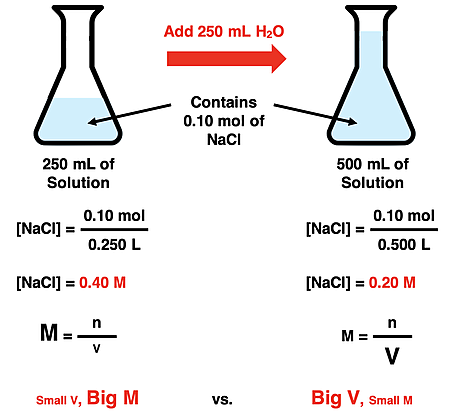
The sodium chloride dilution illustration makes the conservation principle visible: the two flasks contain the same of NaCl. Spreading that amount through twice the volume halves the molarity.
Molarity and Dilutions | 4.4 General Chemistry
Watch the selected parts of Molarity and Dilutions | 4.4 General Chemistry from Chad's Prep. The first segment treats molarity as an algebraic relationship; the second derives the dilution equation from conservation of solute moles and works through common laboratory-style calculations.
Begin with the molarity relationship to reinforce how to solve for M, n, or V. Then watch the dilution examples. Pay close attention to the point that V_2 is the final total volume, whereas the volume of water added is calculated separately.
Volume units in a dilution equation
Unlike the original molarity definition, you may use milliliters directly in
provided both volumes use the same unit. The volume units cancel as a ratio.
For example, this is valid:
But mixing on one side with on the other without conversion is not valid. Convert one of them first.
Solving single-step dilution problems
For a straightforward dilution, write the equation, identify the unknown, rearrange symbolically, then substitute values.
Finding the final concentration
A sample of methanol is diluted to a final volume of . Find the final concentration.
Start with:
Isolate :
Substitute:
The initial volume has increased by a factor of:
So the final concentration should be one-twentieth of the initial concentration:
That factor check is fast and catches a common error: putting in the numerator would incorrectly predict a higher concentration after adding water.
Finding how much stock solution to use
A lab protocol requires of glucose. The available glucose stock is . What volume of stock is required?
Use the dilution equation and solve for :
The protocol therefore begins by measuring of the stock.
If the question also asks for water added, do not report . That is the final solution volume. Assuming additive volumes, calculate:
In actual solution preparation, the more accurate instruction is to transfer the stock solution to an appropriate volumetric container and add water until the total volume reaches .
A reliable workflow and common errors
For both molarity and dilution questions, a consistent setup is more valuable than memorizing isolated tricks.
For molarity calculations
- Identify the solute and the final solution volume.
- Convert the solute amount to moles if it is given in grams.
- Convert volume from milliliters to liters.
- Use
- Check that the final units are .
For dilution calculations
- Confirm that the process adds solvent only and preserves the solute.
- Label initial values with subscript and final values with subscript .
- Use
- Ensure both volumes are in the same unit.
- Ask whether the result matches the physical situation: dilution means lower concentration and higher final volume.
Watch especially for these errors:
- Using solvent volume rather than total solution volume. Molarity is always based on solution volume.
- Forgetting the milliliter-to-liter conversion in .
- Treating as the volume of water added. It is the final total volume.
- Using the dilution equation when solute amount changes. It does not apply if solute is added, removed, precipitated, or reacts.
- Rounding too early. Retain extra calculator digits until the final answer, then apply appropriate significant figures.
Key takeaways
Molarity measures moles of solute per liter of final solution:
When mass is supplied, convert it to moles using molar mass before calculating molarity. In a molarity calculation, volume must be in liters.
A single-step dilution preserves the amount of solute:
Use consistent volume units on both sides, distinguish the final solution volume from the amount of solvent added, and perform a physical check: adding water must lower the concentration.
Next, you will move from quantities of molecules in solution to their chemical features by drawing common biomolecular functional groups and identifying the characteristic properties they confer.
Can't find a good explanation? Sign up and we'll make it for you
Sign up