
Hello again. In the previous lesson, you identified the skills and portfolio evidence most worth building for a research-led content role. That tells you what to develop. This lesson addresses the equally practical question of where and how you can do that work sustainably.
For this career change, a role is not suitable merely because its title says “content writer” or because it is remote. Its daily rhythm, communication habits, workload, and sensory demands determine whether you can keep producing strong work without spending all your energy managing the environment. By the end of this lesson, you will have a usable set of non-negotiable working conditions and flexible preferences for your job search in Delhi’s remote-writing market.
Think in functions, not labels
A non-negotiable is not a wish list item and not a demand for a perfect workplace. It is a condition without which the role is likely to become consistently unworkable, unhealthy, or incompatible with the kind of writing career you are trying to build.
A flexible preference, by contrast, is something that would improve the role but can be traded for another workable condition. For example, a job’s subject area may not be your ideal niche at first, but it may still be worthwhile if it provides stable pay, a manageable workload, and time to keep developing The Journal of Ardency.
It helps to separate four ideas that are often blurred together:
| Category | Meaning | Writing-role example |
|---|---|---|
| Core task | The work you are hired to do. | Researching, drafting, revising, and publishing articles. |
| Working condition | The environment, workflow, or expectation under which you do the task. | Written briefs, predictable deadlines, remote work, manageable revision cycles. |
| Adjustment or support | A practical change that reduces a specific barrier. | Audio-only attendance at routine calls; instructions confirmed in writing. |
| Preference | A desirable feature that is not essential if an effective alternative exists. | Working for a mythology-focused publication rather than an education or wellbeing company. |
This distinction protects you from two unhelpful extremes. You do not need to accept conditions that predictably drain or destabilise you just to appear “easy to work with.” But you also do not need to reject every role that is not an exact reflection of your ideal future identity as a myth–mind–meaning writer.
The relevant question is:
Can I reliably produce good work in this role, recover outside work, and retain enough creative energy to build the career I actually want?
That is a more useful standard than “Would I enjoy every feature of this job?”
Turn difficulty into a clear work requirement
A sustainable boundary becomes clearer when you describe the pattern in four parts:
- Condition: What feature of work causes difficulty?
- Impact: What happens to your performance or energy?
- Requirement: What working condition would reduce that impact?
- Evidence: What have you noticed in your own experience that supports this conclusion?
The Job Accommodation Network’s checklist offers this same practical logic: identify a limitation, assess its effect on performance, identify the task affected, and explore a workable solution. Its lists are options, not a description of every autistic person; take from them only what reflects your own experience.
Read the Job Accommodation Network’s practical checklist to see how a broad difficulty can be translated into a concrete work condition or support. Use it as a planning tool for your career search, not as a diagnostic checklist.
Start with the “Accommodation Checklist” near the top of the page. Read the full checklist, focusing on the sequence from impact to task to solution. Then scan the lists under “Attentiveness/Concentration,” “Executive Functioning Deficits,” “Noise Sensitivity,” “Organizing/Planning/Prioritizing,” and “Stress Intolerance.” Notice especially the recurring strategies: telework, task separation, uninterrupted focus time, flexible scheduling, checklists, written instructions, one-to-one communication, and noise reduction.
For example, “I dislike noisy offices” is real, but it is too vague to guide job decisions. The fuller version is more useful:
Condition: Open-plan noise, frequent conversations, and commuting through crowded spaces.
Impact: My concentration declines, and I use energy coping with sensory input rather than researching and writing.
Requirement: Remote work, or an unusually quiet and predictable work setting with control over noise and a manageable commute.
Evidence: Noise is difficult to tolerate, and focused writing is easier in a controlled environment.
Notice that this statement does not make a judgment about your competence. It identifies the conditions under which your competence can be used.
The same method applies to task-switching:
Condition: Frequent interruption, sudden reassignment, and multiple unrelated tasks competing at once.
Impact: Re-entering a complex writing task takes substantial time and reduces quality.
Requirement: Clear priorities, protected blocks for deep work, and reasonable notice of non-urgent changes.
Evidence: You can work steadily toward deadlines when given enough time, but intensive task-switching is difficult.
The “Employer Top Tips: Reasonable Adjustments at Work for Autistic People” infographic gives a concise version of this logic: a quieter workspace, clear communication, advance notice of change, regular one-to-one meetings, and staff awareness can all affect whether someone can focus on the actual work.
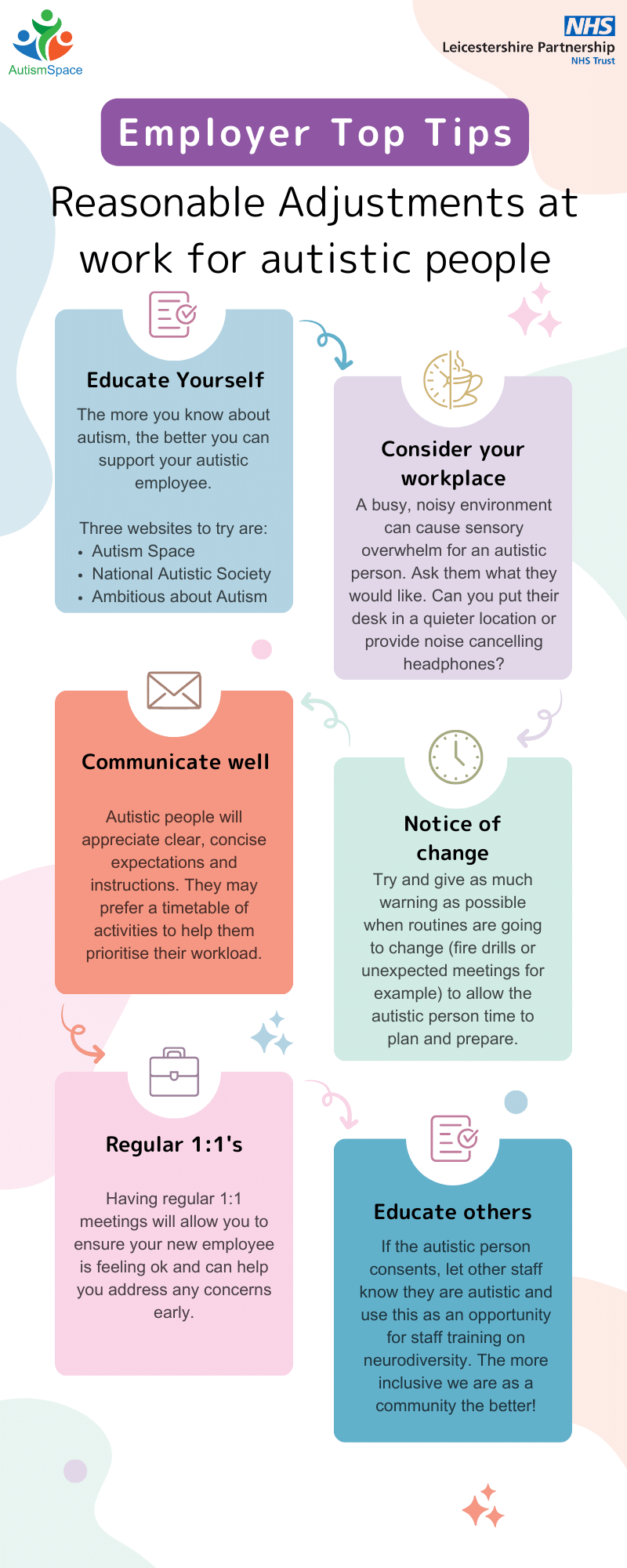
Conditions worth examining for a writing career
Writing work is often described as solitary, but professional content writing still involves briefs, feedback, project-management tools, editorial changes, calls, deadlines, and sometimes competing requests from marketing teams. Therefore, assess the workflow, not only the amount of writing.
For your stated priorities, the following five areas are especially important.
1. Location, sensory environment, and commute
Remote work is valuable here not because it is automatically easier, but because it gives you more control over sound, lighting, breaks, clothing, food, and the transition into focused work. It also avoids a commute that may consume energy before the working day begins.
If a role is described as “remote,” verify what that means. Some employers use the term for a job that still requires frequent office attendance, compulsory camera-on meetings, or availability throughout extended hours. A remote role can also be disruptive if it replaces office noise with continuous messaging and unscheduled calls.
For now, an appropriate functional requirement is:
I need remote or remote-first work, with a home-based setup as the normal arrangement rather than an occasional exception.
An office-based role should not automatically be ruled out forever, but it would need unusually strong alternatives: a quiet workstation, a low-sensory commute, predictable attendance requirements, and enough value to justify the added cost to your energy.
2. Communication format and clarity
You prefer written communication and are comfortable with calls, especially audio rather than video. That is a strong basis for a professional workflow preference, not a personal flaw.
For content writing, written systems are often good business practice anyway: a written brief prevents scope confusion; a documented deadline prevents missed expectations; editorial comments in a shared document create a usable revision record.
The key condition is not “no communication.” It is:
I need important tasks, deadlines, feedback, and priorities documented in writing, with calls used for discussion rather than as the only record of instructions.
The following video is one autistic creator’s account of why verbal “drop-ins,” ambiguous expectations, and constant interruption can make work unnecessarily difficult. Use it to sharpen the distinction between a need for clarity and an inability to collaborate.
5 Workplace Accommodations Every Autistic Person Needs
Watch “5 Workplace Accommodations Every Autistic Person Needs” by Autistic AF for concrete examples of written communication, advance agendas, direct feedback, and clear deadlines. The speaker’s experience is personal rather than universal, but the practical prompts are useful for defining your own workflow needs.
Watch written workflow, which considers interruptions, verbal instructions, written follow-ups, agendas, and asynchronous communication. Then watch clear expectations, focusing on the value of definite deadlines, stated success criteria, and direct feedback rather than implied expectations.
For you, routine calls can remain flexible if they are scheduled, have an agenda, and are followed by a written summary or task list. Regular compulsory video calls, however, may be an unnecessary drain if audio would allow you to listen and contribute more effectively.
3. Focus, workload, and task-switching
A role can be remote and still be unsustainable if it requires an endless stream of unrelated “urgent” tasks. The AppSketch listing from the previous lesson, with its target of 50 articles per month across varied industries, showed why workload is not a minor detail. Such a target could mean a stable production workflow, but it could also mean constant switching, shallow research, and little recovery time.
For a research-led writing role, your condition is best expressed as:
I need a role with clear priorities and enough uninterrupted time to complete one substantial writing task at a time. I can manage deadlines, but not a culture of continual last-minute changes and simultaneous urgent demands.
This does not mean you need to work on only one article for an entire week. It means the organisation should have a coherent way of deciding what matters first. A manageable role might involve drafting one article, revising another, and attending a scheduled editorial call. A high-friction role might repeatedly interrupt a research piece with social captions, emergency edits, unexplained deadlines, and unrelated administrative requests.
4. Management and feedback
The most supportive manager is not necessarily someone who knows all the language around autism. More important is whether they can state expectations clearly, answer questions without irritation, give direct feedback, and judge work by its quality rather than by constant visible busyness.
A brief section of How To Find The Perfect Job When You’re Autistic is useful here because it distinguishes the task from the management culture surrounding it.
How To Find The Perfect Job When You’re Autistic
Watch “How To Find The Perfect Job When You’re Autistic” by Auticate with Chris & Debby for a practical reflection on management support and the balance between routine and variety. Treat it as perspective and career reflection, rather than as a universal rule about autistic workers.
Watch supportive management for signs of a manager who values clear communication and results. Continue with work structure, noting the distinction between useful structure and excessive unpredictability.
A good working condition for you is:
I need a manager or editor who can give clear briefs, realistic deadlines, direct editorial feedback, and a named point of contact for questions.
This is not a request for constant reassurance. It is a request for an intelligible editorial process.
5. Stability, boundaries, and room for original work
Because you need to begin earning within roughly three months and prefer a salaried role, reliable pay is not merely a preference. Nor is it opposed to creativity. A stable role can provide the financial and psychological structure that makes long-term original work possible.
At the same time, a job that claims every evening and weekend will eventually consume the energy you want to devote to The Journal of Ardency. The goal is not to demand that an employer support your personal project. It is to avoid roles whose normal culture depends on unpaid overwork.
A reasonable condition is:
I need a clearly salaried role with written payment terms, defined working hours, and a workload that does not routinely require evening or weekend labour.
Your provisional non-negotiables and flexible preferences
The list below is a starting position based on what you have already shared. It is not a diagnosis, a legal request, or a permanent identity statement. You will refine it as you read job descriptions and notice what happens during your portfolio-building routine.
Non-negotiable conditions for the next role
| Area | Your starting non-negotiable | What to look for in a job description or interview |
|---|---|---|
| Work location | Remote or remote-first work as the ordinary arrangement. | “Fully remote,” “work from home,” clear location policy, no unexplained office-attendance requirement. |
| Income stability | A salaried position with clear monthly pay, or another arrangement with genuinely documented recurring income. | Salary range, employment type, payment date, probation details, written contract. |
| Focus structure | Priorities that permit concentrated work rather than continuous, unrelated urgent tasks. | Defined content calendar, editorial workflow, realistic output expectations, named priorities. |
| Communication | Key tasks, deadlines, feedback, and changes documented in writing. | Written briefs, project tools, Google Docs comments, editorial calendars, clear reporting line. |
| Meeting format | Calls can be part of the job, but routine communication cannot depend on compulsory video presence or unscheduled interruptions. | Scheduled calls, agenda, asynchronous updates, audio-call acceptance where video is not essential. |
| Management style | Direct feedback, explicit expectations, and a reachable editor or manager. | Clear onboarding plan, examples of feedback process, one-to-one check-ins, unambiguous success measures. |
| Workload boundary | No culture of routine unpaid overtime or permanent crisis mode. | Defined workday, leave policy, realistic deadlines, no boastful language about “always on” work. |
Flexible preferences
| Preference | Why it matters | A workable compromise |
|---|---|---|
| Subject matter close to myth, mind, and meaning | It supports long-term intellectual depth and portfolio coherence. | Begin in education, culture, publishing, wellbeing, or research-led marketing while building your niche samples separately. |
| A fully asynchronous team | It protects focus and favours written communication. | A team with limited, scheduled calls and reliable written follow-up. |
| Flexible start and finish times | It gives room to manage energy and personal routines. | Standard office hours with remote work, predictable breaks, and no habitual after-hours work. |
| Minimal client-facing work | Frequent live interaction can increase social and switching demands. | Occasional planned calls, while most work remains research, drafting, editing, and written collaboration. |
| A quiet, mission-led organisation | A thoughtful culture may support the depth of work you want. | A commercially focused company with ethical content standards, clear processes, and a respectful editor. |
| Creative ownership inside the job | Originality matters deeply to you. | A practical content role that leaves enough energy and time for The Journal of Ardency. |
The distinction is important. “My first salaried role must be entirely about mythology” is likely too rigid for a three-month entry plan. “My role must leave no space for original writing” is a warning sign. The first can be flexible; the second is much closer to a boundary.
Write a sustainable-role statement
Create a Google Doc titled Sustainable Working Conditions. Keep it to one page. A short document is more likely to be used when you compare job ads later.
Use these three sections.
A. Non-negotiables
Copy and adapt this draft:
I am seeking a salaried remote or remote-first content-writing role with clear monthly pay and a predictable editorial workflow. I work best when briefs, deadlines, priorities, and feedback are documented in writing. The role should allow sustained research and drafting time, rather than continual last-minute task-switching. Scheduled audio calls are workable; routine compulsory video meetings and constant unscheduled interruptions are not a sustainable default. I need direct expectations, realistic workloads, and normal boundaries around evenings and weekends.
B. Flexible preferences
Add a short paragraph:
My preferred subject area is writing that connects culture, psychology, philosophy, identity, or mythology. I am open to adjacent fields that build transferable research, SEO, and editorial skills, provided the role is remote, stable, clearly managed, and compatible with focused writing. I prefer a largely written, asynchronous workflow, while remaining available for planned calls and collaboration.
C. Deal-breaker signals
These are not abstract dislikes. They are job-ad features that conflict directly with your non-negotiables:
- “Must be available at all times,” “always on,” or regular after-hours work presented as normal.
- High-volume output with no information about research time, editing, or workflow.
- A role combining content writing with constant customer calls, sales targets, and social-media firefighting.
- Vague deadlines, unclear pay terms, or a refusal to put terms in writing.
- “Remote” roles that require an unspecified amount of office attendance.
- A workplace that treats frequent interruption and visible online presence as the measure of productivity.
Do not assume that a single ambiguous phrase makes an employer unsuitable. It may simply mean you need to investigate further. But several such signals together are evidence that the role’s daily reality may not fit.
Separate career planning from legal disclosure
The phrase “reasonable adjustments” has a specific legal meaning in some countries. The National Autistic Society explains the UK framework: adjustments aim to prevent substantial disadvantage and can involve workplace policies, the physical environment, or an aid or service.
What are reasonable adjustments and when can they be requested
Read this National Autistic Society guide for its clear functional framework: identify a disadvantage and consider an effective, practical change. Its legal discussion concerns the United Kingdom, so do not treat it as a statement of employment law in India; use it here to clarify your own needs and possible workplace solutions.
In the section “What are reasonable adjustments?”, read the definition and three categories. Then read the section “How is an adjustment judged to be reasonable or not?” and the examples under “Examples of reasonable adjustments at work.” Focus on how each example identifies an issue, its work impact, and an adjustment that directly reduces that impact.
For your immediate job search, you do not need to decide whether, when, or how to disclose an autism diagnosis. You can first assess whether an employer’s ordinary way of working already meets your needs.
For instance, during an interview you might ask:
- “How are article briefs, deadlines, and revisions usually tracked?”
- “How many articles or content pieces would this role typically handle at one time?”
- “How much of the workday is independent writing and research, compared with meetings or reactive requests?”
- “How are priorities communicated when several projects are active?”
- “What does the onboarding and editorial-feedback process look like?”
These are ordinary professional questions. They help you understand the job while showing that you care about quality, delivery, and workflow.
Key takeaways
A sustainable role is defined by more than job title or subject matter. For a remote content-writing career, the decisive features are often the environment, communication system, workload rhythm, management style, and employment stability.
Your present starting point is clear:
- Non-negotiable: remote or remote-first work; stable and documented pay; written briefs and feedback; protected focus time; limited disruption; realistic workload; direct management; and ordinary boundaries around working hours.
- Flexible: exact industry, job title, degree of schedule flexibility, amount of planned calls, and whether the first role directly serves your myth–mind–meaning niche.
- Core test: a job should let you produce reliable work while retaining enough energy to continue developing The Journal of Ardency.
In the next lesson, you will convert these conditions into practical job-search terms, filters, and saved alerts, so that your search produces fewer unsuitable vacancies and more roles worth investigating.
Can't find a good explanation? Sign up and we'll make it for you
Sign up