
Hello again. You have now clarified the kind of role you are pursuing: a remote, salaried content-writing position, while deliberately building a longer-term editorial direction around myth, mind, and meaning.
The final step in this module is to give those intentions a durable shape in your week. Because task-switching is costly for you, the aim is not to create an impressive-looking calendar packed with tiny tasks. It is to create a predictable, low-friction rhythm in which professional training, job preparation, and The Journal of Ardency each have protected space.
A weekly schedule should reduce decisions, not create more
A to-do list answers, “What could I do?” A time-blocked weekly schedule answers, “What am I doing now?”
For your situation, that distinction matters. When writing work, job-search tasks, learning, and creative ideas all compete for attention in the same afternoon, even choosing where to begin can consume energy. A monotasking schedule makes the choice in advance. During a block, there is one broad commitment and one defined next action.
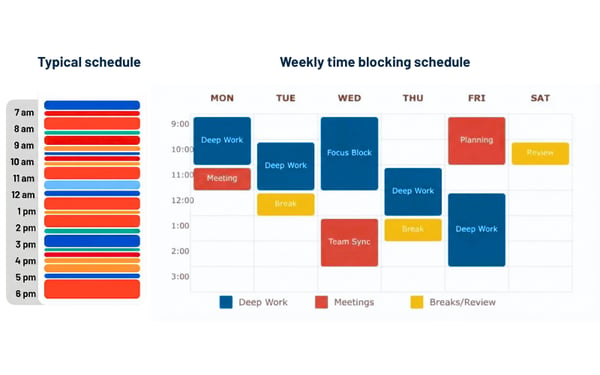
Time blocking does not mean controlling every minute or treating yourself like a machine. It means giving your available hours an intentional purpose, while leaving enough room for pauses, slower days, and unexpected events.
Time Blocking - Your Complete Guide to More Focused Work
Read Todoist’s guide to distinguish time blocking from an over-detailed task list, then borrow its ideas about batching, day themes, and buffers.
Begin in the section “What is time blocking?” and read the core method. Notice that the calendar reserves time while a separate task list holds the detailed actions. Then, in “Time blocking methods,” read the paragraphs on task batching and day theming. In particular, read the explanation of batching, followed by the “Day theming” subsection through its focus rationale. Finally, in “Time-blocking tips,” read the subsections “Pad your schedule with buffer times” and “Adopt a flexible approach.” Focus on building slack into blocks and treating the plan as adjustable.
For you, monotasking has a specific meaning:
- One block belongs to one domain: training, job preparation, or The Journal of Ardency.
- Within that block, choose one concrete output, rather than opening several unrelated tabs and documents.
- A thought from another domain goes on a short “parking list”; it does not become a new task immediately.
- If work runs over, move the unfinished item to a later block. Do not automatically extend the block and take time from rest or from The Journal of Ardency.
A poem idea arriving during job preparation is not a failure of concentration. It is simply an idea that belongs elsewhere. Write a brief phrase in your parking list, then return to the application or tracker in front of you.
Build a schedule around your actual capacity
You have about 12 hours a week, available as two hours a day across six days. Given the need to begin earning within roughly three months, a sensible initial allocation is:
| Commitment | Weekly time | Why it receives this amount |
|---|---|---|
| Professional training | 6 hours | Builds the research, structure, web-writing, and editorial skills needed for sustainable work. |
| Job preparation | 4 hours | Keeps applications, vacancy screening, and professional materials moving while you train. |
| The Journal of Ardency | 2 hours | Protects your original project as a real commitment, not something postponed indefinitely. |
This is not a verdict on the value of your journal. It is a practical first allocation for a short, employment-focused period. Two protected hours are a floor, not a ceiling. If a week is calm and you have additional creative energy, add an optional journal session; do not make it a requirement that turns artistic work into pressure.
Before choosing exact hours, pay attention for one week to the conditions in which work is most possible: noise levels, energy, concentration, hunger, calls or household demands, and recovery after social activity. A stable routine can be helpful, but it needs to fit your own sensory and energy patterns rather than someone else’s ideal timetable.
Why Autistics and ADHDers NEED Routines - and How To Build Your Own
Watch this portion of “Why Autistics and ADHDers NEED Routines — and How To Build Your Own” from Auticate with Chris & Debby for a practical approach to building routine around individual needs, consistency, and flexibility.
Watch observe patterns for the presenter’s method of noticing energy, sensory conditions, downtime needs, and personal values before fixing a routine. Then watch consistency and buffers for the balance between reliable time anchors and open space for disruptions. Use these ideas as prompts, not rules. The relevant question is not whether a schedule looks productive; it is whether it remains usable when your energy or surroundings vary.
Your first monotasking weekly schedule
Choose one reliably quiet two-hour window and use it as a repeating anchor where possible. If you do not yet know the best time, use 10:00 a.m.–12:00 p.m. as a placeholder for the first week, then adjust after observing how it feels. The hour itself matters less than its consistency and the protection around it.
Here is a complete first-week structure:
| Day | Two-hour focus block | Category | One acceptable definition of done |
|---|---|---|---|
| Monday | 10:00 a.m.–12:00 p.m. | Professional training | Complete one course lesson and save its practical output or notes. |
| Tuesday | 10:00 a.m.–12:00 p.m. | Professional training | Continue one learning outcome or create one associated writing artifact. |
| Wednesday | 10:00 a.m.–12:00 p.m. | Job preparation | Complete one job-search batch: screen and record vacancies or tailor one application. |
| Thursday | 10:00 a.m.–12:00 p.m. | Professional training | Complete one course lesson and save its output. |
| Friday | 10:00 a.m.–12:00 p.m. | Job preparation | Complete one professional batch: update CV material, refine portfolio material, follow up, or submit one application. |
| Saturday | 10:00 a.m.–12:00 p.m. | The Journal of Ardency | Draft, revise, sequence, or reflect on one named journal section, poem, or entry. |
| Sunday | 20 minutes, at a low-pressure time | Weekly review | Choose next week’s single outputs and move unfinished tasks without self-criticism. |
The six main blocks total 12 hours. The Sunday review is deliberately short: it is planning, not another demanding work session. If a 20-minute separate review feels unrealistic, do it during the final 20 minutes of Saturday’s journal block only after you have closed the journal document.
This is a day-themed schedule. Monday, Tuesday, and Thursday are for learning. Wednesday and Friday are for career movement. Saturday belongs to the journal. There is no need to decide each morning whether to study, apply, or write creatively; the day has already answered that question.
Keep each two-hour block internally simple
Use the same shape for each block:
-
Opening, 10 minutes
Open only the relevant document, course page, or job-search tracker. Write the block’s single output at the top of your notes. -
Focused work, 80 minutes
Work on that one output. Put the phone away or silence non-essential notifications. If you need a pause, take one without opening messages. -
Break, 10 minutes
Leave the screen if possible. Water, stretch, sit quietly, or look away from text. -
Finish and buffer, 20 minutes
Complete the current piece if it is close to finished. If it is not, write the exact next step for the next relevant block. Do not begin a new task simply because you finished early.
The final 20 minutes are a buffer, not a demand to produce more. On a day when concentration is strong, you may use it to finish the same task. On a slower day, it allows the work to take longer without making the whole schedule collapse.
Separate the calendar from the task list
Your calendar should remain visually calm. Do not add every tiny action—“open laptop,” “find article,” “reply to one email”—as a separate appointment. Instead, create three clearly labelled, repeating calendar blocks:
| Calendar label | Suggested visual cue | What belongs there |
|---|---|---|
| Professional Training | Deep blue | Course lessons, notes, practice writing, research exercises, technical skills such as SEO or WordPress. |
| Job Preparation | Amber or rust | Vacancy screening, applications, CV work, portfolio organisation, follow-ups, and interview preparation. |
| The Journal of Ardency | Plum or muted violet | Drafting, revising, arranging entries, developing themes, and reflective writing. |
| Personal / fixed commitments | Grey or neutral | Appointments, calls, errands, rest, and obligations that must be visible. |
Use whichever colours you find legible and calming. The important point is that each category keeps the same colour and name every week. Written lists, calendars, visual distinctions, and colour coding can make upcoming tasks and their relative importance easier to see.
Create a separate Google Doc titled Weekly Monotasking List. Under each day, write only one next action. For example:
| Day | Calendar block | This week’s single next action |
|---|---|---|
| Monday | Professional Training | Complete the current lesson and save the schedule in my planning document. |
| Wednesday | Job Preparation | Screen three saved remote content-writer listings using my non-negotiables checklist. |
| Saturday | The Journal of Ardency | Revise the “Dreamscapes” entry, preserving its voice while clarifying the central image. |
This separation is important:
- The calendar tells you when a category has your attention.
- The task list tells you what you will do in that category.
- The parking list catches intruding ideas without requiring you to act on them.
Make flexibility part of the design
A sustainable routine is not one that is never disrupted. It is one that tells you what to do when disruption occurs.
Use these rules for the first month:
-
Do not rebuild the whole week after one missed block.
Mark the task as unfinished and place it in the next matching category block where it fits. -
Move tasks, not identities.
A missed training session does not mean you have “failed at becoming a writer.” It means one planned unit of training needs a new home. -
Use a minimum version on low-capacity days.
If two hours feel impossible, spend 25 minutes opening the correct material and taking one defined step. Then write the next step for later. This preserves your relationship with the routine without pretending every day has equal capacity. -
Protect the journal from becoming overflow space.
Do not automatically turn Saturday into job preparation because a Wednesday task took longer. In an unusually urgent application week, make that change consciously during review, and restore the journal block the following week. -
Plan for calls and administrative interruptions.
Keep non-urgent messages outside focused blocks. If a call must happen, place it visibly in the calendar and allow recovery time afterwards rather than expecting immediate deep writing.
At the end of each week, use the 20-minute review to do only the following:
- mark each block as completed, partly completed, or missed;
- move unfinished tasks to a realistic later block;
- choose one concrete output for each of next week’s six blocks;
- check whether the timing, noise level, or block length made focus easier or harder;
- keep the structure if it worked; alter only one or two features if it did not.
Do not use the review to judge your character, redesign your entire life, or create a longer task list. Its purpose is to make Monday easier.
Key takeaways
A monotasking schedule gives each of your major commitments a visible, separate place:
- Six hours of professional training develop the practical writing skills your target role requires.
- Four hours of job preparation keep the search active during the three-month transition period.
- Two protected hours for The Journal of Ardency preserve the original creative work that matters beyond immediate employment.
- Keep calendar blocks broad and calm; keep the exact next action in a separate list.
- Use consistent colours, repeating blocks, a parking list for cross-domain ideas, and a short weekly review.
- Treat buffers and adjustments as features of the system, not evidence that the system has failed.
Put the six repeating blocks into your calendar now, using your most realistic quiet time rather than an idealised one. In the next module, you will begin strengthening the central skill beneath all effective content writing: identifying the intended reader, purpose, format, and desired response of a piece of writing.
Can't find a good explanation? Sign up and we'll make it for you
Sign up