
Welcome to the final lesson of our first module. Over the past several lessons, you've built a solid toolkit for algorithmic reasoning. We started by learning to dissect a problem into its formal inputs and outputs, then moved on to constructing test cases, analyzing time and space complexity, and finally, understanding the concrete performance costs of TypeScript's core data structures.
In this lesson, we will assemble all those pieces into a single, powerful strategy for solving algorithmic problems. You'll learn how to present a solution not as a single, magical piece of code, but as a thoughtful progression from a simple, initial idea to an efficient, optimized final version. We'll also cover how to justify the correctness of your optimized solution with a clear, intuitive argument. This narrative—from brute force to bottleneck to optimization—is precisely what interviewers look for as a sign of a strong problem-solver.
The Problem-Solving Lifecycle
Effective problem-solving in an interview setting isn't about instantly finding the most clever solution. It's an iterative process of refinement. You start with something that works, then you make it better.
This diagram illustrates the process well:
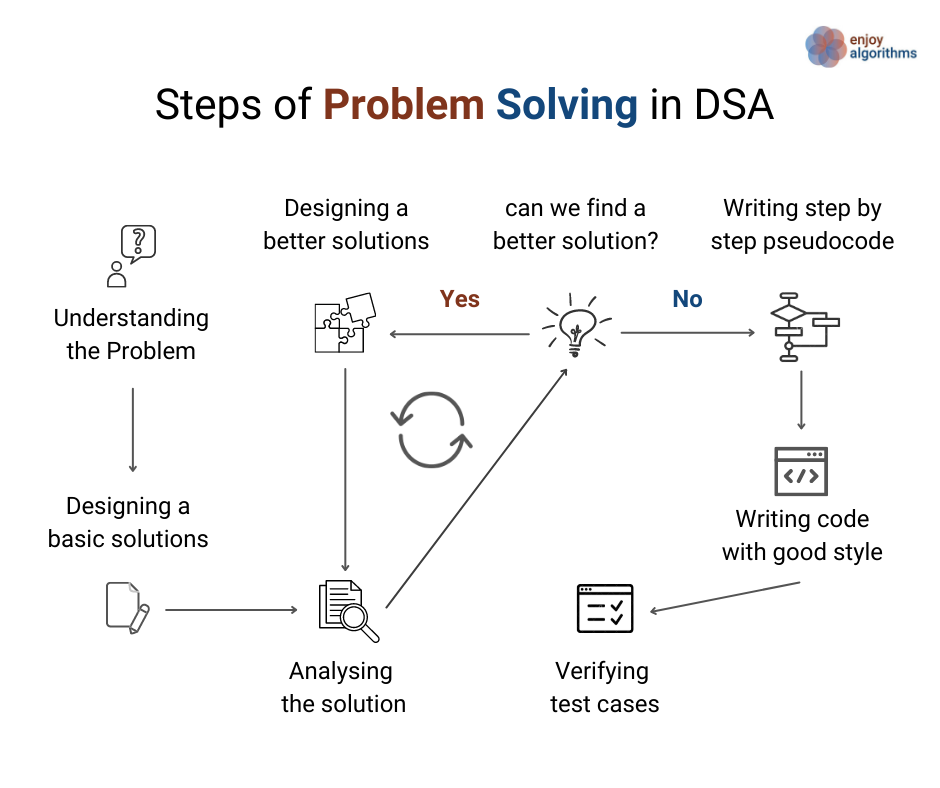
The most important part of this flowchart is the central loop: Design -> Analyze -> Improve. Starting with a "brute-force" or naive solution is not a sign of weakness; it's a smart strategy. It demonstrates that you can solve the problem correctly, provides a baseline for complexity, and gives you a concrete algorithm to analyze and improve upon.
From Brute Force to Optimized
Let's make this process concrete with a classic interview question: Two Sum. The problem is as follows:
Given an array of integers
numsand an integertarget, return the indices of the two numbers such that they add up totarget. You may assume that each input would have exactly one solution, and you may not use the same element twice.
Gordon Zhu has an excellent video that walks through this exact problem, starting from first principles. We'll use it to guide our thinking.
First, let's develop the brute-force solution. The most direct way to find a pair of numbers is to check every possible pair. How do we generate all pairs from an array?
Two Sum | LeetCode 1 | JavaScript | Easy
Watch this first part of the video, where the presenter systematically works out how to generate all unique pairs from an array and translates that logic into a brute-force code structure.
Watch from the beginning until the code structure is derived. Focus on how the visual representation of pairing elements leads directly to the nested loop implementation.
The resulting brute-force approach uses two nested loops:
- The outer loop picks the first number of a pair (
i). - The inner loop iterates through the rest of the array to pick the second number (
j). - Inside the inner loop, we check if
nums[i] + nums[j]equals thetarget.
This solution is correct, but is it efficient? Let's analyze its complexity.
Two Sum | LeetCode 1 | JavaScript | Easy
Now, let's analyze the time and space complexity of our brute-force solution. The presenter does a great job of clarifying a common misconception about the complexity of these kinds of nested loops.
Watch the section from the complexity analysis. He explains why the time complexity is O(n^2) and the space complexity is O(1).
As the video explains, O(1) space is excellent, but O(n^2) time is often too slow for interview problems, which typically have input sizes up to 10^5 or 10^6. An O(n^2) algorithm on n = 10^5 would require roughly (10^5)^2 = 10^{10} operations, which is far too many for a typical one-second time limit.
Identifying the Bottleneck
This is our "Analyze" step. We've identified that the time complexity is the problem. But where in the code is that time being spent? The work is dominated by the nested loops. For each element nums[i], we are performing a linear search through the rest of the array to find its complement (target - nums[i]).
This repeated linear search is the bottleneck. As you learned in the previous lesson, searching in an array is an O(n) operation. Performing an O(n) operation n times results in O(n^2) complexity.
To optimize, we must attack this bottleneck. The core question becomes: How can we find the complement faster than O(n)?
The Space-for-Time Tradeoff
From our last lesson, you know the answer: use a data structure built for fast lookups. A Map (or a hash table) provides average O(1) time for lookups. This insight is the key to optimizing the algorithm. We can trade space (to store the map) for a massive improvement in time.
In an interview, articulating this tradeoff explicitly is a strong signal. The following clip from a video by Anthony D. Mays, a former Google software engineer, discusses this exact strategy.
How to Solve ANY Coding Interview Question in 6 Steps
Listen to this segment on brainstorming solutions and the space-time tradeoff principle. It reinforces the idea that if you need to make an algorithm faster, you should think about what data structure you can use.
Watch the part from improving a naive solution. This highlights the general principle we're about to apply.
Now let's see how this applies to the Two Sum problem. We can iterate through the array once, and for each number, we can instantly check if its complement already exists in a Map.
The Gordon Zhu video continues to walk through this exact line of reasoning, framing it as a question of "perfect information."
Two Sum | LeetCode 1 | JavaScript | Easy
This part of the video is the core of the optimization. The presenter develops the idea of using a map to achieve an O(n) solution and discusses two ways to implement it: a two-pass approach and a one-pass approach.
Watch from the "perfect information" framing through the full development of the two-pass map solution. Pay close attention to how he decides what to store in the map (value as key, index as value) and how he handles edge cases like duplicate numbers.
The optimized solution, using a two-pass Map strategy, looks like this:
- First Pass: Iterate through the entire array and store each element and its index in a
Map. The map will look like{ number => index }. - Second Pass: Iterate through the array again. For each element
nums[i], calculate its complementneeded = target - nums[i]. Check ifneededexists in the map. If it does, and its index is noti, we have found our solution.
This algorithm has a time complexity of O(n) (for the two separate passes) and a space complexity of O(n) (for the map). This is a huge improvement over the O(n^2) brute-force solution and will easily pass the time limits.
Justifying Correctness
You've found an optimized solution. The final step is to convince the interviewer (and yourself) that it's still correct. Simply saying "it works for my example" is not enough. You need a more robust, logical reason. This is where a practical correctness argument comes in.
We don't need a formal mathematical proof. Instead, we can use an intuitive framework based on the idea of a loop invariant: a property that remains true at every step of your algorithm.
Algorithm Correctness Proof: The Interview Framework
This article from CodeIntuiton.io provides an excellent, interview-focused framework for justifying algorithm correctness. It introduces the two-step method of identifying a loop invariant and checking boundaries.
Please read the first two sections, The two step method and Proving the sliding window. Focus on understanding the difference between testing on one example and proving for all inputs via an invariant.
Let's apply this two-step method to our two-pass Map solution for Two Sum:
-
Identify the Invariant:
- For the first loop, the invariant is simple: after
iiterations, theMapcontains the(value, index)pairs for the firstielements of the array. After the loop completes, theMapcorrectly holds all elements and their last seen indices. - For the second loop, the invariant is: "the solution pair, if it involves an element from
nums[0]tonums[i-1], has already been found."
- For the first loop, the invariant is simple: after
-
Check Boundaries and Termination:
- Initialization: Before the second loop begins, the map is fully populated.
- Maintenance: At each step
iof the second loop, we check for a complement tonums[i]. Since the map contains every other number in the array, if a complement exists, we will find it. The checkmap.get(needed) !== icorrectly handles the case where the complement is the element itself (e.g.,nums = [3, 2, 4], target = 6). - Termination: If a solution exists, one of the two numbers in the pair will be found by the time the loop reaches it, and its complement will be in the map. The loop is guaranteed to find the solution. If the loop completes without finding a pair, it correctly implies no solution exists (though the problem statement guarantees one does).
This line of reasoning is far more powerful than just tracing an example. It demonstrates a deep understanding of why your code works.
A Note on the One-Pass Solution
The video you watched also discusses an even more refined one-pass solution. This is a common pattern you'll see online. While it's syntactically shorter, the logic is less direct. In an interview, presenting the two-pass solution first is often clearer and demonstrates a more structured thought process. You can then offer the one-pass version as a further refinement if you have time. The reasoning for its correctness is slightly different, but also relies on an invariant: "At the start of iteration i, the map contains the elements from nums[0] through nums[i-1]."
Conclusion
You have now completed the first module and have a complete framework for tackling an unknown algorithm problem. This process is your defense against "algo phobia." It replaces the need for a sudden flash of insight with a reliable, step-by-step method.
Key Takeaways:
- Follow the Progression: Start with a simple brute-force solution, analyze it to find the bottleneck, and then systematically optimize it. This narrative is highly valued in interviews.
- Identify the Bottleneck: The bottleneck is usually a slow operation (like a linear search) inside a loop. Use your knowledge of Big O and data structure costs to find it.
- Trade Space for Time: A common optimization strategy is to use a data structure like a
MaporSetto speed up lookups, tradingO(n)space for a better time complexity. - Justify with "Why": Don't just show that your code works on an example. Explain why it's correct for all cases using an intuitive correctness argument based on invariants and boundary checks.
In our next module, "Arrays, Strings, and Hash-Based Lookup," we will leave the foundational theory behind and dive into solving common patterns. You'll find that the skills you've just honed—especially identifying bottlenecks and using hash maps for optimization—will be used immediately and repeatedly. Our first lesson will be on using a Set to detect duplicates, a direct application of what you've learned today.
Can't find a good explanation? Sign up and we'll make it for you
Sign up