
Welcome to our next topic, a powerful algorithmic paradigm known as Dynamic Programming (DP). In our previous lessons, we navigated through graphs, mastering DFS, BFS, and finally Topological Sort to handle dependencies. That final concept—breaking down a problem (a dependency graph) into a required sequence—is a perfect mental bridge to DP, which is all about solving complex problems by breaking them down into simpler, reusable pieces.
This lesson is dedicated to the most crucial first step in using Dynamic Programming: learning to identify when it's the right tool for the job. Before writing a single line of optimized code, you must recognize the specific characteristics of a problem that make it suitable for a DP solution. Our goal is to equip you with the ability to spot problems with optimal substructure and overlapping subproblems, two key properties that are the signature of Dynamic Programming.
1. What is Dynamic Programming?
At its heart, Dynamic Programming is an optimization technique. It's not an algorithm itself, but rather a way of thinking and structuring a solution. It's used for problems that can be solved by breaking them into smaller subproblems and then combining their solutions. Where DP truly shines is when these subproblems are not unique and recur multiple times.
To make this concrete, let's consider the classic example of calculating the Nth Fibonacci number, where . A naive recursive approach is straightforward to write, but it's incredibly inefficient.
Consider calculating F(5). The recursive calls would look like this:
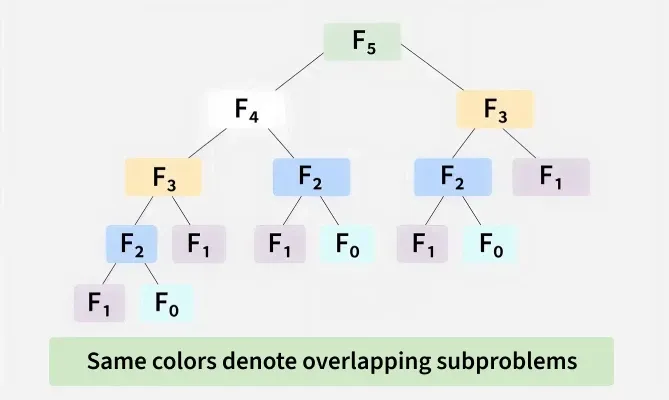
This tree clearly illustrates the two foundational properties of Dynamic Programming:
- Overlapping Subproblems: The same computation, such as
F(3)orF(2), is performed over and over again. This is redundant work that we can optimize away. - Optimal Substructure: The solution to the larger problem,
F(5), can be constructed directly from the solutions of its smaller subproblems,F(4)andF(3).
Dynamic Programming provides a systematic way to solve each subproblem only once and store its result. When the same subproblem is encountered again, we simply look up the stored result instead of re-computing it.
2. The Two Core Conditions for Dynamic Programming
For a problem to be solvable with Dynamic Programming, it must exhibit both of the properties we just saw. Let's formally define them. The following article from interviewing.io offers a clear, concise explanation.
Dynamic Programming Interview Questions & Tips
This article provides excellent, formal definitions of the two conditions required for a problem to be a candidate for Dynamic Programming.
Please read the section titled Optimal Substructure and Overlapping Subproblems. Pay close attention to how it distinguishes between the two concepts. "Optimal substructure" is about being able to build a solution from sub-solutions, while "overlapping subproblems" is about the repetition of those subproblems.
To summarize:
- Optimal Substructure: You have optimal substructure if the optimal solution to your main problem can be constructed from the optimal solutions to its constituent subproblems. The fact that a recursive solution is possible is a strong hint that this property exists.
- Overlapping Subproblems: You have overlapping subproblems if a naive recursive algorithm would solve the same subproblems repeatedly. The more overlap, the more performance gain you'll get from DP.
3. Heuristics for Spotting DP Problems in an Interview
Formal definitions are great, but in a high-pressure interview setting, you need practical heuristics to quickly identify potential DP problems. Your goal is to develop a "sixth sense" for them.
The following video provides a fantastic overview of common problem types that signal a DP approach.
Mastering Dynamic Programming - How to solve any interview problem (Part 1)
This video from Tech With Nikola introduces DP and highlights the most common use cases you'll encounter.
Watch the first minute of the video, from the beginning until the Fibonacci example begins. The speaker points out two major categories of DP problems.
As the video mentions, there are two primary categories of questions that should make you think "Dynamic Programming":
-
Optimization Problems: The question asks for a minimum, maximum, longest, shortest, or best result.
- Example: "What is the minimum number of coins to make a certain amount of change?"
- Example: "What is the longest increasing subsequence in this array?"
-
Counting Problems: The question asks "How many ways..." are there to do something under certain constraints.
- Example: "How many ways are there to reach the top of a staircase if you can take 1, 2, or 3 steps at a time?"
- Example: "How many distinct paths are there from the top-left to the bottom-right of a grid?"
This LeetCode study guide provides further excellent advice on identifying these problems.
How to Solve Dynamic Programming Problems in Coding Interviews - Discuss - LeetCode
This guide reinforces the clues to look for when trying to determine if a problem is suitable for Dynamic Programming.
Read the sections Identify the Problem and Figure out the Recurrence Relation. This will solidify the connection between optimization/counting problems and DP.
4. Case Studies: Analyzing Problems for DP Properties
Let's apply these heuristics to a couple of classic problems. We won't solve them completely yet; the goal is simply to practice the identification process. The Tech With Nikola video provides excellent walkthroughs for this.
Case Study 1: The Coin Change Problem
Problem: Given a set of coin values and a target amount, find the minimum number of coins required to make that amount.
- Heuristic Check: The keyword is "minimum"—this is an optimization problem. It's a strong signal for DP.
- Substructure Analysis: Can we define a subproblem? Let
minCoins(amount)be the solution. To findminCoins(M), we can try using each available coinC. If we use coinC, the problem is reduced to finding1 + minCoins(M - C). The overall solution is the minimum of these choices. This shows it has optimal substructure. The repeated calls tominCoinsfor the same smaller amounts reveal overlapping subproblems.
Watch this segment of the video to see this analysis in action.
Mastering Dynamic Programming - How to solve any interview problem (Part 1)
This part of the video walks through the thought process of breaking down the Coin Change problem into subproblems.
Watch from the introduction of the problem. Observe how the brute-force recursive tree is built and how it naturally leads to the DP recurrence relation.
Case Study 2: The Grid Traveler Problem
Problem: You are in the top-left corner of an N x M grid. You can only move down or right. How many ways can you reach the bottom-right corner?
- Heuristic Check: The keyword is "How many ways"—this is a counting problem. Another strong signal for DP.
- Substructure Analysis: Let
ways(n, m)be the number of paths for an n x m grid. To reach the destination(n, m), you must have come from either(n-1, m)(by moving down) or(n, m-1)(by moving right). Therefore,ways(n, m) = ways(n-1, m) + ways(n, m-1). This demonstrates optimal substructure and, just like Fibonacci, leads to many overlapping subproblems.
This next segment of the video visualizes this breakdown beautifully.
Mastering Dynamic Programming - How to solve any interview problem (Part 1)
This section explains how to define the subproblem, base case, and recursive formula for the Grid Traveler problem.
Watch from the problem statement. The visualization of reducing the grid size is a powerful way to understand how the problem is broken into smaller, identical subproblems.
5. Common DP Problem Patterns
As you solve more DP problems, you'll start to recognize common structural patterns. Just as we saw with graph traversals, identifying the underlying pattern is a huge leap toward finding the solution.

This image showcases several common DP patterns. For example:
- The top-left diagram represents problems on a 1D sequence, like Fibonacci or House Robber. The solution for
f(n)depends onf(n-1),f(n-2), etc. - The bottom-left and bottom-middle diagrams represent problems on a 2D grid or table, such as Grid Traveler or the 0/1 Knapsack problem. The solution for cell
(i, j)often depends on its neighbors(i-1, j),(i, j-1), or(i-1, j-1).
Recognizing these visual structures is a skill you will build over time, and it will dramatically accelerate your problem-solving. We will dive deep into these patterns in the upcoming lessons.
Conclusion
Today, we laid the critical groundwork for mastering Dynamic Programming. You've learned to look past the surface of a problem and identify the two core properties that make it a candidate for a DP solution.
Key Takeaways:
- Dynamic Programming is an optimization technique for problems that have optimal substructure and overlapping subproblems.
- Optimal Substructure: The optimal solution to a problem can be constructed from the optimal solutions of its subproblems.
- Overlapping Subproblems: A recursive approach solves the same smaller subproblems multiple times, indicating inefficiency that DP can fix.
- Heuristics for Identification: Be on the lookout for problems asking for an optimal result (min/max, longest/shortest) or a count of possibilities ("how many ways").
- The First Step is Recognition: Before you can solve a DP problem, you must first correctly identify it as one. This is the skill we focused on today.
In our next lesson, we will transition from identifying these problems to solving them. You will learn the two primary implementation techniques for Dynamic Programming: the top-down approach with memoization and the bottom-up approach with tabulation, starting with common 1D DP problems.